Cover image of the article: Acute Psychoactive Mushroom Poisoning in Iran: Clinical and Mycological Context (AI-generated illustration)

Image Credit:AI-generated illustration

Acute Psychoactive Mushroom Poisoning in Iran: Clinical and Mycological Context

Authors

Hossein Sanaei-ZadehHossein Sanaei-Zadeh ORCID1,*
How to Cite:Sanaei-Zadeh H. Acute Psychoactive Mushroom Poisoning in Iran: Clinical and Mycological Context. Shiraz E-Med J. 2026;27(7):e173853. doi: https://doi.org/10.5812/semj-173853

Dear Editor,
Acute poisoning with psychoactive mushrooms (“magic mushrooms”) is an important consideration in emergency toxicology. Over the past several years, I have encountered patients with acute toxicity after ingesting mushrooms described as psychoactive in my clinical practice at a toxicology referral hospital. Patients reported either purchasing raw or dried mushrooms or obtaining substrate and spawn from distributors for home cultivation. They described the mushrooms as small and brown. The mushrooms were consumed raw or dried, or incorporated into foods such as pizza or sandwiches. These observations reflect clinical experience rather than population-level epidemiological data and should not be interpreted as a formal case report or case series.
To the best of my knowledge, the Iranian mycological literature has reported the occurrence of several taxa with psychoactive or neurotoxic associations documented in the international literature, including Psilocybe cyanescens, Psilocybe serbica, Panaeolus fimicola, P. olivaceus, P. subbalteatus, Pluteus salicinus, Gymnopilus junonius (formerly G. spectabilis), Amanita pantherina, A. gemmata, and A. strobiliformis (1-3). However, Iranian occurrence records and international toxicologic evidence must be interpreted separately. Detection or reporting of a taxon in Iran does not establish the presence or concentration of psychoactive compounds in Iranian specimens, nor does it establish human poisoning attributable to that taxon in Iran (Figure 1). It is also unknown whether any of these taxa correspond to mushrooms currently purchased or cultivated or whether such mushrooms originate outside Iran.
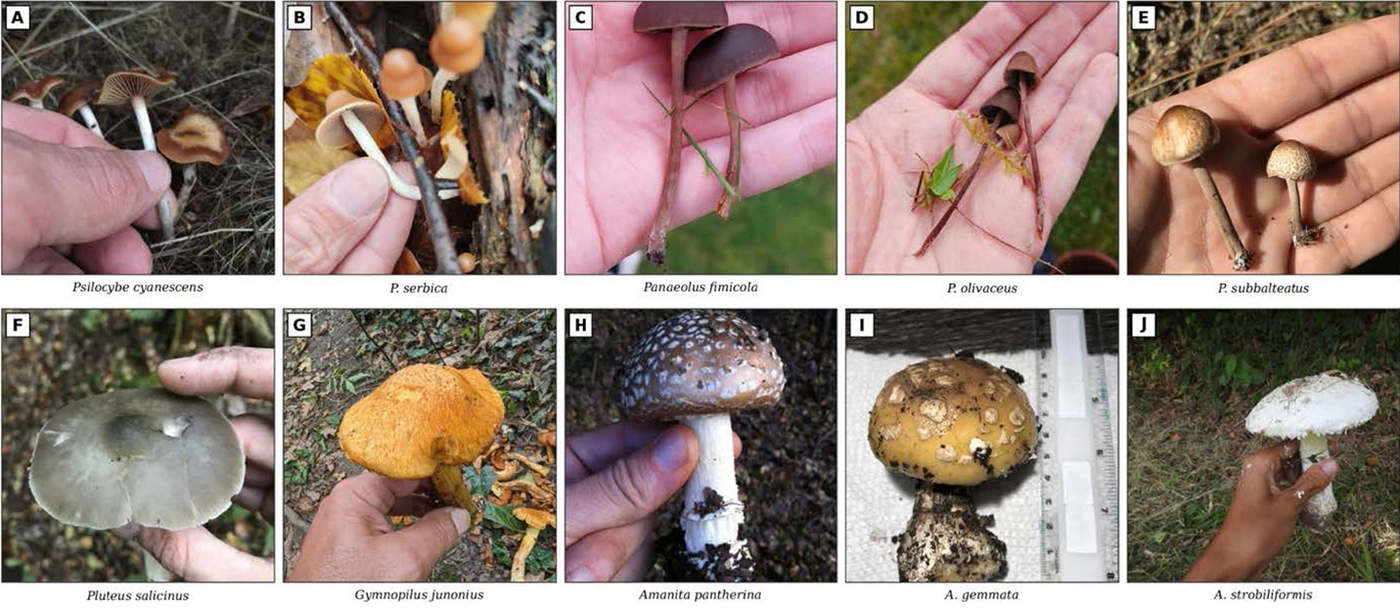
Representative mushroom taxa reported from Iran with documented psychoactive or neurotoxic associations in the international literature. A-B, <i>Psilocybe cyanescens</i> and <i>P. serbica</i>; C-E, <i>Panaeolus fimicola</i>, <i>P. olivaceus</i>, and <i>P. subbalteatus</i>; F, <i>Pluteus salicinus</i>; G, <i>Gymnopilus junonius</i> (formerly <i>G. spectabilis</i>); H-J, <i>Amanita pantherina</i>, <i>A. gemmata</i>, and <i>A. strobiliformis</i>. The occurrence of these taxa in Iranian mycological records does not establish the presence or concentration of psychoactive compounds in Iranian specimens or confirm human poisoning attributable to these taxa in Iran. None of the photographs was taken in Iran.
Figure 1.
Representative mushroom taxa reported from Iran with documented psychoactive or neurotoxic associations in the international literature. A-B, Psilocybe cyanescens and P. serbica; C-E, Panaeolus fimicola, P. olivaceus, and P. subbalteatus; F, Pluteus salicinus; G, Gymnopilus junonius (formerly G. spectabilis); H-J, Amanita pantherina, A. gemmata, and A. strobiliformis. The occurrence of these taxa in Iranian mycological records does not establish the presence or concentration of psychoactive compounds in Iranian specimens or confirm human poisoning attributable to these taxa in Iran. None of the photographs was taken in Iran.
Psilocybe species and some Panaeolus species are associated with psilocybin and psilocin and may produce serotonergic psychedelic effects and associated perceptual and neurobehavioral disturbances (3-5). Psilocybin and psilocin have also been detected in Pluteus salicinus (6), but their concentrations are highly variable, and not all specimens are psychoactive. Amanita pantherina and A. gemmata are associated primarily with ibotenic acid and muscimol, whereas the toxicologic significance of A. strobiliformis is less certain; it is included here only as a reported record (4). Interpretation of G. junonius should likewise be cautious because historical reports under G. spectabilis cannot necessarily be extrapolated to all currently identified G. junonius specimens (1, 4).
Clinical manifestations vary according to the mushroom and its constituents. Psilocybin/psilocin-containing mushrooms may cause hallucinations, perceptual disturbances, anxiety, agitation, ataxia, tachycardia, tremor, and mydriasis, whereas ibotenic acid/muscimol-containing Amanita species may cause confusion, visual disturbances, ataxia, alternating central nervous system excitation and depression, and, in severe cases, seizures or coma (4, 5, 7). Severe neurobehavioral disturbances may result in accidental injury and other secondary complications (7, 8).
Management is primarily supportive and includes a low-stimulus environment and appropriate clinical, cardiopulmonary, and neurological monitoring (7, 8). Benzodiazepines may be used for severe anxiety, agitation, psychomotor disturbance, or seizures (7, 8). Patients should be observed until their mental status, neurological findings, and vital signs have improved sufficiently to permit safe disposition. Persistent or severe neurotoxicity, seizures, prolonged central nervous system depression, significant co-ingestion, diagnostic uncertainty, or secondary injury warrant continued monitoring and supportive care. Consultation with a medical toxicologist is appropriate when the diagnosis or management is uncertain.
In conclusion, Iranian mycological records include multiple taxa with potential psychoactive or neurotoxic relevance, but their documented occurrence does not establish psychoactive chemistry or confirmed human poisoning in Iran. The mushrooms encountered in clinical practice may differ from these taxa. Species-level identification, toxicologic confirmation when feasible, epidemiological surveillance, and public health communication are needed to better characterize psychoactive mushroom exposures.
Acknowledgments

Footnotes

  • Artificial Intelligence (AI) Use Disclosure:The author declares that no generative AI tools were used in the creation of this article.

  • Authors' Contribution:The author conducted all aspects of the study.

  • Conflict of Interests Statement:The author declares no conflicts of interest.

  • Funding/Support:No funding was received for this study.

References

  • 1.
    Ghobad-Nejhad M, Langer E, Antonín V, Gates G, Noroozi J, Zare R. The gilled fungi and boletes of Iran: diversity, systematics, and nrDNA data. Mycol Iran. 2020;7(1):1-43. https://doi.org/10.22092/mi.2021.123456.
  • 2.
    Ghobad-Nejhad M, Antonín V, Moghaddam M, Langer E. Resources of Iranian agarics (Basidiomycota) with an outlook on their antioxidant potential. Front Microbiol. 2022;13. 1015440. [PubMed ID: 36386711]. [PubMed Central ID: PMC9650231]. https://doi.org/10.3389/fmicb.2022.1015440.
  • 3.
    Rahimlou S, Moghaddam MH, Nezhad AMH, Heidari B, Bahram M. A checklist and worldwide distribution patterns of macrofungi in Iran. Mycol Prog. 2023;22(4). 33. https://doi.org/10.1007/s11557-022-01863-4.
  • 4.
    Stebelska K. Fungal hallucinogens psilocin, ibotenic acid, and muscimol: analytical methods and biologic activities. Ther Drug Monit. 2013;35(4):420-442. [PubMed ID: 23851905]. https://doi.org/10.1097/FTD.0b013e31828741a5.
  • 5.
    Nichols DE. Psychedelics. Pharmacol Rev. 2016;68(2):264-355. [PubMed ID: 26841800]. [PubMed Central ID: PMC4813425]. https://doi.org/10.1124/pr.115.011478.
  • 6.
    Christiansen A, Rasmussen K, Høiland K. Detection of psilocybin and psilocin in Norwegian species of Pluteus and Conocybe. Planta Med. 1984;50(4):341-343. [PubMed ID: 17340325]. https://doi.org/10.1055/s-2007-969726.
  • 7.
    White J, Weinstein SA, De Haro L, Bédry R, Schaper A, Rumack BH, et al. Mushroom poisoning: a proposed new clinical classification. Toxicon. 2019;157:53-65. [PubMed ID: 30439442]. https://doi.org/10.1016/j.toxicon.2018.11.007.
  • 8.
    Goldfrank LR. Mushrooms. In: Nelson LS, Howland MA, Lewin NA, Smith SW, Goldfrank LR, Hoffman RS, editors. Goldfrank's Toxicologic Emergencies. New York, USA: McGraw-Hill Education; 2019. p. 1581-1596.

Copyright

Copyright © 2026, Sanaei-Zadeh. This open-access article is available under the Creative Commons Attribution 4.0 (CC BY 4.0) International License (https://creativecommons.org/licenses/by/4.0/), which allows for unrestricted use, distribution, and reproduction in any medium, provided that the original work is properly cited.

Similar Articles

31
Oct
2007
Mushroom Poisoning in Northwest of Iran

Mushroom Poisoning in Northwest of Iran

Mojtaba Varshochi,
Behrooz Naghili

Varshochi M, Naghili B. Mushroom Poisoning in Northwest of Iran. Arch Clin Infect Dis. 2007;2(4):. doi:

12
Jan
2019
Mushroom Poisoning in Children: A Five-Year Review

Mushroom Poisoning in Children: A Five-Year Review

Ying Deng,
Li Qiu

Deng Y, Qiu L. Mushroom Poisoning in Children: A Five-Year Review. Inn J Pediatr. 2019;29(1):e65262. doi: https://doi.org/10.5812/ijp.65262

30
Aug
2016
Acute Poisoning via Consumption of “Natural Max Slimming” Capsule with Complications (Hyperpigmentation and Lower Extremity Edema)

Acute Poisoning via Consumption of “Natural Max Slimming” Capsule with Complications (Hyperpigmentation and Lower Extremity Edema)

Fazel Goudarzi,
Nahid Najafi,
Negar Azarpira,
Nasim Tavakoli,
Zohre Najafi

Goudarzi F, Najafi N, Azarpira N, Tavakoli N, Najafi Z. Acute Poisoning via Consumption of “Natural Max Slimming” Capsule with Complications (Hyperpigmentation and Lower Extremity Edema). Jundishapur J Nat Pharm Prod. 2017;12(2):e34602. doi: https://doi.org/10.5812/jjnpp.34602

24
May
2014
JAMM, Simurgh and Spiritual Symbol of Medicine

JAMM, Simurgh and Spiritual Symbol of Medicine

Alireza Zali

Zali A. JAMM, Simurgh and Spiritual Symbol of Medicine. J Arch Mil Med. 2014;2(2):e20634. doi: https://doi.org/10.5812/jamm.20634

7
Apr
2014
Persian Gulf Bioactive Natural Drugs

Persian Gulf Bioactive Natural Drugs

Mohammad Reza Shushizadeh

Shushizadeh MR. Persian Gulf Bioactive Natural Drugs. Jundishapur J Nat Pharm Prod. 2014;9(2):e19354. doi: https://doi.org/10.17795/jjnpp-19354

More by these authors

Hossein Sanaei-ZadehPubMedScholar
Share
Cited by
Metrics