1. Background
"Quality of life" (QOL) is a general term, which includes a feeling of joy and satisfaction with life. Yet, insufficient attention has been drawn toward the QOL, self-confidences, and self-esteem in patients with skin diseases. Since skin diseases affect mental and general health as well as function and social adaptation of the patients, they can decrease patients’ self-confidence and definitely disrupt their psychological health and quality of life (1). Skin appearing can show a human's self-image or cutaneous body image and any pathologic alterations may lead into disruption of emotional feelings (2). Even with chronic itching, life of a person will be considerably disturbed (3). In addition to evaluating the treatment effectiveness, recording QOL can improve our knowledge regarding emotional stress related with dermatologic disorders (4). According to the studies in the Netherlands (5), the United States (6), Germany (7), Denmark (8), and many other countries (9-23), skin diseases have a great effect on the patients’ QOL. Vitiligo is a chronic, acquired pigmentary disease of the skin, which is characterized by well-circumscribed white macules or patches. Although vitiligo is not fatal, it may significantly affect the patients’ mental health(15). The present study can signify the psychological aspects to its readers and as a result, the necessity of psychological consultation and intervention in patients with vitiligo. Moreover, measuring the incapacities of patients with the aim of taking better care of them can be helpful for leading healthcare services towards the real needs of these patients.
2. Objectives
Regarding the abovementioned facts and according to the regulations of World Health Organization (WHO) stating that one of the duties of healthcare officials is to promote the level of QOL, the present study was conducted to determine the QOL in patients with vitiligo.
3. Patients and Methods
Patients with the confirmed diagnosis of vitiligo were included in this study. Our sampling method was consecutive sampling. Inclusion criteria were diagnosis of vitiligo by a dermatologist and being older than 16 years. Exclusion criteria included diagnosis of skin diseases other than vitiligo, chronic disease such as diabetes mellitus, hypertension, heart disease, stroke, asthma, chronic obstructive pulmonary disease, musculoskeletal illnesses such as rheumatism, arthritis, and back pain, and cancer, any conditions that might have an effect on QOL, and apparent disability. The study was conducted in the Dermatology Clinic of Vali-e-Asr Hospital of Birjand City, Iran, from May 2009 to May 2010. Those who were referred to the clinic and met the eligibility criteria were recruited and the aims of the survey were explained to them. The responders signed a written informed consent. The Institutional Ethical Committee approved the study protocol.
The Farsi version of two questionnaires, namely, Short Form 36 (SF-36) and Dermatology Life Quality index (DLQI), were given to all participants. DLQI, which is a special questionnaire regarding the effect of skin diseases, was designed by Finlay and Khan in 1992 and since then, it has been vastly used in different communities (2, 7, 9-11, 13-17, 20, 21, 23). Furthermore, reliability and validity of the Farsi version of the DLQI questionnaire had been proved through a study in a group of Iranian patients with vitiligo by Aghaei et al. (9) The questionnaire contains ten multiple-choice questions; the points for each question ranges between zero and three. Total score of every individual's QOL would be the sum of the scores of all the questions, i.e., between zero and 30; the higher an individual's score is, the worse his QOL would be. The questionnaire was classified into six headings: symptoms and feelings (questions 1 and 2), daily activities (questions 3 and 4), leisure (questions 5 and 6), personal relationships (questions 8 and 9), work and school (question 7), and treatment (question 10)" (10). SF-36 questionnaire is a generic one that has been used in different communities (12, 24-30). Reliability and validity of the Farsi version of SF-36 had been proved through a study by Montazeri et al. on a random sample of 4163 healthy individuals aged ≥ 15 years (24) and by Jafari et al. on a group of Iranian patients with thalassemia major (25). It comprise 36 items that assess eight dimensions of QOL: physical functioning (PF); role physical (RP), which refers to role restrictions due to physical problems; bodily pain (BP); general health (GH); vitality (VT); social functioning (SF); role emotional (RE), which refers to role restrictions due to emotional problems; and mental health (MH) (12). The obtained scores in each of the dimensions are separately summed up and range from zero to 100; the higher total score is, the better QOL would be. Data were compiled and analyzed by SPSS (version 17, SPSS Inc., Chicago, IL, USA). Data analysis was performed through descriptive Statistics, t test, ANOVA, and Pearson's correlation coefficient test. The conclusions were drawn based on 5% significance level.
4. Results
A total of 70 patients with the diagnosis of vitiligo were included in this study. Overall, 20 patients (28.6%) were male and 50 (71.4%) were female. The age of patients ranged from 16 to 47 years (Table 1).
Table 1.
Mean Age of Patients With Vitiligo Regarding Sex
| Sex | Number of Patients | Mean ± SD | Std. Error of Means | P value |
|---|---|---|---|---|
| Male | 20 | 28.15 ± 11.8 | 2.64 | 0.55 |
| Female | 50 | 26.66 ± 8.34 | 1.18 |
The occupation of participants was homemaker in 23 patients (32.9%), clerk in 18 (25.7%), university or high-school student in 13 (18.55%), and farmer in 6 (8.6%); ten patients (14.25%) were unemployed. There was no significant difference in the mean total score of SF-36 between males and females (ANOVA, P = 0.679) (Table 2).
Table 2.
| Dimension | Sex | P value | ||
|---|---|---|---|---|
| Total | Male | Female | ||
| Physical Functioning | 69.00 ± 21.73 | 68.75 ± 24.11 | 69.10 ± 20.97 | 0.95 |
| Role Physical | 56.43 ± 38.94 | 55.00 ± 39.40 | 57.00 ± 39.14 | 0.85 |
| Role Emotional | 50.95 ± 37.95 | 56.67 ± 37.62 | 48.67 ± 38.22 | 0.43 |
| Vitality | 51.14 ± 21.44 | 55.50 ± 20.89 | 49.40 ± 21.61 | 0.29 |
| Mental Health | 49.60 ± 22.42 | 51.20 ± 22.87 | 48.96 ± 22.43 | 0.71 |
| Social Functioning | 72.14 ± 24.65 | 70.63 ± 22.31 | 72.75 ± 25.72 | 0.75 |
| Bodily Pain | 74.57 ± 21.60 | 74.38 ± 20.01 | 74.65 ± 22.39 | 0.96 |
| General Health | 54.16 ± 19.23 | 57.06 ± 18.49 | 53.00 ± 19.59 | 0.43 |
| Total | 478.00 ± 141.54 | 489.18 ± 126.89 | 473.53 ± 147.98 | 0.68 |
| DLQI | 8.40 ± 5.80 | 8.40 ± 5.63 | 8.40 ± 5.92 | 1.000 |
aAbbreviation: DLQI, dermatology life quality index.
bData are presented as mean ± SD.
cIndependent-samples t test (20 male and 50 female patients).
There was no significant difference among age groups in the mean total score of SF-36 (ANOVA, P = 0.46) (Table 3).
Table 3.
| Dimension | Age Group | P value c | ||
|---|---|---|---|---|
| ≤ 20 y | 21-30 y | > 30 y | ||
| Physical Functioning | 67.89 ± 22.13 | 73.18 ± 19.07 | 62.50 ± 25.16 | 0.24 |
| Role Physical | 51.32 ± 37.71 | 56.82 ± 39.66 | 61.11 ± 40.42 | 0.75 |
| Role Emotional | 56.14 ± 38.57 | 48.48 ± 39.17 | 50.00 ± 36.60 | 0.78 |
| Vitality | 48.42 ± 22.73 | 56.06 ± 17.84 | 45.00 ± 24.97 | 0.17 |
| Mental Health | 45.26 ± 26.64 | 53.09 ± 19.63 | 47.78 ± 22.69 | 0.45 |
| Social Functioning | 67.11 ± 29.23 | 75.38 ± 20.13 | 71.53 ± 27.39 | 0.51 |
| Bodily Pain | 75.00 ± 19.49 | 78.94 ± 16.89 | 66.11 ± 29.01 | 0.13 |
| General Health | 48.68 ± 17.70 | 58.64 ± 20.28 | 51.73 ± 17.80 | 0.17 |
| Total | 459.82 ± 148.90 | 500.59 ± 131.37 | 455.76 ± 153.21 | 0.47 |
| DLQI | 9.84 ± 7.12 | 7.88 ± 5.33 | 7.83 ± 5.14 | 0.45 |
aAbbreviation: DLQI, dermatology life quality index.
bData are presented as mean ± SD.
c ANOVA test.
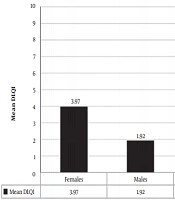
The mean score of the DLQI in patients with vitiligo was 8.40 ± 5.76 (range, 0-23). There was no significant difference in the mean score of DLQI between males and females (P = 1.000) (Table 2). Moreover, the difference between age groups with regard to the mean score of DLQI was insignificant (ANOVA, P = 0.453) (Table 3). Pearson's correlation coefficient test revealed that there was a significant reverse correlation between all the Dimensions of QOL in SF-36 and the obtained scores from DLQI (Table 4).
Table 4.
Pearson Correlation Between the Scores of Different Domains of Quality of Life Obtained From Short Form 36 and Dermatology Life Quality Indexa
| Quality of Life Dimensions | DLQI | Quality of Life Dimensions | |||||||
|---|---|---|---|---|---|---|---|---|---|
| PF | RP | RE | VT | MT | SF | BP | GH | ||
| PF | |||||||||
| Pearson Co | -0.199 | ||||||||
| P Value | 0.099 | ||||||||
| RP | |||||||||
| Pearson Co | -0.327 | 0.327 | |||||||
| P Value | 0.006 | 0.006 | |||||||
| RE | |||||||||
| Pearson Co | -0.324 | 0.148 | 0.552 | ||||||
| P Value | 0.006 | 0.223 | 0.000 | ||||||
| VT | |||||||||
| Pearson Co | -0.349 | 0.381 | 0.343 | 0.269 | |||||
| P Value | 0.003 | 0.001 | 0.004 | 0.024 | |||||
| MT | |||||||||
| Pearson Co | -0.365 | 0.201 | 0.320 | 0.273 | 0.764 | ||||
| P Value | 0.002 | 0.094 | 0.007 | 0.022 | 0.000 | ||||
| SF | |||||||||
| Pearson Co | -0.296 | 0.218 | 0.477 | 0.352 | 0.534 | 0.474 | |||
| P Value | 0.013 | 0.070 | 0.000 | 0.003 | 0.000 | 0.000 | |||
| BP | |||||||||
| Pearson Co | -0.360 | 0.325 | 0.416 | 0.415 | 0.392 | 0.271 | 0.495 | ||
| P Value | 0.002 | 0.006 | 0.000 | 0.000 | 0.001 | 0.023 | 0.000 | ||
| GH | |||||||||
| Pearson Co | -0.347 | 0.146 | 0.371 | 0.365 | 0.536 | 0.546 | 0.324 | 0.353 | |
| P Value | 0.003 | 0.229 | 0.002 | 0.002 | 0.000 | 0.000 | 0.006 | 0.003 | |
| Total | |||||||||
| Pearson Co | -0.472 | 0.480 | 0.773 | 0.700 | 0.723 | 0.664 | 0.709 | 0.665 | 0.636 |
| P Value | 0.000 | 0.000 | 0.000 | 0.000 | 0.000 | 0.000 | 0.000 | 0.000 | 0.000 |
aAbbreviations: DLQI, dermatology life quality index; PF, physical functioning; RP, role physical; RE, role emotional; VT, vitality; MH, mental health; SF, social functioning; BP, bodily pain; GH, general health; and Pearson Co, Pearson correlation coefficient.
5. Discussion
In another study on 532 outpatient patients with dermatologic problems (include Vitiligo) by Farsi version of SF-36 questionnaire, mean score of the patients in every domain were significantly lower than the mean of Iranian healthy individuals (12), which were in agreement with our results. Furthermore, their results showed no correlation between the scores in domains of SF-36 questionnaire and severity, extent, and history of hospital admission for skin disorders; however, there was a strong correlation with location of lesion (12). Regarding the age, the mean score of QOL varied in different age groups, but the difference was insignificant, which was in agreement with the finding by Dolatshahi et al. (2). On the other hand, in another study in Germany, the age group between 20 and 30 years demonstrated a lower QOL (7). The difference between the results of the present study and other study might be due to cultural or socioeconomic differences.
The mean DLQI score in the patients of this study (mean, 8.40) was higher in comparison with that in the studies by Dolatshahi et al (mean, 8.16) in Iran (2), Aghaei et al. (mean, 7.05) in Iran (Shiraz) (9), Finlay and Khan (mean, 7.2) in England (13), Radtke et al. (mean, 7.0) in Germany (7), Kent et al. (mean, 4.82) in UK (14), and Ongenae et al. (mean, 4.95) in Belgium (15). However, it was lower than that in the studies by Parsad et al. (mean, 10.67) in India (16) and Al Robaee (mean, 14.72) in Saudi Arabia (17). The observed difference between the findings of different studies might be due to the contrast between vitiligo lesions and darker skins as some studies showed that there was statistically significant association between DLQI scores and skin phototypes (2). Generally, there was no clear-cut correlation between QOL score and sex in most of the previous studies (15-18), which was in agreement with our result. In contrast, Radtke et al. found a correlation between QOL score and sex (mean of 7.5 in women and 5.5 in men) (7). Kim do et al. also suggested that patients with vitiligo were extremely affected in the functional and emotional dimensions of QOL, with some sex differences (worse in females) (19) and Borimnejad et al. reported that in Iran, Muslim women with vitiligo have more deterioration in QOL than Muslim men do (20). Belhadjali et al. also showed that QOL was considerably deteriorated in patients with vitiligo and to a more extent in women (21). These results disagree with ours. The difference seen between the results of the present study and other studies might be due to cultural or socioeconomic differences.
After determining QOL score through DLQI and SF-36 questionnaires in skin patients, it was found that there was a significant reverse correlation between the scores of all dimensions of QOL obtained from SF-36 with those of DLQI. In other words, the higher the QOL score in any of the dimensions of SF-36 was, the lower DLQI score would be and vice versa. Recent results indicated that the treatment strategies to reduce the number and size of vitiligo lesions and their disfiguring results were certainly useful and enhanced their QOL (2, 31). Tjioe et al. evaluated QOL after long-term narrowband ultraviolet B for the treatment of vitiligo. The patients, with prolonged stable vitiligo who were managed at their clinic, were instructed to complete a purposed QOL questionnaire. Most patients showed an improvement in an emotional level, but an extension in disguising (22). Tanioka et al. assessed the emotional feelings on patients with vitiligo through disguising lessons. Disguise enhanced the scores of DLQI when compared with those without disguise and disguise lessons enhanced a subcategory of "symptoms and feelings". These data confirmed the idea that disguise for patients with vitiligo not only masks the depigmented lesions but also enhances their QOL (23). Recently, Lilly et al. created and validated a new vitiligo-specific QOL tool (VitiQoL) (32). The VitiQoL components demonstrated high internal consistency (Cronbach’s alpha, 0.935). Convergent validity was demonstrated by significant correlations between VitiQoL and outside dermatology indices assessing comparable concepts (Skindex-16, r = 0.82; and DLQI, r = 0.83)" (32). However, this new vitiligo-specific QOL instrument should be evaluated in further studies due to limitations of their study.
Regarding the findings of the present study and other surveys, psychiatric consult or psychotherapy should be included in the treatment of vitiligo. In addition, to promote patients' satisfaction and QOL, the following points are recommended:
1) Establishing supportive groups for patients in the specialized dermatology departments and hospitals
2) Establishing consultation and psychotherapy centers for patients with vitiligo
3) Dermatologists should consider the effect of vitiligo on health-related QOL and educate patients on possible treatments.
The study findings showed that vitiligo has a significant effect on the patients’ QOL. There was not a significant sex-related difference in QOL. We recommend considering psychiatric consult or psychotherapy in the treatment of patients with vitiligo.