1. Background
Diffuse large B-cell lymphoma (DLBCL) is the most common type of lymphoma, accounting for 25% of all cases of non-Hodgkin’s lymphoma (NHL) (1, 2). DLBCL is an aggressive disease that usually affects middle-aged and elderly patients. The new classification of the World health organization (WHO) recognizes several types of large B-cell lymphoma, of which the most common form is unspecified DLBCL (1). The most commonly used prognostic index in aggressive NHL is the international prognostic index (IPI) and its variants for younger or elderly patients (age-adjusted IPI) and those treated with rituximab (revised R-IPI) (3, 4).
With growing evidence of the role of inflammation in cancer biology, the systemic inflammatory response has been postulated as having prognostic significance in a wide range of malignancies. Given the role of inflammation in tumor progression, as well as in DLBCL, researchers are trying to identify easily applicable, easy accessible prognostic markers for individual risk assessment.
The most frequently used inflammatory prognostic markers are the neutrophil-to-lymphocyte ratio (NLR), the platelet-to-lymphocyte ratio (PLR), and the Glasgow prognostic score (GPS). The NLR is an independent prognostic factor for overall survival (OS) and progression-free survival (PFS) in different types of malignancies, including renal cell carcinoma, colorectal tumors, gastric tumors, pancreatic cancer, and sarcomas (5-9). Porrata et al. (10) found that baseline NLR is a simple, inexpensive, standardized prognostic factor that can be used to assess clinical outcomes in DLBCL patients treated with R-CHOP. Patients with NLR values of ≥ 3.5 had worse OS and PFS (10).
Studies have also found that PLR is associated with worse survival and more advanced disease in patients with pancreatic, ovarian, gastric, renal, and prostate cancers (11-15). Asher et al. found that in patients with ovarian cancer, PLR had a stronger predictive value than NLR (12). Liu et al. found that PLR was a potentially useful prognostic marker of response to therapy and of prognosis in non-small-cell lung cancer (16). Unal et al. found that PLR was associated with OS in non-small-cell lung cancer (17).
The GPS is an inflammation-based prognostic scoring system that includes the values of serum albumin and C-reactive protein (CRP). Using the GPS, patients can be stratified into three risk groups. The usefulness of the GPS was first described by Forrest et al. in patients with non-small-cell lung cancer (18). So far, it has been found to be of significant prognostic value in patients with colorectal carcinoma, non-small-cell lung cancer, gastroesophageal cancer, pancreatic cancer, and hepatocellular carcinoma (19-27). Recently, Li et al. found that the GPS was an independent predictor of outcome in patients with extranodal natural killer/T-cell lymphoma (28). Li et al. also recently found that the GPS was a good predictor of clinical outcome in DLBCL patients treated with R-CHOP (29).
2. Objectives
Both NLR and GPS have been recognized as prognostic factors in patients with DLBCL, but no published study has yet compared those markers. There have been no previous reports on the prognostic value of PLR in patients with DLBCL. The aim of our study was to determine and compare the prognostic values of baseline NLR, PLR, and GPS in DLBCL patients for disease outcome, OS, and event-free survival (EFS).
3. Methods
This retrospective study used data from patients with histologically proven DLBCL, diagnosed between November 2006 and July 2015, who were treated with R-CHOP or R-CHOP-like regimens at the University hospital Osijek, Osijek, Croatia. Patients were included in the study who had a disease stage of II-IV, IE, or I bulky, who were initially planned for at least four cycles of immunochemotherapy, and for whom all necessary laboratory and clinical data were available. Those with transformed indolent lymphoma, clinical evidence of infection or active chronic inflammatory disease at the time of diagnosis, or with primary central nervous system (CNS) lymphoma were excluded from the study.
The following demographic characteristics, clinical features, and laboratory parameters were collected from the patients’ medical records: age, disease stage, IPI, presence of B symptoms, red blood cell (RBC) count, white blood cell (WBC) count, platelets, absolute neutrophil count (ANC), absolute lymphocyte count (ALC), lactate dehydrogenase (LDH), CRP, albumin, hemoglobin (Hb), ferritin, eastern cooperative oncology group performance status (ECOG PS), and number of involved extranodal locations. The IPI uses five baseline characteristics (age, ECOG PS, serum LDH, Ann Arbor [AA] disease stage, and number of extranodal locations) to stratify patients into low-risk (IPI = 0 - 1), low-to-intermediate-risk (IPI = 2), high-intermediate-risk (IPI = 3), and high-risk (IPI = 4 - 5) groups.
The initial values of inflammatory biomarkers (NLR, PLR, and GPS) and other laboratory parameters were defined as those obtained within two weeks before first-line treatment was initiated. Baseline NLR was obtained by dividing ANC by ALC. PLR was obtained by dividing platelet count by ALC. GPS was determined according to albumin and CRP serum concentrations as previously described (18). Briefly, patients with both elevated CRP (> 1.0 mg/dL) and hypoalbuminemia (< 3.5 g/dL) were allocated a score of 2. Patients in whom only one of these biochemical abnormalities was present were allocated a score of 1. Patients in whom neither of these abnormalities was present were allocated a score of 0.
Most patients were treated with standard R-CHOP 21 immunochemotherapy consisting of rituximab, cyclophosphamide, doxorubicin, vincristine, and prednisone. The remaining patients received R-CHOP-like regimens.
The analyzed outcomes were response to treatment, EFS, and OS. Response to treatment was determined according to the international working group criteria (30). EFS was calculated from the date of diagnosis until the date of one of the following events: disease progression, initiation of another anti-lymphoma treatment, relapse, or death, irrespective of cause. OS was calculated from the date of the diagnosis until the date of death due to any cause or until the latest control.
3.1. Statistical Analysis
SPSS (version 15.0, SPSS Inc., Chicago, IL, USA) and MedCalc statistical software (version 11.4.2.0, Ostend, Belgium) were used. Variables were tested for normality using the Kolmogorov-Smirnov test. Continuous variables with normal distribution were expressed as mean ± standard deviation (SD) and those without a normal distribution were expressed as median and range (minimum–maximum). Categorical variables were compared with the χ2 test or Fisher’s exact test. Two continuous independent variables were analyzed with the t-test for normally distributed variables and by the non-parametric Mann-Whitney U test for non-normally distributed variables. More than two independent samples were analyzed using one-way analysis of variance (ANOVA) or the Kruskal-Wallis test. Correlation was assessed using Pearson’s or Spearman’s tests, as appropriate. Survival was analyzed with Kaplan-Meier curves and survival variables were compared with the log-rank test. To estimate the predictive value of PNI, we used Cox regression univariate and multivariate analyses. A receiver operating characteristic (ROC) analysis was used to determine the cutoff values of PNI for mortality. P values of < 0.05 were considered statistically significant.
Ethical approval was obtained from the ethics committees of the Osijek university hospital and the faculty of medicine, University of Osijek.
4. Results
4.1. Study Subjects
Between 2006 and 2015, 117 patients with DLBCL were diagnosed and treated at our institution. Fourteen patients were excluded from the analysis: two with stage I nodal non-bulky disease, one due to insufficient data, three due to transformation of indolent lymphoma, two for primary CNS disease, one who died before treatment began, two due to infection at the time of diagnosis, and three who were not treated with R-CHOP or a similar regimen. Sixty-six of the participants were women and the median age was 63 years (range 22 - 87). Median follow-up was 27 months (range 1 - 105 months). Median value of NLR was 3.045, with a range of 0.56 - 29.66. Median PLR was 162.38, with a range of 13.05 - 2080.25. Of the total number of patients, 48 (46.6%) had GPS = 0, 41 (39.8%) patients had GPS = 1, and 14 (13.6%) had GPS = 2.
4.2. NLR and DLBCL
There was a significant positive correlation between NLR and CRP (rs = 0.31, P = 0.001), WBC (rs = 0.271, P = 0.006), PLR (rs = 0.583, P < 0.001), ferritin (rs = 0.272, P = 0.009), GPS (rs = 0.33, P = 0.001), and IPI (rs = 0.244, P = 0.013). There was a negative correlation between NLR and Fe (rs = -0.376, P < 0.001) and albumin (rs = -0.353, P < 0.001). We did not find significant correlations between NLR and age, ECOG PS, RBC, platelet count, or Hb.
Higher NLR values were found in patients with IPI of > 2 compared to those with IPI of 0 - 2 (3.79 [0.62 - 29.66] vs. 2.38 [0.56 - 26.33], P = 0.01, Mann-Whitney U-test) (Figure 1A). Patients who responded to therapy had lower NLR values than those who did not respond to therapy (2.87 [0.56 - 26.33] vs. 4 [0.62 - 29.66], P = 0.026, Mann-Whitney U-test) (Figure 1B).
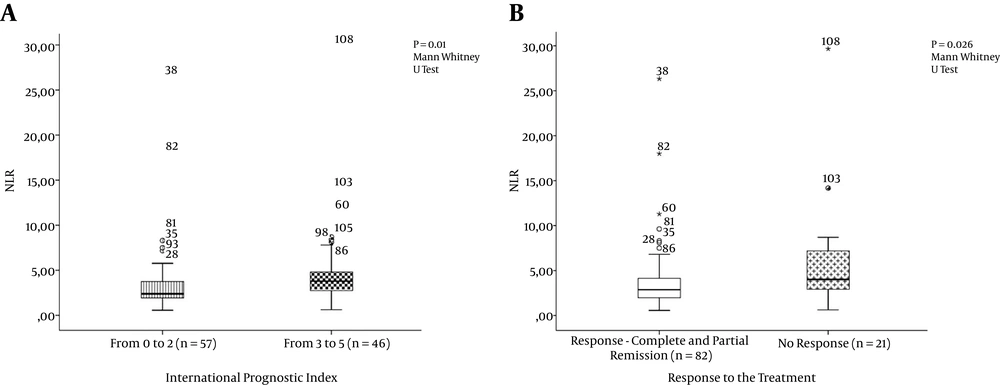
Figure 1.
A, according to the international prognostic index and; B according to response to treatment.
We defined the cutoff NLR value for mortality in our cohort by ROC analysis. The area under the curve (AUC) for NLR was 0.631 (95% CI 0.531 - 0.724, Z = 2.18); the optimal cutoff value was 2.63, with 82.8% sensitivity and 50% specificity (P = 0.0293) (Figure 2). Forty-two patients had low NLR (≤ 2.63) and 61 patients had high NLR (> 2.63). The patients with high NLR had significantly higher IPI (P = 0.002), LDH (P = 0.001), CPR (P = 0.004), PLR (P < 0.001), and GPS (P = 0.002); they also more often expressed B symptoms (P = 0.016), had lower serum albumin (P = 0.001), and showed a poorer response to treatment (P = 0.026) (Table 1).
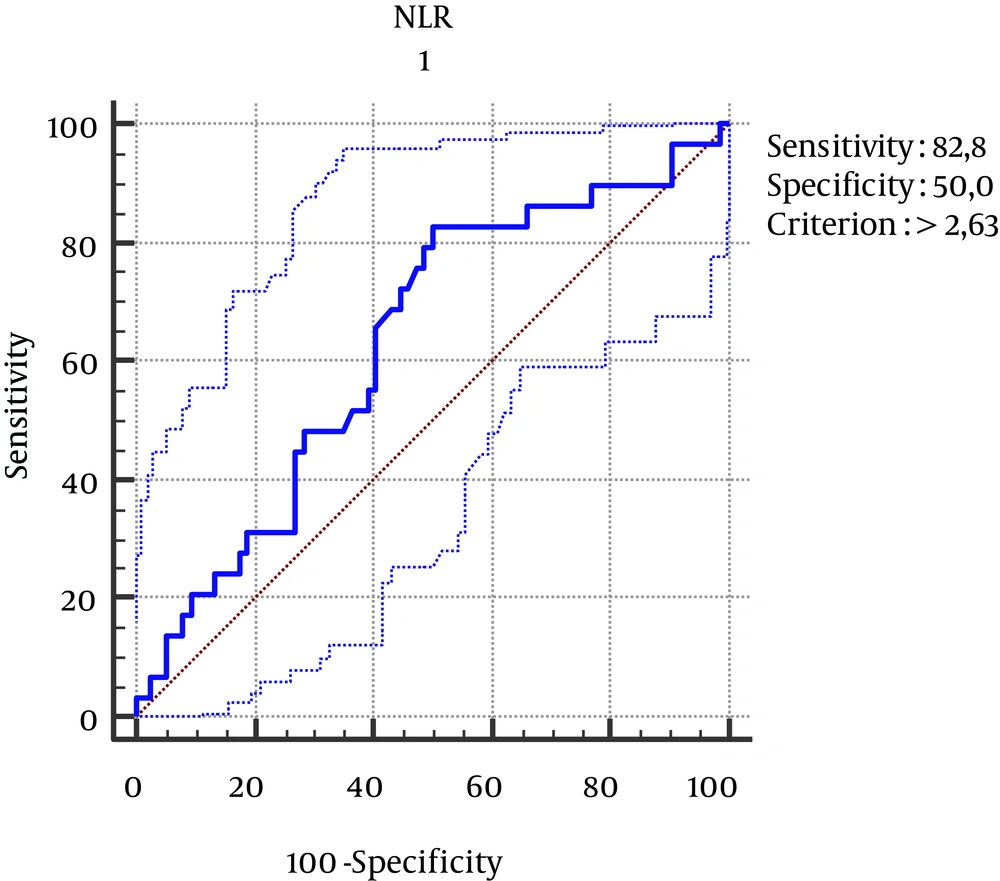
Figure 2.
ROC Curve of NLR for Differentiating OS in Patients With DLBCL (n = 103).
Table 1.
Baseline Characteristics and Treatment Outcomes in DLBCL Patients According to 2.63 NLR Cutoff, Median Value of PLR, and GPSa
| Variable | NLR | PLR | GPS | |||||||
|---|---|---|---|---|---|---|---|---|---|---|
| Low ≤ 2.63 (n = 42) | High > 2.63 (n = 61) | P | Low ≤ 162.38, (n = 52) | High > 162.38, (n = 51) | P | Score 0 (n = 48) | Score 1 (n = 41) | Score 2 (n = 14) | P | |
| Age in years, median (range) | 64 (22 - 81) | 63 (23 - 87) | 0.766b | 63 (27 - 87) | 64 (22 - 86) | 0.591b | 63.5 (22 - 81) | 62 (23 - 87) | 69.5 (53 - 86) | 0.128b |
| Age group | 0.303c | 0.907c | 0.072c | |||||||
| ≤ 60 years | 15 (35.7) | 28 (45.9) | 22 (42.3) | 30 (50) | 21 (43.8) | 20 (48.8) | 2 (14.3) | |||
| > 60 years | 27 (64.3) | 33 (54.1) | 30 (57.7) | 30 (50) | 27 (56.2) | 21 (51.2) | 12 (85.7) | |||
| Gender | 0.703c | 0.173c | 0.856c | |||||||
| Male | 16 (38.1) | 21 (34.4) | 22 (42.3) | 15 (70.6) | 16 (33.3) | 16 (39) | 5 (35.7) | |||
| Female | 26 (61.9) | 40 (65.6) | 30 (57.7) | 36 (70.6) | 32 (66.7) | 25 (61) | 9 (64.3) | |||
| ECOG PS | 0.305c | 0.456c | < 0.001c | |||||||
| < 2 | 34 (81) | 44 (72.1) | 41 (78.8) | 37 (72.5) | 44 (81.7) | 28 (68.3) | 6 (42.9) | |||
| ≥ 2 | 8 (19) | 17 (27.9) | 11 (21.2) | 14 (27.5) | 4 (8.3) | 13 (31.7) | 8 (57.1) | |||
| IPI | 0.002c | 0.094c | < 0.001c | |||||||
| ≤ 2 | 31 (73.8) | 26 (42.6) | 33 (63.5) | 24 (47.1) | 39 (81.3) | 18 (43.9) | 0 (0) | |||
| > 2 | 11 (26.2) | 35 (57.4) | 19 (36.5) | 27 (52.9) | 9 (18.8) | 23 (56.1) | 14 (100) | |||
| LDH | 0.001c | 0.008c | < 0.001c | |||||||
| Normal | 32 (76.2) | 26 (42.6) | 36 (69.2) | 22 (43.1) | 40 (83.3) | 17 (41.5) | 1 (7.1) | |||
| >241 U/L | 10 (23.8) | 35 (57.4) | 16 (30.8) | 29 (56.9) | 8 (16.7) | 24 (58.5) | 13 (92.9) | |||
| B symptomse | 0.016c | 0.372c | < 0.001c | |||||||
| No | 26 (61.9) | 23 (37.7) | 27 (51.9) | 22 (43.1) | 37 (77.1) | 12 (29.3) | 0 (0) | |||
| Yes | 16 (38.1) | 38 (62.3) | 25 (48.1) | 29 (56.9) | 11 (22.9) | 29 (70.7) | 14 (100) | |||
| Infiltration of bone marrow | 0.3c | 0.739c | 0.006c | |||||||
| No | 29 (69) | 36 (59) | 32 (61.5) | 33 (64.7) | 38 (79.2) | 21 (51.2) | 6 (42.9) | |||
| Yes | 13 (31) | 25 (41) | 20 (38.5) | 18 (35.3) | 10 (20.8) | 20 (48.8) | 8 (57.1) | |||
| AA clinical stage | 0.078c | 0.043c | 0.003c | |||||||
| I and II | 18 (42.9) | 16 (26.2) | 22 (42.3) | 12 (23.5) | 24 (50) | 8 (19.5) | 2 (14.3) | |||
| III and IV | 24 (57.1) | 45 (73.8) | 30 (57.7) | 39 (76.5) | 24 (50) | 33 (80.5) | 12 (85.2) | |||
| RBC (× 1012/L, [mean ± SD*]) | 4.27 ± 0.53 | 4.28 ± 0.7 | 0.931d | 4.45 ± 0.62 | 4.1 ± 0.61 | 0.005d | 4.41 ± 0.59 | 4.33 ± 0.54 | 3.67 ± 0.72 | < 0.001d |
| Hemoglobin (g/L, [mean ± SD]) | 122 ± 17 | 121 ± 21 | 0.892d | 127 ± 19 | 116 ± 18 | 0.003d | 127 ± 17 | 120 ± 18 | 105 ± 20 | < 0.001d |
| WBC (× 109/L, [mean ± SD]) | 6.59 ± 2.48 | 7.91 ± 2.75 | 0.013d | 7.61 ± 2.78 | 7.13 ± 2.64 | 0.37d | 6.561.93 | 7.652.94 | 9.353.26 | 0.002d |
| ANC (cells × 109/L, [mean ± SD]) | 3.78 ± 1.55 | 5.65±2.06 | < 0.001d | 4.74 ± 1.99 | 5.05 ± 2.17 | 0.456d | 4.21 ± 1.64 | 5.27 ± 2.33 | 6.12 ± 1.9 | 0.003d |
| ALC (cells × 109/L, [mean ± SD]) | 2.03 ± 0.75 | 1.26 ± 0.56 | < 0.001d | 1.91 ± 0.76 | 1.23 ± 0.56 | < 0.001d | 1.64 ± 0.6 | 1.49 ± 0.68 | 1.6 ± 1.27 | 0.62d |
| Platelet (×109/L, [mean ± SD]) | 234 ± 92 | 284 ± 134 | 0.037d | 199 ± 70 | 329 ± 127 | < 0.001d | 245 ± 93 | 276 ± 135 | 288 ± 158 | 0.345d |
| CRP (mg/L), median (range) | 6.05 (0.5 - 101.9) | 17.1 (0.5 - 247.7) | 0.004b | 5.85 (0.5 - 124.4) | 14.91 (1 - 247.7) | 0.002b | 3.7 (0.5 - 9.7) | 23.8 (2.6 - 171.3) | 89.2 (28.8 - 247.7) | < 0.001b |
| Albumin (g/L, [mean ± SD]) | 43 ± 4.89 | 39.07±6.98 | 0.001d | 42.74 ± 6.12 | 38.57 ± 6.21 | 0.001d | 45.05 ± 4.02 | 39.29 ± 4.03 | 29.67 ± 3.75 | < 0.001d |
| Iron (µmol/L, [mean ± SD]) | 11.4 ± 4.23 | 8.95 ± 5.71 | 0.07d | 11.07 ± 4.52 | 8.87 ± 7.9 | 0.1d | 12.4 ± 6.78 | 8.13 ± 5.32 | 6.83 ± 5.16 | 0.002d |
| Ferritin (µg/L), median (range) | 87.6 (5.8 - 2350) | 139.95 (7.7-1288.7) | 0.177b | 83.35 (7.8 - 2350) | 139.95 (5.8 - 1262) | 0.081b | 79.3 (5.8 - 2350) | 170.3 (17.8 - 1288.7) | 348.3 (15 - 662.4) | < 0.001b |
| NLR, median (range) | 1.92 (0.56 - 2.63) | 4 (2.64 - 29.66) | < 0.001b | 2.23 (0.56 - 11.29) | 3.88 (1.26 - 29.66) | < 0.001b | 2.28 (0.56 - 26.33) | 3.21 (0.62 - 18) | 4.24 (1.44 - 29.66) | 0.003b |
| PLR, median (range) | 117.79 (13.05 - 305.37) | 194.71 (33.76-2080.25) | < 0.001b | 103.94 (13.05 - 162.38) | 249.07 (163.75 - 2080.25) | < 0.001b | 133.76 (54.32 - 1363.63) | 180.45 (37.68 - 1108) | 257.88 (13.05 - 2080.25) | 0.048b |
| GPS | 0.002c | 0.02c | - | - | - | - | ||||
| 0 | 28 (66.7) | 20 (32.8) | 31 (59.6) | 17 (33.3) | ||||||
| 1 | 12 (28.6) | 29 (47.5) | 17 (32.7) | 24 (47.1) | ||||||
| 2 | 2 (4.8) | 12 (19.7) | 4 (7.7) | 10 (19.6) | ||||||
| Treatment outcome | 0.026c | 0.811c | < 0.001c | |||||||
| Response | 38 (90.5) | 44 (72.1) | 42 (80.8) | 40 (78.4) | 46 (95.8) | 31 (75.6) | 5 (35.7) | |||
| No response | 4 (9.5) | 17 (27.9) | 10 (19.2) | 11 (21.6) | 2 (4.2) | 10 (24.4) | 9 (64.3) | |||
Abbreviations: AA, Ann Arbor; RBC, red blood cells; ALC, absolute lymphocyte count; ANC, absolute neutrophil count; CRP, C-reactive protein; DLBCL, diffuse large B-cell lymphoma; ECOG PS, eastern cooperative oncology group performance status; GPS, Glasgow prognostic score; IPI, international prognostic index; LDH, lactate dehydrogenase; MCV, mean corpuscular volume; NLR, neutrophil-to-lymphocyte ratio; PLR, platelet-to-lymphocyte ratio; SD, standard deviation; WBC, white blood cells.
aValues are expressed as No. (%) unless otherwise indicated.
bMann-Whitney U-test.
cχ2 test.
dt-test.
efever, nights sweats, weight loss.
Two-year OS and two-year EFS were 74.2% and 71.1% for all patients, significantly poorer in those with NLR > 2.63 (65.1% vs. 87.2% for two-year OS, P = 0.002, log-rank test; 59.8% vs. 87.1% for two-year EFS, P = 0.001, log-rank test) (Figure 3A).
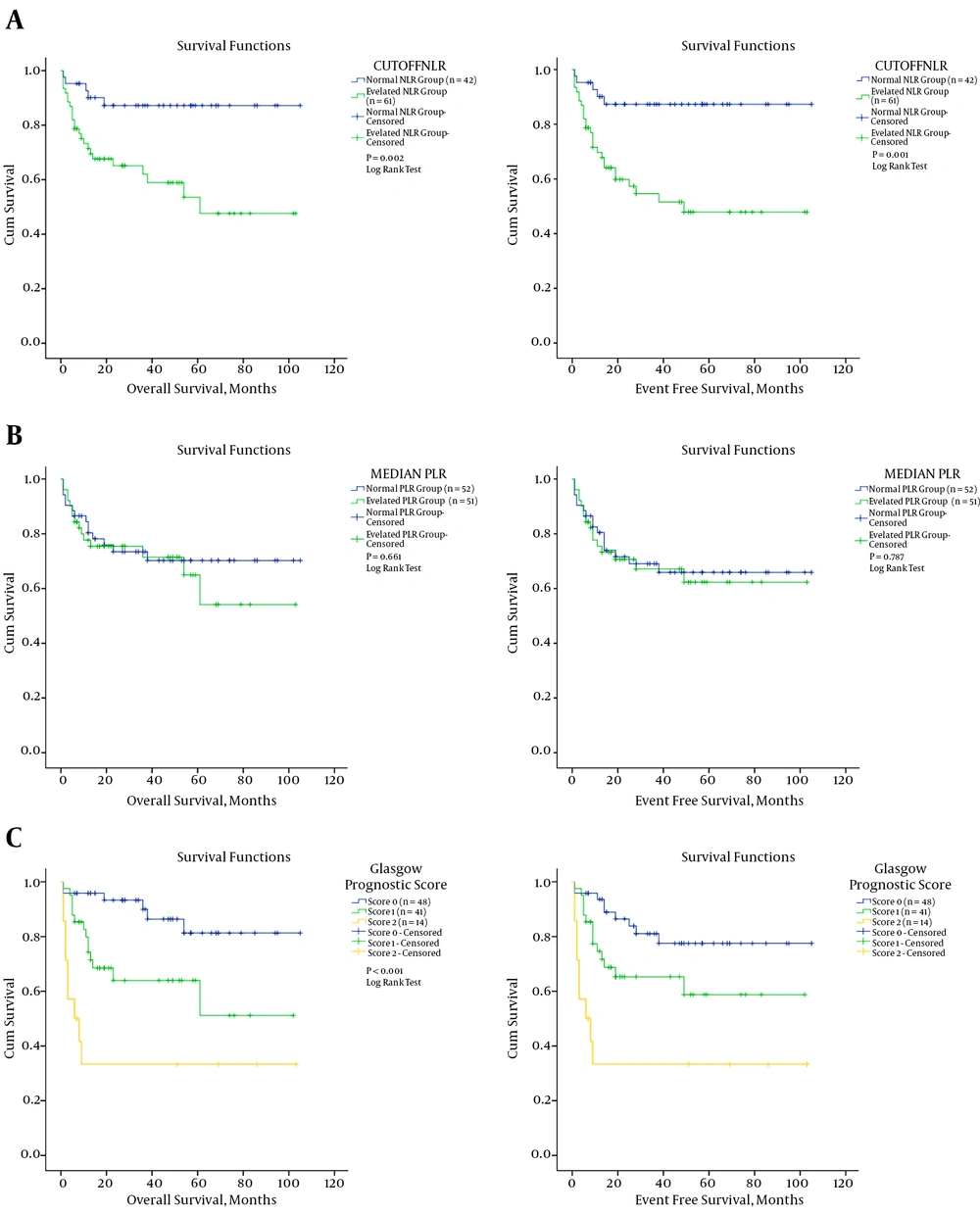
Figure 3.
A, according to NLR level (normal ≤ 2.63, elevated > 2.63%); B, according to PLR level (normal ≤ 162.38, elevated > 162.38); C, and according to the GPS of 0, 1, and 2.
4.3. PLR and DLBCL
There was a significant positive correlation between PLR and CRP (rs = 0.288, P = 0.003), NLR (rs = 0.583, P < 0.001), ferritin (rs = 0.23, P = 0.027), GPS (rs = 0.24, P = 0.015), and IPI (rs = 0.197, P = 0.046), but a negative correlation between PLR and RBC (rs = -0.207, P = 0.036), Fe (rs = -0.35, P = 0.001), and serum albumin (rs = -0.304, P = 0.002). We did not find significant correlations between PLR and WBC, ANC, age, or ECOG PS.
In patients with advanced disease and those with IPI of > 2, PLR was not higher (P = 0.166; P = 0.099) (data not shown). Patients who responded to therapy did not have lower PLR than those who did not respond to therapy (P = 0.556) (data not shown).
Next, we divided the patients into two groups based on the median value of PLR (≤ 162.38 and > 162.38). Fifty-two patients had low PLR (≤ 162.38) and 51 had high PLR (> 162.38). The patients with high PLR had significantly higher AA stage (P = 0.043), LDH (P = 0.008), CPR (P = 0.002), NLR (P < 0.001), and GPS (P = 0.02), as well as lower serum albumin (P = 0.001) and Hb (P < 0.001) (Table 1).
There was no statistically significant difference in OS (P = 0.611, log-rank test) or EFS (P = 0.787, log-rank test) according to the median value of PLR (Figure 3B).
We next performed the ROC analysis, which showed that PLR was not a statistically significant factor for mortality. AUC for PLR was 0.539 (95% CI 0.438 - 0.638, Z = 0.595; optimal cutoff value was 150.28, with 62.1% sensitivity and 50% specificity, P = 0.552) (data not shown).
4.4. GPS and DLBCL
There was a significant positive correlation between GPS and CRP (rs = 0.842, P < 0.001), ANC (rs = 0.356, P < 0.001), ferritin (rs = 0.411, P < 0.001), NLR (rs = 0.33, P = 0.001), PLR (rs = 0.24, P = 0.015), IPI (rs = 0.574, P < 0.001), ECOG PS (rs = 0.39, P < 0.001), and clinical stage (rs = 0.347, P < 0.001), while there was a negative correlation between GPS and RBC (rs = -0.29, P = 0.003), Hb (rs = -0.38, P < 0.001), and serum albumin (rs = -0.743, P < 0.001). We did not find significant correlations between GPS and platelet count or ALC.
Patients with higher GPS were in poorer general condition (P < 0.001), expressed B symptoms more frequently (P < 0.001), and had bone marrow involvement (P = 0.006), advanced disease stage (P = 0.003), higher IPI (P < 0.001), higher NLR (P = 0.003), higher LDH (P < 0.001), higher WBC (P = 0.002), higher serum ferritin (P < 0.001), lower RBC (P < 0.001), lower serum concentration of Hb (P < 0.001), and a poorer response to therapy (P < 0.001) (Table 1). The two-year OS rates for patients with GPS = 0, GPS = 1, and GPS = 2 were 93.3%, 63.9%, and 33.3%, respectively (P < 0.001, log-rank test) (Figure 3C). Patients with GPS = 0 had significantly better OS than those with GPS = 2 (P < 0.001). The two-year EFS rate was 86.5% in patients with GPS = 0, 65.3% in patients with GPS = 1, and 30.3% in patients with GPS = 2, respectively (P < 0.001, log-rank test).
4.5. Univariate and Multivariate Cox Regression Analysis
In the univariate analyses, unfavorable IPI (> 2), elevated LDH (> 241 UI), worse ECOG PS (≥ 2), advanced stage (III + IV), the presence of B symptoms, NLR of > 2.63, and GPS of ≥ 1 significantly influenced OS (Table 2). PLR was not a significant prognostic factor for OS (P = 0.789) or EFS (P = 0.613). In multivariate analyses, unfavorable IPI (> 2) (hazard ratio [HR] = 4.887; 95% CI 1.091 - 21.888; P = 0.038) and elevated NLR (> 2.63) (HR = 2.857; 95% CI 1.022 - 8.699; P = 0.048) were independently associated with shorter OS (Table 2). Also in the univariate analyses, unfavorable IPI (> 2), elevated LDH (> 241 UI), older age (> 60 years), worse ECOG PS (≥ 2), advanced stage (III + IV), the presence of B symptoms, NLR of > 2.63, and GPS of ≥ 1 significantly influenced EFS (Table 2). In the multivariate analyses, unfavorable IPI (> 2) (HR = 4.778; 95% CI 1.164 - 19.609; P = 0.034), elevated NLR (> 2.63) (HR = 4.06; 95% CI 1.357 - 12.151; P = 0.012), and the presence of B symptoms (HR = 3.215; 95% CI 1.262 - 8.192; P = 0.012) were independently associated with shorter EFS (Table 2).
Table 2.
Univariate and Multivariate Analysis for OS and EFS in DLBCL Patients (n = 103)
| Univariate | Multivariate | |||||||||||
|---|---|---|---|---|---|---|---|---|---|---|---|---|
| OS | EFS | OS | EFS | |||||||||
| HR | 95% CI | P | HR | 95% CI | P | HR | 95% CI | P | HR | 95% CI | P | |
| NLR (> 2.63) | 4.077 | 1.551 - 10.712 | 0.004 | 4.589 | 1.764 - 11.939 | 0.002 | 2.857 | 1.022 - 8.699 | 0.048 | 4.06 | 1.357 - 12.151 | 0.012 |
| PLR (> 162.38) | - | - | NS | - | - | NS | - | - | - | - | - | - |
| GPS (≥ 1) | 4.43 | 1.796 - 10.929 | 0.001 | 2.94 | 1.355 - 6.379 | 0.006 | - | NS | - | - | NS | |
| Age (> 60 years) | - | - | NS | 2.573 | 1.155 - 5.734 | 0.021 | - | - | - | - | - | NS |
| Sex (male) | - | - | NS | - | - | NS | - | - | NS | - | - | - |
| ECOG PS (≥ 2) | 6.152 | 2.876 - 13.161 | < 0.001 | 4.795 | 2.363 - 9.729 | < 0.001 | - | - | NS | - | - | NS |
| IPI* (> 2) | 11.408 | 3.951 - 32.94 | < 0.001 | 6.762 | 2.906 - 15.734 | < 0.001 | 4.887 | 1.091 -21.888 | 0.038 | 4.778 | 1.164 - 19.609 | 0.034 |
| LDH (> 241 U/L) | 4.146 | 1.832 -9.383 | 0.001 | 3.09 | 1.486 - 6.422 | 0.003 | - | - | NS | - | - | NS |
| B symptomsa (yes) | 4.442 | 1.804 - 10.94 | 0.001 | 4.347 | 1.874 - 10.079 | 0.001 | - | - | NS | 3.215 | 1.262 - 8.192 | 0.014 |
| Clinical stage AA (III and IV) | 18.224 | 2.475 - 134.205 | 0.004 | 9.642 | 4.581 - 20.296 | 0.005 | - | - | NS | - | - | NS |
Abbreviations: AA, Ann Arbor; CI, confidence interval; ECOG PS, eastern cooperative oncology group performance status; EFS, event-free survival; GPS, Glasgow prognostic score; HR, hazard ratio; IPI, international prognostic index; LDH, lactate dehydrogenase; NLR, neutrophil-to-lymphocyte ratio; NS, non-significant; OS, overall survival; PLR, platelet-to-lymphocyte ratio.
afever, nights sweats, weight loss
5. Discussion
This is the first study to compare different biomarkers of systemic inflammation in patients with DLBCL. The results showed that increased NLR at the time of DLBCL diagnosis is associated with a poorer prognosis, and NLR is an independent prognostic factor for OS and EFS. Patients with NLR values of > 2.63 have shorter OS and EFS. Our study indicates that in patients with DLBCL, NLR is a better prognostic factor than PLR or GPS, which is similar to results obtained in patients with breast, colorectal, and lung carcinoma, as well as malignant mesothelioma (31-34).
A significant positive correlation of NLR with CRP and ferritin and a negative correlation of NLR with serum albumin were found in our study. The results confirm that a high NLR reflects chronic inflammation and poor nutritional status in patients with DLBCL (10). We analyzed the cutoff NLR value (≥ 3.5) for mortality of patients with DLBCL established by Porrata et al. (10) but could not find a survival difference between patients with low and high values. In our series, the cutoff value of 2.63, determined by ROC analysis, discriminated best between patients who survived and those who died. The obtained cutoff value, lower than the one previously established, could be a result of the relatively small number of patients or differences between patient populations. When we divided the patients into two groups based on the cutoff value of NLR (≤ 2.63 or > 2.63), we found that patients with higher values had higher IPI, LDH, and CPR, expressed B symptoms more often, had lower serum albumin, and showed a poorer response to treatment. These results are in accordance with those of Porrata et al. (10) and confirm that higher NLR values are associated with worse treatment outcomes. In the multivariate analysis, NLR was found to be an independent prognostic factor for OS and EFS. So far, there have been no reports on the prognostic value of PLR in patients with DLBCL. PLR is associated with prognosis in many types of cancer, including colorectal, pulmonary, and hepatocellular. However, the specific mechanism of this correlation is not fully understood (35). Platelets can trigger tumor growth by accelerating angiogenesis via the cytokine vascular endothelial factor (VEGF) pathway (36). Our study identified a positive association of PLR with CRP, ferritin, and IPI, and a negative association of PLR with serum albumin. PLR was not different in patients who responded to treatment and those who did not, nor did it influence OS or EFS. According to the results obtained in our group of patients, PLR has no prognostic value in DLBCL.
Our study indicates that GPS is a prognostic factor for OS and EFS. Patients with higher values (GPS = 2) had shorter OS and EFS. High GPS is associated with poorer prognostic factors, including worse ECOG PS (≤ 2), bone marrow involvement, advanced disease stage, and the presence of B symptoms. These results indicate that GPS may reflect tumor growth and the invasive potential (tumor stage), and the patient’s response to the tumor (B symptoms). Our results are consistent in large part with the recently published results of Li et al., who found that GPS was good predictor of clinical outcome in patients with DLBCL who were treated with R-CHOP (29). They found that patients with lower GPS values had better outcomes (longer OS and EFS). In their series, GPS was an independent predictor of OS, whereas we did not obtain a similar result in our study. The difference was possibly a consequence of the relatively small number of patients and the fact that we included NLR in the multivariate analysis while the previous authors did not.
We also determined mutual positive correlations between NLR, PLR, and GPS, likely due to an increased inflammatory response. Malignant tumors lead to chronic inflammation and malnutrition (37). Inflammatory processes have been identified as critical components of tumor progression, highlighting the role of the microenvironment, which is largely orchestrated by inflammatory cells as an indispensable participant in the neoplastic process, fostering proliferation, survival, and migration (38). An acute inflammatory reaction is a common event in patients with malignant disease, which results in an excess of proinflammatory cytokines, such as interleukins 1, 6, and 8, tumor necrosis factor, and interferon (39). This systemic inflammatory response, reflecting both the disease activity and the host’s innate response to the tumor, has a causative role in determining most of the constitutional symptoms and signs reported by cancer patients, including weight loss, anorexia, fatigue, and cancer-related anemia (40). It was found that the systemic inflammatory response was associated with poor outcomes in various diseases. For various solid tumors, as well as for lymphomas, inflammation parameters such as WBC, ANC, ALC, and CRP have been associated with higher mortality rates (41-46). Our results are in accordance with findings on the important roles of inflammation and malnutrition in tumor progression. Patients with high NLR and GPS had a poor response to treatment. Chronic inflammation is also reported to lead to an unfavorable response to chemotherapy (47, 48). More research is needed to explain the relationships of NLR and GPS with inflammation and response to cancer treatment.
This is the first study to compare inflammatory markers in patients with DLBCL. So far, there have been no reports on the prognostic value of PLR in patients with DLBCL. A limitation of this study was its retrospective design and the fact that it was conducted in a single center. The obtained cutoff value should be externally validated within independent cohorts of patients, preferably in a prospective study. Based on our results, some of the studied inflammatory prognostic biomarkers may be associated with patient survival. NLR as an indicator of systemic inflammation was an independent prognostic factor for OS and EFS in DLBCL. Our research confirmed NLR as a useful prognostic marker, while PLR and GPS did not show independent prognostic value for survival, although they were also associated with the clinical features of the patients. The easy availability and inexpensiveness of inflammatory biomarkers should encourage their use in clinical practice.