
1. Background
Individual health is regarded as a complex interplay among biological, environmental, social, and political factors, which in turn should be considered in many instances because of their potential roles in health disparities (1). This multi - faceted situation must be dealt with different aspects using a transdisciplinary framework addressing preventable factors that contribute to health disparities. Strong collaborations among governmental organizations, service providers, and other stakeholders including researchers and non-governmental organizations may provide opportunities to reach less disparity on population health, particularly in incidence and prevalence of diseases, morbidity and mortality, and access to health care, or survival rates (2). In line with the I.R Iran's constitutional law (3), vision for 2020 (4, 5), and five - year socio - economic and cultural development plans of the Islamic Republic of Iran (6), which all emphasize on reducing deprivation in different aspects, MOHME established the secretariat for social determinants of health. However, it has recently been upgraded to social deputy, which was designated as the focal point for coordinating actions on health disparities elimination (“Action for SDH”). In the past 10 years, based on a national SDH conceptual framework, major steps have been taken to identify major social factors that have led to health disparities. This paper reviews intersectoral actions which have been already formulized and implemented to reduce health disparities by the MOHME.
2. Methods
We reviewed all documents and presentations from SDH secretariat in the MOHME within 10 years to show formulized actions in 3 main aspects targeting health disparity: (1) Iranian will, (2) defining priority areas with pertinent strategies and plan of actions, and (3) assuring the integration of health in all policies through a monitoring system.
3. Results
3.1. Iran Commitments on Reducing Health Disparities
Equity - oriented approaches of Iranian government, which is evident from many national documents, as well as national plans provide a unique opportunity for Iran’s health sector to take the necessary steps toward health equity through switching from biological factors to social, environmental, and political ones (7).
In 2005, Iran was nominated as WHO partner to develop a strategic plan targeting social element leading to poor health and disparities. The Iranian MOHME established a secretariat of Social Determinants of Health in the deputy for health in 2006, which was attributed to the Health Policy Council in 2008. This secretariat tries to make a strategic plan for SDH through effective collaborations of other sectors that potentially affect health to improve health and also reduce health inequity. Such efforts have led to collaboration of sectors both within and beyond the health sector, and this systematically affects health outcomes.
3.2. Nomination of the National Think Tank Committee
Given the investments on health equity by the MOHME, national think tank committee was established in 2007 to consider the health equity goals, strategies, and action plans targeting health inequities, which have arisen from social and economic factors. Members of this committee came from more than 15 various ministries including Ministry of Education, Ministry of Labor and Social Affairs, and Ministry of Finance.
To this end, the think tank committee was charged to determine which social factors should be targeted as priorities and how interventions could be implemented to reduce health disparities.
3.3. Summary of the Products from Think Tank Committee
The think tank committee recognized the urgency and the complexity of the task, and particularly, the need for intersectoral, interdisciplinary, and multilevel approaches.
In 2008, fundamental social and economic causes of health inequities, which were rooted in the unequal access to wealth, resources, and knowledge, were introduced: early childhood development, spiritual and mental health, equitable health services, employment and job security; nutrition and food security, health life style, education, housing, environment; social support, marginalization and remote areas, equitable distribution of income and economic security, and special groups (8). Figure 1 illustrates the interaction between SDH priorities and main activities. Based on strategic planning for each priority, specific activities in various domains, such as research, education, health equity in all policies, geographical localization and intersectoral collaboration, were taken into account.
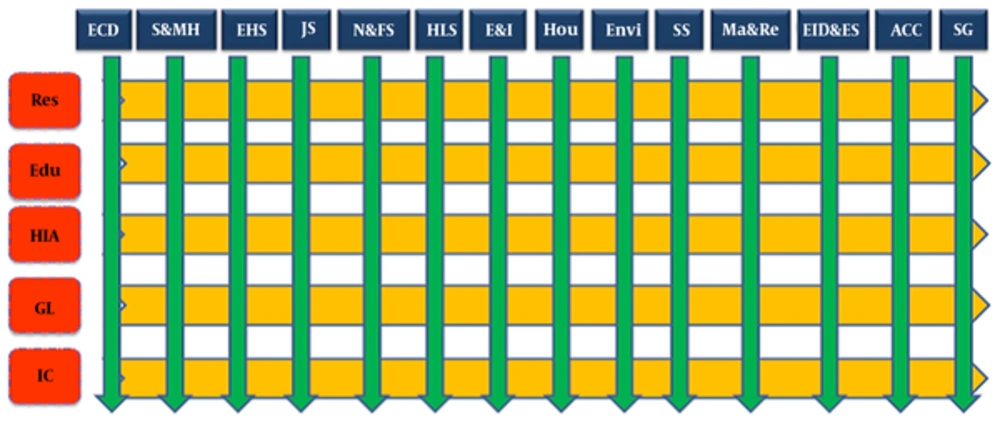
Figure 1.
Proposed strategic plans on SDH&HE in IR. Iran. Key of the ECD: ECD: early childhood development; S&ME: spirtual and mental health; EHC: equitable health services; JS: job security; N&FS: nutrition and food security; HLS: healthy life style; E&I: education and information; Hou: housing; Envi: environment; SS: social support; Ma&Re: margin and remote areas; EID&ES: equitable income distribution and economic security; Acc: accident; SG: special groups; Res: research; Edu: education; HIA: health equity in all policies; GL: geographical localization; IC: intersectoral collaboration.
Also, this committee set out plans of actions to address health inequities in those 14 themes through promoting participation in policymaking on health, further reorientation of various sectors (including 12 ministries) toward reducing health inequities, and strengthening national government to monitor and increase accountability.
3.4. A Warranty for the Inclusion of Health in All Policies by Establishing SDH Monitoring System
Considering the connection of health status with inequalities in various other areas including employment, income, educational level, lifestyle, living and working conditions, and accessibility to care services (9, 10), national think tank committee proposed a monitoring framework for the underlying determinants involved not only in the health sector but also in other social sectors to inject health in all policies. To this end, by applying rigorous criteria, they selected 52 indicators related to population’s health that were mostly affected by social factors (3, 11) and by previous experience obtained by Tehran municipality on Urban HEART rapid assessment in 2009 (5, 12-14).
All those 52 indicators were summarized in 5 domains of measurement: health, physical environment and infrastructure, social and human development, economic development, and governance.
Subsequently, in 2011, the Iranian cabinet approved 52 selected intersectoral indicators for health (15) across different levels of government, which mandated such activities and developed accountability mechanisms assuring effective implementation of actions.
Those indicators could be calculated at provincial, district, and national levels with participation from governmental, non - government organizations, academic organizations, and professional organizations.
3.5. Major Characteristics of Iranian Health Equity Metric Tool
This tool relies on 2 different sources for data collection comprising routine system and household survey tools. Health equity indicators based on routine system is estimated annually by age, sex, education, economics status, age, and place of residency (including urban, rural) in each district. Data from routine information system is the main source of data for measuring health equity indices. On the other hand, data from national surveys will be used in specific subjects. Health Council at the district level is responsible to collect, analysis and disseminate the result of measuring health equity indices. Health council’s supports appropriate interventions on reducing inequalities in health at district level between districts at the province and national levels.
Main actions considered for the modifications of health equity monitoring system based on routine system are as follows:
- Redesigning and revising of health information system forms to be linked to census data using household national ID number to determine socio - economic status.
- Pilot HEMS in Semnan for routine system information (8).
- Preparing protocols and guidelines and training packages for data collection in the revised routine system.
- Training instructors on health equity monitoring system.
- Preparing organizational structure for committees and working groups at the national and subnational levels.
Data collation for those indictors based on the routine system has been started from March 2013.
A household survey was developed to estimate the indicators that could not be measured through the routine system, (12, 16). A comprehensive guide with relevant questionnaires was prepared in collaboration with related sectors in November 2013. All survey questionnaires and protocols underwent a pilot study in Islam - Shahr district, Tehran province, Iran, comprising 100 households.
Challenges of HEMS based on 52 indicators were as follow:
- Coordinating various organizations at different levels (district, province, national).
- A need to change various processes in different organizations to generate valid and reliable disaggregated data based on routine system.
- Conducting census after a 5 - year interval.
- Missing data for national ID number of head of the households for some cases at the beginning of the data collection.
- Sophisticated analysis particularly for socioeconomic categorization based on linkage of data to census data.
- Large sample size for the survey that required too many resources.
- Lack of political commitment by the MOHME particularly in 2013.
After forming the Deputy for Social Affairs within the MOHME and reviewing the challenges of the 52 indicators, the indicators were revised by contribution of all stakeholders, particularly by involving the Organization of Planning and Budgeting; moreover, a list of 69 health equity indicators was prepared in 2016 (11).
4. Discussion
Although broader sociopolitical interventions reducing disparities in health mainly remain outside the remit of health disciplines, it is the health sector’s obligation to provide evidence of how a broad range of collaborative strategies, policies, and interventions may improve health status and decrease health disparities and how it can provide a tool to measure the influence of those factors on health over time.
Based on conceptual framework for action on the SDH presented by WHO (17) to develop a policy action to tackle the SDH, 3 aspects should be taken into account: (a) strategies and interventions to be content with all components of socioeconomic context of the society, (b) intersectoral collaboration activities, and (c) community involvement and empowerment. Reviewing the Iranian SDH policies showed that these 3 aspects have not been addressed in a comprehensive approach and due to the changing of governments over the last decade, policy action and monitoring system based on 52 health equity indicators were not implemented.
This paper showed current platforms developed by MOHME to facilitate the implementation of actions and also monitoring disparity reduction. Through providing the current picture of the diverse spectrum of activities across levels of governmental sectors to improve health equity through addressing SDH in Iran, we intend to make some suggestions for the continuation and improvement of future practices to close the gap in health status.
Policy action on SDH and health inequality should be considered in the context of health policies, and Iran has made considerable efforts towards this goal. However, a focus on developing national framework for health strategies based on SDH policy framework is an urgent priority for public health policy in Iran. Furthermore, a functional health equity monitoring system to measure the trends on health inequality based on data from routine systems and conducting surveys and subsequent improvements in infrastructure, capacity-building, and sustainable resources for such system are priorities.