


1. Background
One of the most important implicit objectives in health systems is equity in reach to marginal objectives (1, 2). Thus, recently, equity in health resources distribution (such as bed, physician, and equipment,) has increasingly been paid attention (3).
An expand in literature is in the health area regarding concept and measure method of equity due to the fact that the subject is a multi-aspect and expand concept, which includes resource allocation (2, 4).
This concept is one of the important criteria in resource distribution and access to health services. In view of experts, equity in health resources distribution is guaranteed for health society (5). In other ways, the study of the equity in facility distribution in health sector is a perquisite for fair utilization of health intervention as one of the ways for assessing the government access level in achievement to social equity (6, 7).
On the other hand, the demand growth, health costs, as well as the human and financial resource scarcity have created limitation for responsibility to need society health care in different geographical areas and inequity in health resource distribution (8, 9). Based on the WHO definition, health inequity is an avoidable inequality in health status or social determinant health different groups of society (10). Despite economic growth and health gains, there are many differences in the society health status as well as individuals within a country (11). In developing countries, resources are often unbalanced due to the lack of appropriate information and poor health planning (12).
In Iran, health promotion and the fair distribution of health facilities have always been of particular importance. Policy makers have followed the achievement to this goal in economic and social development programs (13). However, limited comprehensive studies have been done on the status of health resources distribution, including the human resources employed in the health system, hospital beds, and health centers in Iran. In another study, in evaluating the geographical distribution of ICU beds for non-cardiac diseases in Iran, showed that the distribution of intensive care unit beds in the provinces of the country was fair, however, the number of beds was lower than in other countries (14). In addition, In another study, in regards to examining the geographical distribution of access to health care in rural areas, have shown that there is a significant difference in the distribution of health house based on rural mortality rates (15).
Regarding the mentioned cases, the present study aimed to investigate the status of equity in health resources distribution, including the human resources of the health system, hospital beds, and health centers in Iran. The results of this study can inform policy makers on how these resources are distributed among the provinces. Furthermore, the findings of the present study provide appropriate evidence for future planning and management of health sector resources to improve access to health services in the country.
2. Methods
2.1. Data and Variables
The present descriptive-analytical study was done in a cross-sectional way in all provinces of Iran in 2014. The analysis variables consist of population, healthcare centers, health human resources, and hospital beds. The population of provinces was a variable collected from the last census by Iran statistics center. Health care centers include public health care centers in each province. It includes a rural health house, rural health center, delivery center, urban health house (payegah-e-behdashti), urban health center, and pubic educational hospitals. Health human health resources include all human resources in mentioned public healthcare centers. Bed variables are limited to active beds in public educational hospital.
The data related to healthcare centers, health human resources, and hospital beds were collected from the budget and surveillance office of ministry of health.
2.2. Analysis
The distribution of health sector resources were analyzed using the Gini coefficient, Hoover index, and Lorenz curve by Excel (2013) and Stata 13 software. The most usual inequality index is Gini coefficient. It is the algebraic method to assess the income distribution, which is statistically the ratio of current income inequality to maximum possible inequality ratio in a complete fair distribution. The Gini coefficient is between 0 (perfect equality) and 1 (perfect inequality). Usually, if the index is 0.25 - 0.35, the distribution is relatively fair; if it is 0.35 - 0.50, the distribution is relatively unequal, and if it is 0.50 - 0.70, the distribution is unequal completely (16). It is possible to find Gini and Hoover indices by Lorenz curve. One dimension of the curve is the population cumulative percent (Xs axis) and another dimension is the cumulative share of the considered variable (in this study, it is manpower, health centers, and hospital beds, Ys axis) (Figure 1).
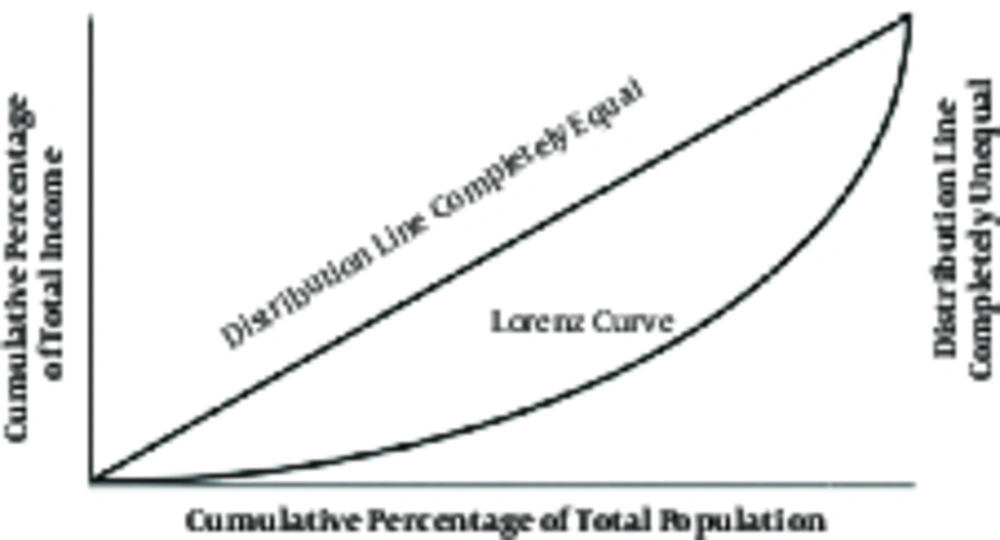
Figure 1.
Lorenz curve
In this Figure, the 45 degree line indicates the equality in distribution and the distance between the curve and the line indicates the extent of inequality, namely if the distance is more the inequality is also more among the population. In order to examine the exact distribution of manpower, health centers, and hospital beds, it is necessary to measure the distance between the 45 degree line and the curve to be able to measure the Gini coefficient. The Gini coefficient was measured by the following formula:

Equation 1.
Where:
X = cumulative percentage of the population
Y = cumulative percent of the variable
On the other hand, Hoover index is the extent of the resources redistribution, which is needed to achieve perfect equality. It is equal to the maximal vertical distance between the Lorenz curve and equity line (Figure 2) (17).
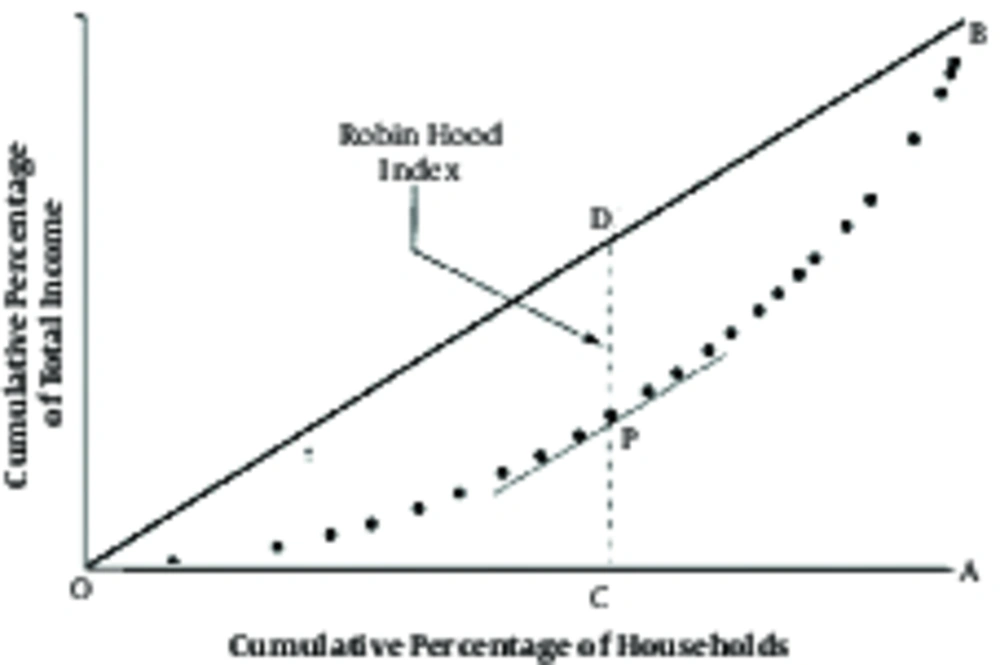
Figure 2.
Hoover index
3. Results
The study findings indicated that the highest ratio of health centers and hospital beds per 1,000 population belongs to south Khorasan province and the highest manpower number/1,000 population belongs to Ilam province (Table 1).
Table 1.The Health Care Centers, Manpower’s and Active Beds Proportions per Thousand People in Iran Provinces
| Provinces | Healthcare Centers | Manpower | Active Beds |
|---|---|---|---|
| Ardabil | 0.6464 | 4.5727 | 1.0316 |
| Alborz | 0.0958 | 1.8367 | 0.3818 |
| Booshehr | 0.3592 | 5.1929 | 1.0368 |
| Chaharmahal and Bakhtiari | 0.5295 | 5.9737 | 1.346 |
| East Azarbayejan | 0.4301 | 4.3851 | 1.0806 |
| Esfahan | 0.2361 | 4.4726 | 0.9637 |
| Fars | 0.3474 | 4.9734 | 1.2191 |
| Gilan | 0.4861 | 5.1675 | 0.94 |
| Golestan | 0.4817 | 5.3629 | 0.9229 |
| Hamedan | 0.48 | 3.628 | 1.1801 |
| Hormozgan | 0.4873 | 4.7662 | 0.8541 |
| Ilam | 0.477 | 7.1646 | 1.042 |
| Kerman | 0.4029 | 4.2916 | 0.9786 |
| Kermanshah | 0.4236 | 4.7619 | 1.0744 |
| Khuzestan | 0.2818 | 4.1695 | 1.0376 |
| Kohgiluyeh and Boyer Ahmad | 0.7318 | 7.2788 | 1.2845 |
| Kurdistan | 0.5323 | 0 | 1.1495 |
| Lorestan | 0.5535 | 4.765 | 1.0369 |
| Markazi | 0.5135 | 5.4379 | 1.1443 |
| Mazandaran | 0.5784 | 5.9139 | 1.1763 |
| North Khorasan | 0.5705 | 4.3067 | 0.9657 |
| Qazvin | 0.3712 | 3.7285 | 0.8447 |
| Qom | 0.1363 | 3.3516 | 0.8457 |
| Razavi Khorasan | 0.3507 | 3.9684 | 1.0435 |
| Semnan | 0.3374 | 2.5015 | 0.7509 |
| Sistan and Baluchestan | 0.4873 | 4.7085 | 0.8424 |
| South Khorasan | 0.7277 | 6.0189 | 2.4529 |
| Tehran | 0.0817 | 2.6395 | 0.8443 |
| West Azarbayejan | 0.4178 | 4.7215 | 0.9336 |
| Yazd | 0.3248 | 5.052 | 2.136 |
| Zanjan | 0.5385 | 5.2671 | 1.1125 |
The present study findings indicated that Kohgilooyeh and Booyer Ahmad, Ilam, South Khorassan, Chaharmahal and Bakhtiari, Mazandaran, and Markazi provinces are the richest in the field of manpower /population ratio and Alborz, Semnan, Tehran, Ghom, Hamedan, and Ghazvin are the poorest. In addition, Kohgilooyeh and Booyer Ahmad, South Khorassan, Ardabil, Mazandaran, Kermanshah, and Lurestan provinces are the richest in field of health centers/population ratio and Tehran, Alborz, Ghom, Esfahan, and Khoozestan provinces are the poorest. On the other hand, South Khorassan, Yazd, Chaharmahal and Bakhtiari, Kohgilooyeh and Booyer Ahmad, Fars, and Hamedan provinces are the richest in field of hospital beds/population ratio and Alborz, Semnan, Sistan and Baluchestan, and Tehran provinces are the poorest.
The Lorenz curve, Gini, and Hoover coefficients for health manpower, health centers, and hospital beds are presented in Table 2 and Figures 3 - 5. By virtue of the numerical rate of the Gini coefficient indices of the manpower, centers, and hospital beds were distributed in the country relatively equitably. In addition, based on Hoover coefficient, 7% of manpower, 8.6% of health centers and 6.7% of the active hospital beds in the richer provinces should be transferred to the poorer ones in order to have a completely equity distribution of resources.
Table 2.Gini and Hoover Coefficients for Health Care Resources Distribution Among Iran’s Provinces
| Resources | Gini Coefficient | Hoover Coefficient | Standard Error |
|---|---|---|---|
| Manpower | 0.13797 | 7 | 0.0089 |
| health Centers | 0.19980 | 8.60 | 0.0112 |
| Active Beds | 0.1499 | 6.70 | 0.0299 |
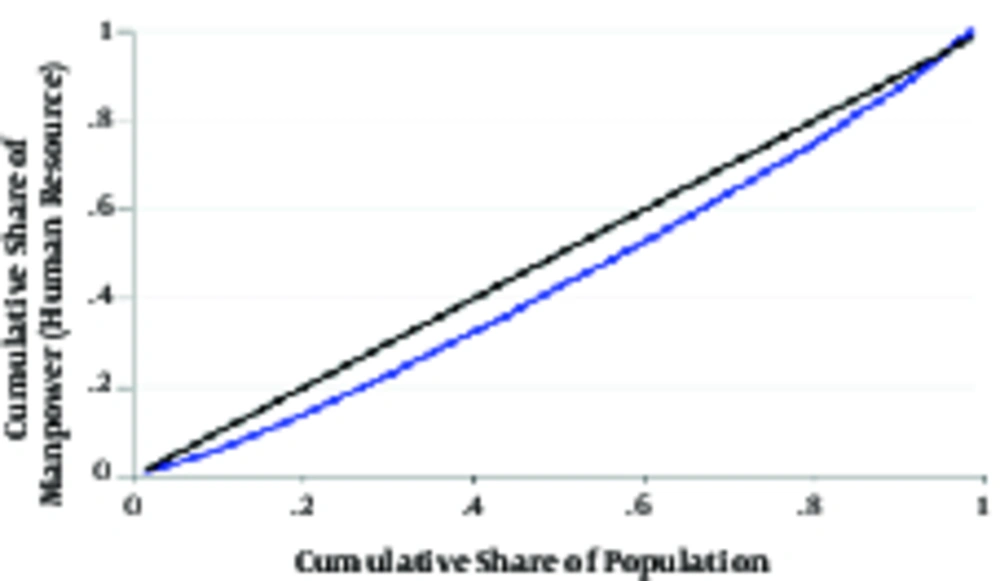
Figure 3.
Lorenz curve for manpower distribution among Iran’s provinces
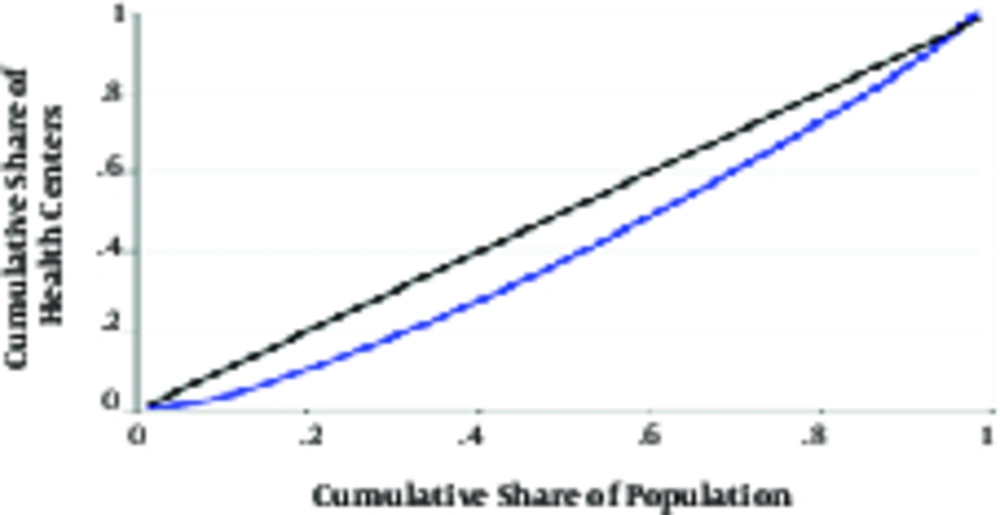
Figure 4.
Lorenz curve for health centers distribution among Iran’s provinces
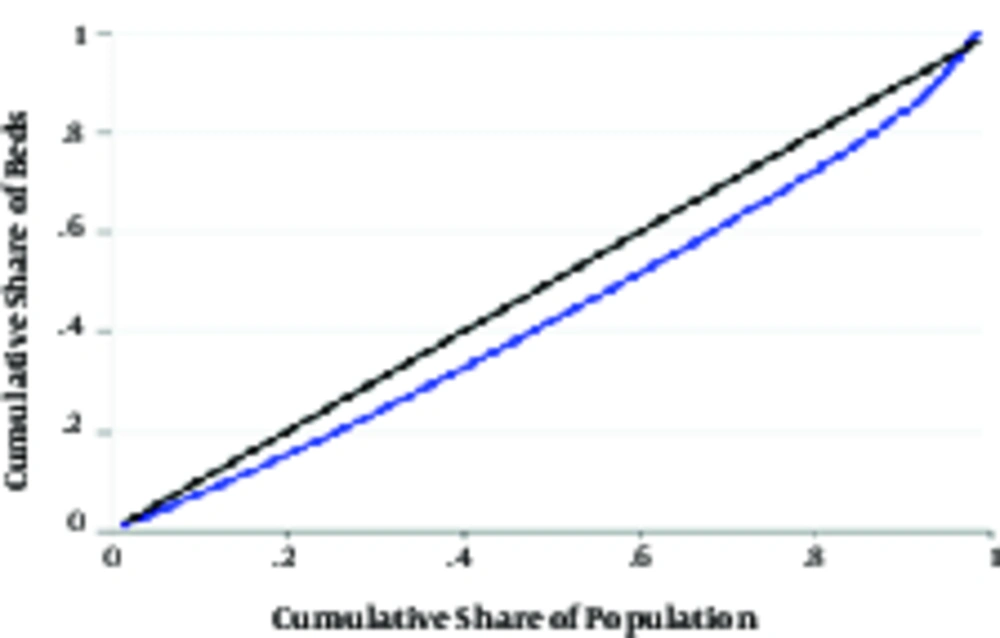
Figure 5.
Lorenz Curve for active beds distribution among Iran’s provinces
4. Discussion
Equilibrant and proper distribution of the resources in the health sector is considered as a factor promoting the health indices and more equity and social justice. In this study, having used Hoover and Gini coefficients as an image of the provincial distribution of manpower, health centers, and hospital beds in the governmental sector in Iran was presented to draw the attention of the decision makers and policy makers in the health sector to a way to distribute such resources. The study findings revealed that the manpower distribution has been relatively equal in the provinces of Iran; the manpower resources have always been an essential element in the health system and played the most important role in providing health services (18); thus, the lack of manpower may create a great obstacle against the goals of organizational development in the third millennium; it has economic, social, and direct effects on the rate of access to health services and the quality of such services (19, 20). Besides, it is necessary to have a special attention for proper distribution of specialist manpower in the hospitals and other health centers in developing countries to achieve the goals of permanent development (21). Farahani et al., (22) indicated that the resources distribution (specially manpower) has been effective on the mortality rate of children aged under 1 year in both short and long term and the effects have been more in the long term. Matsumoto et al., (23), study findings indicated that the distribution of manpower was improper in health care sector in Japan, U.S.A. and England. In addition, Zhang et al., (24), in a study in China, reported high levels of inequality in geographic distributions of health workers. Shinjo and Aramaki’s study indicated that there was a strong relationship between the ways of distributing manpower and providing services for the patients in the health sector, thus, proper distribution of manpower may create the field appropriate to provide more favorable services with high quality (25). Besides, having examined justice in the distribution of manpower in the ministry of health in 2003 - 2007, Mobaraki et al., (5), reported that manpower resources had been distributed equitably in the ministry of health; however, a part of the employment permission should be redistributed in the state universities in order to have equal distribution. Mirsaeid et al., (26), found that the hospitals of Tehran University of Medical Sciences did not have enough manpower and the distribution of manpower was not according to the directions of ministry of health in most units of the hospitals.
The present study indicated that the health centers had relatively equal distribution between Iran’s provinces. In this regard, in a research in China, it was presented that there were inequality in distributions of institutions for both the hospitals and the primary care sectors (24). Kiadaliri et al., (27), examined the geographical distribution of access to the health care in rural regions of Iran in 2006 - 2009 and indicated that there was a considerable difference between the distribution of health centers and mortality rate in the rural regions indicating the relatively low inequity. Also, Rezaei et al., (28) indicated that the distribution of the pharmacies and health centers had become more and more equity in 2001 - 2011 and was better than the distribution of other centers. Taghvaei and Zakeri showed that there were some differences concerning available hospital and clinical services between 14 districts of Esfahan city. In such a way, 20 out of 29 hospitals were located in three regions while some city districts had no hospital (29), which is one of the reasons leading to a difference between the Esfahan study and the findings of the present. Thus, in this study the indices were assessed generally in high-level Iran provinces, while the Esfahan study examined only the spatial distribution of the hospital and clinical services in a metropolis.
In addition, the results of the present study indicated that the distribution of active hospital beds in provinces was just. In this regard, the findings of a case study regarding Iran showed that the Gini and Hoover coefficients and Lorenz curve indicated that the distribution process of the hospital beds was equity (30). Zhang et al., (24), indicated that the geographical distribution of the beds in both the hospitals and the primary care sectors was unequal. In their study, Ameryoun et al., (13), assessed the geographical distribution of the beds in the ICU unit for non-cardiac patients and concluded that such distribution was equity in Iran; however, the beds/population ratio was less than other countries. Another study indicated that although there was some difference regarding the medical specialists/population and active beds/population ratios among the governmental hospitals in Iran provinces. The hospital beds have been distributed equitably in Iran governmental hospitals by virtue of Gini coefficient (31).
Finally, the resources/population ratio has been relatively equal between Iran provinces. It should be noted that after years now the resources allocation criteria, such as population and the cities’ needs play a more important role than other ones, due to the fact that a proportion of different variables under examination in the immigrant provinces is less than the others; namely Tehran and Alborz provinces were at the lowest rates regarding all the three indices (Manpower, active beds, and health and treatment centers). On the other hand, another factor may play an important role in creating such balances is an irregular increase of immigration to Tehran city and suburbs as a metropolis. Notwithstanding many physical, resources, and manpower of the health sector of Tehran province are in Tehran city, the distribution rate of the governmental services has had more disadvantages than profit for the province.
Like other studies, this study has had some limitations; for instance, the variables under the study were general and only the resources of governmental sector were taken into consideration; however, the current study may present a comprehensive view towards geographical distribution of the resources of the health sector to the policy makers in health system because most of the resources in health sector including manpower, physical resources, and hospital beds were analyzed.
The proper and fair distribution of manpower resources, health centers, and hospital beds have effective roles in distributing other healthcare services. The distribution situation of the health sector resources between Iran provinces was relatively equal. Therefore, health policy makers should be focused on the other aspects of accessibility such as distribution of resources according to health needs, resources distribution within provinces, and quality of provided services.

