
1. Background
Domestic violence against women is one of the issues that affects the lives of many women in various social classes and sectors. Although domestic violence usually occurs in the privacy of the family, it affects women’s lives in all areas (1). According to the definition of the World Health Organization, violence against women includes any violent and gender-based behavior that causes injury or is likely to cause sexual, physical, and emotional harm to women (1, 2). Such behavior may be life-threatening, can deprive women’s absolute freedom and power, and can occur privately or publicly (3, 4). Violence against women is a very global phenomenon and is viewed from a variety of social, cultural, political, demographic, and health perspectives (5). Based on previous research, almost 75% of women in the world have experienced violence at least once in their lives (6) and violence affects their physical and mental health and sometimes makes them commit suicide (7, 8). Domestic violence is the most common form of violence against women and an important public health problem that affects 5% of women (9, 10).
Although both women and men may commit violent acts in the family, research suggests that women are more likely to be mistreated (11, 12). In other words, the harassment and violence, whose aim is control and dominance, occur in 90% of cases against women, in 7% - 8% of the cases are bilateral, and in 2% - 3% of the cases are against men (13). At a large scale in the world, this problem is a serious cause of death or disability in women at childbearing age, as well as a reason for severe and untreatable diseases (14, 15). According to the World Bank report, rape and domestic violence more than diseases such as breast and uterine cancer and painful, accidental deliveries can lead to the loss of health among women between the ages of 15 and 44 (16).
On the other hand, violence against women has a negative impact on other important health priorities such as maternal health, safety, family planning, sexual transmitted diseases (STDs) acquired immune deficiency syndrome (AIDS) prevention, and mental health (11). Conditions such as pelvic pain, irritable bowel syndrome, headaches, insomnia, fatigue, depression, alcoholism, and substance abuse are the results of this problem (12). In addition, violence can be seen among pregnant women, which increases the risk of abortion, preterm delivery, low-birth weight, and stillbirth (14, 15). As a social inheritance, violence is transmitted from one generation to the next generation. In fact, it can influence children’s lives and the features of social relationships (17).
There is convincing evidence that indicates an association between lower education attainments and the increased likelihood of experiencing IPV in women (18, 19). Although domestic violence is not a new phenomenon, the investigation of various aspects affecting IPV among women is a new interest. Given the considerable number of reports of violence against women and spousal abuse, there is a need for further investigation of domestic violence.
2. Objectives
The current study was conducted to evaluate the prevalence of different types of intimate partner violence (IPV) in pregnant and non-pregnant women living in urban and rural areas, and its association with some socio-demographic variables such as spouses’ education level, age, and economic condition in the Southeast of Iran. According to similar research in the field, there are limited data regarding the prevalence of IPV among women according to residence place in the Southeast of Iran. It is expected that the residence place and demographic variables are effective on the prevalence of IPV among women. It is hoped that the results of this study can provide appropriate solutions for preventing violence against women by identifying the prevalence of violence against pregnant and non-pregnant women and its relevant causes and factors.
3. Methods
The present cross-sectional study was conducted on a sample of 800 pregnant and non-pregnant women (n = 400 pregnant women; n = 400 non-pregnant women) who referred to rural and urban health centers in Kerman, Iran, from 2015 to 2016. The criteria for inclusion in the study included pregnant women and non-pregnant women aged 15 - 49, without infertility background, having no use of sedative and antianxiety drugs, without any history of known mental illnesses and drug addiction. The sample size was determined by examining the prevalence of spouse abuse in other similar studies with P = 50% and α = 0.05%.
The individuals were selected based on convenience sampling. To this end, a list of health centers in the study area was prepared and then according to statistics, the list of the qualified population from each center was prepared. Given that the research population was distributed in four urban and eight rural health centers and the populations of both urban and rural areas were approximately the same, two urban centers and two rural centers covering more populations were selected. 800 women were participated at this study, 400 pregnant, 400 non-pregnant. Then, 400 pregnant and non-pregnant women were selected from each center according to the inclusion criteria and were placed in four groups: (1) urban pregnant women (UP), (2) rural pregnant women (RP), (3) urban non-pregnant women (UNP), and (4) rural non-pregnant women (RNP).
The data were collected through the Persian version of a standardized violence questionnaire that was validated by Behboudi Moghadam et al. (2010) and had been used in several studies. This questionnaire included 30 questions regarding various aspects of violence such as physical, psychological, and sexual violence, and physical violence resulting in injury, with 12, 8, 4, and 6 questions, respectively. Scoring was simply done such that a positive response to each question was an indicator of participant’s experience of that violence (19).
Before collecting the data, a briefing session was held with the attendance of three midwifery experts working in urban and rural health centers as interviewers to get them familiar with completing the questionnaires for research units. In order to determine inter-rater reliability, 40 women (10 from each group) who had the inclusion criteria were selected from urban and rural health centers outside the study area and interviewed by 40 interviewers. Then, they were interviewed by the researcher herself and the correlations between the two sets of responses were calculated by the Pearson correlation coefficient, which showed no significant difference in the responses [r = 0.90]. Afterward, the researchers and the interviewers referred to the selected healthcare centers, introduced themselves, tried to establish intimate communication with the respondents, and provided explanations of research goals in a relatively quiet environment. They were assured that the results would not be given to any other person or organization without their permissions and their information would be kept confidential.
3.1. Ethical Issue
The study was approved by the Ethics Committee (Ref. 9111373027-103148) and written informed consent was obtained from all the participants.
3.2. Data Analysis
After obtaining the respondents’ informed consent and completing the questionnaires by the researcher and the trained interviewers, the collected data were analyzed by SPSS 16 software. The distribution of dependent variables was assessed by the Kolmogorov-Smirnov normality test. Variables with P values of ≥ 0.05 were considered to have a normal distribution. The normal variables were analyzed by the one-way ANOVA and non-normal. The Kruskal Wallis test is non-parametric test and used for non-normal distribution. To determine Pearson correlation coefficients, Spearman’s rank correlation coefficient test was used for non-parametric variables. Differences with P values of ≤ 0.05 were considered significant. The means and standard deviations are presented.
4. Results
The overall mean age of women in urban and rural areas was 29.15 ± 5.37 and 28.25 ± 6.3 years, respectively. The age range of women was 16 to 46-years-old. Besides, the mean age of the pregnant and non-pregnant women’s partners in urban and rural areas was 32.5 ± 6.1 and 31.1 ± 3.4 years, respectively. Table 1 shows the effects of respondents’ demographic data including children number, marriage duration, parity, level of the couple’s education, and spouse’s addiction on the type of violence. The children number, marriage duration, and parity of participants did not have any significant effect on the scores of violence against women (P = 0.75, 0.16, and 0.7, respectively). Additionally, the spouse’s age and addiction did not have any significant effect on violence scoring (Table 1).
Table 1.
Effects of Some Demographic Parameters on Violence Scoresa
| Variables | Number | Violence Scores | SD | P Values |
|---|---|---|---|---|
| Children number | 0.75 | |||
| 0 - 1 | 155 | 144.06 | 3.21 | |
| 2 - 3 | 133 | 145.01 | 2.4 | |
| Marriage duration | 0.114 | |||
| < 5 | 18 | 123 | 4.1 | |
| 5 - 10 | 105 | 132.24 | 4.4 | |
| 10 - 15 | 92 | 153.99 | 2.3 | |
| 15 - 20 | 73 | 155.47 | 3.2 | |
| Parity | 0.858 | |||
| 0 - 1 | 110 | 141.18 | 2.5 | |
| 2 - 3 | 159 | 146.23 | 1.9 | |
| 4 - 5 | 19 | 149.24 | 2.8 | |
| Spouse age | 0.22 | |||
| 20 - 30 | 123B | 153.21 | 4.8 | |
| 30 - 40 | 120A | 134.79 | 5.2 | |
| 40 - 50 | 45C | 146.6 | 3.9 | |
| Spouse addiction | 0.589 | |||
| Addicted | 204A | 146.2 | 2.7 | |
| Non-addicted | 84B | 140.37 | 3.1 |
aDifferent superscripts (A, B, C) indicate significant differences between the groups (P < 0.05).
According to Table 2, there were positive significant correlations between the spouse’s education level and physical violence (P = 0.003) and sexual violence (P = 0.005) and injury caused by violence (P = 0.041). however, there was no significant correlation between the spouse’s economic level and various types of violence.
Table 2.
The Correlation Coefficient Between Spouses’ Demographic Parameters and Various Types of Violencea
| Variables | Physical Violence | Psychological Violence | Sexual Violence | Violence-Induced Injury |
|---|---|---|---|---|
| Spouse’ education level | r = 0.104** | r = 0.038 | r = 0.1** | r = 0.72* |
| Family income level | r = - 0.03 | r = - 0.062 | r = 0.023 | r = - 0.063 |
aSignificant correlations between variables were indicated by **P ≤ 0.01 and *P ≤ 0.05.
Table 3 presents the effects of residence place (urban vs. rural) on the occurrence of different types of violence. The residence place had no significant effect (P = 0.69) on the occurrence of physical violence. There were significant differences in experienced psychological violence, sexual violence, violence-induced injury, and overall violence between rural and urban women. However, rural women experienced significantly more psychological violence, sexual violence, and violence-induced injury than urban women (P = 0). Generally, the overall violence was significantly higher in rural women than in urban women (P < 0.05).
Table 3.
| Variables | Frequency, No. (%) | Score | P Values | |
|---|---|---|---|---|
| Mean | SD | |||
| Physical violence | ||||
| Rural | 335 (41.87) | 1.33 | 0.011 | 0.60 |
| Urban | 308 (38.5) | 1.32 | ||
| Psychological violence | ||||
| Rural | 304 (38) | 1.42A | 0.27 | 0.0 |
| Urban | 293 (36.5) | 1.156B | ||
| Sexual violence | ||||
| Rural | 270 (33.7) | 1.34A | 0.13 | 0.0 |
| Urban | 282 (35.25) | 1.2B | ||
| Violence induced-injury | ||||
| Rural | 389 (48.6) | 1.4A | 0.28 | 0.0 |
| Urban | 309 (38.6) | 1.12B | ||
| Overall violence | ||||
| Rural | 324.5 (40.56) | 1.37A | 0.19 | < 0.05 |
| Urban | 298 (37.25) | 1.2B | ||
aDifferent superscripts (A, B) represent significant differences between the two groups.
bScores: 1, no violence experience; 2, a violence experience.
According to Table 4, various types of violence against women were significantly affected by pregnancy condition and residence place. The highest physical, psychological, and sexual violence and injury caused by violence were observed in rural non-pregnant women (P < 0.01). In general, the various types of violence were more common in rural and non-pregnant women.
Table 4.
The Effect of Residence Place (Urban vs. Rural) and Pregnancy Status (Pregnant vs. Non-Pregnant) on Various Types of Violence Against Womena
| Violence | Group | P Valueb | |||
|---|---|---|---|---|---|
| RNP | UNP | RP | UP | ||
| Physical violence | 3.4 ± 1.45A | 3.27 ± 1.8AB | 2.9 ± 1/3B | 2.6 ± 1.7C | < 0.01 |
| Psychological violence | 3.1 ± 1.7A | 2.9 ± 1.3A | 2.1 ± 0.9B | 1.7 ± 0.8B | < 0.01 |
| Sexual violence | 2.1 ± 0.56A | 1.78 ± 0.9B | 1.16 ± 1.1D | 1.66 ± 1.7C | < 0.01 |
| Injury caused by violence | 1.2 ± 0.9A | 0.97 ± 0.8A | 0.6 ± 0.16B | 0.3 ± 0.12C | < 0.01 |
| Overall violence | 9.8 ± 4.61A | 8.92 ± 4.8AB | 6.76 ± 3.46B | 6.26 ± 4.56B | < 0.05 |
Abbreviations: RNP, rural non-pregnant women; RP, rural pregnant women; UNP, urban non-pregnant women; UP, urban pregnant women.
aDifferent superscripts (A, B, C, D) indicate significant differences between the groups
bP values of ≤ 0.05 were considered significant.
According to Figure 1, the violence scores were significantly higher (P < 0.05) in rural women who their spouses were aged between 40 - 50 years than their counterpart urban women.
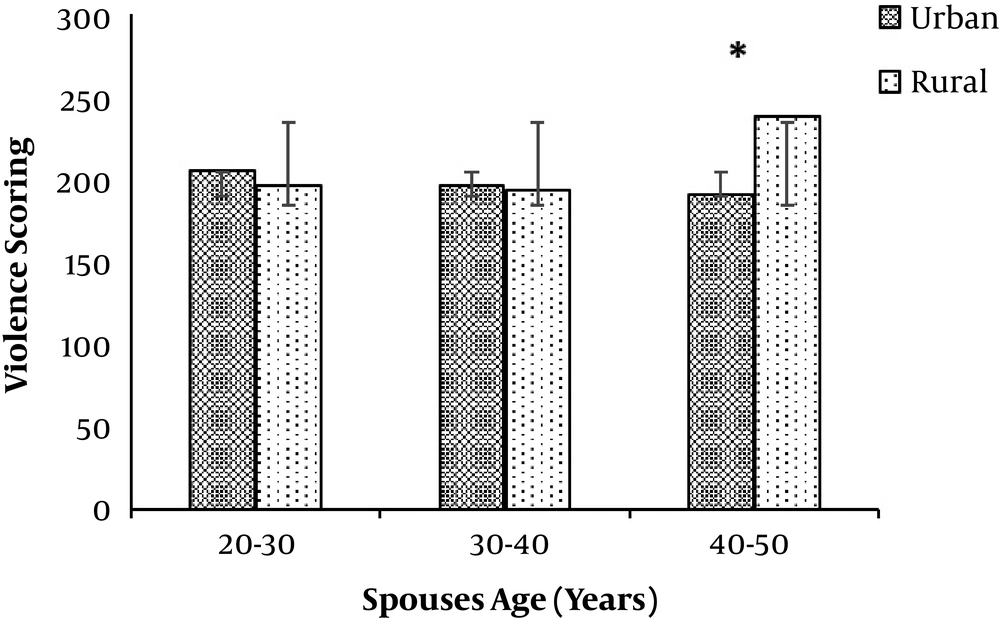
Figure 1.
Means and standard deviations of violence scores against rural and urban women based on their spouses’ age. *Represents significant differences (at P ≤ 0.05) between the three categories of age by Two-way ANOVA.
5. Discussion
This study was conducted to evaluate the prevalence of different types of intimate partner violence (IPV) in pregnant and non-pregnant women living in urban and rural areas, and its association with some socio-demographic variables such as spouse’s education level, age, and economic condition in the Southeast of Iran.
According to Iranian culture and the importance of household affairs privacy, it is estimated that more than half of families are engaged in violence against women (20). In the present study, positive significant correlations were observed between the spouse’s education level and physical violence, sexual violence, and injury caused by violence. In fact, violence was more experienced by women whose husbands had lower education levels. Our result is in agreement with the findings of Ghazizadeh (21) and Balali Meybodi and Hassani (22) who found that higher education level was associated with less violence in many third world countries. Moreover, it is reported that higher education levels of spouses might decrease severe violence (23). The education level of a couple is an interaction factor for IPV and the gap in the education level of the wife and the husband could affect the IPV. Therefore, it would be better if we evaluated the educational gap in couples. It is plausible that the higher education level can raise the awareness of partners of life skills, violence, and behavior management when confronting daily stressors (22). Moreover, men with higher education levels may provide better economic status for their family and it may be another reason for less IPV (24).
However, we did not find any significant correlation between the family’s economic level and experienced violence by women. It was reported that family financial level negatively affected IPV and unemployment was positively associated with IPV. Men’s dissatisfaction with low and unstable economic situations can cause mental pressures or stress for men and thus affect IPV (24-26).
In this study, we observed a significant difference in sexual, psychological, and injury-induced by violence between rural and urban women. All the aforementioned parameters had higher scores in rural women. These results indicate residence place may be a risk factor for IPV. Similarly, Aghakhani et al. (27), Bueno and Lopes (28), and Peek-Asa et al. (29) reported rural women experienced higher rates of IPV than urban peers. Rural women usually have not efficient awareness of their rights and where should they report their issues. In fact, poor cultural standards, low education level, financial dependence, unawareness of women’s rights due to lack of education, and inefficient life skills can cause to raise IVP against rural women. On the one hand, the urban area provides women with higher opportunities to efficiently cope with violence by tolerance, availability of economic resources, and institutional support (30).
Furthermore, we observed that rural non-pregnant women experienced the most IPV among other groups of women in this study. In fact, a pregnancy status could cause a reduction in violence occurrence. These findings are consistent with previous studies (30-32) who concluded that the prevalence of IPV was lower during pregnancy than the year before pregnancy. It is suggested that pregnancy is a protective period, especially when spouses are aware of the wife’s pregnancy; in fact, husbands control their violence to prevent any possible injury to the fetus (17). However, violence sometimes is intensified or begins during the pregnancy period if the partner doubts about the baby (33). Therefore, a comprehensive program for the prevention of violence against women and screening of violence in all health centers in the south of Iran are proposed.
Interestingly, the violence score was significantly higher in rural women whose spouses were 40 - 50-years-old than their counterpart urban women. This finding was not reported in similar previous studies, according to older ideologies, it beliefs the male sexual entitlement is more periority than women s intitlement and should be only granted to women few options to refuse sexual advances. Physical abuse probably increases when women refuse to participate in sexual intercourses (34).
5.1. Conclusions
According to the importance of women’s education level in the awareness of their rights, it would be better if information regarding women’s education was collected and evaluated. Moreover, there was no information regarding women’s and partners’ age at the time of marriage. Taken together, rural women experienced greater violence, especially if they were not pregnant. We suggest pregnancy is a protective period that reduces the prevalence of violence. Spouses’ education level is a risk factor for committed violence. Therefore, a comprehensive program for the prevention of violence against women and screening of violence in all health centers in the south of Iran are recommended.