Fulltext
This part is available in the PDF file.
Image Credit:Shiraz E-Med J
Authors
Background: one of the most important neonatal morbidity during labor is Perinatal asphyxia. Hypoxia causes release troponin from cardiac muscles. Fetal distress during labor may be detected by monitoring the fetal heart rate. Elevated levels of troponin T in cord blood may be associated with intrauterine hypoxia
Aim: Relations between umbilical troponin T levels and fetal distress
Method: Cord blood samples were collected from 80 neonates and analyzed. Data on birth weight, sex, APGAR scores, and mode of delivery were recorded
Results: a total of 80 samples were collected, 40 samples from infants with fetal distress and 40 samples from infants without fetal distress. The gestational age of these infants ranged from 38 to 40 weeks and birth weight ranged from 2.5 to 4 kg. There was no relation between umbilical troponin T levels and mode of delivery. Fetuses with distress had significantly higher cord troponin T levels than control group (26/42 versus 50/46 μg /ml respectively; p < 0.01)
Conclusions: Troponin T levels in the cord blood are unaffected by mode of delivery. Infants with distress had significantly higher cord cardiac troponin T levels, suggesting that troponin T may be a useful marker for early detection of hypoxia in neonates
© 2012, Author(s). This open-access article is available under the Creative Commons Attribution 4.0 (CC BY 4.0) International License (https://creativecommons.org/licenses/by/4.0/), which allows for unrestricted use, distribution, and reproduction in any medium, provided that the original work is properly cited.
Rafati S, Rabi M, Borna H. Cardiac Troponin T Levels of Umbilical Cord in Neonates with Abnormal Fetal Heart Rate. Inn J Pediatr. 2013;23(1):. doi:
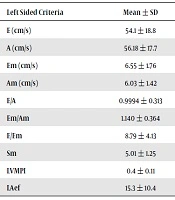
Tanasan A, Eghbalian F, Sabzehei MK, Rastgoo Haghi A. The Relationship Between Serum Levels of Troponin I and Myocardial Function in Neonates Under Mechanical Ventilation. Inn J Pediatr. 2019;30(1):e93846. doi: https://doi.org/10.5812/ijp.93846
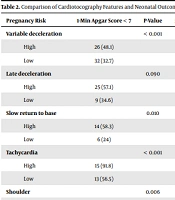
Shirazi M, Sahebdel B, Golshahi F, Ghaemi M. Need for Further Medical Attention to Nonreassuring Cardiotocography Near Delivery in High-Risk Pregnancies. Fertil Gynecol Androl. 2021;1(1):e122521. doi: https://doi.org/10.5812/fga.122521
Mostafa-Gharehbaghi M, Davari Farid S, Najati N, Ghorbani Haghjo A, Ghojazadeh M. Resistin in Cord Blood of Small for Gestation Age and Appropriate for Gestation Age Term Neonates. Inn J Pediatr. 2013;23(6):. doi:

Pourarian S, Fotouhikia S, Saki F. Association of Cord Blood Resistin with Neonatal Birth Weight and Gestational Age. J Compr Ped. 2018;9(4):e67091. doi: https://doi.org/10.5812/compreped.67091
Last Update: 3 weeks ago
Last Update: 3 weeks ago
Last Update: 3 weeks ago
Last Update: 5 days ago
Last Update: 1 day ago
Last Update: 4 days ago