
1. Introduction
Foreign accent syndrome is a rare motor speech disorder in which a person speaks with a dialect different from that of his accent (1, 2). In some studies, the syndrome has been reported in 62% of female patients with brain damage and 38% of male patients (3). This syndrome is due to trauma or stroke that impairs a person’s speech output (4). This disorder often involves different brain structures in the left hemisphere, especially areas associated with speech (5, 6). The most commonly encountered areas are the prerolandic motor cortex (BA 4), the frontal motor (motor association cortex (BA 6 or 44), and striatum (usually with Broca's aphasia) (2). Among important features of foreign accent syndrome, we can refer to the involvement of prosodic and segmental units, such as pitch, inflection, and stress (2, 5). In a study, the spoken areas involved in a person with foreign accent syndrome after the stroke were examined. The purpose of this study was to investigate the phonetic characteristics, acoustic parameters such as voicing and place, and the manner of articulation. This study indicated that defects of foreign accent syndrome were different from Broca aphasia in terms of symptoms (2). In another study, a 51-year-old man was studied after head and neck trauma by comparing linguistic, phonetic, and speech acoustic features before and after stroke. It was assumed that the subject with the foreign accent syndrome had an injury in the subcortical region. This patient had a language impairment without emotional and prosodic damage (7). In another report, an individual with a foreign accent syndrome with left parieto-frontal stroke was followed up for three years. It was found in this study that the foreign accent syndrome was caused by functional damage between supra speech and infratentorial centers during speech disorder planning (8). Acoustic analysis was performed in another case study from an English-speaking female with Scottish English accent after the right hemisphere stroke. Prosodic and segmental units were discussed in this post-stroke study. Based on the results, the prosodic properties are unusually less than the phonetic segmental features in the person’s speech after the stroke (5). In another case study, a 75-year-old man was examined after a brain injury with foreign accent syndrome. The results of the study consistent with other studies in this area indicated variations in vowel duration, formants, frequencies, and prosodic features. The study does not support the notion that foreign accent syndrome is an apraxia disorder. Rather, it indicated that this syndrome is just a prosodic defect (4).
Regarding the limited studies in the field of speech damage in foreign accent syndrome in Iran and the rareness of this syndrome, and the uncertainty about the exact symptoms of this syndrome, the present study is important in carrying out a case report of a person with foreign accent syndrome.
2. Case Presentation
The patient under study was a 47-year-old woman with a Turkish mother tongue, right-handed and without any motor disorders such as weakness, imbalance, paresis, and paralysis. The patient had light skin and hair with an accent that appeared to be of European descent. She had a Turkish-Persian accent. She was also sometimes using English words in his speech. So that after referring to speech therapy, it was first thought that the patient was a foreign language speaker. She went to the speech therapy clinic five months after the surgery, due to the removal of the brain tumor, only with speech problems. Her speech problems arose after frequent seizures caused by brain tumors. According to what the patient said during the interview, she was in convulsions in November 2015 and was subsequently fainted. She had a speech impairment after recovery. She also had problems with word finding, and instead of Persian words, their English equivalent was aroused for the person (before the seizure, he was fluent in four languages: Persian, Turkish, English, and Arabic). After repeated seizures, it was diagnosed with radiographic experiments that there was a tumor in the left parietal part of the brain. According to the doctor’s diagnosis, this lesion was the cause of seizure. According to medical advice, removal of the tumor through surgery became necessary. After the conducted surgery, the most important speech complication was the problem of word-finding. But this problem was resolved over time. The only problems remaining in the patient during the referral to speech therapy were the problems of the prosodic unit. At the history-making meeting, he stated that after the damage to all the four languages they understood all four languages (Persian, Turkish, English, and Arabic), but they were only able to speak Persian and sometimes some English words. In fact, the expressive language skills of other languages were lost. Speech and language pathologists suspected the existence of this syndrome with regard to the diagnostic criteria in foreign accent syndrome, including the accent change of the person into a foreign accent according to his relatives (while before the injury he did not have a foreign accent), as well as the association of this damage with central nervous system (1). Eventually, a survey was conducted by the consultation of a group of speech and language pathologists, as well as neurologists, about the affliction of this person, to a kind of syndrome. Finally, they found that he has foreign accent syndrome.
2.1. Medical Reports Based on MRI
Despite the abnormalities in the left-back parietal lobe, the ventricular system and the cerebrospinal fluid were normal. Non-pressure and any displacement between the hemispheres of the brain were reported. Posterior fossa, pons, brachium cerebelli were also normal. Normal anatomy was observed in parts such as sella, posterior regions, pituitary gland. There were no abnormalities in the upper cervical cord, bulb, and medulla oblongata.
2.2. Assessments Performed
2.2.1. Linguistic Assessment
A narrative speech from the patient was recorded using the Sony recorder, LCD560F. For assessment the language, the Persian aphasia test Dr. Nilipour was used (9). The patient under study scored a complete score in the rest of the comprehension and expression skills except for naming skills.
2.2.2. Oral Motor Assessment
According to oral assessment in this test, the person had no problems with oral movements (9).
2.2.3. Acoustic Findings
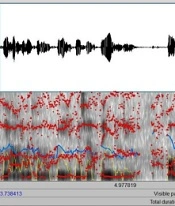
Acoustic analysis was performed using Praat software version 6.0.35, based on the sound sample taken from the patient. Comparing the spectrogram of the patient and the healthy person, it was observed that changes in pitch, the intensity of sound, exacerbating the sound, and basal frequency fluctuations were completely different in subjects. For example, timely pauses are used in the speech of normal people. There were also no long pauses between the words of a sentence (10, 11). But in the speech of the person under study, there was a long pause between words like [to and the Pulɑnd]. Also, the patient’s statements were accompanied by more emotions, and this condition had made pitch fluctuations to be severe in the patient. As seen in Ferment 2 (Turquoise Blue), in the sentence [ǰɑvâbe in či Šod?] It can be observed that this formulation has very high basic frequency fluctuations. But these fluctuations are more uniform in a healthy person, that is, the pitch changes are not severe, and the sentences are more consistent. Prosodic texture is also more uniform. In addition, the intensity of the sound in a healthy person is more than the patient. It is observed in formations 3.4 and 5 that the sound resonance in the patient was not well-formed, which indicates that there was no proper resonance. Therefore, as seen in the comparisons, the number of words expressed per minute by the patient is much less than that of the healthy person, while in a healthy person, the number of words per minute is more and is done faster (Figure 1). Therefore, these cases indicate that the duration of words is longer in the patient and that the coordination of production was less accurate, maybe that is why the sound of the patient could be heard as a foreign accent. In general, a person with a severe dislocation in the prosodic items of the language includes unnecessary stress, more duration, and unnecessary pauses (Figure 2).

Figure 1.
Healthy person’s spectrogram is shown

Figure 2.
The patient’s spectrogram is shown
2.3. Treatment
An important part of the treatment process was allocated to word finding. The main goal was to correct the patient’s speech errors. Therefore, at first, treatment was started with saying the patient’s words to correct the existing errors. During the word-finding treatment, naming was used in the things in the vision. In this way, visual stimuli, as well as phonological and semantic cues, were used to facilitate word retrieval. Self-learning principles were also used during treatment with the person mentioned (12). In addition, in the therapeutic areas associated with the damage to prosodic units, remarkable changes in pitch and reduction in duration occurred through visual feedbacks using the Praat software and auditory feedbacks by recording his voice and announcing him. Imitation was also used for the correct use of stresses and pauses. The treatment sessions at Rofeideh Rehabilitation Hospital were conducted in a fully acoustic room. Each treatment session was about half an hour (30 minutes). The treatment session process was recorded and broadcast to the patient for feedback on how she spoke. The patient was then asked to listen to it at home. The length of the patient’s treatment lasted 12 weeks, which led to significant changes in the prosodic units. Based on the re-evaluation with the Praat software program, the findings of the treatment were reported. Many amendments were made to reduce the number of pauses, decrease duration, change the pitch, increase coordination and accuracy in production, as well as increase the expression of the number of words in the interval in the patient’s speech.
3. Discussion
According to previous similar studies, the results of acoustic analysis in a study of a woman with foreign accent syndrome indicated that the prominent aspects of speech include excessive tongue retardation in vowel production, weak acoustic and co-articulation variability in the person with syndrome. Moreover, formant frequencies of vowels were higher than that of their peers in natural conditions (3). Although there were different symptoms in the foreign accent syndrome, also the disagreement in the diagnosis of the underlying mechanism of the syndrome was found in this study, what was consistent with the results of a number of studies of foreign accent syndrome, was the damage to the prosodic units in the patient’s speech (3, 4, 6). Some of the factors associated with the damage to prosodic units are inappropriate stress and uniform rhythm (12), increased pitch in the ending position of the clause (13), and inappropriate pauses (6). Regarding what was observed in the spectrogram of the patient with foreign accent syndrome, as in the Graff-Radford study, the person has a slow speech rate (14). Considering that in 68% of cases, this syndrome is associated with aphasic, apraxic, and dysarthria defects, it is thought that researchers consider foreign accent syndrome as a type of speech impairment in apraxia or aphasia (3, 15). But there is still a disagreement about whether the foreign accent syndrome is considered a separate disorder or is part of apraxia, aphasia, or dysarthria disorders (16). Considering that no changes occur in the linguistic characteristics of a person with foreign accent syndrome, unlike aphasia and apraxis or dysarthria, the foreign accent syndrome may be considered a separate and distinct disorder (17). As stated, there is no linguistic change in the individual being studied, and the only basic and significant problem is the changes in the prosodic units of speech. On the other hand, in some studies, this syndrome is considered apart from apraxia and as a prosodic disorder (3). In fact, the general conclusion of the present study during the 12-week treatment period included: Fundamental changes in prosodic units such as stress reduction, change in tone and rhythm of speech, coordination of speech speed with timely pauses during speech, and increasing patient speech intelligibility. Although the study of a rare disorder in the field of speech and language disorders and the achievements of its findings are important and considered a strength, this study was limited in terms of short treatment period and sometimes the patient’s absence at the appointed time and intervals. For this reason, it is suggested that still a need for more studies to examine the foreign accent syndrome as a separate disorder.