
1. Background
The concentration of high-density lipoprotein (HDL) is inversely associated with the occurrence of coronary heart disease (CHD) (1). This anti-atherogenic property of HDL is mainly due to its role in reverse cholesterol transport (RCT), by which extra cholesterol from the peripheral tissues, including arteries, is delivered to the liver for removal in the bile. The first step in RCT is thought to be the transfer of cholesterol from cell membranes to apoA-I and HDL (2, 3).
Cholesterol-efflux mediated by HDL is the rate-limiting step of RCT and occurs via different pathways. The first is aqueous diffusion and the second involves scavenger receptor (SR-BI)-mediated two-way free cholesterol exchanges that depend on the cholesterol amount. The third involves the ABCA1 and ABCG1, which mediates cholesterol-efflux in a unidirectional manner to lipid-poor Apo A-I and to other subfamily members of HDL, respectively (4). It has been demonstrated that cellular lipid efflux is affected in the presence of HDL and Apo A-I (5). It is proposed that the ABCA1 protein primarily transports phospholipids to apoA1 and the lipidated Apo A-I subsequently drives cholesterol efflux to produce mature HDL-c particles and protects against atherosclerosis (6). ABCs is a multi-span transmembrane molecule with a high expression in the liver, small intestine, placenta, leukocytes, and macrophages among other tissues (7, 8).
Furthermore, it is believed that ABCA1 plays a key role in protecting atherosclerosis and it is affected by cholesterol influx, high fat diet, plasma glucose concentrations, and physical activity (9).
Exercise-induced gene regulation in tissues and cells, particularly lymphocytes, has a critical role in keeping body homeostasis (10, 11). Studies reported that exercise training significantly altered the expression of hundreds of genes such as pro-inflammatory and anti-inflammatory ones and the genes known to be associated with other key physiological functions (12).
A few researchers published articles regarding the effects of physical exercise on white blood cells. Hoang et al. measured the ABCA1 expression in human skeletal muscle biopsies and assessed leukocytes after physical activity. The main results of the study were that leukocyte ABCA1 expression was related directly to the frequency of the activity (9).
In addition, Ghorbanian et al. showed that Rope training could increase ABCA1 gene expression in lymphocytes in students (13). Ghanbari-Niaki et al. reported that circuit resistance exercise with moderate intensities provided bigger increases in blood mononuclear cells ABCA1 expression and not in plasma HDL-C levels (14).
We reported in our recent studies that wrestling technique-based circuit training protocol, combined with the wrestling program, was able to increase lymphocyte ABCA1 expression and also subjects showed higher plasma HDL-C and lower LDL-C concentrations (15, 16).
Considering the information previously discussed, the science of exercise-induced ABCA1expression is poorly defined in target groups, especially in CHD patients.
Cardiac rehabilitation is a medically supervised program for people who have had a heart attack, heart failure, heart valve surgery, coronary artery bypass grafting, or percutaneous coronary intervention (17). Recent studies claimed participation in cardiac rehabilitation programs is a valuable stage of a multidisciplinary treatment strategy after the diagnosis of acute myocardial infarction and coronary artery bypass graft surgery (18).
Recent studies showed that CR induces positive results in reducing mortality and morbidity rates (19, 20) and risk factors for heart disease (21, 22), and improves health-related quality of life (23). Unfortunately, even with the apparent increasing need, the CR remains under-used in the eligible patients (21).
The purpose of the present study was to evaluate the effect of two months of CR on ABCA1 expression and other RCT indicators in patients treated with a coronary artery bypass graft operation.
2. Methods
2.1. Participants and Study Design
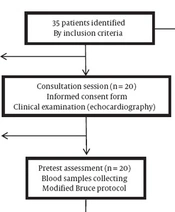
This study was approved by the hospital's ethical committee. Informed consent was obtained from all of the participants after their respective physicians gave assent. The study was designed as a non-randomized trial (quasi-experiment). The selected patients who were assigned to the CR group (n = 12) were introduced to the cardiac rehabilitation program at the Javad Al-Aeme heart and vascular hospital in Mashhad, Iran. The patients who could not come to our rehabilitation office mainly because their place of residence was too far from our institution and/or they could not be trained after discharge were assigned to the control group (n = 12). They were asked to keep a sedentary lifestyle at home after their coronary artery bypass graft operation.
The exclusion criteria were patients with congestive heart failure, permanent pacemaker/defibrillator placement, valvular disease, history of a hernia or an aneurysm, unstable angina Pectoris, and physical disability that would limit treadmill exercise.
2.2. Rehabilitation Program
The multi-disciplinary circuit rehabilitation program started four weeks after the operation for a total duration of two months. Each week, three one-hour aerobic exercise-training sessions (treadmill, cycling, and arm cranking) were held. A physician was present during each workout session.
The Borg rating of perceived exertion scale was explained to the study participants (24), and the CR group was asked to keep their perceived exertion between 11 (fairly light) and 13 (somewhat hard) and the specialist set the device based on the reported exertion.
However, all the participants cooled down before the beginning of the next exercise. Peak electrocardiogram, HR, and blood pressure were recorded during the training. Perceived exertion rating of all parameters was assessed after 5 minutes of treadmill walking and the peak values were recorded.
Each session included a 5-minute warm-up, 15 minutes of fast treadmill walk, 10 minutes of ergometer bicycle, 10 minutes of cranking, and 5 minutes of cool-down, in sequence. The subjects rested passively for 3 minutes before going to the next device. For cardiac monitoring, ECG lead was recorded for each participant.
2.2.1. Nutrition and Medication Control
Since nutrition may affect research markers, in order to control the nutrition of the subject, they were asked to contribute to the recommendations of the Javad Al-Aeme Hospital in the form of brochures provided to the patients. Moreover, because the dosage and type of medications used by the patients were different, matching for the researcher was not feasible and this is one of the limitations of this research.
2.2.2. Blood Sampling/Lymphocyte Isolation
48 hours before and after starting the program, 10 cc of blood was taken from their brachial vein while all subjects were fast under the same condition. Blood samples were collected in EDTA tubes. Blood lymphocytes were isolated by density gradient centrifugation at 900 g according to the manufacturer's instructions (Cedarlane Laboratories Limited, Burlington, ON, Canada) and the pellet containing lymphocytes were used for further analysis (15).
2.2.3. PCR Procedure
Blood lymphocytes were powdered with cold mortar and pestle and used for RNA isolation. Total RNA was extracted by the guanidine thiocyanate method (25). mRNA was purified using an mRNA isolation kit (Roche, Germany) according to the manufacturer's instructions. 200 nanograms of mRNA were used to synthesize first strand cDNA in a 20/dL volume using oligo (dT) primer in the first-strand synthesis kit (Fermentase, Germany). Primer sequences are shown in Table 1. qRT-PCR was conducted to calculate the expression of target gene ABCA1 using RotoroGen 6000 system (QiaGen, USA). Real-time PCR was carried out using a Taqman probe. The profile of the amplification reaction was as follows: 5 minutes of initial denaturation at 95 degrees following 40 cycles of denaturation, annealing, and extension for 20 seconds for each step. A device configured to read the fluorescence emission at the extension step. The relative fold change of gene expression was calculated using the Pfaffl method (26). PCR reactions were carried out in triplicate in a final volume of 20 μL. The level of ABCA1 mRNA expression was normalized with GAPDH gene using the ΔΔct method.
Table 1.
Primer Sequences Used in This Study
| Primer Sequences | |
|---|---|
| Hum-GAPDH-F | 5'-GGAAGGTGAAGGTCGGAGTC-3' |
| Hum-GAPDH-R | 5'-CGTTCTCAGCCTTGACGGT-3' |
| Hum-ABCA1-F | 5'-CAAGGGGTAGGAGAAAGAGACGC-3' |
| Hum-ABCA1-R | 5'-CTCAGCCAGCACCCCCAG-3' |
| Hum-GAPDH-Probe | 5'-TTTGGTCGTATTGGGCGCCTG-3' |
| Hum-ABCA1-Probe | 5'-CCAGCCACGGCGTCCCTGCTGT-3' |
2.3. Data Analysis
Kolmogorov-Smirnov test was used to assure data normality. Chi-squared test was used to analyze qualitative data. Paired sample t-test was used to measure within-group changes and Independent t-test to measure between-group mean differences. Statistical calculations were done by SPSS software, Ver.16.
3. Results
3.1. Subject Characteristics
Table 2 describes the clinical characteristics of the patients at baseline. Except for weight, there was no significant difference in the distribution of other anthropometric variables between the CR and Control groups.
Table 2.
Patients' Clinical Characteristics at Baselinea
| Control (N = 12) | CR (N = 12) | |
|---|---|---|
| Age (years) | 52.83 ± 1.33 | 54.66 ± 1.30* |
| Sex | ||
| Male | 12 | 12 |
| Female | 0 | 0 |
| BMI, kg/m2 | 24.44 ± 1.1 | 26.03 ± 0.9* |
| Smoking | ||
| Smoker | 0 | 1 |
| Non-smoker | 8 | 6 |
| Prior smoker | 4 | 5 |
| Hypertension | 9 | 7 |
| Prior MI | 2 | 4 |
Abbreviation: MI, myocardial infarction.
a Values are mean ± SEM. Baseline means differences between groups showed by * (P ≤ 0.05).
3.2. ABCA1 and Reverse Cholesterol Transport
q-RT PCR data show that ABCA1 gene expression in lymphocytes elevated in the CR group following two months of the rehabilitation program (P = 0.0002). However, it remained unchanged in the CON group (Figure 1). Plasma HDL-C concentration was also higher in the CR group following the program (P = 0.034). Nevertheless, in the CR group, there was no significant change in plasma LDL-C and triglyceride compared to the control group (P = 0.191 and P = 0.213, respectively). The results are demonstrated in Table 3.
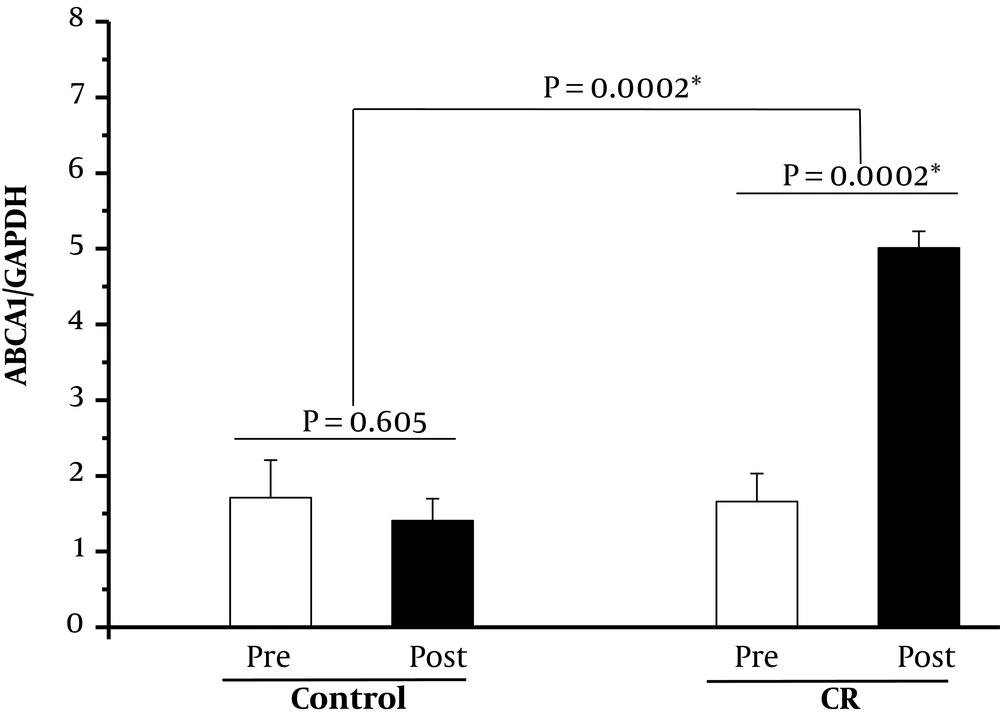
Figure 1.
Changes in the ABCA1/GAPDH ratio in CR and CON groups
Table 3.
RCT Indices Following Two Months of the Study Protocol
| Control | CR | Independent t-Test | |||||
|---|---|---|---|---|---|---|---|
| Pre Test | Post Test | Paired Sample t-Test | Pre Test | Post Test | Paired Sample t-Test | ||
| ABCA1/GAPDH | 1.71 ± 0.50 | 1.41 ± 0.29 | t = 0.541, P = 0.605 | 1.66 ± 0.37 | 5.01 ± 0.22 | t = -3.67, P = 0.0002 | t = -3.82, P = 0.0002 |
| HDL-c (mg/dL) | 45.75 ± 1.76 | 43.87 ± 1.41 | t = 1.12, P = 0.300 | 43.37 ± 1.63 | 46.37 ± 1.91 | t = -2.44, P = 0.044 | t = -3.04, P = 0.034 |
| LDL-c (mg/dL) | 61.75 ± 2.80 | 63.77 ± 4.66 | t = -0.824, P = 0.437 | 58.25 ± 2.92 | 53.62 ± 2.11 | t = 1.701, P = 0.133 | t = 1.87, P = 0.191 |
| TG (mg/dL) | 98.13 ± 11.23 | 102 ± 10.10 | t = -1.755, P = 0.274 | 92.88 ± 12.32 | 84.91 ± 13.33 | t = 1.412, P = 0.193 | t = 1.54, P = 0.213 |
4. Discussion
Cardiovascular events (atherosclerosis, acute myocardial infarction, and death) may occur after CABG. However, with respect to the total cardiovascular event rate, the benefit of physical activity seems to be greater in CABG patients as compared to any other cardiovascular disease (CVD) (27).
The results of this study supported the findings of previous research regarding the effects of training on the RCT procedure (9, 13-16).
Previous research showed that ABCA1 expression related directly to the frequency of the activity (9). Moreover, the recent studies showed that Rope training (13) and circuit resistance exercise (14-16) could increase ABCA1 gene expression in healthy subjects.
To our knowledge, this is the first study to document the effects of a cardiac rehabilitation program on RCT parameters in CABG patients. However, the present study focused on cardiac high-risk individuals and filled a research gap.
Our results demonstrated that a long-term cardiac rehabilitation and exercise-training program led to elevated ABCA1 gene expression in lymphocytes. As previously mentioned, it is a key element for HDL maturation in the RCT procedure. It is clearly showed that high levels of HDL prevent cardiovascular diseases such as atherosclerosis (12).
A two-month cardiac rehabilitation and exercise training program appears to provide cardiovascular protective effects through multiple mechanisms.
It has been shown that peroxisome proliferator-activated receptors (PPARs) is a key mediator for fatty acids regulation and it is also clearly defined that PPAR is a nuclear receptor such as liver X receptor (LXR) and retinoid X receptor (RXR) that regulates the expression of lipid-controlling genes (28).
Fatone et al. showed that short-term aerobic and resistance circuit training resulted in an increase in PPAR (28).
It has been suggested that ligand activation of PPAR triggered up-regulation of ABCA1 and ABCG1 and consequently started the RCT pathway (29).
4.1. Conclusion
In summary, this is the first direct report implying that two months of CR program enhance lymphocytes'ABCA1mRNA expression, accompanied by an elevated plasma HDL-C. The present results also indicated that the CR program must be seriously considered for CABG patients in order to reduce the future CVD event rate.