Fulltext
Fulltext is availale in the PDF.
Zahedan Journal of Research in Medical Sciences
The Official Journal of Zahedan University of Medical Sciences
Image Credit:Zahedan J Res Med Sci
Authors
Background: A culture-bound syndrome common in Baluchistan is Djinnati that is classified as trance and possession state, a sub-class of dissociative disorders NOS, in DSM IV-TR. The present study aims to determine the frequency of Djinnati syndrome among in-patients at Baharan psychiatric hospital in Zahedan, Iran.
Materials and Methods: In this descriptive study, the statistical community includes all patients (N=773) who were admitted in Baharan psychiatric hospital during a 6 months period. After considering the inclusion and exclusion criteria, 150 subjects (61 males and 89 females) were selected. Semi-structural interview and Dissociative Experience Scale (DES) questionnaire were performed for them. Spearman’s rank correlation coefficient, χ2, and t-tests were employed for analysis of data in SPSS-18.
Results: Frequency of Djinnati syndrome among patients admitted in this referral psychiatric hospital was 4.1% and this syndrome showed a significant dominance in female sex (M/F=1/3). There was also a positive and significant correlation between child abuse and dissociative experiences including Djinnati.
Conclusion: The study has shown that dissociative disorders NOS, in the form of trance and possession states (such as Djinnati), are not rare especially in the eastern parts of Iran and among poor and young women. It is important to define Djinnati syndrome in this region and prepare medical students and psychiatric residents for diagnosing and managing this condition. Its relationship with child abuse should be considered in preventive medicine.
© 2014, Author(s). This open-access article is available under the Creative Commons Attribution 4.0 (CC BY 4.0) International License (https://creativecommons.org/licenses/by/4.0/), which allows for unrestricted use, distribution, and reproduction in any medium, provided that the original work is properly cited.
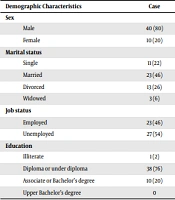
Fateminasab MS, Raaii F, Ghafarinejad A, Pouya F. Prevalence of Dissociative Experiences and Dissociative Disorders in Methamphetamine Users in Shahid Beheshti Hospital of Kerman. Thrita J Neu. 2021;10(1):e113930. doi: https://doi.org/10.5812/thrita.113930

Khosravi M, Shamekhi M. Dissociative Experiences Among Methadone Maintenance Treatment Patients. Int J High Risk Behav Addict. 2019;8(1):e80216. doi: https://doi.org/10.5812/ijhrba.80216
Kianpoor M, Bahredar MJ, Ommizade SJ. Comparing the Level of Dissociative Experience in Prisoners with and without Opioid Dependence Disorder in Shiraz and its Relationship with Other. Iran J Psychiatry Behav Sci. 2010;4(1):. doi:
Rahnamay Namin M. Comparison of depression in students of Islamic Azad University living in Takestan, Abhar, and Bouin-Zahra dormitories (2009). J Inflamm Dis. 2024;16(2):e155701. doi:
Habibisaravi R, Navaeinia S, Farnia S, Zarghami M. Alcohol, Cannabinoids, and Opioids Abuse and Dependence Among Psychiatric Inpatients. Iran J Psychiatry Behav Sci. 2015;9(1):-. doi: https://doi.org/10.17795/ijpbs229
Last Update: 1 week ago
Last Update: 1 week ago
Last Update: 1 week ago
Last Update: 8 hours ago
Last Update: 12 hours ago
Last Update: 5 days ago