Fulltext
Fulltext is availale in the PDF.
Zahedan Journal of Research in Medical Sciences
The Official Journal of Zahedan University of Medical Sciences
Image Credit:Zahedan J Res Med Sci
Authors
Background: The purpose of this study is to investigate theory of mind development (TOM) with regard to mental retarded students (MRS) and its relationship with verbal and non-verbal abilities, and number of siblings.
Materials and Methods: This study is a cross-sectional, for all male mental retarded students, age of 8 to 14 years (about 59 individuals) which were from the city Torbat-e Heidarieh, Iran. Unexpected-content task (UCT) and 38-items test were used for measuring TOM. Also, the Wechsler Intelligence Scale for children Revised (WISC-R) was used to examine the verbal and non-verbal abilities. Information of siblings was established in an interview with the parents, also by looking at the students’ ID cards. In order to analyze data, ANOVA, Scheffe, Pearson correlation coefficient and chi- square were carried out.
Results: First and second level theory of mind development with regard to intellectually disable students were ascending to 12 years age (p<0.05) and then maintained stable (p=0.87). However, theory of mind development that measured by Unexpected Content Task (UCT), was always ascending (p<0.05). The verbal ability had a positive and significant correlation with first (p<0.001) and second level (p<0.001) theory of mind, while non-verbal ability had a positive and significant correlation with both first (p<0.009) and second level (p<0.001). Number of siblings had not been significantly correlated with theory of mind development which related to intellectually disable students (p>0.05).
Conclusion: Altogether, the things “theory theory” and “modular” approaches state might be acceptable. Those theories which are based on sociocultural approaches expressing experiment of communication underlies mind understanding development must be more examined.
© 2014, Author(s). This open-access article is available under the Creative Commons Attribution 4.0 (CC BY 4.0) International License (https://creativecommons.org/licenses/by/4.0/), which allows for unrestricted use, distribution, and reproduction in any medium, provided that the original work is properly cited.
Aliakbarzade Arani Z, Khari Arani M. Evaluation of the self-concept of mothers with educable mentally retarded (EMR) children. J Nurs Midwifery Sci. 2016;3(1):e141264. doi: https://doi.org/10.18869/acadpub.jnms.3.1.23
Pahlevanian A, RasolZadeh M, AmozadehKhalili M. Comparison between normal and mental retard children with mental aged 6-7 on motor skills. koomesh. 2012;13(4):e152536. doi:
Seyed S, Salmani M, Motahari Nezhad F, Noruzi R. Self-Efficacy, Achievement Motivation, and Academic Progress of Students with Learning Disabilities: A Comparison with Typical Students. Middle East J Rehabil Health Stud. 2017;4(2):e44558. doi: https://doi.org/10.5812/mejrh.44558
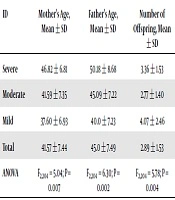
Agha Mohammad Hasani P, Mokhtaree M, Rezaeian M, Jalaladdini A. Investigating the Characteristics of Intelligence Quotient in Individuals with Intellectual Disability in Rafsanjan, 2019. J Adv Immunopharmacol. 2021;1(1):e113794. doi: https://doi.org/10.5812/tms.113794
Taheri M, Qasemi K, Sadr-Jahani S, Pourmohamed Rezaae-Tajrishi M, Akbari-Bayatiani A, et al. The correlation between mother's attachment style and communication skills of their educable mentally retarded sons. J Kermanshah Univ Med Sci. 2012;16(2):e78831. doi:
More by these authors
Last Update: 1 week ago
Last Update: 1 week ago
Last Update: 1 week ago
Last Update: 3 hours ago
Last Update: 6 hours ago
Last Update: 5 days ago