Cover image of the article: Comparison of the Forward Head Posture on Scapular Muscle Contributions During Shoulder Flexion of Predominant Arm in Women with Forward Head Posture

Image Credit:Zahedan J Res Med Sci

Comparison of the Forward Head Posture on Scapular Muscle Contributions During Shoulder Flexion of Predominant Arm in Women with Forward Head Posture

Authors

Aydin Valizadeh1, Reza Rajab2, Farhad Rezazadeh3,*, Azam Mahmoudpour4, Shirin Aali5
1Department of Physical Education, Faculty of Education and Psychology, University of Mohaghegh Ardabili, Ardabil, Iran
2Tehran, Iran
3Department of Sport Medicine, Faculty of Physical Education and Sport Sciences, Kharazmi University, Tehran, Iran
4Department of Sport Medicine, Faculty of Physical Education and Sport Sciences, Tehran Universiy, Department of Sport Medicine, Faculty of Physical Education and Sport Sciences, Tehran Universiy, Tehran, Iran
5Department of Sport Medicine, Faculty of Physical Education and Sport Sciences, Kharazmi University, Tehran, Iran
*Corresponding Author: Department of Sport Medicine, Faculty of Physical Education and Sport Sciences, Kharazmi University, Tehran, Iran Email: rezazade.farhad@gmail.com

Zahedan Journal of Research in Medical Sciences:Vol. 16, issue 6
Published online:Jun 19, 2013
Article type:Research Article
Received:May 28, 2012
Accepted:Aug 02, 2012
How to Cite:Valizadeh A, Rajab R, Rezazadeh F, Mahmoudpour A, Aali S. Comparison of the Forward Head Posture on Scapular Muscle Contributions During Shoulder Flexion of Predominant Arm in Women with Forward Head Posture. Zahedan J Res Med Sci. 2014;16(6):. doi:

Abstract

Background: Because of the corrigibility of forward head posture (FHP), the recognition of the relationship between this deformity and scapular rotator muscles may be influential on scapular muscle activities in detection of better way to improve movement disorders. Therefore, the aim of this study was to compare the serratus anterior, upper and lower trapezius muscle contributions during shoulder flexion without weight in women with and without FHP.

Materials and Methods: In this case-control study was carried out on 18 women with FHP and 14 healthy subjects who were matched. EMG muscle activities were recorded during shoulder flexion and abduction. The value of each muscle divided on total muscle values to calculate contribution ratio and independent t-test was used to compare contributions between groups.

Results: There was a significant decrease in serratus anterior muscle activity ratio (p=0.002) and a significant increase in upper trapezius muscle activity ratio (p=0.001) between subjects with and without FHP. There was not also significant difference in contribution of lower trapezius muscle.

Conclusion: Contribution of the serratus anterior muscle in individuals with forward head posture is less than healthy subjects. The contribution of upper trapezius muscle also in individuals with FHP is greater than healthy subjects.

Highlights

Fulltext

Fulltext is availale in the PDF.

References

  • 1.
    Refrences are available in PDF.

Copyright

© 2014, Author(s). This open-access article is available under the Creative Commons Attribution 4.0 (CC BY 4.0) International License (https://creativecommons.org/licenses/by/4.0/), which allows for unrestricted use, distribution, and reproduction in any medium, provided that the original work is properly cited.
Similar Articles

12
Jul
2023
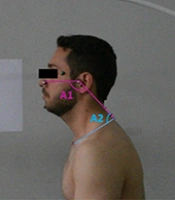
Postures of the Head, Upper, and Lower Neck in Forward Head Posture: Static and Quasi-static Analyses

Postures of the Head, Upper, and Lower Neck in Forward Head Posture: Static and Quasi-static Analyses

Maryam Poursadegh,
Mohammad Reza Azghani,
Zahra Chakeri,
Seyed Mehdi Okhravi,
Zahra Salahzadeh

Poursadegh M, Azghani MR, Chakeri Z, Okhravi SM, Salahzadeh Z. Postures of the Head, Upper, and Lower Neck in Forward Head Posture: Static and Quasi-static Analyses. Middle East J Rehabil Health Stud. 2023;10(4):e136377. doi: https://doi.org/10.5812/mejrh-136377
25
Feb
2012
The relationship between forward head deviation and balance parameters in young females

The relationship between forward head deviation and balance parameters in young females

Solmaz Salehi,
Amir Hushang Bakhtiari,
Mohamadali Senjri,
atefe aminianfar,
Rozita Hedayati,
Raheb Ghorbani

Salehi S, Bakhtiari AH, Senjri M, aminianfar A, Hedayati R, et al. The relationship between forward head deviation and balance parameters in young females. koomesh. 2012;14(1):e152551. doi:
2
Jun
2021
Immediate effect of forward head rounded shoulder posture corrective orthosis on craniovertebral and protraction-retraction angles

Immediate effect of forward head rounded shoulder posture corrective orthosis on craniovertebral and protraction-retraction angles

Reza Hamzelouie,
Alireza Khaghani,
Fatemeh Azadinia

Hamzelouie R, Khaghani A, Azadinia F. Immediate effect of forward head rounded shoulder posture corrective orthosis on craniovertebral and protraction-retraction angles. koomesh. 2021;23(3):e149955. doi:
24
Jul
2021
Correlation Between Craniovertebral Angle and Thickness of Longus Colli in Women with and Without Forward Head Posture

Correlation Between Craniovertebral Angle and Thickness of Longus Colli in Women with and Without Forward Head Posture

Fateme Bokaee,
Ehsan Ghasemi,
Fateme Etemadi,
Sedighe Sadat Naimi

Bokaee F, Ghasemi E, Etemadi F, Naimi SS. Correlation Between Craniovertebral Angle and Thickness of Longus Colli in Women with and Without Forward Head Posture. Middle East J Rehabil Health Stud. 2021;8(3):e112112. doi: https://doi.org/10.5812/mejrh.112112
21
May
2024
Evaluating the Stability Limits Between Individuals with Mild and Moderate-to-Severe Grades of Forward Head Posture

Evaluating the Stability Limits Between Individuals with Mild and Moderate-to-Severe Grades of Forward Head Posture

Zahra Heidary,
Nahid Pirayeh,
Mohammad Mehravar,
Mohammad Jafar Shaterzadeh Yazdi

Heidary Z, Pirayeh N, Mehravar M, Shaterzadeh Yazdi MJ. Evaluating the Stability Limits Between Individuals with Mild and Moderate-to-Severe Grades of Forward Head Posture. Middle East J Rehabil Health Stud. 2024;11(4):e144970. doi: https://doi.org/10.5812/mejrh-144970

More by these authors

Aydin ValizadehPubMedScholar
Reza RajabPubMedScholar
Farhad RezazadehPubMedScholar
Azam MahmoudpourPubMedScholar
Shirin AaliPubMedScholar
Share
Cited by
Metrics