Fulltext
Fulltext is availale in the PDF.
Zahedan Journal of Research in Medical Sciences
The Official Journal of Zahedan University of Medical Sciences
Image Credit:Zahedan J Res Med Sci
Authors
Background: In this study, the effects of antibacterial activity of Urtica dioica and Iris pseudacorus essential oils, native plant northern of Iran, were investigated for some selected bacteria.
Materials and Methods: The influence of essential oils was tested by the using of disk diffusion and micro-broth dilution methods against standard strains of the picked out bacteria. Gas Chromatography/Mass Spectroscopy (GC/MS) analysis, bioactivity determination, Minimum inhibitory concentrations (MIC) and minimum bactericidal concentration (MBC) of essential oils were utilized for this goal.
Results: This study showed that, Inhibition zone diameter varied from 11 to 19 mm and 9 to 17 mm for Urtica dioica and Iris pseudacorus respectively. In contrast, this figure fluctuated from 19 to 28 mm and 7 to 17 mm for gentamicin and ampicillin separately. By the application of micro-broth dilution technique, MICs for 1% essential oils were 1.8-7.5 μg/ml and 3.75-15 μg/ml for, Urtica dioica and Iris pseudacorus against gram-positive and gram-negative bacteria individually. Furthermore, the MBCs of herbal essences were 1.8-15 μg/ml for, Urtica dioica and 15-30 μg/ml for Iris.
Conclusion: The application of essential oils for the bio-control of diseases, as a novel emerging alternative to antimicrobial treatments, lead to safer and more environmental management for infective diseases.
© 2014, Author(s). This open-access article is available under the Creative Commons Attribution 4.0 (CC BY 4.0) International License (https://creativecommons.org/licenses/by/4.0/), which allows for unrestricted use, distribution, and reproduction in any medium, provided that the original work is properly cited.
Motamedi H, Seyyednejad SM, Bakhtiari A, Vafaei M. Introducing Urtica dioica, A Native Plant of Khuzestan, As an Antibacterial Medicinal Plant. Jundishapur J Nat Pharm Prod. 2014;9(4):e15904. doi: https://doi.org/10.17795/jjnpp-15904
Owlia P, Saderi H, Rasooli I, Sefidkon F. Antimicrobial characteristics of some herbal Oils on Pseudomonas aeruginosa with special reference to their chemical compositions. Iran J Pharm Res. 2009;8(2):e128624. doi: https://doi.org/10.22037/ijpr.2010.797
Jahani S, Saeidi S, Javadian F, Akbarizadeh Z, Sobhanizade A. Investigating the Antibacterial Effects of Plant Extracts on Pseudomonas aeruginosa and Escherichia coli. Int J Infect. 2016;3(2):e34081. doi: https://doi.org/10.17795/iji-34081
Asadian M, Zarei H, Fakheri BA, Fahmideh L. Evaluation of Antimicrobial Activity of Essential Oil of Eshvark (Rhazya stricta) Against Two Strains of Staphylococcus aureus and Listeria monocytogenes. Int J Infect. 2017;4(4):e61912. doi: https://doi.org/10.5812/iji.61912
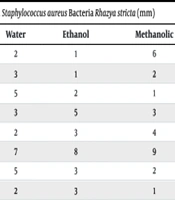
Eslam-Manesh T, Gumshadzehi AK, Badrloo F, Rezaei M. Investigating the Antimicrobial Activity and Pigmentation of the Extract of Rhazya stricta Plant Against Human Bacteria. Gene Cell Tissue. 2024;11(4):e148763. doi: https://doi.org/10.5812/gct-148763
Last Update: 1 week ago
Last Update: 1 week ago
Last Update: 1 week ago
Last Update: 9 hours ago
Last Update: 13 hours ago
Last Update: 5 days ago