Fulltext
The full text of this article is available on the PDF file.
Zahedan Journal of Research in Medical Sciences
The Official Journal of Zahedan University of Medical Sciences
Image Credit:Zahedan J Res Med Sci
Authors
Background : A few factors appear to boost a child's risk of having recurrent febrile seizures, including young age during the first seizure, seizure type, and having immediate family members with a history of febrile seizures. The present study aimed to provide reliable information about recurrent febrile seizure in Iranian children.
Materials and Methods : On the computerized literature valid on valid keyword with search in valid database PubMed, Scientific Information Databases (SID (, Global medical article limberly (Medlib), Iranian Biomedical Journals (Iran Medex), Iranian Journal Database (Magiran), and Google Scholar recruited in different geographic areas. To explore heterogeneity in studies I2 index was used. Meta-analysis used to data analysis with random effects model.
Results : Hospital data of 4,599 children with febrile seizure. Overall, 21 studies met our inclusion criteria. Febrile seizure in 2 age groups (<2 and 2-6 years) were 55.8% (95% CI: 50.4-61.2) and 44.2% (95% CI: 38.8-61.2) respectively. Pooled recurrent rate of febrile seizure in Iran was 20.9% (95% CI: 12.3-29.5). In 28.8 (95% CI: 19.3-38.4), children there was positive family history. The mean prevalence of simple and complex seizures was 69.3% (95% CI: 59.5-79.0) and 28.3% (95% CI: 19.6-31.0) respectively. The rates in different geographical regions of central, east, and west of Iran, 25, 20.8 and 27.1% were estimated, respectively.
Conclusion : According to the data the prevalence febrile seizure is higher in males and children under two years. Recurrence rate in Iran, similar to other studies performed in other regions of the world.
© 2013, Author(s). This open-access article is available under the Creative Commons Attribution 4.0 (CC BY 4.0) International License (https://creativecommons.org/licenses/by/4.0/), which allows for unrestricted use, distribution, and reproduction in any medium, provided that the original work is properly cited.
Sayehmiri K, Veisani Y, Delpisheh A. Familial History and Recurrence of Febrile Seizures; a Systematic Review and Meta-Analysis. Inn J Pediatr. 2013;23(4):. doi:
Miri Aliabad G, Khajeh A, Fayyazi A, Safdari L. Clinical, Epidemiological and Laboratory Characteristics of Patients with Febrile Convulsion. J Compr Ped. 2013;4(3):134-7. doi: https://doi.org/10.17795/compreped-7647

Heydarian F, Bakhtiari E, Yousefi S, Heidarian M. The First Febrile Seizure: An Updated Study for Clinical Risk Factors. Inn J Pediatr. 2018;28(6):e69761. doi: https://doi.org/10.5812/ijp.69761
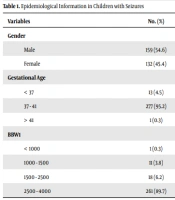
Shirooye P, Yousefichaijan P, Faraji F, Dorreh F, Arjmand A, et al. Risk Factors of Seizures in Children. Zahedan J Res Med Sci. 2023;25(1):e119968. doi: https://doi.org/10.5812/zjrms-119968
Blouki Moghaddam K, Bidabadi E, Hassanzadeh Rad A, Dalili S. Causes of Infectious Diseases Which Tend to Get Into Febrile Convulsion. Int J Infect. 2016;3(1):e29861. doi: https://doi.org/10.17795/iji-29861
More by these authors
Last Update: 1 week ago
Last Update: 1 week ago
Last Update: 1 week ago
Last Update: 3 hours ago
Last Update: 7 hours ago
Last Update: 5 days ago