Fulltext
The full text of this article is available on the PDF file.
Zahedan Journal of Research in Medical Sciences
The Official Journal of Zahedan University of Medical Sciences
Image Credit:Zahedan J Res Med Sci
Authors
Background : Neuropathy is the mostly prevalent of complications and the major cause of amputation, pain and disability in patients with diabetes. The purpose of this study was to investigate the role of individual, psycho-social, and disease-related risk factors in neuropathy of type 2 diabetes patients.
Materials and Methods : In this retrospective cross-sectional study, 271 patients with type 2 diabetes were selected by convenience sampling in diabetic outpatient clinics of Tehran University of Medical Sciences and the Iranian Diabetic Association. The data were collected by demographical and disease characteristics questionnaires and DASS-42, QOLS, DSMS, and DKS scales. Then, the data were analyzed by r binary logistic regression along with PASW software.
Results : Socio-economic status, glycosylated hemoglobin, body mass index, diabetes self-management, depression, quality of life, diabetes knowledge, and diabetes duration were significantly able to differentiate diabetic patients with neuropathy from diabetic patients without neuropathy (p<0.001). Gender, treatment type and patient age were not significantly able to differentiate two groups (p>0.05). The total regression model explained that 95.2% of cases were classified correctly.
Conclusion : Inappropriate socio-economic status, glycosylated hemoglobin over 9%, being overweight and obesity, poor diabetes self-management, clinical depression, low quality of life, poor diabetes knowledge, and longer diabetes duration contribute to the incidence of neuropathy in patients with type 2 diabetes and attention must be paid to them for neuropathy prevention.
© 2012, Author(s). This open-access article is available under the Creative Commons Attribution 4.0 (CC BY 4.0) International License (https://creativecommons.org/licenses/by/4.0/), which allows for unrestricted use, distribution, and reproduction in any medium, provided that the original work is properly cited.
Aghili R, Khamse ME, Baradaran HR, Aghili SM, Malek M. Diabetic distal symmetric polyneuropathy: Role of physical examination in screening. koomesh. 2013;14(3):e152584. doi:
Kassaeian SS, danai N, Shahryar SM, Taherian MH, Ebrahimi Tavani M, et al. The prevalence of type 2 diabetes complications and their related factors in Semnan, Iran: a cross-sectional study. koomesh. 2023;25(3):e152838. doi:
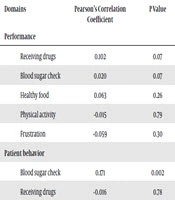
Ayatollahi SMT, Malekmakan L, Sayadi M, Karami Daranjani S. Factors Related to Type 2 Diabetes Self-Care. Zahedan J Res Med Sci. 2019;22(1):e96207. doi: https://doi.org/10.5812/zjrms.96207
Vahedi H, Khosravi A, Sadeghi Z, Aliyari R, Shabankhamseh A, et al. Health-Promoting Lifestyle in Patients with and without Diabetes in Iran. Health Scope. 2017;6(2):e39428. doi: https://doi.org/10.5812/jhealthscope.39428
Khalooei A, Mahmoodi Meymand M. Frequency of Diabetes Foot Ulcer and Related Factors Among Adult Diabetic Patients in the Diabetes Center of Kerman, Iran. Shiraz E-Med J. 2020;21(1):e90082. doi: https://doi.org/10.5812/semj.90082
Last Update: 2 weeks ago
Last Update: 2 weeks ago
Last Update: 2 weeks ago
Last Update: 4 hours ago
Last Update: 7 hours ago
Last Update: 5 days ago