Fulltext
The full text of this article is available on the PDF file.
Zahedan Journal of Research in Medical Sciences
The Official Journal of Zahedan University of Medical Sciences
Image Credit:Zahedan J Res Med Sci
Authors
Background: Social support is known as a health behavior facilitator which is correlated with
adherence of self care behaviors among diabetic patients. The aim of this study was determining the
status of this construct and its correlated factors and also its association with self care behaviors in
diabetic patients.
Materials and Methods: This analytical and cross-sectional study was carried out on 120
patients who referred to Yazd diabetes research center. A questionnaire was used for data
collection which measured perceived social support and self care behaviors constructs.
Questionnaire was completed with a private interview of subjects. Subjects' demographic variables
were also enquired. Validity and reliability of the questionnaire was assessed and approved.
Results: Subjects earned 58.1 % of earnable score of social support which was due to 56.4% of
earnable score of supportive family behaviors and 39.4% of earnable score of nonsupportive family
behaviors. Among self care dimensions, correct taking of drugs was at the lowest rate of perceived
support and general cares of diabetes was at the highest level. Perceived nonsupportive family
behaviors, was significantly more common among women. Perceived social support was positively
associated with self care behaviors (r=0.253). Perceived supportive family behaviors also was
correlated with self care behaviors but the correlation of perceived nonsupportive family behaviors
and self care behaviors was not statistically significant. Perceived social support predicted only 6.4
% of variance in self care behaviors while perceived supportive family behaviors predicted 9.1% of
variance in self care behaviors.
Discussion: Perceived family support level was not at a favorite level and some dimensions of self
care behaviors such as correct taking of drugs was at a worse situation. Attention to family support
in educational programs for increasing self care behaviors among diabetic patients is highly
recommended.
© 2007, Author(s). This open-access article is available under the Creative Commons Attribution 4.0 (CC BY 4.0) International License (https://creativecommons.org/licenses/by/4.0/), which allows for unrestricted use, distribution, and reproduction in any medium, provided that the original work is properly cited.
Ershad Sarabi R, Mokhtari Z, Naghibzadeh Tahami A, Borhaninejad VR, Valinejadi A. Assessment of type 2 diabetes patients’ self-care status learned based on the national diabetes control and prevention program in health centers of a selected city, Iran. koomesh. 2021;23(4):e153275. doi:
Shareh H, Soltani E, Ghasemi A. Prediction of Quality of Life of Non–Insulin-Dependent Diabetic Patients Based on Perceived Social Support. Zahedan J Res Med Sci. 2012;14(2):e93590. doi:
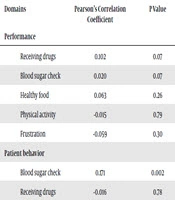
Ayatollahi SMT, Malekmakan L, Sayadi M, Karami Daranjani S. Factors Related to Type 2 Diabetes Self-Care. Zahedan J Res Med Sci. 2019;22(1):e96207. doi: https://doi.org/10.5812/zjrms.96207
Haji-Arabi E, Nobahar M, Ghorbani R. Relationship between depression and knowledge about diabetes with the amount of self-care in patients with type 2 diabetes. koomesh. 2018;20(2):e152951. doi:
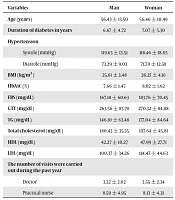
Jahangir F, Kavi E, Masmouei B, Bazrafshan M, Delam H, et al. Self-Management Status in Patients with Diabetes and Disease Control Indicators in Lamerd City, Iran. Jundishapur J Chronic Dis Care. 2020;9(2):e99992. doi: https://doi.org/10.5812/jjcdc.99992
Last Update: 3 weeks ago
Last Update: 3 weeks ago
Last Update: 3 weeks ago
Last Update: 9 hours ago
Last Update: 2 days ago
Last Update: 4 days ago