1. Introduction
Cancer as a genetic disorder is the main cause of death in economically developed countries and the second one in emerging countries (1). The reports indicate that about 13% of total deaths (7.6 million) are induced by cancer and its global burden is increased largely regarding both the aging and growth of the world population besides the growing of cancer inducing behaviors, especially smoking (2, 3). The majority of these disorders are generated by lung, stomach, liver, colon and breast cancer (4). It has been estimated that about 50% - 60% of cancer enduring in the United States exploit compounds deriving from different parts of plants or nutrients (as a complementary agent and/or substitute medicine), solely or alongside with traditional therapeutic treatment like chemotherapy and/or radiation therapy (5-7).
Natural herbs have been used for thousands of years for prevention and/or treatment of diverse diseases (8). The presence of bioactive components in plants makes them appropriate choices to be used especially by gourmet food consumers (9-11). Evidences confirmed the anticancer activities of natural plants derived bioactive components (12-16). The bulk of research has been devoted to dietary phytochemicals which resulted in an increase in comprehension of these compounds as a chemical and biological functional agent which has a constructive effect on human health. Regarding to development of studies which are done in vitro (advent of different cellular, molecular, and genomic trial systems) and in vivo (transgenic and knockout animal models), the mechanisms by which dietary phytochemicals are involved has been greatly understood.
Upon entering cells, the phytochemicals are able to hunt free radicals immediately (10, 17) and create the signals in response to chemical or electrophilic stress that activate proteins associated to diverse cellular signaling pathways (18, 19). The mentioned ability involves the activation of the nuclear factor erythroid-2 (NF-E2)-related factor 2 (Nrf2)-Kelch-like ECH associated protein 1 (Keap1) (Nrf2-Keap1 complex) (20, 21). This complex activation consequently influences the cellular defense mechanisms, counting phase II detoxifying enzymes, phase III transporters, anti-oxidative stress proteins, and other stress-defense molecules induction which defend the normal cells against reactive oxygen species (ROS), reactive nitrogen species (RNS) and/or reactive metabolites of carcinogenic species (22, 23). They are also able to cause death of apoptotic cell in pre-neoplastic or neoplastic cells via different growth suppression methods comprising the organization of cytochrome c (Cyt c)/caspases, cell cycle catch, the embarrassment of the nuclear factor- κ B (NF- κB), Janus kinase (JAK)-signal transducer, and activator of transcription (STAT) signaling pathways, resulting in the tumor progression reticence (24, 25). It is worthy to consider that advanced/metastatic cancers which have highly genetic mutations, loss of heterozygosity, and/or epigenetic changes are greatly resistant even toward radiation or chemotherapeutic drugs and so they will not be responded to dietary phytochemicals alone (26, 27). These defensive mechanisms that prevent the induction of carcinogenesis are defined as chemoprevention perception that was originally established by Wattenberg (1966) (28, 29).
Chemoprevention passes on using agents able to prevent, reverse or postpone tumorigenesis (15, 30). It has been reported that several phytochemicals originated of edible plants are able to impede with a specific stage of the carcinogenic process. Different studies revealed that phytochemicals are able to be a chemopreventative agent toward the human cancer by inflection of the cancer cell cycle, proliferation inhibition, and initiation of apoptosis (31). Considering both the cancer epidemiology and trial finding it has been revealed that dietary phytochemicals can be used rightly in chemoprevention and its daily consumption is a hopeful new attitude to avoid carcinogenesis. In this review, an attempt has been devoted to introduce dietary phytochemicals, their healthful impacts to prevent cancer along with their mechanisms of action.
2. Evidence Acquisition
Review was conducted using keywords such as cancer, chemoprevention, phytochemical thorough PubMed, Science direct, Google Scholar, and Scopu sites. High quality articles and books were reviewed. Articles and books providing constructive information to the topic were further comprised in the current study.
3. Results
3.1. Phytochemicals
Plant derived phytochemicals are defined as bioactive non-nutrient compounds which have been connected to reduction of major chronic diseases risk (32-34). The Greek word ‘phyto’ in phytochemicals means plant (35, 36). In other words, phytochemicals are plant chemicals. It is predicted that more than 5000 particular phytochemicals have been recognized in grains, fruits and vegetables but a large percentage are still unknown and must be identified before understanding their health benefits in whole foods (10, 37). An ideal chemopreventive factor must be considered by different criteria as mentioned in Figure 1.
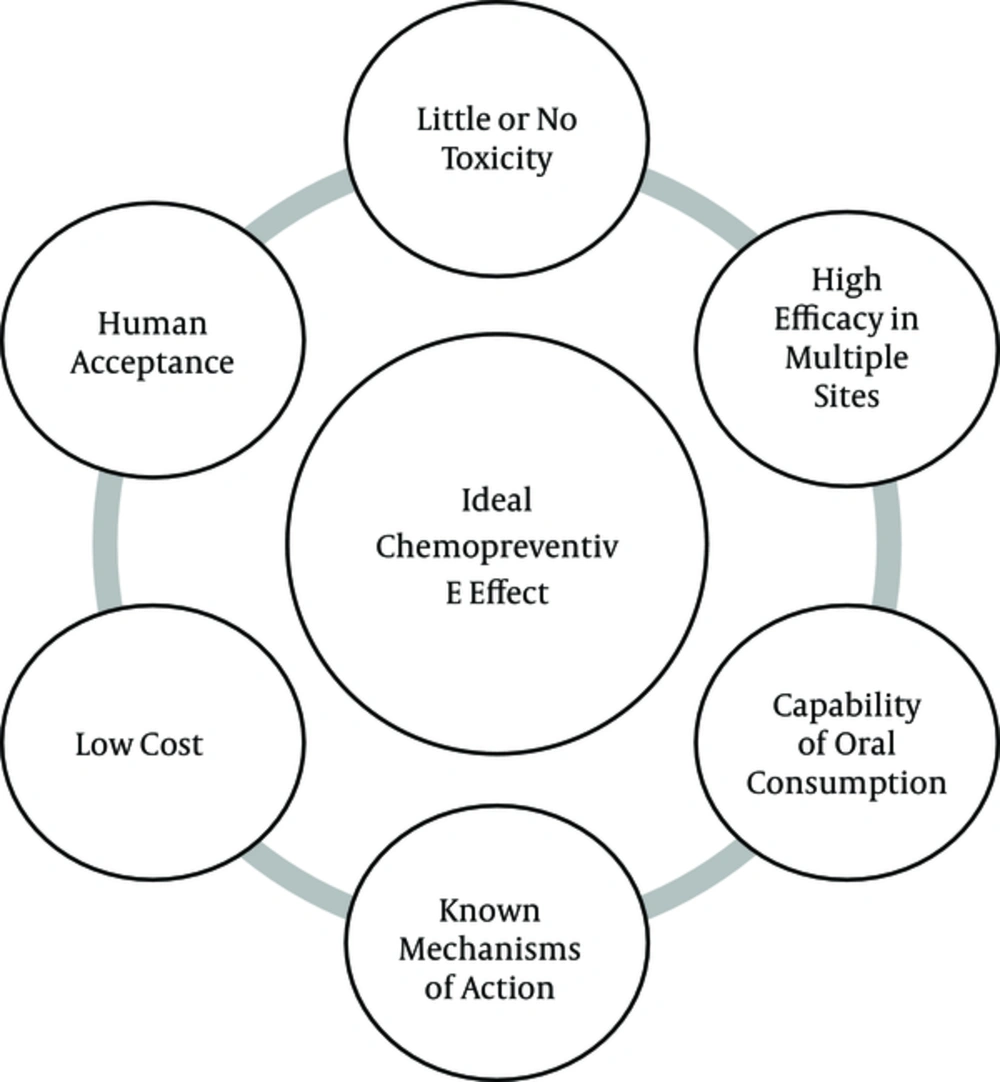
Figure 1.
The Characteristics of an Ideal Chemopreventive Agent
Phytochemicals are able to impede initiation or repeal the promotion step of multistep carcinogenesis (15, 38). They can also stop or postpone the development of pre-cancerous cells into the malignant ones (39, 40). Nevertheless, evidences indicated that the health benefits of phytochemicals in fruits and vegetables would be even greater than it is currently implicit, regarding the role of oxidative stress induced free radicals in a wide range of chronic diseases.
Different biologically active phytochemicals have been identified to have the capability to control the carcinogenesis at different stages which are presented below and summarized in Figure 2.
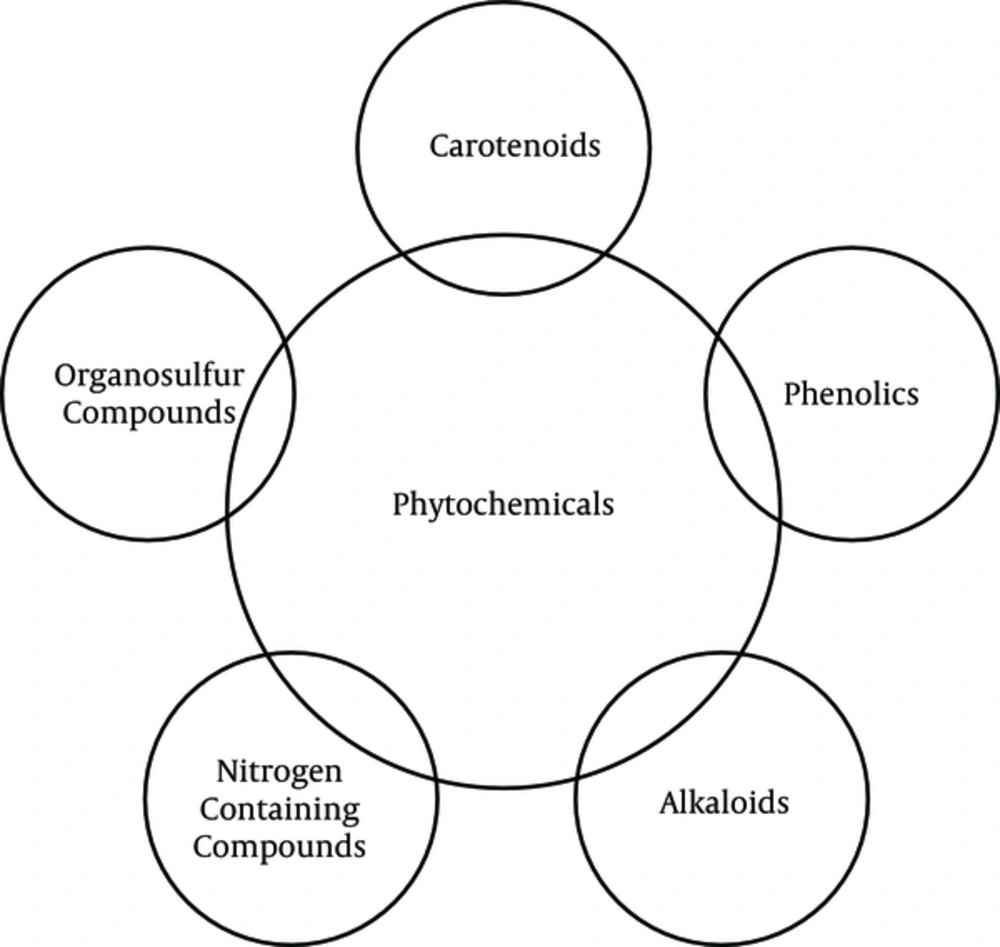
Figure 2.
Classification of Dietary Phytochemicals
3.1.1. Phenolics
The secondary metabolites phenolics are extensively found in fruits (41). These compounds have one or more aromatic rings with one or more hydroxyl groups (42). The main phenolic compounds which are found in food could be categorized into three groups: simple phenols and phenolic acids, hydroxycinnamic acid derivatives and flavonoids. They play an essential role in the growth and reproduction of the plants besides acting as defense mechanisms against pathogens, parasites, and predators (43, 44). The upward attention in these compounds is mainly attributed to their antioxidant capacity and their ability to prevent some diseases. It is notable that the phytohemicals health benefits will be achieved by their regular intake and their bioavailability (45).
Simple phenols and phenolic acids are precursor to the synthesis of other complex compounds such as flavonoids and tannins (46, 47). They act in the natural defense mechanism of plants to prevent them from infectious diseases and reduce the growth of pathogenic bacteria, viruses, and fungi. They include monophenols, 3-ethylphenol, 3, 4-dimethylphenol and diphenols which are possibly the most prevalent simple pheno1 (47).
Hydroxycinnamic acids and their esterified derivatives in fruits and vegetables are almost completely originated from p-coumaric acid (PCA), caffeic acid (CA), and ferulic acid (FA) (48). They are frequently present in conjugated forms, usually as esters rather than glycosides (49). Hydroxycinnamic acids derivatives like chlorogenic acid, coumaric acid, caffeic acid and sinapic acid are the foremost of phytochemicals in the plant food powders (50). Consequently,the addition of these food plant powders high in bioactive phytochemicals will beneficially create food reformulations able to improve foods regarding both the quality and health endorsement properties. This approach will directly improve the plant-based foods consumption which is established as being beneficial for health.
Flavonoids as a major class of phenolic compounds exhibited highly antioxidant activity (51). These compounds have been connected to reducing the risk of main chronic diseases and have been recognized largely in fruits, vegetables, and other plant foods (52). More than 4000 diverse flavonoids have been known. They frequently have a general structure containing two aromatic rings (A and B rings) connected via 3 carbons which are typically in an oxygenated heterocycle ring or C rings. Flavonols, flavones, flavanols (catechins), flavanones, anthocyanidins, and isoflavonoids are different types of flavanoids considering the variation of the general structure of the heterocyclic C ring (53).
3.1.2. Organosulfur Compounds
Organosulfur compounds are organic compounds which can be recognized according to their sulfur containing functional groups (54). The regular intake of organosulfur compounds imparts bioactive properties especially about cardiovascular health (37). Several organosulfur compounds were assessed by Wattenberg et al considering their ability to prevent carcinogenesis stimulated by N-nitrosodiethylamine, and the strongest was diallyl disulfide (55). Considering the ability of natural products derived from cruciferous plants and members of Allium genus to prevent cancers, these vegetables have been investigated in several studies. Watercress, Chinese cabbage and broccoli are some examples of vegetable rich in organosulfur compounds (OSCs).
3.1.3. Carotenoids
Carotenoids as the most extensive natural pigment have gained considerable attention regarding their provitamin and antioxidant properties (56, 57). More than 600 different carotenoids have been recognized in nature. They may be of plants, microorganisms, and/or animals origin. They have a skeleton of isoprene units containing 40-carbon (58). Their structure may be cyclized at one or both ends, having diverse hydrogenation degree, holding oxygen-containing functional groups. Carotenoid compounds are mainly present in all-trans form in nature. The most typical properties of carotenoids are their long sequences of conjugated double bonds formed at the center of the molecule. This characteristic is impressive in their shape, chemical reactivity, and light-absorbing properties. Carotenoids are able to react with free radicals and create radicals themselves (59). The existence of sufficient carotenoids can inhibit lipid oxidation and related oxidative stress.
3.1.4. Alkaloids
Alkaloids are a group of ring structure nitrogen containing organic compounds with a wide range of anticancer activity (60). These compounds take part in cancer inhibition via prevention of enzyme topoisomerase activity which is involved in DNA imitation, inducing apoptosis and expression of p53 gene (61, 62). However, alkaloids have long been existed before humans; some of them are structurally similar to neurotransmitters present in the central nervous system of humans. Considering the medicinal importance of alkaloids and research explaining their role in treating wild propagation of cells, they would be used as an effective chemopreventive agent in the era of modern drug innovation (63, 64). Amaryllidaceae alkaloids, betalain alkaloids, diterpenoid alkaloids, indole alkaloids, isoquinoline alkaloids, lycopodium alkaloids, monoterpene and sesquiterpene alkaloids, peptide alkaloids, pyrrolidine and piperidine alkaloids, pyrrolizidine alkaloids, quinoline alkaloids, quinolizidine alkaloids, steroidal alkaloids, tropane alkaloids, and miscellaneous alkaloids are the main categories of Alkaloids.
3.2. Cancer Chemoprevention by Phytochemicals
Cancer, a multistage, multi-mechanism carcinogenesis process, comprises mutagenic, cell death and epigenetic mechanisms, through three separate but closely linked stages: initiation, promotion, and progression (65, 66). The first step, initiation, is mainly concluded from a single using of a subcarcinogenic dose of a carcinogen (67). In another words, exposing to carcinogen agents creates permanent injuries to genetic material which are almost irreversible. Promotion, the second step, resulted via repeatedly applying of an irritating agent (68). It involves cellular explosion and selective clonal growth which are reversible, during its early stages, but becomes irreversible with time. Cells in humans and other organisms are frequently interpretate to a variety of oxidizing agents which are necessary for life in some cases (69, 70). These factors may be present in air, food, and water, or may be created during metabolic activity within cells (43). The main factor that must be considered is keeping equilibrium between oxidants and antioxidants to prolong the optimal physiological conditions. An imbalance created by producing high amounts of oxidants, will, lead to oxidative stress, especially in chronic bacterial, viral, and parasitic infections (10). Oxidative stress can hurt large biomolecules like lipids, proteins, and DNA, resulting in an increased risk for cancer and cardio-vascular diseases (CVD). Since the initiation phase reduction to a zero level is impossible, the main interference would be achieved at the promotion level to eradicate premalignant cells before being malignant (50). The conversion of the normal cells to malignant ones took place during several years. So, their delaying or prevention of this transformation is a viable and possible objective for the future (70). The results of many laboratory animal studies evidently denote that different cancers can be prohibited using certain chemicals. In order to avoid and/or slow the oxidative stress created by free radicals, adequate amounts of antioxidants are necessary to be used. Cancer chemoprevention is the main cancer preventive approach that exploits naturally dietary phytochemicals or remedial drugs with fairly low toxicity. The anti-cancer properties of phytochemicals are presented in Table 1. Different mechanisms involved in chemoprevention of different phytochemicals are presented in Table 2.
Table 1.
The Anticancer Properties of Phytochemicals
| Phytochemicals | Anti-Cancer Properties |
|---|---|
| Phenolic compound | Reduced incidence of neoplasia induced by chemical carcinogens |
| Preventing nitrosation of susceptible secondary amines and amides to form highly potent carcinogenic nitrosamines and nitrosamides in our foods | |
| Potent chemical nucleophiles | |
| Inhibitors of promotion processes | |
| Inhibitors of kinases by reducing hyperproliferationof | |
| Epithelial cells | |
| Organosulfur compounds | Induction of carcinogen detoxification |
| Inhibition of tumor cell proliferation | |
| Antimicrobial effect | |
| Free radical scavenging | |
| Inhibition of DNA adduct formation | |
| Induction of cell cycle arrest | |
| Induction of apoptosis | |
| Alkaloids | Modification of carcinogen metabolism |
| Modification of tumor metabolism | |
| Inhibition of tumor cell growth | |
| Carotenoids | Inducers of differentiation |
| Nitrogen containing compounds | Inhibit the metabolic activation and carcinogenicity |
Table 2.
The Mechanistic Insight Into Chemoprevention of Different Phytochemicals
| Mechanism of Cancer Prevention | Reference |
|---|---|
| Antioxidant activity | (9) |
| Scavenge free radicals and reduce oxidative stress | |
| Inhibition of | |
| Cell proliferation | |
| Cell differentiation | |
| Oncogene expression | |
| Signal transduction pathways | |
| Induction of | |
| Tumor suppress gene expression | |
| cell-cycle arrest | |
| Enzyme induction and enhancing detoxification | |
| Phase II enzyme | |
| Glutathione peroxidase | |
| Catalase | |
| Superoxide dismutase | |
| Enzyme inhibition | |
| Phase I enzyme (block activation of carcinogens) | |
| Cyclooxygenase-2 | |
| Inducible nitric oxide synthase | |
| Xanthine oxide | |
| Enhancement of immune functions and surveillance | |
| Antiangiogenesis | |
| Inhibition of cell adhesion and invasion | |
| Inhibition of nitrosation and nitration | |
| Prevention of DNA binding | |
| Regulation of steroid hormone metabolism | |
| Regulation of estrogen metabolism | |
| Antibacterial and antiviral effects |
As is presented in Table 2 the success of chemopreventive agents is dependent on their ability to neutralize the precise upstream signals which create different forms of cellular stress, genotoxic damage and redox imbalances.
Different phytochemicals in fruits and vegetables have been detached and recognized which their ability to impede different stages of the carcinogenic process in numerous animal models have been demonstrated (52, 58, 61). Chemicals which are able to avoid the development of carcinogens from precusor substances or to inhibit carcinogens from attaining or responding to critical target DNA sites in the tissues are named ‘blocking agents’. Chemicals which keep on suppressing the illustration of neoplasiain cells interpretate to doses of a carcinogenic agent are called ‘suppressing agents’. Administration of vegetables and/or fruits or their components in the diet to animals is able to reduce chemically-generated tumor occurrence (53). As previously mentioned, carcinogenic species, like environmental pollutants, dietary mutagens and radiation, will possibly result in the creation of reactive oxygen species (ROS) and/or reactive nitrogen species (RNS), which react with cellular molecules like proteins, lipids, and DNA to provoke carcinogenesis. Dietary phytochemicals intake not only scavenge ROS/RNS directly but also eliminate carcinogenic reactive intermediates indirectly by the transcription factor Nrf2 [nuclear factor erythroid 2 p45 (NF-E2)-related factor 2] antioxidant and detoxification system. When Nrf2 is released from Kelch-like ECH associated protein 1 (Keap1) and translocates to the nucleus, Nrf2 binds to antioxidant responsive elements (AREs) in the promoter/enhancer region of phase II detoxification and antioxidant enzyme genes with the Maf protein. Recent research has also shown that the reactivation of Nrf2 might be regulated by dietary phytochemicals through epigenetic modifications such as DNA methylation and histone modification.
Block et al. investigated more than 200 epidemiological cases that studied the daily intake of fruits and vegetables effects on different cancers naming lung, colon, breast, cervix, esophagus, oral cavity, stomach, bladder, pancreas, and ovary (36). In 128 of 156 dietary studies, utilization of fruits and vegetables create a significant protective effect. Results indicated that the cancer risk decreased due to consumption fruits and vegetables. Significant protection was observed in 24 of 25 studies for lung cancer (35). Fruits consumption was significantly able to create a protective effect in the case of esophagus, oral cavity, and larynx cancers. Their intake was also protective for cancer of the pancreas and stomach in 26 of 30 studies and for colorectal and bladder cancer in 23 of 38 studies. Studies to date which demonstrated the ability of common phytochemicals regarding the cancer which they are preventive are presented in Table 3.
Table 3.
The ability of Common Phytochemicals Regarding Their Cancer Preventive Effects
| Phytochemicals | Cancer Target | Results | Reference |
|---|---|---|---|
| Cranberry extracts | Breast cancer MCF-7 cells | Cranberry phytochemical extracts possess the ability to suppress the proliferation of human breast cancer MCF-7 cells | (6) |
| Blueberry extract | MDA-MB-231 Breast Cancer Cells | Decreased phosphatidylinositol 3-kinase (PI3K)/AKT and NFκB activation in MDA-MB-breast cancer cells | (18) |
| Carotenoids, retinol, and tocopherols | Breast cancer | The results indicated an inverse association of carotenoids and breast cancer among postmenopausal women | (39) |
| Selenium and Vitamin E | Prostate cancer | Dietary supplementation with vitamin E significantly increased the risk of prostate cancer among healthy men | (25) |
| Glucosinolates (secondary metabolites produced by crucifers) | Prostate cancer | Inhibit prostate cancer by both blocking initiation and suppressing prostate cancer progression in vitro and in vivo | (42) |
| Quercetin | Cancer | Quercetin can be efficient attreating cancer by inducing cell death or cell cycle arrestpreferentially in cancer cells versus their normal counterpartsthrough a process involving the down-regulation of selectiveoncogenes (such as Mcl-1, Ras, MEK, PI3K), or the up-regulation oftumorsuppressor genes which, in turn enhance selectivepathways leading to the elimination of cancer cells | (38) |
| Resveratrol (polyphenol) | Colorectal cancer pancreatic cancer stem cellbreast cancer | Resveratrol induces cell; Apoptosis like as many other polyphenols | (47) |
| Tocopherols, tocotrienols and γ-oryzanol (rice bran extracts) | Colorectal cancer | Rice bran extracts differentially inhibit colorectal cancer (CRC) cell growthRice bran chemoprevention is due to the complex phytochemical mixture | (52) |
4. Conclusions
The process of carcinogenesis is complex and heterogenous regarding to several combinations of genetic and epigenetic events which occur in an individual cell to create a neoplastic deformation. Considering different stages of cancer, initiation, promotion and progression, the second step is the main one to be considered for cancer chemoprevention. It has been predicted that more than two-thirds of human cancers could be prevented via proper lifestyle adjustment. Phytochemicals are mainly present in fruits and vegetables and their regular intake would be effective to cancer prevention.