
Cover image of the article: Reversal of Dyslipidemia Through Shared Decision Making: A Case Report on Unfiltered Coffee Abstinence and Patient-Centered Care

Image Credit:Int J Cardiovasc Pract

Reversal of Dyslipidemia Through Shared Decision Making: A Case Report on Unfiltered Coffee Abstinence and Patient-Centered Care

Authors

Soo How LimSoo How Lim ORCID1, 2,*, Hong Chin WeeHong Chin Wee ORCID2, 3, Ming Yao LimMing Yao Lim ORCID4

Abstract

Introduction:

Current clinical guidelines recommend lifestyle modifications for dyslipidemia, yet long-term adherence remains challenging. Shared decision-making (SDM) provides a structured framework for improving patient engagement and compliance. We report the application of SDM to address heavy unfiltered coffee consumption and facilitate patient adherence to nonpharmacological cholesterol management.

Case Presentation:

A 35-year-old man presented with elevated total cholesterol (394.4 mg/dL) and low-density lipoprotein cholesterol (278.4 mg/dL) during routine screening. Using Elwyn's “Three-Talk” model of SDM, the clinician and patient collaboratively developed a 12-week intervention plan. In response to the patient's concerns about potential statin side effects on his high-intensity exercise routine, the intervention consisted of complete abstinence from his baseline intake of 5 to 10 cups of unfiltered coffee daily, and pharmacotherapy was delayed. At the 12-week follow-up, total cholesterol had decreased to 208.8 mg/dL and low-density lipoprotein cholesterol to 116.0 mg/dL; these levels were achieved without lipid-lowering medications.

Conclusions:

This case demonstrates that use of a structured SDM framework can support the patient's complete adherence to targeted dietary modifications, such as abstaining from unfiltered coffee. Engaging patients as active participants in their care can effectively improve dyslipidemia, avoiding the need for immediate medical intervention.

How to Cite:Lim SH, Wee HC, Lim MY. Reversal of Dyslipidemia Through Shared Decision Making: A Case Report on Unfiltered Coffee Abstinence and Patient-Centered Care. Int J Cardiovasc Pract. 2026;11(2):e175444. doi: https://doi.org/10.5812/intjcardiovascpract-175444

1. Introduction

Atherosclerotic cardiovascular disease remains a leading cause of global mortality, and elevated plasma cholesterol is a primary modifiable risk factor (1). To manage dyslipidemia, current guidelines from the European Society of Cardiology and the American Heart Association recommend a combination of pharmacotherapy and lifestyle modifications (1, 2). Although lifestyle interventions are highly effective (3), achieving long-term patient adherence in outpatient settings is notoriously difficult. To address this barrier, shared decision-making (SDM) has emerged as a valuable communication framework that transforms the traditional paternalistic clinical model into a collaborative partnership (4). By integrating patient values with evidence-based options, SDM improves treatment adherence and overall quality of care (5, 6). In this report, we present a case in which a structured SDM approach successfully targeted a specific dietary risk factor by eliminating heavy consumption of unfiltered coffee. This strategy yielded significant improvements in the patient's serum lipid levels, highlighting the practical utility of patient-centered care.

2. Case Presentation

A healthy 35-year-old, non-smoking Asian male presented with a point-of-care fasting total cholesterol level of 394.4 mg/dL (10.2 mmol/L). He had no family history of hypercholesterolemia or heart disease, maintained an active lifestyle that included high-intensity free-weight training four times per week, and worked in a sedentary office role. The patient reported consuming 5 to 10 cups of unfiltered coffee (Americano or espresso) daily for over a decade, with an estimated caffeine intake of 500 mg to 1540 mg per day. Written, signed informed consent was obtained from the patient for publication of this case report and any accompanying data. Physical examination revealed a normal body mass index (BMI) of 24.8 kg/m2, normal blood pressure, and no tendon xanthomas. A comprehensive lipid profile confirmed elevated total cholesterol (394.4 mg/dL) and low-density lipoprotein (LDL) (278.4 mg/dL), along with normal triglycerides (62.0 mg/dL) and high-density lipoprotein (104.4 mg/dL). His calculated Framingham Risk Score was 2.3%, indicating a low risk of cardiovascular events. His estimated daily dietary and caffeine intake at presentation is given in Table 1.
Table 1.
Estimated Daily Dietary and Caffeine Intake at Presentation
Dietary ComponentEstimated Daily Intake / Characteristics (servings/day, mg/day)Clinical Note
Macronutrient ProfileModerate Carbohydrate, High ProteinTypical Asian diet comprising rice, noodles, poultry, and pork.
Fiber Intake~4 - 5 servings dailySourced primarily from steamed/stir-fried mixed vegetables and fruit.
Primary BeverageUnfiltered Coffee (Americano, Espresso) a5 to 10 cups daily
Estimated Caffeine500 mg – 1540 mg dailyPrimary modifiable risk factor identified.
a Americano (1 cup= 12 oz= 154mg of caffeine), espresso (1 cup= 1 oz=100mg)

2.1. Treatment and the SDM Process

Following the exclusion of secondary causes of hypercholesterolemia, the clinical encounter followed the Elwyn "Three-Talk" Model of SDM.
Team Talk (Establishing Partnership and Choice): The patient expressed a strong belief that his unfiltered coffee consumption was driving his dyslipidemia. The clinician validated the patient’s self-directed research, acknowledging clinical evidence linking unfiltered coffee to elevated lipids, and established that the patient’s preferences would guide the care plan.
Option Talk (Comparing Alternatives): Two evidence-based options were compared. Option A involved standard pharmacotherapy (statins), which the patient was hesitant to initiate because of concerns about potential myopathy affecting his athletic recovery. Option B involved strict elimination of unfiltered coffee (dietary modification) while maintaining his exercise regimen and delaying medication.
Decision Talk (Reaching Consensus): Given the patient’s low cardiovascular risk score, immediate pharmacotherapy was not strictly indicated. A consensus was reached on a 12-week trial of total unfiltered coffee abstinence, with a follow-up lipogram scheduled to monitor safety and progress.

2.2. Outcome and Follow-Up

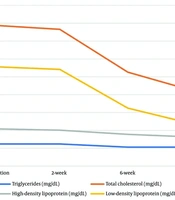
At the 12-week follow-up, the patient had lost 2.2 kg, with BMI improving to 24.1 kg/m2. Lipogram results (Figure 1) at this visit showed significant improvement, with total cholesterol at 208.8 mg/dL (5.4 mmol/L), high-density lipoprotein at 81.2 mg/dL (2.1 mmol/L), and LDL at 116.0 mg/dL (3.0 mmol/L).
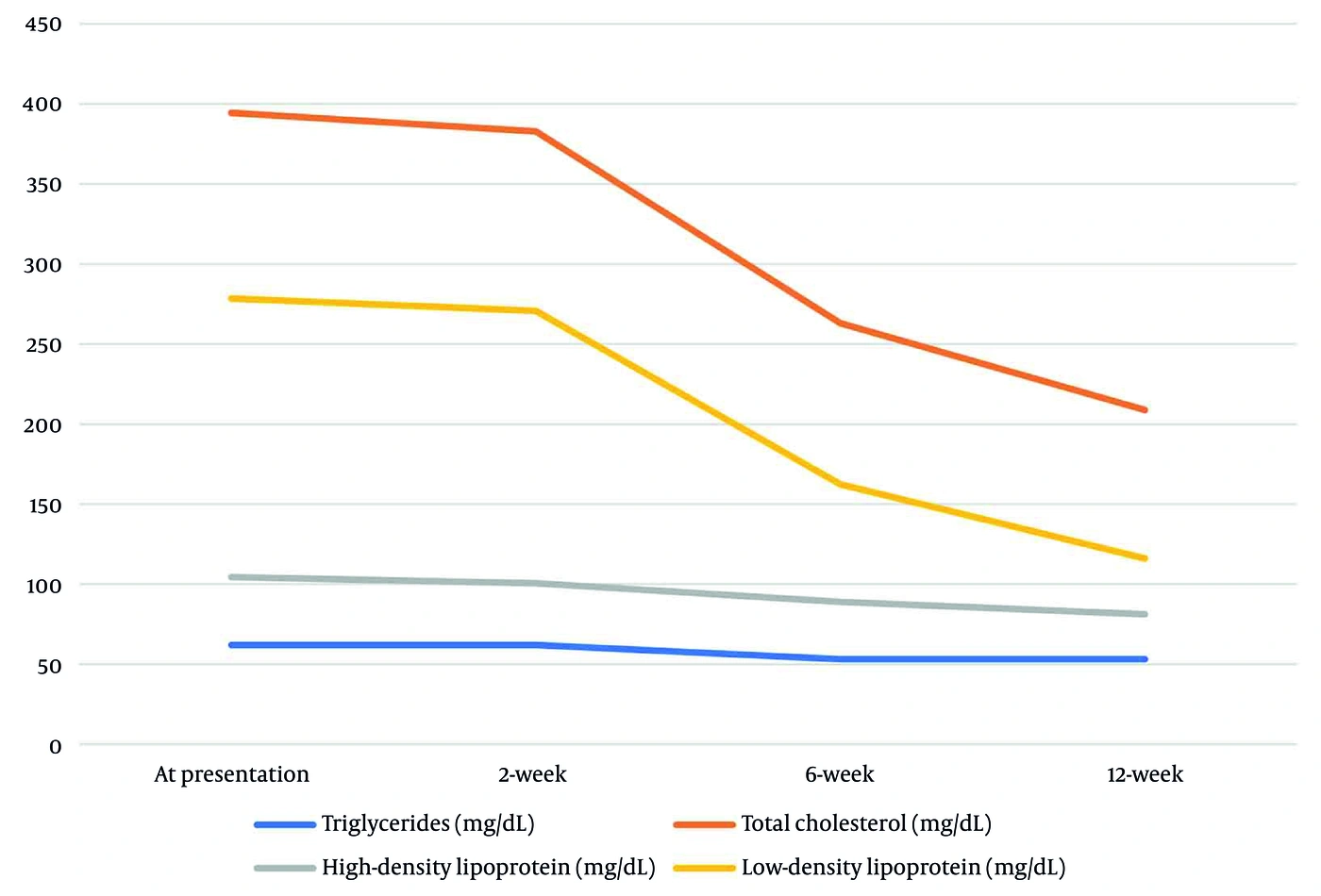
Cholesterol Profile Trend over 12-week course of caffeine abstinence
Figure 1.
Cholesterol Profile Trend over 12-week course of caffeine abstinence
A comprehensive overview of the patient’s sequential lipid profile, detailed in Table 2, illustrates the chronological trends and fluctuations in lipid levels over the 12-week monitoring period.
Table 2.
Serial Cholesterol Profile of the Patient
VariablesReference RangeAt Presentation2-week6-week12-week
Triglycerides< 203.7 mg/dL (2.3 mmol/L)62.0 mg/dL (0.7 mmol/L)62.0 mg/dL (0.7 mmol/L)53.1 mg/dL (0.6 mmol/L)53.1 mg/dL (0.6 mmol/L)
Total cholesterol< 201.1 mg/dL (5.2 mmol/L)394.4 mg/dL (10.2 mmol/L)382.8 mg/dL (9.9 mmol/L)262.9 mg/dL (6.8 mmol/L)208.8 mg/dL (5.4 mmol/L)
High-density Lipoprotein> 56.1 mg/dL (1.45 mmol/L)104.4 mg/dL (2.7 mmol/L)100.5 mg/dL (2.6 mmol/L)88.9 mg/dL (2.3 mmol/L)81.2 mg/dL (2.1 mmol/L)
Low-density lipoprotein< 100.5 mg/dL (2.6 mmol/L)278.4 mg/dL (7.2 mmol/L)270.7 mg/dL (7.0 mmol/L)162.4 mg/dL (4.2 mmol/L)116.0 mg/dL (3.0 mmol/L)

3. Discussion

This case highlights a significant reduction in total cholesterol and LDL levels in a 35-year-old man after 12 weeks of abstaining from heavy unfiltered coffee consumption (5 to 10 cups daily), facilitated by a structured SDM framework. The clinical presentation demonstrates that incorporating dietary habits into discussions about cholesterol management can yield favorable outcomes, particularly for patients motivated to pursue nonpharmacological interventions.
The association between unfiltered coffee and elevated serum lipid levels is well documented in the literature (7, 8). Historical data, including the Tromsø heart study, established that abstaining from boiled or unfiltered coffee reduces serum cholesterol (9, 10). This lipid-raising effect is primarily attributed to cafestol, a diterpene that interacts with the farnesoid X receptor and pregnane X receptor (11). Cafestol suppresses the expression of cholesterol 7 alpha-hydroxylase (CYP7A1), slowing the conversion of cholesterol into bile acids and resulting in serum LDL accumulation (11). Conversely, recent literature suggests that other preparation methods, such as filtered or soluble green coffee, do not have the same adverse lipid profiles and may even reduce cardiovascular risk markers (12, 13).
The successful implementation of this targeted dietary modification underscores the value of the Elwyn "Three-Talk" model in routine practice. By deliberately dedicating time to validate the patient's self-directed research during the "Team Talk" phase, the clinician built essential rapport. The subsequent "Option Talk" directly addressed the patient's specific concerns regarding statin-induced myopathy and its potential interference with his high-intensity training. By shifting from a prescriptive approach to a collaborative partnership, the patient took ownership of the intervention, resulting in complete adherence and improved metabolic outcomes without the need for immediate medication.
However, this report has several limitations. As a single-subject observational case relying on self-reported dietary adherence, the findings are susceptible to recall bias and lack generalizability. Furthermore, the observed improvements in the lipid profile cannot be attributed solely and definitively to coffee abstinence or the SDM process. Other uncontrolled variables, such as underlying metabolic shifts, unrecorded dietary changes, or modifications in physical activity, may also have influenced the outcomes. Future randomized controlled trials involving diverse populations are needed to establish causality and evaluate the broader clinical applicability of SDM in nutritional management.

3.1. Conclusions

This case illustrates that dyslipidemia can be effectively managed without immediate pharmacological intervention when targeted dietary modifications are implemented within a structured SDM framework. By actively engaging the patient and aligning treatment options with the patient’s lifestyle values, the clinician achieved complete adherence to the dietary protocol. Fostering structured, collaborative communication remains a vital tool for improving patient compliance and achieving sustainable clinical outcomes.
Footnotes

  • AI Use Disclosure:The authors declare that no generative AI tools were used in the creation of this article.

  • Authors' Contribution:Conceptualization, Supervision, Manuscript Review and Editing, and Corresponding Authorship: S. H. L.; Data Curation, Data Analysis, and Writing – Original Draft: M. Y. L. and H. C. W. All authors reviewed and approved the final manuscript.

  • Conflict of Interests Statement:The authors declare no conflicts of interest related to this study.

  • Data Availability:The dataset presented in this study is available upon request from the corresponding author during manuscript submission or after publication. The data are not publicly available because of privacy and ethical restrictions related to patient confidentiality.

  • Ethical Approval:This case report was registered with the Malaysian National Medical Research Register (NMRR ID-24-00937-2WM) and was exempt from ethical review because it was strictly observational.

  • Funding/Support:No public or commercial funding was received for the publication of this case report.

  • Informed Consent:The patient provided consent for publication of the results. No personal information will be disclosed, and the patient will not be identified when the results of the case report study are published.

References

  • 1.
    Mach F, Baigent C, Catapano AL, Koskinas KC, Casula M, Badimon L, et al. 2019 ESC/EAS Guidelines for the management of dyslipidaemias: Lipid modification to reduce cardiovascular risk. Eur Heart J. 2020;41(1):111-188. [PubMed ID: 31504418]. https://doi.org/10.1093/eurheartj/ehz455.
  • 2.
    Grundy SM, Stone NJ, Bailey AL, et al. 2018 AHA/ACC guideline on the management of blood cholesterol. Circulation. 2019;139(25):e1082-e1143.
  • 3.
    Föger B, Jennings C, Pirillo A, Tokgözoğlu L, Pirro M, Catapano AL. Hypercholesterolemia and cardiovascular disease: What to do before initiating pharmacological therapy. Atheroscler Suppl. 2020;42:e25-e29. [PubMed ID: 33589220]. https://doi.org/10.1016/j.atherosclerosissup.2021.01.005.
  • 4.
    Charles C, Gafni A, Whelan T. Shared decision-making in the medical encounter: What does it mean? (Or it takes at least two to tango). Soc Sci Med. 1997;44(5):681-692. [PubMed ID: 9032835]. https://doi.org/10.1016/S0277-9536(96)00221-3.
  • 5.
    Ting HH, Brito JP, Montori VM. Shared decision making: Science and action. Circ Cardiovasc Qual Outcomes. 2014;7(2):323-327. [PubMed ID: 24496298]. https://doi.org/10.1161/CIRCOUTCOMES.113.000288.
  • 6.
    Dennison Himmelfarb CR, Beckie TM, Allen LA, Commodore-Mensah Y, Davidson PM, Lin G, et al. Shared decision-making and cardiovascular health: A scientific statement from the American heart association. Circulation. 2023;148(11):912-931. [PubMed ID: 37577791]. https://doi.org/10.1161/CIR.0000000000001162.
  • 7.
    Schoeneck M, Iggman D. The effects of foods on LDL cholesterol levels: A systematic review. Nutr Metab Cardiovasc Dis. 2021;31(5):1325-1338.
  • 8.
    Urgert R, Katan MB. The cholesterol-raising factor from coffee beans. Annu Rev Nutr. 1997;17(1):305-324. [PubMed ID: 9240930]. https://doi.org/10.1146/annurev.nutr.17.1.305.
  • 9.
    Førde OH, Knutsen SF, Arnesen E, Thelle DS. The Tromsø heart study: Coffee consumption and serum lipid concentrations. Br Med J. 1985;290(6472):893-895.
  • 10.
    Wei M, Macera CA, Hornung CA, Blair SN. The impact of changes in coffee consumption on serum cholesterol. J Clin Epidemiol. 1995;48(10):1189-1196. [PubMed ID: 7561980]. https://doi.org/10.1016/0895-4356(95)00023-W.
  • 11.
    Guercia E, Berti F, De Zorzi R, Navarini L, Geremia S, Medagli B, et al. On the cholesterol raising effect of coffee diterpenes cafestol and 16-O-methylcafestol: Interaction with farnesoid X receptor. Int J Mol Sci. 2024;25(11):6096. [PubMed ID: 38892285]. [PubMed Central ID: PMC11173301]. https://doi.org/10.3390/ijms25116096.
  • 12.
    Martínez-López S, Sarriá B, Mateos R, Bravo-Clemente L. Moderate consumption of a soluble green/roasted coffee rich in caffeoylquinic acids reduces cardiovascular risk markers: Results from a randomized, cross-over, controlled trial in healthy and hypercholesterolemic subjects. Eur J Nutr. 2019;58(2):865-878. [PubMed ID: 29858625]. https://doi.org/10.1007/s00394-018-1726-x.
  • 13.
    Zhang WL, Lopez-Garcia E, Li TY, Hu FB, van Dam RM. Coffee consumption and risk of cardiovascular events and all-cause mortality among women with type 2 diabetes. Diabetologia. 2009;52(5):810-817. [PubMed ID: 19266179]. [PubMed Central ID: PMC2666099]. https://doi.org/10.1007/s00125-009-1311-1.

Copyright

Copyright © 2026, International Journal of Cardiovascular Practice. This open-access article is available under the Creative Commons Attribution 4.0 (CC BY 4.0) International License (https://creativecommons.org/licenses/by/4.0/), which allows for the copying and redistribution of the material only for noncommercial purposes, provided that the original work is properly cited.

Similar Articles

3
Apr
2018
Effect of life style modification on adherence to diet and hypertension in hypertensive patients

Effect of life style modification on adherence to diet and hypertension in hypertensive patients

Atharalsadat Mirkarimi,
Homeira Khoddam,
Mohammad Ali Vakili,
Mohammad Bagher Sadeghi,
Mahnaz Modanloo

Mirkarimi A, Khoddam H, Vakili MA, Sadeghi MB, Modanloo M. Effect of life style modification on adherence to diet and hypertension in hypertensive patients. Koomesh. 2018;20(2):e152949. doi:

24
Jan
2017
Evaluation of a Clinical Decision Support System for Dyslipidemia Treatment (HTE-DLPR) by QoE questionnaire

Evaluation of a Clinical Decision Support System for Dyslipidemia Treatment (HTE-DLPR) by QoE questionnaire

Alberto Zamora,
Carme Carrion,
Marta Aymerich,
Xavier Castells,
Lidia Blanco,
Anabel Martin-Urda
,et al.

Zamora A, Carrion C, Aymerich M, Castells X, Blanco L, et al. Evaluation of a Clinical Decision Support System for Dyslipidemia Treatment (HTE-DLPR) by QoE questionnaire. Int J Cardiovasc Pract. 2017;2(1):e130057. doi: https://doi.org/10.21859/ijcp-020105

31
Jul
2025
Comparing the Effectiveness of Group Discussion and SMS-Based Education on Nutritional Status, Physical Activity, and Blood Cholesterol Levels in Women with Elevated Cholesterol: A Randomized Controlled Trial

Comparing the Effectiveness of Group Discussion and SMS-Based Education on Nutritional Status, Physical Activity, and Blood Cholesterol Levels in Women with Elevated Cholesterol: A Randomized Controlled Trial

Hossein Ashtarian,
Neda Yavari,
Behrooz Hamzeh,
Afshin Almasi

Ashtarian H, Yavari N, Hamzeh B, Almasi A. Comparing the Effectiveness of Group Discussion and SMS-Based Education on Nutritional Status, Physical Activity, and Blood Cholesterol Levels in Women with Elevated Cholesterol: A Randomized Controlled Trial. Int J Endocrinol Metab. 2025;23(3):e160891. doi: https://doi.org/10.5812/ijem-160891

12
Aug
2020
The Effect of Using the Question Prompt List on Shared Decision Making, Self-Efficacy in Decision Making, and Preferences for Participation Among Women with Breast Cancer: A Study Protocol

The Effect of Using the Question Prompt List on Shared Decision Making, Self-Efficacy in Decision Making, and Preferences for Participation Among Women with Breast Cancer: A Study Protocol

Reza Negarandeh,
Zahra Yazdani,
Rebecca Lehto,
Marzieh Lashkari

Negarandeh R, Yazdani Z, Lehto R, Lashkari M. The Effect of Using the Question Prompt List on Shared Decision Making, Self-Efficacy in Decision Making, and Preferences for Participation Among Women with Breast Cancer: A Study Protocol. Int J Cancer Manag. 2020;13(8):e103873. doi: https://doi.org/10.5812/ijcm.103873

21
Jun
2026
Current Trends in Lipid-Lowering Target Therapy

Current Trends in Lipid-Lowering Target Therapy

Mahdi Rahmanian,
Alireza Arjangzadeh,
Soorena Khorshidi,
Zahra Rahmanian,
Reza Elmafshar,
Hamed Bazrafshan Drissi

Rahmanian M, Arjangzadeh A, Khorshidi S, Rahmanian Z, Elmafshar R, et al. Current Trends in Lipid-Lowering Target Therapy. Int Cardiovasc Res J. 2026;20(1):e169719. doi: https://doi.org/10.69107/icrj-169719

More by these authors

Soo How LimPubMedScholar
Hong Chin WeePubMedScholar
Ming Yao LimPubMedScholar
Share
Cited by
Metrics