
1. Context
Cardiovascular diseases are the leading cause of death globally, accounting for approximately one-third of all deaths worldwide (1). Dyslipidemia refers to abnormal plasma lipid levels resulting from dysfunctional lipid metabolism and increases the risk of atherosclerotic cardiovascular diseases (ASCVD) (2).
A standard lipid profile includes plasma levels of low-density lipoprotein cholesterol (LDL-C), high-density lipoprotein cholesterol (HDL-C), total cholesterol, and triglycerides. Typically, a standard lipid profile is characterized by LDL-C levels of less than 100 mg/dL, HDL-C levels above 40 mg/dL in men and 50 mg/dL in women, total cholesterol levels below 200 mg/dL, and triglyceride levels below 150 mg/dL (3).
Dyslipidemia is divided into primary and secondary types. Primary dyslipidemias, including familial hypercholesterolemia, chylomicronemia, familial combined hyperlipidemia, and familial dysbetalipoproteinemia, are caused by genetic mutations. Secondary dyslipidemia is caused by poor lifestyle habits or medical conditions, such as alcohol consumption, smoking, obesity, diabetes mellitus, hypothyroidism, chronic kidney disease, impaired liver function, and certain medications, including corticosteroids, beta-blockers, oral contraceptives, and antiretroviral agents (2, 4).
Dyslipidemia is a modifiable risk factor that can be managed with lipid-lowering medications in addition to lifestyle modification (5). In recent decades, gene therapy has also been developed as a lipid-lowering intervention (6).
This narrative review first reviews lipid-lowering medications. It then discusses lipid-lowering gene therapy and the management of dyslipidemia according to the guidelines of the European Society of Cardiology (ESC)/European Atherosclerosis Society (EAS) and the American College of Cardiology (ACC)/American Heart Association (AHA).
2. Evidence Acquisition
This narrative mini-review included the most relevant articles on lipid-lowering target therapy, pharmacological interventions, genetic interventions, and guideline-based management of dyslipidemia, without time restriction.
3. Results
3.1. Lipid-Lowering Medications
3.1.1. Approved Medications
3.1.1.1. Statins
Hydroxymethylglutaryl-CoA (HMG-CoA) reductase inhibitors, commonly known as statins, are the primary pharmacological treatment for various types of dyslipidemia. The FDA-approved statins are atorvastatin, rosuvastatin, simvastatin, pravastatin, fluvastatin, lovastatin, and pitavastatin (7).
Statins act as competitive inhibitors of HMG-CoA reductase in hepatocytes by blocking the conversion of 3-hydroxy-3-methylglutaryl-CoA to mevalonate, the first and rate-limiting step in cholesterol biosynthesis. In addition, statins increase LDL-C receptor transcription in hepatocytes, leading to decreased serum LDL-C and VLDL-C levels. Statins also lower triglyceride and apolipoprotein B levels and increase HDL-C levels (8, 9).
Statins are commonly prescribed to lower lipid levels for the primary and secondary prevention of ASCVD, including peripheral artery disease, stroke, and coronary artery disease (CAD) (10, 11). Primary prevention of ASCVD, which aims to prevent disease onset, includes statin therapy as the primary pharmacological intervention in addition to lifestyle modification (12). Statins also play a substantial role in the secondary prevention of ASCVD, which focuses on reducing mortality and morbidity in patients with high and very high ASCVD risk by preventing future cardiovascular events (13).
Statins have pleiotropic effects, meaning that they exert cholesterol-independent effects. They help stabilize coronary plaques and reduce the risk of cardiovascular events. They also reduce serum levels of several inflammatory markers, including tumor necrosis factor alpha (TNF-α), interleukin-6 (IL-6), IL-8, C-reactive protein, and serum amyloid A. Moreover, statins decrease tissue factor expression and platelet aggregation, thereby reducing procoagulant activity and producing an antithrombotic effect. In addition, statins reduce the expression of major histocompatibility complex class II (MHC-II) and immunoregulatory molecules, such as CD3, CD4, CD8, CD28, CD40, and CD80. They also enhance myocardial blood flow by increasing nitric oxide synthase activity. Collectively, these pleiotropic effects help prevent cardiovascular events (14, 15). Perioperative statin use has shown promising effects in reducing postoperative complications after noncardiac surgery (16, 17).
3.1.1.2. Ezetimibe
Ezetimibe is the second most widely used non-statin lipid-lowering agent for reducing LDL-C levels. It is commonly used as first-line pharmacological therapy, often in combination with statins, to effectively reduce serum total cholesterol, LDL-C, and apolipoprotein B levels in patients with primary hyperlipidemia (18). Ezetimibe inhibits cholesterol absorption at the brush border of the small intestine by binding to the Niemann-Pick C1-like 1 (NPC1L1) protein, a key mediator of cholesterol absorption (19). Studies have shown that ezetimibe provides an additive reduction in LDL-C when added to statins, demonstrating benefit in both the primary and secondary prevention of ASCVD (20, 21).
3.1.1.3. Fibrates
Fibrates are lipid-lowering medications that reduce serum triglyceride, total cholesterol, LDL-C, and apolipoprotein B levels and increase HDL-C levels. These drugs include gemfibrozil, fenofibrate, bezafibrate, and ciprofibrate (22). Fibrates are prodrugs that are activated in hepatocytes. Their primary mechanism of action involves increasing lipoprotein lipase activity by activating peroxisome proliferator-activated receptors (PPARs), which are nuclear hormone receptors. Moreover, fibrates can modulate the interaction between LDL-C receptors and their ligands, thereby promoting receptor-mediated LDL-C clearance. In addition, fibrate-stimulated upregulation of apolipoprotein A in hepatocytes increases serum HDL-C levels (23). In severe hypertriglyceridemia, fibrates are the drugs of choice for preventing pancreatitis (24). Fibrate use should be monitored with liver and kidney function tests. In rare cases, fibrates can cause pancytopenia (25).
3.1.1.4. Proprotein Convertase Subtilisin/Kexin Type 9 Inhibitors
Proprotein convertase subtilisin/kexin type 9 (PCSK9) is a regulator of the LDL-C receptor. Gain-of-function mutations in the PCSK9 gene reduce LDL-C receptor levels on hepatocyte surfaces, leading to LDL-C hypercholesterolemia. Alirocumab and evolocumab are monoclonal antibodies with marked effects on reducing plasma LDL-C. They also modestly increase HDL-C levels (26). Moreover, alirocumab and evolocumab have shown promising effects in reducing lipoprotein (a) (27).
Inclisiran is a double-stranded small interfering RNA that stimulates the breakdown of PCSK9 mRNA, leading to reduced translation of PCSK9 in hepatocytes and, subsequently, reduced plasma LDL-C levels (28).
3.1.1.5. Bempedoic Acid
Bempedoic acid is a cholesterol-lowering agent that inhibits cholesterol synthesis through the same pathway as statins. It reduces serum LDL-C and apolipoprotein B levels. Bempedoic acid is administered as a prodrug that undergoes hepatic metabolism to generate its active form, bempedoyl coenzyme A. Activated bempedoyl coenzyme A decreases the activity of 3-hydroxy-3-methyl-glutaryl-coenzyme A reductase, resulting in reduced cholesterol synthesis in hepatocytes (29, 30). The activation of bempedoic acid is mediated by long-chain acyl-CoA synthetase I, which is primarily expressed in the liver and is not found in skeletal muscle. Therefore, bempedoic acid is a suitable alternative to statins in cases of statin-induced myotoxicity (31).
3.1.1.6. Lomitapide
Lomitapide is used to lower LDL-C, apolipoprotein B, non-HDL-C, and lipoprotein (a) levels. It is beneficial for treating patients with homozygous familial hypercholesterolemia who have an insufficient response to PCSK9 inhibitors. Lomitapide inhibits the synthesis of apolipoprotein B-containing lipoproteins by binding to microsomal triglyceride transfer protein in the endoplasmic reticulum lumen of hepatocytes and enterocytes (32).
3.1.1.7. Volanesorsen
Volanesorsen is an antisense oligonucleotide that prevents the translation of apolipoprotein C-III. Apolipoprotein C-III increases triglyceride levels by inhibiting lipoprotein lipase. In severe hypertriglyceridemia, often caused by familial chylomicronemia, volanesorsen is prescribed to lower plasma triglyceride levels and prevent acute pancreatitis (33).
3.1.1.8. Evinacumab
Evinacumab is an LDL-C-lowering agent administered as an adjunct treatment in children and adults with homozygous familial hypercholesterolemia. Evinacumab is a monoclonal antibody that inhibits angiopoietin-like protein 3, a major regulator of lipid metabolism that blocks lipoprotein lipase and endothelial lipase (34).
3.1.1.9. Omega-3 Fatty Acids
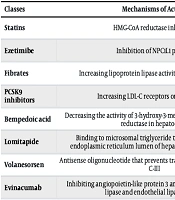
Omega-3 fatty acids are polyunsaturated fatty acids found abundantly in certain foods, such as flaxseed and fish. Alpha-linolenic acid (ALA), eicosapentaenoic acid (EPA), and docosahexaenoic acid (DHA) are the 3 main types of omega-3 fatty acids (35). Omega-3 supplementation has been shown to reduce triglyceride and LDL-C levels; however, it can also modestly increase LDL-C levels (36). Omega-3 fatty acids lower triglyceride levels by promoting fatty acid oxidation, thereby inhibiting hepatic lipogenesis and VLDL-C production. In addition, omega-3 fatty acids can inhibit intestinal triglyceride hydrolysis, thereby reducing lipid absorption (37) (Table 1).
Table 1.
Approved Lipid-Lowering Medications
| Classes | Mechanisms of Action | Primary Effects | Indications |
|---|---|---|---|
| Statins | HMG-CoA reductase inhibitors | ↓LDL-C, ↓TG, ↑HDL-C | Hypercholesterolemia, hypertriglyceridemia, cardioprotective effects |
| Ezetimibe | Inhibition of NPC1L1 protein | ↓LDL-C | Combination therapy with statins in primary hyperlipidemia, cardioprotective effects |
| Fibrates | Increasing lipoprotein lipase activity by activating PPAR | ↓TG, ↓LDL-C | Prevention of pancreatitis in severe hypertriglyceridemia |
| PCSK9 inhibitors | Increasing LDL-C receptors on hepatocytes | ↓LDL-C, ↑HDL-C, ↓ lipoprotein (a) | Hypercholesterolemia |
| Bempedoic acid | Decreasing the activity of 3-hydroxy-3-methyl-glutaryl-coenzyme A reductase in hepatocytes | ↓LDL-C | Hypercholesterolemia, statin-induced myotoxicity |
| Lomitapide | Binding to microsomal triglyceride transfer protein in the endoplasmic reticulum lumen of hepatocytes and enterocytes | ↓LDL-C, ↓ lipoprotein (a) | Homozygous familial hypercholesterolemia |
| Volanesorsen | Antisense oligonucleotide that prevents translation of apolipoprotein C-III | ↓TG | Familial chylomicronemia |
| Evinacumab | Inhibiting angiopoietin-like protein 3 and increasing lipoprotein lipase and endothelial lipase activity | ↓LDL-C | Homozygous familial hypercholesterolemia |
| Omega-3 fatty acids | Inhibiting hepatic lipogenesis and VLDL-C production | ↓LDL-C, ↓TG | Hypercholesterolemia, hypertriglyceridemia |
3.1.2. Withdrawn or Phased-Out Medications
3.1.2.1. Mipomersen
Mipomersen is a lipid-lowering drug indicated as an adjunct treatment for homozygous familial hypercholesterolemia. It is an antisense oligonucleotide that targets apolipoprotein B mRNA, leading to its degradation. It effectively reduces LDL-C, apolipoprotein B, and non-HDL-C levels. However, the FDA has withdrawn mipomersen (38).
3.1.2.2. Niacin
Niacin, also known as vitamin B3, is a combination of nicotinic acid and nicotinamide and was among the first drugs approved for treating dyslipidemia. It reduces serum triglyceride, total cholesterol, LDL-C, and lipoprotein (a) levels. Niacin decreases hepatic triglyceride synthesis by inhibiting diacylglycerol acyltransferase. Reduced triglyceride synthesis leads to increased degradation of apolipoprotein B and, subsequently, decreased LDL-C levels. Moreover, niacin increases the expression of PPARs, thereby elevating HDL-C levels (39). Niacin administration can be associated with hyperglycemia, hepatotoxicity, hypotension, and impaired coagulation function. With the emergence of newer and safer non-statin lipid-lowering medications, niacin use has decreased significantly and is being phased out (40).
3.1.3. Investigational Therapies
3.1.3.1. Lepodisiran
Although still under investigation, lepodisiran is a short-interfering RNA that degrades the mRNA encoding apolipoprotein (a) and has shown a promising effect in reducing plasma lipoprotein (a) levels (41).
3.1.3.2. Gene Therapy
Gene therapy for dyslipidemias includes gene-transfer and gene-editing approaches. In the gene-transfer method, a copy of a functional gene is integrated into the genome of a recombinant adeno-associated virus and delivered to human cells (42). Alipogene tiparvovec is a gene-transfer therapeutic approach for familial lipoprotein lipase deficiency, which is characterized by hypertriglyceridemia and severe pancreatitis (6, 43).
Gene-editing treatment options focus on directly restoring or disrupting endogenous genes. These therapies often use the CRISPR/Cas system, which creates double-strand DNA breaks that are repaired via nonhomologous end joining. In addition, advanced CRISPR/Cas-derived techniques, such as base editing, prime editing, and epigenome editing, are used to refine targeted genes in human DNA. Gene-editing techniques for the treatment of dyslipidemia aim to target genes encoding the LDL-C receptor, apolipoprotein B, PCSK9, angiopoietin-like 3, and apolipoprotein C3. Although gene therapy can be long lasting, it remains suboptimal for many patients with dyslipidemia, and most approaches are still in the preclinical phase (44).
3.2. Management of Dyslipidemias
3.2.1. Lifestyle Modification
The first and most important step in the treatment of dyslipidemia is lifestyle modification. Lifestyle modification to address dyslipidemia should include dietary adjustment, weight management, physical activity, and smoking and alcohol cessation (5). A diet rich in fiber, plant sterols, antioxidants, and unsaturated fats, including omega-3 and omega-6 fatty acids, has proven effective in treating dyslipidemia. This healthy diet helps lower total cholesterol, LDL-C, and triglyceride levels while increasing HDL-C levels (45). Obesity and overweight impose low-grade chronic inflammation on the body, which can trigger ASCVD. Patients with dyslipidemia should aim to maintain a healthy weight to reduce ASCVD risk (46). Physical activity reduces the risk of ASCVD by lowering blood pressure, promoting weight loss, decreasing the risk of diabetes mellitus, and improving the lipid profile (47). Exercise increases triglyceride uptake by skeletal muscle cells. Moreover, exercise reduces PCSK9 expression, thereby lowering serum LDL-C levels. Increased physical activity also enhances hepatic cholesterol uptake by increasing ATP-binding cassette transporter A1 expression in macrophages (48). Smoking causes chronic systemic inflammation and increases ASCVD risk by increasing endothelial damage, platelet aggregation, and oxidative stress (49). It also promotes dyslipidemia by increasing LDL-C and triglyceride levels and decreasing HDL-C levels (50). Excessive alcohol consumption is also linked to increased triglyceride and LDL-C levels (51).
3.2.2. Pharmacological Interventions
According to guidelines recommended by the ESC/EAS and ACC/AHA, ASCVD risk assessment is the initial step in treating dyslipidemia (52, 53). The 10-year ASCVD risk score classifies patients with dyslipidemia by estimating the likelihood of developing an ASCVD event within 10 years. The ESC/EAS recommends using the Systematic Coronary Risk Estimation (SCORE) ASCVD calculator, which uses age, sex, systolic blood pressure, total cholesterol, HDL-C, and current smoking status as inputs for adults aged 40 to 89 years. The SCORE risk estimator classifies patients into low-risk (<1%), moderate-risk (≥1% and < 5%), high-risk (≥5% and < 10%), and very-high-risk (≥10%) categories. SCORE2 is a newer, more age-specific risk prediction algorithm recommended by the ESC/EAS that focuses on both cardiovascular disease mortality and morbidity in individuals aged 40 to 69 years (54). SCORE2-OP provides a risk prediction algorithm tailored for people aged 70 to 89 years (55).
The ACC/AHA guidelines recommend using the Pooled Cohort Equations (PCE), which consider age (20 - 79 years), sex, systolic and diastolic blood pressure, total cholesterol, HDL-C, a history of diabetes and hypertension, and smoking status. Based on the PCE, patients are categorized as low risk (< 5%), borderline risk (5% to 7.4%), intermediate risk (7.5% to 19.9%), and high risk (≥ 20%) (53). Individuals with documented ASCVD, diabetes mellitus, very high individual risk factors, such as familial hypercholesterolemia, or chronic kidney disease are categorized as being at high or very high risk without using ASCVD risk estimators (53, 54).
Based on the ESC/EAS guideline, LDL-C targets for patients with low, moderate, high, very high, and extreme 10-year ASCVD risk scores are < 116 mg/dL, < 100 mg/dL, < 70 mg/dL, < 55 mg/dL, and 40 mg/dL, respectively. Moreover, the non-HDL-C targets are < 145 mg/dL for low-risk patients, <130 mg/dL for moderate-risk patients, <100 mg/dL for high-risk patients, and < 80 mg/dL for very-high-risk patients. Statins are the first-line pharmacological treatment for dyslipidemia. The ESC/EAS guideline recommends moderate-intensity statins for patients with moderate or low ASCVD risk and high-intensity statins for those with high or very high ASCVD risk. If cholesterol targets are not achieved, ezetimibe or PCSK9 inhibitors can be added to the treatment regimen, followed by fibrates and omega-3 fatty acids. Plasma lipoprotein (a) levels greater than 50 mg/dL have a likely causal association with a higher risk of ASCVD and aortic valve stenosis. Because statins are not effective against lipoprotein (a), injectable RNA-based therapies, such as lepodisiran, should be considered. Moreover, statin therapy is recommended for individuals with human immunodeficiency virus infection who are 40 years or older as a primary prevention measure for ASCVD, regardless of their plasma LDL-C level. In people with cancer, statin therapy can also reduce anthracycline-induced cardiac dysfunction (56).
For patients with acute coronary syndrome, intensifying lipid-lowering therapy or using combination therapy with a high-intensity statin and ezetimibe during initial hospitalization is important. Approximately 70% of patients with elevated plasma LDL-C cannot reach the optimal goal with statins alone. Therefore, to achieve optimal LDL-C goals and enable initiation of third-line therapy after 4 to 6 weeks, upfront combination therapy with statins and ezetimibe is recommended for patients at very high and extremely high risk (56-58).
According to the ACC/AHA guideline, the LDL-C target is < 100 mg/dL for patients without diabetes mellitus or ASCVD and < 70 mg/dL for patients with diabetes mellitus or ASCVD. Similar to the ESC/EAS guideline, the ACC/AHA guideline recommends statins as the first-line treatment option; however, it recommends moderate-intensity statins for all patients. If cholesterol-lowering targets are not met, high-intensity statins should be followed by ezetimibe or PCSK9 inhibitors (53).
Statins, ezetimibe, PCSK9 inhibitors, fibrates, and omega-3 fatty acids are the most frequently used medications for the treatment of dyslipidemia, whereas other treatment options are reserved for special conditions or remain under investigation. In cases of statin-induced myotoxicity, bempedoic acid can be used instead. Familial chylomicronemia leading to severe hypertriglyceridemia can be treated with volanesorsen. Moreover, evinacumab is frequently used in homozygous familial hypercholesterolemia. Gene-related therapeutic approaches for the treatment of dyslipidemia are still in trials.
3.3. Limitations
Although this narrative review article aimed to provide a thoughtful and practical synthesis of lipid-lowering target therapy, it has several limitations, including subjectivity in study selection due to the lack of a systematic methodology. In addition, this study did not provide a quantitative synthesis.
4. Conclusions
Dyslipidemia is a substantial, modifiable risk factor for ASCVD. Statins are first-line medications that should be used in addition to lifestyle modification to treat most dyslipidemias. Statins are also recommended for both the primary and secondary prevention of ASCVD. In addition, ezetimibe is the drug of choice to add to statins for combination lipid-lowering therapy. Plasma lipoprotein (a) levels are resistant to most lipid-lowering therapies, including statins, and should be managed with combination therapy regimens. The efficacy of gene-related therapeutic approaches for the treatment of dyslipidemia, including gene-transfer and gene-editing methods, needs to be investigated in clinical trials.