
1. Introduction
Based on the 2019 Global Burden of Disease study, the worldwide age-standardized prevalence rate of heart failure (HF) was 711.90 per 100,000 people in 2019 (1). Projections indicate that the number of people with HF could increase by 46%, leading to more than 8 million adults in the US experiencing this condition (2), largely because of an aging population and improved survival rates following myocardial infarction (MI) (3). Among those with congestive heart failure (CHF), about half retain normal systolic function (4). Research consistently shows that individuals with normal or near-normal left ventricular ejection fraction (LVEF) generally have a more favorable prognosis than those with reduced LVEF (5). Depression, a mood disorder with various manifestations, is associated with a higher risk of morbidity and mortality. The overlap between HF symptoms and depressive symptoms complicates the diagnosis of depression in patients with HF. Diagnosing depression remains challenging, resulting in inadequate treatment for many patients with HF. Clinical interviews conducted according to the Diagnostic and Statistical Manual of Mental Disorders (DSM-IV-TR) criteria, together with adherence to strict diagnostic standards, remain the best approach (6). The DSM-IV-TR defines a major depressive episode through a specific set of symptoms (7).
Depression is linked to a heightened risk and worse outcomes for individuals with HF (8, 9). A study involving 4,500 patients with HF revealed that the relative risk of HF among those with depression, compared with those without depression, was 2.6, even after factoring in conventional cardiovascular disease (CVD) risk variables (10). The rates of mortality, clinical events, hospital readmission, and overall healthcare utilization are significantly increased among patients with HF who report experiencing more intense depression (8). A recent cohort study conducted in 2024 revealed that a baseline score greater than 5 points on the Hospital Anxiety and Depression Scale—Depression (HADS-D) is notably linked to an increased risk of the combined outcome of all-cause mortality and hospitalization due to HF (11).
Research shows that depression predicts both the incidence and severity of CVD, raising questions about the mechanisms involved (8). The progression of CHF linked to mental health issues is partially influenced by biological mechanisms, including autonomic dysregulation, neuroendocrine processes, and inflammation. These factors are likely to contribute to an imbalance in the compensatory neurohormonal response that exacerbates CHF progression (12). In addition, several biological and behavioral factors have been identified, including smoking, physical inactivity (13), medication nonadherence (14), low heart rate variability (15), and inflammation (16). Among these, poor health behaviors, particularly physical inactivity, appear to contribute substantially to the increased CVD risk associated with depression (17). HF occurs most frequently in older adults, an age group in which depression is also common. Although most HF cases in older adults are characterized by preserved ejection fraction (HFpEF), limited information is available regarding the relationship between depressive symptoms and the likelihood of developing incident HF with reduced ejection fraction (HFrEF). Progression to clinical HF is driven by structural changes in the heart and dysfunction in both systolic and diastolic function of the left ventricle (LV) (18).
As mentioned above, there is a significant connection between depression and HF, yet this pairing frequently goes undiagnosed and is often treated inadequately. Current guidelines from the European Society of Cardiology (ESC) (19) and the American College of Cardiology/American Heart Association/Heart Failure Society of America (ACC/AHA/HFSA) (20) advocate screening and pharmacologic treatment to lessen morbidity in patients with depression and HF. Given the mixed results from antidepressant trials, it is essential to identify those who might benefit from such treatments. A comprehensive care approach is crucial for managing this growing medical burden in the future (21).
2. Objectives
The current study investigated the impact of escitalopram treatment, compared with placebo, on the hospitalization rate and quality of life of patients with systolic HF and depression.
3. Methods
3.1. Trial Design
This study was a double-blind controlled clinical trial. The clinical trial registration number is IRCT20230510058142N1, and the study was conducted from June 22, 2023, to October 23, 2023. The study was also reported in accordance with the CONSORT guidelines for randomized clinical trials (22).
3.2. Participants
The sample consisted of patients aged 30 to 75 years who were referred to Imam Hossein Hospital. These patients had experienced at least one episode of shortness of breath during minimal activity or at rest and had systolic HF, defined as an LVEF of less than 40%. They were also classified as NYHA functional class III or IV and met the criteria for depression treatment based on the HADS questionnaire. All participants provided informed consent to participate in the study.
Individuals were excluded if they had a history of intolerance to selective serotonin reuptake inhibitors (SSRIs), bipolar disorder, severe personality disorders, strong suicidal thoughts, recent dependence on alcohol or drugs, or were pregnant or breastfeeding.
3.3. Ethics Statements
This randomized clinical study was conducted in accordance with the Declaration of Helsinki. Informed consent was obtained from all participants before the study commenced. The Ethical Committee at Shahid Beheshti University of Medical Sciences (Tehran, Iran) approved the study protocol (IR.SBMU.MSP.REC.1402.047) on June 5, 2023.
3.4. Study Procedure
3.4.1. Data Collection
After registration, participants' clinical histories, including underlying diseases, drug history, and hospitalization history, and left ventricular systolic function were evaluated, and personal information (sex, age, income, insurance, and smoking, alcohol, and opium abuse) was collected. Participants completed the HADS questionnaire, the Patient Health Questionnaire (PHQ-9), and the Minnesota Quality of Life questionnaire.
3.4.2. Questionnaires
In this study, two questionnaires were used to identify depression in patients experiencing depressive symptoms.
1. The HADS, developed by Zigmond and Snaith (23, 24), consists of four items designed to assess mood fluctuations, specifically anxiety and depression. The scale includes seven items related to anxiety symptoms and seven related to depressive symptoms. It is rated on a four-point scale (0, 1, 2, and 3), and the authors suggested a cutoff score of 11; scores above this threshold indicate clinically significant symptoms. Elevated scores on the depression section suggest that additional treatment methods should be explored alongside anxiety management.
2. The PHQ-9, created by Kroenke et al. in 1999 (25), is designed to assess the intensity of depressive symptoms. It consists of 9 questions and has no subscales. Responses are scored on a 4-point Likert scale: “not at all” scores 0, “a few days” scores 1, “more than half the days” scores 2, and “almost every day” scores 3. The possible scores range from 0 to 27, with a score of 12 or higher indicating a diagnosis of depression (26).
In addition, the Minnesota Living with Heart Failure Questionnaire (MLHFQ) (27) was used to assess participants’ quality of life.
3.5. Intervention
After psychiatric consultation, patients who achieved the optimal score for initiating depression treatment were randomly assigned to two groups in a 1:1 ratio. One group received escitalopram 20 mg for 8 weeks, and the other received a placebo. After 8 weeks, patients were followed up using a quality-of-life questionnaire.
3.6. Sample Size
The sample size was calculated as 42 participants per group, providing 81% power to detect superiority using a one-sided, two-sample t-test with unequal variances. The defined superiority margin was 1, assuming a true difference between the means. The significance level (alpha) was set at 0.05. The data were drawn from populations with standard deviations (SD) of 1.7 for group 1 and 1.5 for group 2.
3.7. Randomization
M.H.A generated the randomization concealment using statistical calculator software and a simple randomization method. J.SH. and M.P.M. enrolled the participants, whereas R.S. and F.P. assigned them to the intervention.
3.8. Blinding
This study was double-blind, and F.P. and R.S. blinded participants to whether they were assigned to the escitalopram or placebo group.
3.9. Statistical Analysis
Data evaluation was conducted using SPSS version 24 software. Mean (with standard deviation) was utilized to characterize data that was normally distributed, and frequency (percentage) was used for qualitative data. An independent t-test was implemented to compare the means of quantitative variables and their changes between two groups at the start and conclusion of the study, while the chi-square test or Fisher's exact test was used for qualitative data. A paired t-test was performed to analyze the means of quantitative variables before and after the intervention within each group. To address confounding factors, an adjusted ANCOVA test was conducted for the baseline MLHFQ questionnaire scores and for hypertension (HTN). In this investigation, a P value below 0.05 was considered statistically significant.
4. Results
Of the 240 patients who registered to participate in this study, 90 were included in the randomization phase. Forty-five patients were in the escitalopram group, and forty-five were in the placebo group. During the study, three deaths occurred in the intervention group and six in the control group; ultimately, 81 patients completed the 8-week study. (Figure 1).
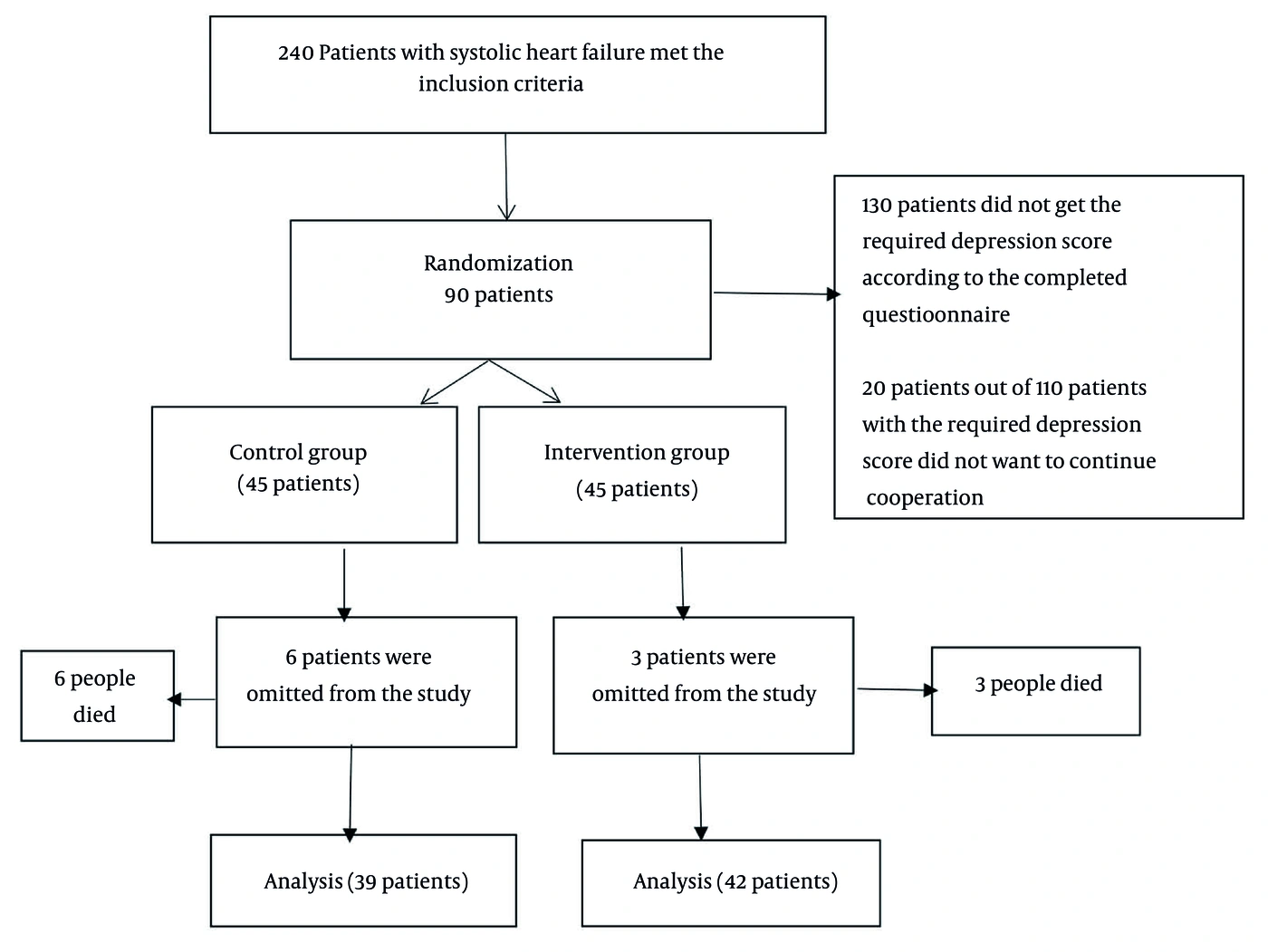
Figure 1.
Participants flow diagram
The mean age of participants was 56 years in the intervention group and 54 years in the control group. The intervention group included 42 individuals (32 men), and the control group included 39 individuals (30 men). Analysis showed no significant differences in age or gender between the two groups.
The findings also showed no notable difference in the types of drugs used by participants in the intervention and control groups at the start of the study.
A notable difference between the intervention and control groups was observed regarding HTN (P value: 0.007). However, there were no significant differences between the groups in other underlying diseases at study onset. Further information about these outcomes is presented in Table 1.
Table 1.
Demographic and Medical Characteristicsa
| Demographics | Group | P-Value | |
|---|---|---|---|
| Interventional (n = 42) | Control (n = 39) | ||
| Age (mean ± SD) | 56.83 ± 12.49 | 54.12 ± 12.09 | 0.326 b |
| Sex | |||
| Male | 32 (76.2) | 30 (76.9) | 1.00 c |
| Drugs | |||
| Diuretics | 0.494 c | ||
| No | 13 (31.00) | 15 (38.5) | |
| Yes | 29 (69.00) | 24 (61.5) | |
| ACEIs | 0.368 c | ||
| No | 22 (52.4) | 25 (64.1) | |
| Yes | 20 (47.6) | 14 (35.9) | |
| ARBs | 0.395 c | ||
| No | 36 (85.7) | 30 (76.9) | |
| Yes | 6 (14.3) | 9 (23.1) | |
| Empagliflozin | 0.630 c | ||
| No | 13 (31.00) | 10 (25.6) | |
| Yes | 29 (69.00) | 29 (74.4) | |
| Sacubitril-valsartan | 0.522 c | ||
| No | 35 (83.3) | 35 (89.7) | |
| Yes | 7 (16.7) | 4 (10.3) | |
| Betablockers | 0.221 c | ||
| No | 14 (33.3) | 8 (20.5) | |
| Yes | 28 (66.7) | 31 (79.5) | |
| Disease (yes/no) | |||
| DM | 1.00 c | ||
| No | 22 (52.4) | 20 (51.3) | |
| Yes | 20 (47.6) | 19 (48.7) | |
| HTN | 0.007 c, e | ||
| No | 26 (61.9) | 12 (30.8) | |
| Yes | 16 (38.1) | 27 (69.2) | |
| CAD | 0.268 c | ||
| No | 26 (61.9) | 19 (48.7) | |
| Yes | 16 (38.1) | 20 (51.3) | |
| CKD | 1.00 d | ||
| No | 39 (92.9) | 37 (94.9) | |
| Yes | 3 (7.1) | 2 (5.1) | |
| CVA | 0.617 d | ||
| No | 39 (92.9) | 38 (97.4) | |
| Yes | 3 (7.1) | 1 (2.6) | |
| RF | 0.714 d | ||
| No | 37 (88.1) | 36 (92.3) | |
| Yes | 5 (11.9) | 3 (7.7) | |
a Values are expressed as No. (%) unless otherwise indicated. Abbreviations: ACEIs, angiotensin-converting enzyme inhibitors; ARBs, angiotensin II type I receptor blockers; DM, diabetes mellitus; HTN, hypertension; CAD, coronary artery disease; CKD, chronic kidney disease; CVA, cerebrovascular accident; RF, respiratory failure.
b P-value for intergroup comparison of quantitative variables using the parametric Independent-Samples t test.
c P-value for intergroup comparison of qualitative variables using the Chi-Square test.
d P-value for intergroup comparison of qualitative variables using Fisher's Exact Test.
e Statistical significance.
Table 2 shows no significant differences between participants in the intervention and control groups regarding income, history of hospitalizations, or insurance status. There was also no significant difference between the groups regarding cigarette, alcohol, or opium use.
Table 2.
Comparison of patients in terms of income, history of hospitalization, insurance, smoking, alcohol, and opium consumption in the studied groupsa
| Variables | Group | P-Value | |
|---|---|---|---|
| Interventional (n = 42) | Control (n = 39) | ||
| Income | 0.855 b | ||
| Low income | 15 (35.7) | 15 (38.5) | |
| Middle income | 23 (54.8) | 19 (48.7) | |
| High income | 4 (9.5) | 5 (12.8) | |
| History of hospitalization | 0.172 c | ||
| No | 20 (47.6) | 12 (30.8) | |
| Yes | 22 (52.4) | 27 (69.2) | |
| Insurance | 0.191 b | ||
| No | 1 (2.4) | 4 (10.3) | |
| Yes | 41 (97.6) | 35 (89.7) | |
| Smoking | 0.471 c | ||
| No | 31 (73.8) | 25 (64.1) | |
| Yes | 11 (26.2) | 14 (35.9) | |
| Alcohol | 0.706 b | ||
| No | 39 (92.9) | 35 (89.7) | |
| Yes | 3 (7.1) | 4 (10.3) | |
| Opium | 1.00 c | ||
| No | 35 (83.3) | 33 (84.6) | |
| Yes | 7 (16.7) | 6 (15.4) | |
a Values are expressed as No. (%).
b P-value for intergroup comparison of qualitative variables using Fisher's Exact Test.
c P-value for intergroup comparison of qualitative variables using the Chi-Square test.
At the start of the study, the mean hospitalization rate was 1.76 ± 2.16 in the intervention group and 2.28 ± 2.13 in the control group (P = 0.280), and the mean PHQ-9 score was 8.09 ± 4.71 and 7.25 ± 4.29, respectively (P = 0.406). Neither difference was statistically significant.
The mean MLHFQ score before the intervention was 32.19 ± 17.78 in the intervention group and 34.69 ± 15.03 in the control group, with no significant difference between the groups (P = 0.498). At the end of the study, the mean scores were 27.69 ± 15.52 and 27.71 ± 11.59, respectively (P = 0.993). Both groups experienced a significant decrease in mean MLHFQ scores throughout the study period (intervention group: −4.50 ± 9.28, P = 0.003; control group: −6.97 ± 10.20, P < 0.001); however, the difference in change between the groups did not reach significance (P = 0.257). Even after adjustment for the baseline MLHFQ score and HTN, the difference remained non-significant (adjusted P = 0.587).
During the study period, hospital readmission occurred in 5 patients (11.9%) in the intervention group and 6 patients (15.4%) in the control group, with no significant difference between the groups (P = 0.751). Further details about these outcomes are presented in Table 3.
Table 3.
Comparison of average hospitalization rate, PHQ-9 questionnaire score, MLHFQ questionnaire score, and hospital readmission rate between the studied groups and in each group before and after the studya
| Variables | Group | P-Value | |
|---|---|---|---|
| Interventional (n = 42) | Control (n = 39) | ||
| Hospitalization rate | 1.76 ± 2.16 | 2.28 ± 2.13 | 0.280 b |
| PHQ-9 score | 8.09 ± 4.71 | 7.25 ± 4.29 | 0.406 b |
| MLHFQ score | 0.587 c, d | ||
| Before intervention | 32.19 ± 17.78 | 34.69 ± 15.03 | 0.498 b |
| After intervention | 27.69 ± 15.52 | 27.71 ± 11.59 | 0.993 b |
| Change | -4.50 ± 9.28 | -6.97 ± 10.20 | 0.257 b |
| P-value | 0.003 e | < 0.001 e | |
| Hospital readmission, No. (%) | 0.751 f | ||
| No | 37 (88.1) | 33 (84.6) | |
| Yes | 5 (11.9) | 6 (15.4) | |
a Values are expressed as mean ± SD unless otherwise indicated. Abbreviations: PHQ-9, Patient Health Questionnaire-9; MLHFQ, Minnesota Living with Heart Failure Questionnaire; HTN, hypertension.
b P-value for intergroup comparison of quantitative variables using the parametric Independent-Samples t test.
c P-value using ANCOVA test adjusted for MLHFQ scores before intervention and HTN.
d Adjusted P-value = 0.587
e P-value for intragroup comparison of quantitative data using the parametric Paired-Samples t test.
f P-value for intergroup comparison of qualitative variables using the Chi-Square test.
5. Discussion
In this randomized trial of patients with chronic systolic HF and depression, escitalopram (20 mg daily for 8 weeks) was well tolerated but did not differ significantly from placebo in quality of life or hospitalization rate. Quality of life, assessed with the MLHFQ, improved significantly within both groups over the study period; however, the between-group difference was not significant, including after adjustment for the baseline MLHFQ score and HTN.
Of the 90 patients randomized (45 per group), 81 completed the study (42 in the escitalopram group and 39 in the placebo group). The groups were comparable at baseline in age (mean, 56 and 54 years in the intervention and control groups, respectively), sex, medication use, income, hospitalization history, insurance, hospitalization rate, MLHFQ score, and PHQ-9 score. The only exception among the underlying conditions was HTN, which was more prevalent in the control group; this imbalance was accounted for in the adjusted analysis.
Depressive disorders, ranging from mild symptoms to major psychiatric comorbidities, pose ongoing challenges in HF and significantly affect patient morbidity and mortality (6), yet the impact of antidepressants on HF outcomes remains unclear. A meta-analysis indicates that antidepressant use may increase the risk of all-cause mortality in these patients, irrespective of depression status or medication type (28). Current evidence only partially supports the safety of SSRIs, with results varying across analyses, and suggests some effectiveness of psychotherapy in patients with HF (6, 28). SSRIs have minimal adverse cardiac effects but may increase the risk of bleeding and QTc prolongation, potentially affect medication levels, and possibly be linked to higher mortality, likely reflecting disease severity (6, 28).
Few studies have investigated the effects of antidepressants on cardiac measures, cardiovascular events, and depression scores, and evidence on escitalopram in HF is particularly limited. Most available studies have focused on sertraline, whereas escitalopram is considered a superior treatment for primary depression (29). Similarly, most studies have enrolled patients who were post-MI, and few studies have been conducted in patients with HF. Given the scarcity of direct evidence on escitalopram, we first compare our findings with existing trials in patients with HF and then, as an indirect reference, with studies of sertraline in patients with acute coronary events, because sertraline is the most frequently studied antidepressant in cardiac populations. Escitalopram was chosen for the present trial because its superior effectiveness in primary depression has been confirmed in various superiority studies.
Our findings are consistent with those of randomized trials in patients with HF. In the study by Christiane E. Angermann et al. (30), escitalopram did not reduce mortality or hospitalization in patients with chronic HF with reduced LVEF and depression after 18 months of treatment, nor did it improve depressive symptoms (Montgomery-Åsberg Depression Rating Scale score) compared with placebo, raising questions about its efficacy in this population. Similarly, in the study by Christopher M. O'Connor et al. (31), sertraline was safe in patients with severe HF but did not significantly improve depression or cardiovascular status compared with placebo.
In contrast, studies of sertraline in patients with acute coronary events have reported some benefits. Mohapatra et al. (32) found a greater reduction in depression scores and fewer cardiac events with sertraline in patients with acute MI. In the study by Glassman et al. (33), sertraline had no significant effect on LVEF or other cardiac measures in patients with acute MI or unstable angina, but it was associated with a lower incidence of severe cardiovascular events and better Clinical Global Impression Improvement scores, particularly in patients with a history of depression, although the difference in Hamilton Depression Rating Scale scores was not significant.
More broadly, SSRIs are frequently recommended for treating depression, and a meta-analysis found sertraline and citalopram to be more effective and more acceptable than other modern antidepressants (29). Randomized trials in patients with coronary artery disease indicate that SSRIs are safe to use and may alleviate depression, although they do not improve outcomes or decrease hospitalizations in these patients (33). Nevertheless, post hoc analyses of clinical trials in coronary heart disease have suggested that long-term use of SSRIs might decrease both mortality and morbidity (34). The absence of a significant difference in hospitalization rate between the intervention and control groups in our study is consistent with the randomized trials in coronary artery disease described above.
In the current study, assessment of patients after 8 weeks using depression questionnaires based on DSM-IV-TR criteria showed that escitalopram had no effect. This finding contrasts with earlier research in patients with coronary artery disease, in which SSRI treatment led to a notable reduction in depressive symptoms compared with placebo (35). Several explanations for the lack of benefit in our patients with HF can be considered. We present them in order of evidential support: first, explanations grounded in the design and data of this trial and in the existing HF trials; and second, biological hypotheses that were not tested here and remain speculative.
First, the number of participants may have contributed to the neutral results. The sample size of 42 per group was calculated to detect a predefined superiority margin, but the control group had 39 patients because of dropouts and a high mortality rate. Second, the 8-week follow-up was short compared with the 18 months of the HF trial described above, and adherence to the prescribed medications was not closely monitored. Third, both groups improved significantly in MLHFQ scores, which suggests that nonspecific factors, such as optimized HF therapy, regular clinical contact, or placebo response, may have improved quality of life in both arms and masked a specific drug effect; this interpretation could not be tested in our design. The imbalance in HTN and the predominance of men may also have influenced the results. However, because the HF trials discussed above, which used different SSRIs and designs, also reported no benefit, limited sample size alone may not fully explain our findings.
Beyond these study-related factors, two biological explanations have been proposed but were not examined in our trial and therefore remain hypothetical. First, patients with chronic HF use HF-related drugs for a long period, whereas patients with acute coronary events use cardiac drugs for a shorter period, and this chronic exposure might reduce the response to antidepressants. Second, the pathophysiological mechanisms underlying depression in HF, such as autonomic dysregulation, neuroendocrine processes, and inflammation outlined in the Introduction (12), may differ from those in acute coronary disease, which could make depressive symptoms less responsive to SSRIs. Studies specifically designed to test these hypotheses are needed.
Patients with HF who are depressed have an increased mortality risk. Our results indicate that escitalopram does not appear to negatively affect cardiovascular health in these patients, suggesting that it may be a viable treatment option for those who continue to experience depression despite nonpharmacological approaches, although a benefit was not demonstrated in this trial. Moreover, patients with both depression and coronary heart disease may qualify for depression treatment based solely on their cardiac condition.
Considering these points and findings from previous research, our study has notable strengths. It appears to be the first study to examine the effect of escitalopram on quality of life among patients with HF and depression, and its entry and exit criteria were clearly defined. Furthermore, there were no significant differences in confounding factors between the two groups, apart from a higher prevalence of HTN in the control group, which was addressed through statistical adjustment; this suggests minimal variability between the groups. Additional research is necessary to identify the optimal combination of pharmacological and nonpharmacological treatments for depression in individuals with HF.
5.1. Limitation
A reduction in sample size occurred due to the high mortality rate among participants, which resulted in both the intervention and control groups having fewer participants than their predetermined target sample sizes. Additionally, there was inadequate oversight of adherence to the prescribed intervention and control medications. Another issue was the uneven gender distribution across the groups, with a higher number of male participants, which may have influenced the study outcomes, given the higher prevalence of depression among females.
5.2. Conclusions
In patients with chronic HF, reduced LVEF, and depression, escitalopram treatment did not significantly improve depressive symptoms or hospitalization outcomes compared with placebo, and no notable improvement in depressive symptoms was observed. So, we did not find sufficient evidence for the effect of escitalopram in individuals with chronic systolic HF and depression.