
1. Background
Substance use disorder (SUD) is among adults’ most common mental disorders (1). It is common for SUD to co-occur with other mental health disorders. About 50% of persons suffering from persistent mental illness are affected by substance abuse (2). Substance use disorder can negatively impact multiple aspects of the affected person’s life and lead to problems such as social withdrawal, violence, unemployment, academic decline, delinquency, and deterioration of physical and mental health (3).
Multiple theories have been proposed regarding the association between substance use disorder and other psychological factors, including defense mechanisms, personality traits, and attachment styles. Studies have reported that factors such as insecure attachment, unresolved trauma, and abuse/neglect could lead to the development of neurobiological pathways related to addiction (4). Defense mechanisms, a central concept in psychology, are considered fundamental in the formation and function of personality. They are considered “unconscious ego functions” aiming to reduce anxiety. Various models of ego defenses have been proposed and used to categorize defense mechanisms based on their flexibility, maturity, function, and reality distortion (5).
Attachment styles have been widely used to provide theories in interpreting the behavior displayed by an individual as well as their responses to different stimuli and emotional regulation (6). Meyers and Landsberger have described attachment styles as how adults interact, think, and feel within their relationships (7). Attachment styles in childhood correspond to behavior presented in adulthood and can play a role in forming various psychological disorders (8).
Previous studies have reported a link between attachment styles and defense mechanisms and substance use disorder. A study by Besharat et al. found a significant difference in attachment style between opioid users and the control population. Insecure attachment styles were associated with opioid use disorder (9). In addition, a higher prevalence of anxious attachment styles has been reported in smokers compared to non-smokers (10).
A study by Akbari Zardkhaneh et al. reported that immature defense mechanisms were associated with addiction and that emotional intelligence can play a role in substance use disorder (11). Zilberman et al. reported a higher incidence of neuroticism and impulsivity in those struggling with addiction than those who didn’t use substances (12). Wedekind et al. reported an association between insecure attachment style, anxiety, cognitive avoidance to control anxiety, and alcohol addiction (13).
2. Objectives
Considering the prevalence and burden of substance use disorders, this study assessed the possible association between SUD and attachment styles, defense mechanisms, and other demographical factors. It is hoped that by better understanding the factors associated with this phenomenon, more effective measures can be developed for its prevention and treatment (14).
3. Patients and Methods
This case-control study was conducted on 120 participants divided into two groups: 60 patients diagnosed with substance abuse disorder based on the Diagnostic and Statistical Manual of Mental Disorders V (DSM-V) and a group of 60 controls without substance abuse disorder according to DSM-V criteria. The participants were chosen using the convenience sampling method. The substance abuse disorder group were patients referred to Ibn-e-Sina Psychiatric Hospital and 22 Bahman Clinic in Mashhad, Iran, from September 2020 to September 2021. The subjects of the control group were selected from the patients’ companions as well as people available in the community who were eligible to enter the study. They were matched with the substance abuse disorder group in terms of age, sex, level of education, income, and marital status.
The required sample size was calculated by using the G*Power sample size software and determining input coefficients based on the study of Maurya et al. (15), considering a confidence interval of 99% and the test power of 90%, the number of participants in each group was calculated as 60.
The inclusion criteria for the study were as follows: (1) A diagnosis of substance abuse disorder according to DSM-V criteria (for the addiction group); (2) lack of addiction, substance abuse, or history of substance abuse (for the control group); and (3) age between 20 and 40. Accordingly, those with the following criteria were excluded from the study: (1) Active psychosis; (2) active suicidal thoughts; and (3) autism spectrum disorders (ASD).
The study process was thoroughly explained to the participants before the project and informed oral and written consent was obtained from them. In addition, they were informed they were free to leave the study anytime they wished. The participants were all interviewed by a clinical psychiatrist before and during the study. The Revised Collins and Read Adult Attachment Scale (RAAS), the Defense Style Questionnaire (DSQ-40), and a checklist consisting of information regarding age, sex, job, marital status, level of education, history of addiction, and history of psychiatric illnesses were used to assess the subjects. The Revised Collins and Read Adult Attachment Scale assesses attachment styles. This 18-item scale consists of three subscales (6 questions each). The three subscales include the close, depend, and anxiety subscales. The first subscales measure a person’s comfort in intimacy, while the second measures the test-takers’ comfort level depending on and relying on others. The third subscale measures the participant’s worriedness and anxiousness regarding being rejected or abandoned by others (16). The Defense Style Questionnaire is a self-report instrument that investigates defense mechanism styles. This 40-item measure divides defense mechanisms into four categories: immature, neurotic, image-distorting, and mature (16).
The normality of the collected data was checked. Appropriate parametric methods, such as the student’s t test, were used for non-normal data. The chi-square test was used for data in nominal scale, and in cases where more than 20% of the expected frequencies of the tables were less than 5 (Cochran), Fisher’s exact test was used. Multilevel logistic regression was used in the general review. The software used in this research was SPSS v26, and a significance level of 0.05 was considered for all the tests.
The ethics code of this project was registered under IR.IAU.MSHD.REC.1399.181 in Mashhad University of Medical Sciences Ethical Research Committee.
4. Results
In total, 60 substance users and 60 non-users were included in the study and compared in terms of mechanisms of defense and attachment styles. The baseline characteristics are summarized in Table 1. Although the two groups were similar in average age, marital status, and occupational state, substance users have significantly lower educational levels and higher rates of criminal acts and psychological disorders. In the substance user group, the most frequent drug used was methadone at 33.3%, followed by crystal at 26.7% and heroin at 13.3%.
Table 1.
Baseline Characteristics in Substance User and Non-user Groups a
| Characteristics | Substance User (n = 60) | Substance Non-user (n = 60) | P Value |
|---|---|---|---|
| Age (y) | 30.38 ± 6.04 | 29.77 ± 5.86 | 0.571 |
| Marital status | 0.05 | ||
| Single | 31 (51.7) | 25 (41.7) | |
| Married | 29 (48.3) | 35 (58.3) | |
| Job status | 0.126 | ||
| Occupied | 35 (58.3) | 43 (71.7) | |
| Non-occupied | 25 (41.7) | 17 (28.3) | |
| History of trauma in childhood | 19 (31.7) | 15 (25.0) | 0.418 |
| History of criminal acts | 6 (10.0) | 0 (0.0) | 0.027 |
| History of psychological disorders | 7 (11.7) | 0 (0.0) | 0.013 |
| Education level | 0.05 | ||
| Illiterate | 2 (3.3) | 0 (0.0) | |
| Primary level | 5 (8.3) | 0 (0.0) | |
| Secondary level | 0 (0.0) | 5 (8.3) | |
| Diploma | 38 (63.3) | 20 (33.3) | |
| Academic degree | 15 (25.0) | 35 (58.3) |
a Values are expressed as mean ± SD or No. (%).
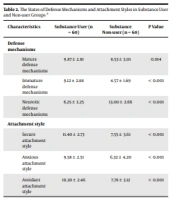
Regarding defense mechanisms (Table 2), just the mean value of neurotic defense mechanisms was significantly higher in the user group. In the multivariable linear regression model and adjusted for baseline parameters (Table 3), the difference in the value of defense mechanisms remained significant between the two groups.
Table 2.
The States of Defense Mechanisms and Attachment Styles in Substance User and Non-user Groups a
| Characteristics | Substance User (n = 60) | Substance Non-user (n = 60) | P Value |
|---|---|---|---|
| Defense mechanisms | |||
| Mature defense mechanisms | 9.9 ± 2.81 | 10.9 ± 2.9 | 0.054 |
| Immature defense mechanisms | 9.12 ± 2.88 | 8.5 ± 3.0 | 0.281 |
| Neurotic defense mechanisms | 6.25 ± 3.25 | 4.6 ± 1.7 | < 0.001 |
| Attachment style | |||
| Secure attachment style | 11.40 ± 2.73 | 13.0 ± 2.7 | < 0.001 |
| Anxious attachment style | 9.58 ± 2.51 | 6.32 ± 4.20 | < 0.001 |
| Avoidant attachment style | 10.30 ± 2.46 | 7.78 ± 3.12 | < 0.001 |
a Values are expressed as mean ± SD.
Table 3.
The Difference in Defense Mechanisms and Attachment Style Between Substance Users and Non-users According to the Multivariable Linear Regression Modeling Adjusted for Baseline Parameters a
| Characteristics | P Value | Beta | 95% Confidence Interval for Beta | R Square |
|---|---|---|---|---|
| Mature defense mechanisms | 0.054 | 3.365 | 1.331 to 5.399 | 0.327 |
| Immature defense mechanisms | 0.281 | -4.511 | -6.362 to -2.660 | 0.541 |
| Neurotic defense mechanisms | 0.001 | 5.303 | 3.147 to 7.458 | 0.669 |
| Secure attachment style | 0.001 | -2.364 | -4.900 to 0.172 | 0.577 |
| Anxious attachment style | 0.0001 | -0.053 | -2.759 to 2.654 | 0.276 |
| Avoidant attachment style | 0.002 | -0.030 | -0.141 to 0.081 | 0.159 |
a Age, marital status, job status, education level, medical and psychological history
Regarding attachment styles in substance users and non-users (Table 2), the mean values of the two components of attachment styles, including anxious and avoidant attachment styles, were significantly higher in substance users than non-users. And secure attachment style was higher in non-users. However, as shown in Table 3 and multivariate linear regression analysis, marital status was associated with attachment style (P-value < 0.05). The probability of having an anxious attachment style for unmarried people was 4.5 times higher than for married people. Other variables had no significant relationship with any attachment style types.
5. Discussion
In our study, 60 SUD patients and 60 non-SUD participants were assessed to study the possible relationship between substance abuse, defense mechanisms, and attachment styles. Even after adjusting baseline parameters, we observed significant differences between the two groups regarding neurotic defense mechanisms. Also, although the difference in attachment styles was univariately significant between substance users and non-users, this difference turned insignificant when adjusted for baseline parameters. In other words, the difference in attachment styles between the two groups was confidingly affected by the baseline characteristics of the study subjects but not substance use. A study by Gidhagen et al. aimed to assess the relationship between substance use, attachment styles, and psychological distress (17). They found that insecure attachment style was more common among their SUD participants than non-SUD subjects. They also reported that at the end of the study, the psychological treatment of their SUD participants contributed to changes from insecure to secure attachment style (17). Their findings align with our results that SUD patients are more likely to have insecure attachment styles and that proper psychological treatment may be helpful in people diagnosed with SUD. A review article by Schindler also found a link between insecure attachment style and SUD and insecure attachment style mentioned as a risk factor for SUD (18). They also wrote that continued substance abuse can impair forming and maintaining close relationships. They reported a higher prevalence of fearful-avoidant attachment style in people addicted to heroin, while alcohol abusers had more heterogeneous patterns (18). Another review article by Schindler on attachment styles and adolescent substance abuse found significantly higher rates of insecure attachment styles in SUD patients (18). Fearful and dismissing avoidance were the most common patterns they reported. They also suggested that fostering secure attachment styles could improve both the interventional treatment and prevention of substance use disorder (18). These findings align with our results and show more prevalent insecure attachment styles in the SUD population. A study by Ghinassi and Casale aimed to investigate the relationship between attachment styles and gambling disorder (19). They concluded that a secure attachment style could be considered protective against gambling behavior. In contrast, they contended that an insecure attachment style could be considered a vulnerability as it favors gambling behavior and disrupts the affected individual’s coping ability to regulate and identify emotions (19). These reports also show that insecure attachment styles can play a role in forming and continuing addictive behavior and disorders. Another study investigating the relationship between attachment styles and the use of heroin, cannabis, and ecstasy observed fearful-avoidant attachment styles mainly in heroin abusers. They found more prevalent preoccupied, dismissing-avoidant attachment patterns in ecstasy abusers and a higher incidence of dismissing-avoidant and fearful-avoidant attachment patterns in cannabis abusers. At the same time, their non-SUD controls had a higher rate of secure attachment style. They also reported higher global assessment function (GAF) scores in cannabis abusers compared to ecstasy and opioid abusers. They wrote that heroin could be considered an “emotional substitute” for a lack of coping skills. At the same time, cannabis seems to be used to support deactivating and distancing strategies in those who abuse these substances (20). Similar to our study, these findings suggest that insecure attachment style is more prevalent in substance use disorder. A study by Taurino et al. investigated defensive functioning and alexithymia in SUD (21). They found higher maladaptive patterns in the SUD population compared to non-SUD subjects. They also found that among the SUD group, alcohol abusers showed more dysfunctional defenses (21). In a study by Ribadier et al. which assessed defense styles and personality traits in female alcohol abusers, higher neuroticism and lower extraversion and conscientiousness were found in alcohol abusers compared to the control group (22). They also wrote that high neurotic, low mature, and immature defense styles could be considered predictive of alcohol abuse disorder (22). Their findings also suggest that less effective and more immature defense styles are used in individuals who abuse alcohol or other substances. Another study by Raketic et al. investigated defense mechanisms in female alcohol and opiate abusers and found that neurotic and immature defense mechanisms were significantly higher in this group compared to those who didn’t abuse these substances (23). They found higher neurotic defense mechanisms in alcohol abusers and more common immature defenses in opiate abusers (23). They found no significant difference in mature defense mechanisms between the two groups. These results align with our findings and suggest that substance abusers are more likely to use maladaptive defense styles. According to a similar study that investigated emotion regulation in SUD patients, limited access to emotion regulation strategies was associated with SUD. They also reported that limitation in access to emotional regulation strategies was associated with lower use of mature defense mechanisms and a higher likelihood of SUD (24). Their findings suggest that people diagnosed with SUD are less likely to use mature defense mechanisms and that lack of emotional coping skills could play a role in substance use disorder.
4.1. Conclusions
Overall, the results of this study suggest the difference in neurotic defense mechanisms and attachment styles in people struggling with substance use disorder as compared to non-users. We suggest further studies be conducted on larger populations and among different age groups to study the possible association between substance use disorder and attachment styles. In addition, other factors can be included in future studies, such as personality traits, the type of substance used, gambling disorder, gaming disorder, the co-existence of other mental disorders such as obsessive-compulsive disorder, and the possible association between them and SUD. It is hoped that by better understanding the etiology of substance use disorders, we can propose more effective strategies to prevent and treat this disorder. This could include providing SUD patients with adequate knowledge and education about defense mechanisms and attachment styles and addressing these issues in psychotherapy for better outcomes.
