
1. Background
Decision-making and risk-taking are interrelated processes. Humans constantly face challenging problems in their daily life, which accompanies decisions with unpredictable risks or uncertainty (1). Risk-taking is known as a personality trait (2). Riskier people accept higher risks and are less thoughtful about the risk and vice-versa (3). Risk-taking is associated with mental development, genetic and neurological factors, and personality traits (4). There is a significant relationship between emotions (fear, anxiety, emotional stress, etc.) and risky behaviors (5). Adventure, in particular, is positively associated with increased risk-taking (6). Risk perception and risk-taking concepts are influenced by personality traits (excitement, impulsivity, etc.) (2, 3).
Several theories have been proposed based on the psychological analysis of risk, including "risk homeostasis theory" (7), "interactive risk-taking model" (8), "expected utility" (9), the main and revised versions of "behavioral decision theory" (10, 11), "theory of planned behavior" (12), and "rational choice theory" (13). In addition, several questionnaires have been designed based on these theories.
As stated by Lermer et al., risk-taking is related to several personal characteristics in different areas rather than being a uni-dimensional trait (14). They proposed a conceptual model based on previous studies, in which some personality traits and higher-order temperament dimensions in six domains (social, recreation, investment, gambling, health/safety, and ethics) of risk-taking were proposed (14).
Approximately 80% of accidents are caused by unsafe acts like risky behavior or risk-taking (15, 16). Therefore, it is of great importance to screen people who applied for high-risk areas, like nuclear power plants, chemical industries, etc., for risk-taking. Despite such criticality, there is minimal research about these concepts in the literature.
Risk-taking assessment is done using questionnaires, which check the psychological traits, or software, which checks the risk-taking behavior.
Balloon analog risk task (BART) (17) and Iowa gambling task (IGT) (1) are examples of risk-taking software. Proposed by Lejuez et al. (17), BART evaluates laboratory-based risk-taking behavior and correlates with scores on sensation-seeking and impulsivity measures. Introduced by Bechara et al. (18), IGT is a psychological decision-making task used for measuring impulsivity and risk-taking.
There are well-known questionnaires available in several languages, including domain-specific risk-taking (DOSPERT), offered by Weber et al., which evaluates risk-taking in six areas (2, 19). The General Risk Propensity Scale (GRiPS), proposed by Zhang et al. (4), is a uni-dimensional questionnaire that shows general risk-taking propensity. These questionnaires show risk-taking in general people, which might not apply to specific workplaces with a high level of risk. Another important aspect that should be considered when designing a risk-taking questionnaire is the association between risk-taking and other psychological traits, as Lermer et al. showed in a conceptual model (14).
In the occupational setting, three distinct job risk questionnaires have been presented so far. However, these questionnaires are limited to the specific job they were designed for and could not be used in other settings. These include the "Questionnaire for Construction Worker Risk-taking (Q-CWRT)" (20), the "Manchester Driver Behavior Questionnaire (DBQ)" (21), and "attitudes to risk-taking in medical decision" (22).
Accordingly, we aimed to design a questionnaire applicable to more settings based on Lermer et al.'s conceptual model, which is the first one to the best of our knowledge.
2. Objectives
This survey aimed to design a specific questionnaire based on the conceptual model to be used in potentially high-risk industrial workplaces to assess the risk-taking trait of control room operators.
3. Methods
3.1. Participants
A total of 208 male participants, working in control rooms of several industries in Markazi province, Iran, in 2021, were enrolled using a convenience sampling method. The control room operators were responsible for checking the process or operation and stopping if any fault occurred. There was a wide variety of control room operators in terms of number, type of assessment approach, as well as expertise. The study group's mean age was 39.81 ± 10.78 (22 - 66) years, with a mean duration of experience of 15.09 ± 11.24 (1 - 35) years. All were holders of bachelor's degrees or higher because it was a technical job requiring a high level of education.
3.2. Ethical Considerations
An outline was provided at the beginning of the questionnaire to adhere to ethical standards, explaining that workers' information would be kept confidential. This research was registered and granted by the Hamadan University of Medical Sciences, and the study protocols were approved by the Hamadan University of Medical Sciences Research Ethics Committee with the ethics code: IR UMSHA.REC.1399.112.
3.3. Questionnaire Designing Procedure
Figure 1B shows the steps taken in this survey. The questions were collected based on Lermer et al.'s conceptual model (14), represented in Figure 1A. The questions were gathered regarding traits of agreeableness, conscientiousness, self-control, impulsivity, sensation-seeking, neuroticism, and anxiety, following the pattern of well-known psychological scales (4, 19, 23-33).
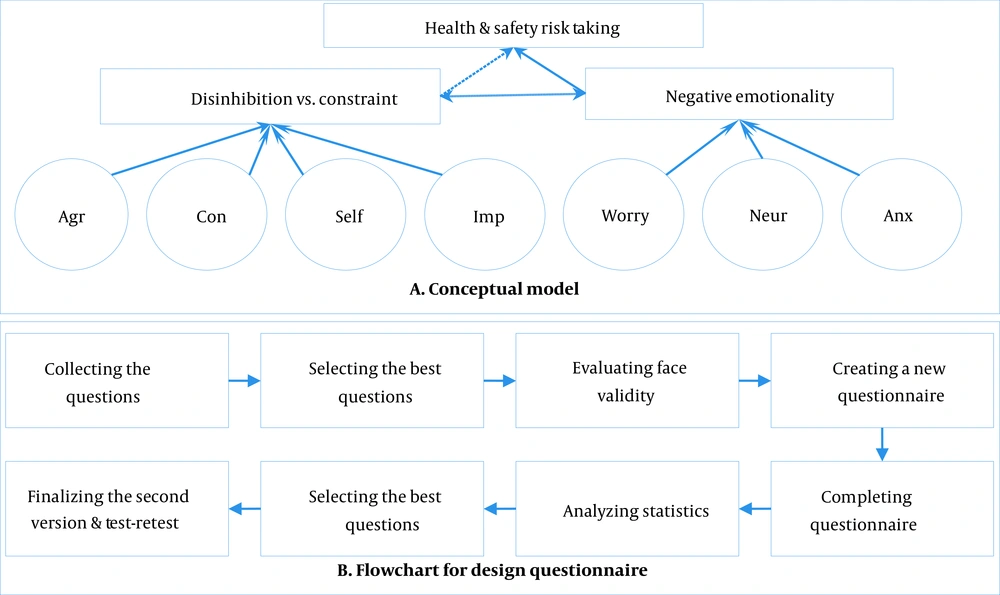
Figure 1.
A, proposed conceptual model; B, design questionnaire flowchart. Agr, agreeableness; Con, conscientiousness; Self, self-control; Imp, impulsive unsocialized sensation seeking; Worry, trait worry; Neur, neuroticism; Anx, trait anxiety.
Questions were selected according to the following criteria:
- Two experts on safety and health made the selection independently
- Work and job-linked questions were selected
- Repetition or duplication was avoided
After three separate analyses, the number of questions decreased from 623 to 50. Then, questions were modified to indirectly represent the individual's characteristics.
The content validity of the selected questions was assessed by 10 experts from multiple scientific areas (psychology, human factors and ergonomics, health, and safety). It should be noted that the selected specialists had experience in at least two scientific fields (i.e., ergonomics and health, ergonomics and psychology). For further understanding, 10 operators were randomly selected and asked about the simplicity and fluency of the questions. Questions were read to them, and their opinions were asked. All individuals emphasized the simplicity and fluidity of the questions. Ultimately, 20 questions were extracted in the first version, as shown in Table 1. The most suitable questions were chosen based on statistical analysis (as bolded in Table 1). Also, GRiPS was used to validate the accuracy of the questionnaire concerning trans-lingual orientation (before starting this survey, the standard forward-backward translation for validation GRiPS was executed, confirmed by the author of GRiPS). A code was dedicated to each question in the first version of the questionnaire (Table 1) to make it easily referred to.
Table 1.
The First Version of the Questionnaire
| Code | Questions | Dimension |
|---|---|---|
| Q1 | Other people tell me I am very cautious | Impulsivity |
| Q2 | I generally prefer novelty over familiarity. | Need for complexity and novelty |
| Q3 | I prefer to do whatever comes to mind rather than stick to a plan | Conscientiousness |
| Q4 | I try to do anything skillfully | Conscientiousness |
| Q5 | New things are pleasant even if they are scary a | Impulsivity |
| Q6 | I do something a little scared | Venturesome |
| Q7 | Taking risks is an important part of my life | GRiPS (risk-taking) |
| Q8 | I think about its safety at all | Risk-taking |
| Q9 | I like to dive off the highboard | Thrill and adventure-seeking |
| Q10 | I like to change my job very lot | Impulsivity |
| Q11 | I like to experience anything once | Sensation-seeking |
| Q12 | My friends would say that I am a risk-taker | GRiPS (risk-taking) |
| Q13 | Quick driving is enjoyable | Impulsivity |
| Q14 | Taking risks makes life more fun | GRiPS (risk-taking) |
| Q15 | A good job is that everything is transparent | Moral Absolutism/Splitting |
| Q16 | The work should be accomplished fast, even if the accuracy would decrease | Impulsivity |
| Q17 | Which do you prefer? A: Low-risk work and low salary. B: High-risk work and high salary | Risk-taking |
| Q18 | I enjoy taking risks in most aspects of my life | GRiPS (risk-taking) |
| Q19 | I avoid the conditions that are unclear what happens | Risk-taking |
| Q20 | I enjoy doing something that needs to be in the duties | Impulsivity |
| Q21 | I am a believer in taking chances | GRiPS (risk-taking) |
| Q22 | I am attracted, rather than scared, by risk | GRiPS (risk-taking) |
| Q23 | I like to do something that is relatively fixed and confident | Risk-taking |
| Q24 | I would take a risk even if it meant I might get hurt | GRiPS (risk-taking) |
| Q25 | I commonly make risky decisions | GRiPS (risk-taking) |
| Q26 | I am not afraid to do something new and exciting | Venturesome |
| Q27 | When it comes to physical danger, I get stressed | Emotionality |
| Q28 | An aspect of the venture is the pleasure | Venturesome |
a Bolded questions were selected after EFA as the final questions in ORTQ.
3.4. Statistical Analysis
We used R (3.6.3) software and its packages for data analysis, including lavaan (0.6 - 5), blavaan (0.4 - 3), lavaanPlot (0.6.2), psych (1.9.12.31), dplyr (1.0.7), and mice (3.8.0).
After face validity confirmation, the content validity ratio (CVR) and content validity index (CVI) were calculated, and then questions with > 80 were selected (34).
Missing data were imputed with the proportional odds logistic regression method. Weak questions were omitted using several methods, including average inter-item correlation, average item-total correlation, Cronbach's alpha, split-half reliability (adjusted using the spearman-brown prophecy formula), and composite reliability.
For exploratory factor analysis (EFA), the following tests were conducted: Kaiser-Meyer-Olkin (KMO) and Bartlett's tests for sphericity (correlation matrix), and parallel analysis was used to determine the number of factors (eigenvalue method ("Kaiser's rule")). The factor loading ≥ 0.5 was the criterion for selecting questions (35). P-value was supposed to be less than 0.05 (95% confidence) for all tests. After EFA, confirmatory factor analysis (CFA), Bayesian confirmatory factor analysis (BCFA), structural equation model (SEM), and Bayesian structural equation model (BSEM) were done. The data was randomly divided into two parts. A hundred questionnaires were selected for EFA, and 108 questionnaires were chosen for modeling (CFA, BCFA, SEM, and BSEM). Fit indices used to examine the models were relative χ2 (χ2/df), incremental fit index (IFI), parsimony normed fit index (PNFI), comparative fit index (CFI), root mean square error of approximation (RMSEA), standardized root mean square residual (SRMR), Bayesian information criterion (BIC), and leave-one-out cross-validation information criterion (LOOIC). The criteria for the accepted model were χ2/df < 3, IFI and CFI ≥ 0.90, PNFI ≥ 0.50, RMSEA < 0.05, and SRMR < 0.08 (35, 36). The RMSEA of 0.05 - 0.08 was regarded as a relatively good fit, 0.08 - 0.1 as the margin, and less than 0.1 as a poor fit (35, 36). The BIC and LOOIC were used to compare models where fewer values were desirable. Test-retest was done with 42 operators (at a three-month interval). It needs at least 50 participants (preferred n = 100) based on Hair et al. (35).
4. Results
Regarding the P-value, as shown in Figure 2, the questions with no significant correlation were omitted from the analysis (Q1, Q4, Q8, Q15, Q19, and Q27).
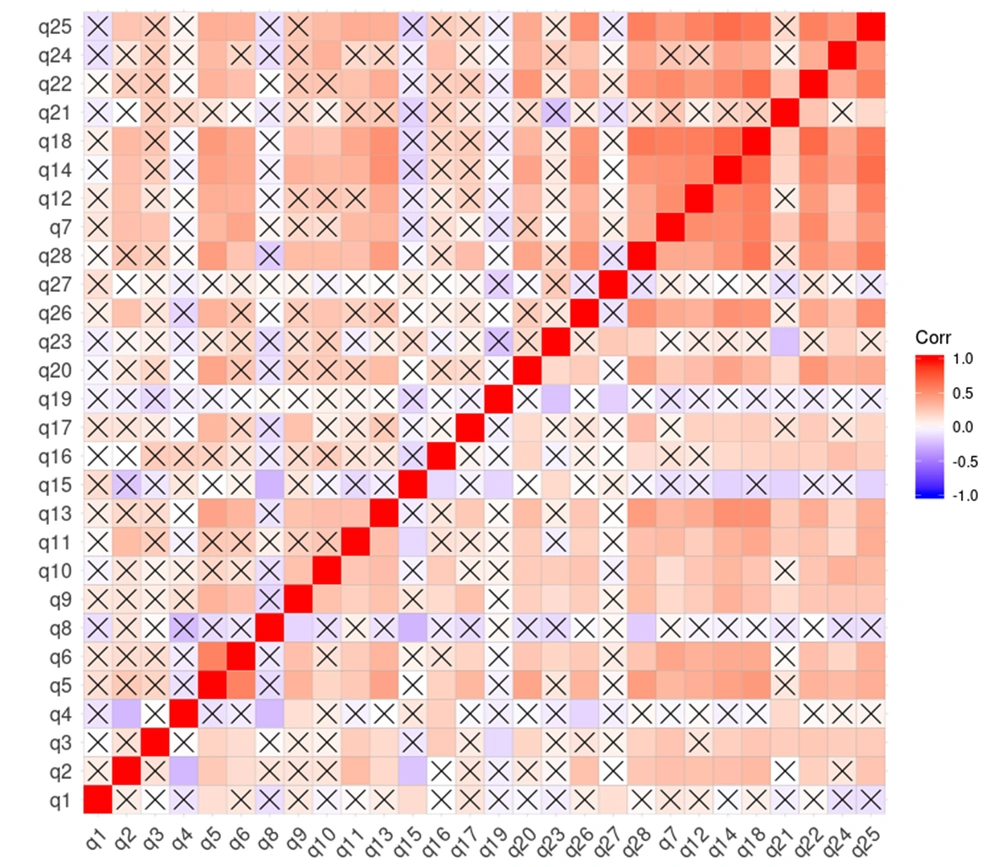
Figure 2.
The correlation coefficient between questions. The cross means a non-significant P-value. The correlation coefficient is shown in the lower part of the diagonal, and the adjusted correlation coefficient is illustrated in the upper part.
Table 2 shows each question's mean, standard deviation, and internal mean correlations. The total standard Cronbach's alpha was 0.85, and the total correlating scores from even and odd items, adjusted using the Spearman-Brown prophecy formula, was 0.84. Based on Table 2, questions in which both mean correlation and standardized factor loadings were greater than 0.3 were selected (35). Based on these criteria, 18 questions remained that were used for the following investigations and analyses.
Table 2.
Mean, Standard Deviation, Internal Mean Correlations, and Factor Analysis Results
| Question Code | Mean ± SD | Mean Correlation | Std.Alpha | Std.FL | KMO | Factor Loading | Uniqueness |
|---|---|---|---|---|---|---|---|
| Q1 | 3.23 ± 0.98 | 0.14 | 0.84 | 0.05 | |||
| Q2 | 3.89 ± 0.88 | 0.37 | 0.83 | 0.36 | 0.84 | 0.41 | 0.83 |
| Q3 | 3.12 ± 1.05 | 0.37 | 0.83 | 0.31 | 0.79 | 0.30 | 0.92 |
| Q4 | 1.65 ± 0.73 | 0.03 | 0.84 | -0.02 | |||
| Q5 | 3.17 ± 1.04 | 0.64 | 0.82 | 0.58 | 0.81 | 0.56 | 0.68 |
| Q6 | 3.17 ± 1.02 | 0.54 | 0.82 | 0.49 | 0.74 | 0.50 | 0.75 |
| Q7 | 3.52 ± 0.89 | 0.61 | 0.82 | 0.64 | 0.82 | 0.67 | 0.55 |
| Q8 | 3.3 ± 0.84 | -0.1 | 0.84 | -0.09 | |||
| Q9 | 2.1 ± 1.07 | 0.52 | 0.83 | 0.4 | 0.73 | 0.42 | 0.82 |
| Q10 | 1.98 ± 1.03 | 0.46 | 0.83 | 0.39 | 0.84 | 0.35 | 0.88 |
| Q11 | 3.03 ± 1.09 | 0.5 | 0.83 | 0.44 | 0.68 | 0.35 | 0.88 |
| Q12 | 3.01 ± 0.97 | 0.62 | 0.82 | 0.65 | 0.84 | 0.68 | 0.55 |
| Q13 | 2.91 ± 1.18 | 0.61 | 0.82 | 0.57 | 0.90 | 0.62 | 0.61 |
| Q14 | 3.07 ± 1.02 | 0.74 | 0.82 | 0.8 | 0.87 | 0.87 | 0.24 |
| Q15 | 1.87 ± 0.84 | -0.05 | 0.84 | -0.13 | |||
| Q16 | 2.11 ± 1.01 | 0.34 | 0.83 | 0.26 | |||
| Q17 | 3.5 ± 1.67 | 0.41 | 0.83 | 0.3 | |||
| Q18 | 3.15 ± 0.92 | 0.77 | 0.82 | 0.83 | 0.90 | 0.85 | 0.28 |
| Q19 | 3.22 ± 1.13 | -0.02 | 0.85 | -0.07 | |||
| Q20 | 2.3 ± 0.99 | 0.54 | 0.82 | 0.51 | 0.75 | 0.52 | 0.73 |
| Q21 | 2.67 ± 1.02 | 0.3 | 0.83 | 0.26 | |||
| Q22 | 2.86 ± 0.92 | 0.71 | 0.82 | 0.73 | 0.79 | 0.74 | 0.46 |
| Q23 | 2.18 ± 0.95 | 0.23 | 0.84 | 0.16 | |||
| Q24 | 2.13 ± 1.01 | 0.53 | 0.82 | 0.5 | 0.82 | 0.46 | 0.79 |
| Q25 | 2.58 ± 1.02 | 0.71 | 0.82 | 0.77 | 0.79 | 0.80 | 0.37 |
| Q26 | 3.34 ± 0.97 | 0.56 | 0.82 | 0.58 | 0.90 | 0.63 | 0.60 |
| Q27 | 2.99 ± 1.04 | 0.11 | 0.84 | 0.02 | |||
| Q28 | 2.81 ± 1.14 | 0.69 | 0.82 | 0.69 | 0.84 | 0.67 | 0.55 |
Abbreviations: Std.Alpha, standard alpha; Std.FL, standardized factor loadings; KMO, Kaiser-Meyer-Olkin factor adequacy.
Kaiser-Meyer-Olkin factor adequacy was done, and the results are shown in Table 2. Then, sampling adequacy was calculated (MSA = 0.89). Bartlett test result for factor analysis was χ2 = 1428 (df = 153, P < 0.001) (31). Parallel analysis was done to extract the number of factors, which was suggested to be one (Figure 3A). The factor analysis result and the related graph are shown in Table 2 (P < 0.001) and Figure 3B, respectively. Correlation and amplitude for each question were understood based on the direction and length of any vector using a biplot of principal component analysis (Figure 3C). Finally, 12 questions were selected as Operator Control Room Risk-taking Questionnaire (ORTQ). Table 3 shows CFA, BCFA, SEM, and BSEM results, based on which ORTQ was shown to be a valid tool with a goodness of fit to the model. Models were defined as shown in Figure 3D to F. The GRiPS CFA model was not meaningful (P = 0.08). To create a shorter version of the questionnaire, 10 best items were modeled (ORTQ10) (by omitting Q20 and Q6), which was shown to pass the goodness of fit and be valid for use.
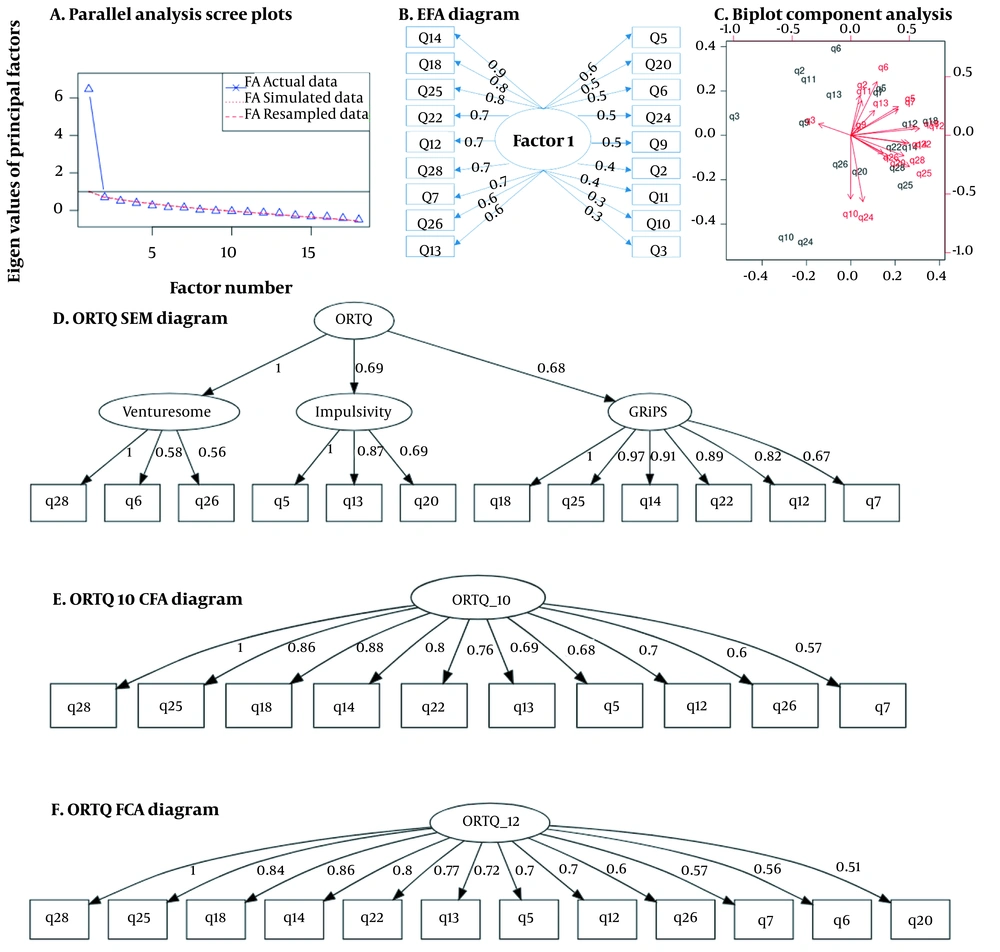
Figure 3.
A, parallel analysis scree plot; B, factor analysis output model; C, principal component analysis (PCA) biplot output model; D, ORTQ SEM diagram output model; E, ORTQ 10 items CFA diagram output model; F, ORTQ 13 items FCA diagram output model.
Table 3.
SEM, BSEM, CFA, and BCFA Goodness of Fit Results
| Model | Items | χ2/df | CFI | PNFI | IFI | RMSEA (95%CI, P-Value) | SRMR | BIC | LOOIC |
|---|---|---|---|---|---|---|---|---|---|
| SEM & BSEM ORTQ | Q14, Q18, Q25, Q22, Q12, Q28, Q7, Q26, Q13, Q5, Q20, Q6 | 1.89 | 0.93 | 0.65 | 0.93 | 0.08 (0.05 - 0.11, 0.043) | 0.06 | 3269 | 3170 |
| CFA ORTQ | Q14, Q18, Q25, Q22, Q12, Q28, Q7, Q26, Q13, Q5, Q20, Q6 | 1.94 | 0.90 | 0.67 | 0.90 | 0.09 (0.07 - 0.12, 0.007) | 0.07 | 3271 | 3181 |
| CFA ORTQ10 | Q14, Q18, Q25, Q22, Q12, Q28, Q7, Q26, Q13, Q5 | 1.98 | 0.91 | 0.66 | 0.92 | 0.09 (0.06 - 0.13, 0.009) | 0.06 | 2769 | 2695 |
The correlation coefficient was 0.65 (P < 0.001) between risk-taking and impulsivity, 0.69 between venturesomeness and risk-taking, and 0.58 between impulsivity and venturesomeness. The correlation coefficient between ORTQ and GRiPS was 0.93 (P < 0.001). Disinhibition vs. constraint, calculated by the sum of impulsivity, sensation-seeking, and conscientiousness, was correlated with GRiPS with a coefficient of 0.69 (P < 0.001). Traits related to risk-taking, calculated by the sum of impulsivity, sensation-seeking, conscientiousness, need for complexity and novelty, in addition to thrill and adventure-seeking, were found to be correlated with GRiPS with a coefficient of 0.76 (P < 0.001). Cronbach's alpha was 0.89 and 0.87 for ORTQ and ORTQ10, respectively, in test-retest reliability.
5. Discussion
To the best of our knowledge, no specific questionnaire has been available to assess risk-taking traits in operating room workers in industrial workplaces. The present study aimed to develop a new questionnaire applicable to high-risk locations like control rooms, which was based on Lermer et al.'s conceptual model and was amended with other psychological traits. The questionnaire was validated as the "ORTQ". The final version of the questionnaire showed that safety-associated risk-taking tends to be more related to impulsivity, venturesome, and GRiPS. Nonetheless, all other traits, including conscientiousness (Q3, Q4), emotionality (Q27), and need for complexity and novelty (Q2), were poorly related or completely unrelated (no significant P-value) to other questions, especially with GRiPS and impulsivity. This finding was in line with the following studies. Verdejo-Garcia et al. reviewed the association of impulsivity with personality in addition to neurocognitive investigations in high-risk people (with substance abuse disorder). They showed that genetic factors and brain structure damages play a role in this regard (37). Swann concluded that impulsivity is needed for fast responses based on incomplete information processing (14). Moeller et al. showed that impulsivity involves risks but suggested that impulsive risk-taking may be distinct from sensation-seeking risks (38). Lejuez et al. carried out a laboratory-based study of behavioral measures by BART and evaluated the associations between BART and self-report measures of risk-related constructs, as well as self-reported real-world behaviors (17). They found that scores on measures of sensation-seeking, impulsivity, and deficiencies in behavioral constraint were associated with BART (17). Bleichrodt et al. found that two psychological traits, venturesomeness and impulsivity, were associated with risk-taking (39). Eysenck et al. (40, 41), Corulla (42, 43), Lijffijt et al. (44), and Caci et al. (45) found that impulsivity and venturesomeness correlated with each other. There are trivial differences between impulsiveness and venturesomeness, which are common structures in some cultures (44). The coefficient of correlation in all the above studies was considerably lower than in our survey, which might be attributed to the selection method of the questions in the current study based on psychological traits, which is due to the impact of risk-taking on job.
Both ORTQ and ORTQ10 have been shown to be valid with the goodness of fit to the model. The ORTQ (the 12-item model) was confirmed to have a better LOOIC based on BSEM than BCFA. Although ORTQ10 is shorter, valid, and reliable, we recommend ORTQ as a better option because it includes more questions related to impulsivity and venturesomeness (three vs. two questions for each aspect), which makes it more beneficial in evaluating these characters. The GRiPS FCA result was insignificant, which means that ORTQ is better than GRiPS. Moreover, GRiPS reliability was shown by Zhang et al. (4) to be 0.80, while ORTQ reliability in the present study was 0.89. This emphasizes the superiority of ORTQ over GRiPS.
Zhang et al. (4) showed that GRiPS could be correlated with DOSPERT and big five. Because six items of GRiPS were included in ORTQ and there was a high correlation between them, it can be concluded that ORTQ is correlated with the above-mentioned well-known questionnaires.
Notably, this study aimed to assess risk management in industrial processes that might be naturally dangerous. Therefore, because mental, psychological, and genetic characteristics are important in risk-taking, it is necessary to check whether the person has acceptable risk-taking personality traits before enrolment; ORTQ is valid and reliable that can be used to reach this goal.
Like many other surveys, this study had some limitations. First, the study group was selected from the male operators working in the control room; therefore, the data may suffer from gender bias limitations. Second, some industries selected operators based on psychological tests. In fact, we studied a specific group who might have been screened before employment, which could create a selection bias. Moreover, the study group had at least a bachelor's degree and might have passed some psychological tests before being admitted to the industry, which might also lead to selection bias. In addition, according to the unavailability of a golden standard for risk-taking, it was impossible to assess this survey's sensitivity, specificity, and cut-off point. Finally, the time of performing this study coincided with COVID-19, which might have affected our results.
Suggestions for future research: Future studies may evaluate the relationship between ORTQ and EEG or GSR to investigate the influence of brain activity and psychosomatics on the results of this questionnaire. The results of ORTQ are proposed to be compared with other well-known questionnaires like big five. The validation of ORTQ to apply to industrial workers other than control room operators is highly suggested.
5.1. Conclusions
Operator Control Room Risk-taking Questionnaire is a valid and specific questionnaire with 12 questions that can be used to select risk-taking control room operators and conduct research studies. It is akin to GRiPS and complements it.

