
1. Background
Road traffic accidents (RTAs) cause more than one million deaths and 50 million injuries globally, posing a major public health problem. The World Health Organization (WHO) has identified RTAs as the leading cause of death among individuals aged 5 - 29 years, underscoring the critical need for effective road safety measures. Numerous factors contribute to RTAs and can be classified into four main categories: roads, vehicles, humans, and the environment (1, 2). One of the main human factors is risky driving behavior (RDB) (3). The Theory of Planned Behavior explains the relationship between personality traits and RDB. It posits that risk-taking intentions are shaped by three core components: attitude toward the behavior, subjective norms (perceived social pressure), and perceived behavioral control (belief in one's ability to perform the behavior). Personality traits can influence each of these components (4). Iran, like many other countries, faces substantial challenges in reducing RTAs and improving road safety (5). Iran's unique geography, culture, and socioeconomic conditions further exacerbate these challenges. Previous studies have reported high road traffic accident rates, emphasizing the need for research to identify and address the causes of RDB (6). Factors such as high vehicle density, inadequate infrastructure, inconsistent law enforcement, and cultural driving attitudes contribute to RDB in Iran. RTAs affect health, social, and economic outcomes. Therefore, identifying key determinants is essential for effective intervention.
2. Objectives
Despite the importance of understanding human factors in driving, a substantial gap remains in the literature regarding self-reported determinants of risky driving, particularly in Iran. Such data capture drivers’ perceptions and attitudes and provide insights beyond those obtained through observational studies. Shiraz’s distinctive urban and cultural context offers a valuable opportunity to examine these determinants within Iran. This study investigated factors influencing RDB among drivers in Shiraz, including demographic characteristics, personality, driving experience, environmental factors, and vehicle characteristics. It aimed to identify key determinants to support the development of strategies to reduce risky behaviors and improve road safety. By collecting extensive self-reported data, the study provides a model for future research that emphasizes the importance of understanding drivers’ perspectives. To our knowledge, this is one of the most comprehensive studies in Iran examining factors associated with RDB. Furthermore, we used a latent clustering approach to provide a more accurate understanding of the issue.
3. Methods
3.1. Study Design and Setting
This study was conducted in Shiraz, Iran, a city with a diverse transportation system and road network. Shiraz was selected as the study site because of its representativeness and accessibility for data collection. In this study, we aimed to examine comprehensive determinants of risky driving. We conducted a literature review on various aspects of RDB and, to deepen our understanding, obtained input from a multidisciplinary panel of experts in traffic safety, psychology, transportation engineering, public health, and sociology. A framework was developed based on this collaborative approach (Figure 1). Measures were selected to collect data on the variables included in this framework. Due to budget constraints, self-reported data were used for all data collection rather than objective measurements.
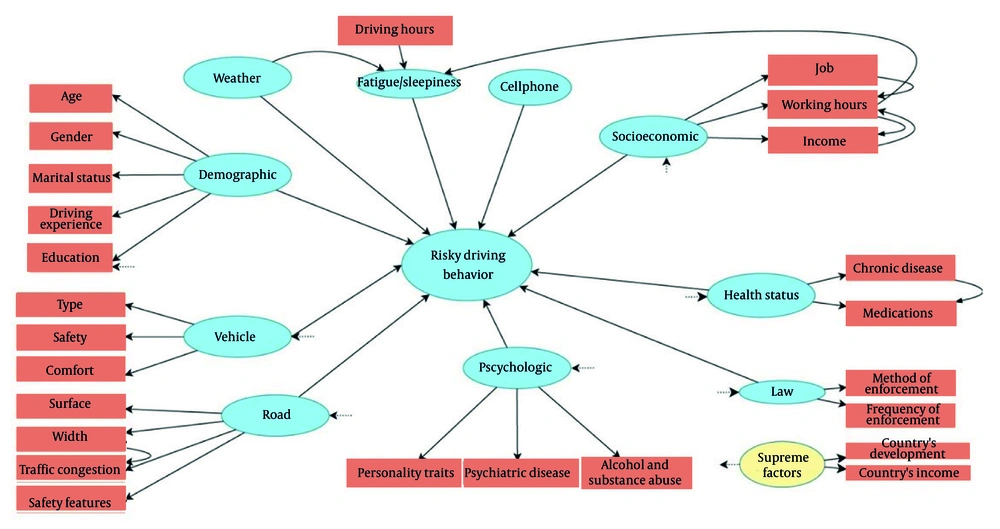
Figure 1.
Theoretical model for risky driving behavior inferred from literature review and expert opinion
In our theoretical model, we initially considered weather and macro-level factors, such as a country's level of development, as determinants of risky driving. However, because of the study's geographical limitations, these factors were excluded from the analysis. The remaining factors were measured as planned; however, in some cases, variables with very low representation in the sample were excluded from the analysis to ensure the robustness of the results.
3.2. Participant Selection
Participants were recruited via convenience sampling. We collected data from drivers across five city districts of Shiraz to ensure broad representation across the city. To include taxi drivers and heavy vehicle drivers in the study, we visited their respective terminals and invited them to participate.
3.3. Data Collection
All data collected in this study were self-reported by the participants. During face-to-face interactions, trained researchers administered questionnaires, and participants responded based on their personal experiences and perceptions.
3.4. Measures
3.4.1. Personality Traits
To assess personality traits, we used the Mini International Personality Item Pool (Mini-IPIP) questionnaire, a validated Persian version comprising 20 questions that evaluates the Big Five personality traits: openness, conscientiousness, extraversion, agreeableness, and emotional stability. However, the expert panel, including a clinical psychologist, determined that the Mini-IPIP did not adequately capture sensation seeking (SS) and normlessness. Therefore, we used separate questionnaires to assess these traits. For SS, we used three questions from the NEO Personality Inventory, which had previously been used in another Iranian study (7), to capture this specific personality trait. For normlessness, we used a standard four-question version developed by Kohn and Schooler (1982) (8) and previously used by a few studies (9, 10) to assess this trait in participants.
3.4.2. Risky Driving Behavior
Risky driving behavior was measured using the Manchester Driving Behavior Questionnaire (DBQ), as proposed by Lajunen et al. (11), which includes 27 items. The DBQ assesses various aspects of RDB and provides insights into participants' attitudes and actions on the road. In the DBQ, participants report the frequency of engagement in different types of aberrant driving behaviors over the past year. These behaviors are categorized as errors, lapses, aggressive violations, or ordinary violations (12).
3.4.3. Vehicle Characteristics
Participants provided information about their vehicles, including whether their most frequently used vehicle was foreign-made or Iranian-made and the vehicle's safety and comfort. Questions regarding safety and comfort were designed by the authors in consultation with an expert panel. The comfort questionnaire comprised five items assessing steering wheel comfort, car seat comfort, air-conditioning effectiveness, seatbelt comfort, and the presence of an automatic transmission. Internal consistency, measured using Cronbach alpha, was 0.835 for the first four questions: steering wheel, car seat, air conditioning, and seatbelt. We excluded the question on automatic transmission from the internal consistency calculation because it was factual. These questions were then grouped into two clusters using latent class analysis (LCA). The number of clusters was determined based on a low Bayesian information criterion, a significant log-likelihood ratio, and a manageable sample size per cluster. Clusters were then sorted in ascending order, with the first cluster indicating low comfort and the second indicating higher comfort.
Safety was assessed using a questionnaire comprising five items: Brake effectiveness, control in turns, self-assessment of car protection in an accident, number of airbags, and the presence of an anti-lock braking system (ABS). Internal consistency for the first three questions, namely brake efficacy, control in turns, and self-assessment of car protection, was 0.733, calculated using Cronbach alpha. We excluded questions regarding ABS brakes and airbags from the internal consistency analysis because they were factual and not directly related to the safety perception being measured. All five questions were used in the LCA to create two clusters: high safety and low safety.
3.4.4. Road Conditions
Participants were asked about the roads they usually drive on, including whether the roads most frequently driven on were rural or urban and the level of traffic congestion. Regarding road features, five questions assessed experiences with road surface smoothness and potholes; the presence of sufficient road width or lanes; the adequacy of lighting, markings, and signs; the presence of risky or sudden turns; and whether opposite lanes were separated. The last question was removed from the analysis because of its low item-test correlation. Cronbach alpha for the remaining five questions was 0.766. Road features were then categorized into two clusters using K-means clustering. Other compiled data included demographic and socioeconomic variables, such as age, gender, level of education, income-to-expenses ratio, occupation, hours worked per day, and hours driven per day. Questions on the history of psychological disorders (12) and medical diseases (13) that may affect driving were compiled from the referenced studies. The use of medications with high-risk warnings was also assessed (14, 15). The history of smoking, alcohol use, and recreational drug use was also requested. Participants were asked two questions about encounters with law enforcement while driving: how often they encounter law enforcement and the type of enforcement they typically experience, including officers or remote monitoring via traffic cameras. The frequency of fatigued driving and cellphone use while driving was assessed with one question each.
3.5. Statistical Analysis
Before analysis, clusters of the study's statistical constructs were created. For car safety and car comfort, which comprised a mixture of binomial and fixed-ordinal Likert-scale variables, LCA was used to identify two clusters for each construct. For RDB, personality traits, and road variables, all measured using Likert-scale variables, K-means clustering was used. The Calinski-Harabasz Index was used to determine the optimal number of clusters, which was two across all variables. Subsequently, a multivariate logistic regression model was developed and applied. In the regression model, RDB was defined as the outcome variable, with the high-risk cluster as the outcome of interest. Backward elimination was used in the regression analysis, given the large number of variables in the dataset, to mitigate concerns about multicollinearity and overfitting. A significance level of 0.3 was used to enter variables into the model.
Latent class analysis was conducted using Latent Gold software (Release 4.5; Belmont). K-means clustering and logistic regression were performed using Stata Statistical Software: Release 17 (StataCorp LLC, College Station, TX, USA).
3.6. Ethical Considerations
The Research Ethics Committee of Shiraz University of Medical Sciences (SUMS) approved the study procedures and informed consent forms, with the approval code IR.SUMS.REC.1400.801. Written informed consent was obtained from each participant before the interview, and all principles of confidentiality, anonymity, and voluntary participation, in accordance with the Declaration of Helsinki, were maintained.
4. Results
As previously stated, clustering was performed on the measures to identify patterns and groupings within the data. Cluster characteristics are presented in Tables 1 and 2.
Table 1.
Characteristics of Clusters of Roads and Vehicles a
| Variables | Values | |
|---|---|---|
| Question (min – max score) | 1 | 2 |
| Road surface (0 - 4) | 0.96 (0.85 - 1.07) b | 2.06 (2.00 - 2.13) b |
| Road width (0 - 4) | 1.14 (1.03 - 1.25) b | 2.15 (2.08 - 2.21) b |
| Road lighting, marking, and signs (0 - 4) | 1.34 (1.24 - 1.43) b | 2.36 (2.30 - 2.43) b |
| Allowed speed (0 - 4) | 1.25 (1.14 - 1.35) b | 2.21 (2.14 - 2.27) b |
| Design of turns/dangerous turns (0 - 4) | 1.24 (1.14 - 1.33) b | 2.13 (2.06 - 2.19) b |
| Controlling ability in turns (0 - 4) | 1.13 (0.99 - 1.27) c | 2.47 (2.40 - 2.53) c |
| ABS brakes (binary), percentage of yes | 75.29% c | 11.28% c |
| Brake power (0 - 4) | 1.33 (1.20 - 1.46) c | 2.39 (2.33 - 2.45) c |
| Protection in case of accident (0 - 4) | 0.48 (0.36 - 0.60) c | 2.03 (1.97 - 2.09) c |
| Airbag number (0 - 6) | 0.31 (0.15 - 0.46) c | 2.15 (1.98 - 2.31) c |
| Automated gear (binary), percentage of yes | 30.77% d | 69.23% d |
| Car seat comfort (0 - 4) | 1.87 (1.80 - 1.94) d | 2.83 (2.75 - 2.91) d |
| Steering wheel comfort (0 - 4) | 1.76 (1.69 - 1.83) d | 3.08 (3.01 - 3.15) d |
| Air conditioning comfort (0 - 4) | 1.87 (1.79 - 1.94) d | 3.07 (2.99 - 3.14) d |
| Seatbelt comfort (0 - 4) | 1.81 (1.74 - 1.88) d | 3.06 (2.98 - 3.13) d |
a Values are expressed as mean score (95% CI) unless otherwise indicated.
b K-means clusters; 1 (n = 195), 2 (n = 422).
c LCA clusters; mean score (95% CI); 1 (n = 85), 2 (n = 532).
d LCA clusters; 1 (n = 420), 2 (n = 197).
Table 2.
Characteristics of Each K-Means Cluster of Personality Traits
| Traits and Trait Clusters | Sample Size | Mean Sum of Score (95% CI) | Minimum - Maximum Sum of Score |
|---|---|---|---|
| Neuroticism | |||
| Low | 203 | 3.81 (3.57 - 4.06) | 0 - 16 |
| High | 414 | 10.33 (10.12 - 10.54) | 0 - 16 |
| Extraversion | |||
| Low | 203 | 1.40 (1.19 - 1.61) | 0 - 16 |
| High | 414 | 7.50 (7.33 - 7.66) | 0 - 16 |
| Openness to experience | |||
| Low | 280 | 6.68 (6.50 - 6.86) | 0 - 16 |
| High | 337 | 11.34 (11.13 - 11.54) | 0 - 16 |
| Conscientiousness | |||
| Low | 331 | 8.20 (8.01 - 8.40) | 0 - 16 |
| High | 286 | 13.70 (13.49 - 13.91) | 0 - 16 |
| Agreeableness | |||
| Low | 291 | 7.80 (7.63 - 7.97) | 0 - 16 |
| High | 326 | 12.24 (12.05 - 12.43) | 0 - 16 |
| Sensation seeking | |||
| Low | 199 | 0.94 (0.70 - 1.19) | 0 - 12 |
| High | 418 | 10.08 (9.89 - 10.27) | 0 - 12 |
| Normlessness | |||
| Low | 199 | 0.94 (0.70 - 1.19) | 0 - 16 |
| High | 418 | 10.08 (9.89 - 10.27) | 0 - 16 |
The Mini-IPIP assessed neuroticism, extraversion, openness, conscientiousness, and agreeableness. Sensation seeking was measured using three selected items from the NEO Personality Inventory. Kohn and Schooler's 4-item scale measures normlessness.
A multivariate logistic regression analysis was performed to assess the relationship between various predictors and high-risk driving behavior. After backward elimination, the following factors were removed: married marital status, income levels equal to or greater than expenses, vehicle types such as motorcycle, bus, pick-up truck, and van, professional driver status, vehicle comfort, personality traits of extraversion and agreeableness, road features, traffic congestion levels, working less than 4 hours or more than 8 hours daily, driving 2 to 4 hours or 4 to 8 hours daily, cellphone use categorized as "sometimes" and "often or always," high-risk medication use, alcohol and recreational drug use, and a history of psychological disorders. The variables retained in the final model are shown in Table 3.
Table 3.
Factors Associated With RDB, Results of Multivariate Backward Elimination Logistic Regression with a Significance Threshold of 0.3
| Variables | Adjusted Odds Ratio | 95% CI (Lower – Upper) | P Value a |
|---|---|---|---|
| Gender | |||
| Male | Ref. | - | - |
| Female | 0.63 | 0.28 - 1.42 | 0.264 |
| Marital status | |||
| Single | Ref. | - | - |
| Divorced or widowed | 33.00 | 0.25 - 4431.98 | 0.162 |
| Education | |||
| Under diploma | Ref. | - | - |
| Diploma | 0.22 | 0.07 - 0.67 | 0.008 |
| Associate's degree | 0.30 | 0.09 - 0.97 | 0.044 |
| Bachelor's degree | 0.40 | 0.17 - 0.95 | 0.038 |
| Income | |||
| Less than expenses | Ref. | - | - |
| Way more than expenses | 0.28 | 0.00 - 1.26 | 0.066 |
| Job | |||
| Unemployed | Ref. | - | - |
| Employed | 0.30 | 0.10 - 0.89 | 0.031 |
| Personality traits b | |||
| Neuroticism | 3.44 | 1.57 - 7.51 | 0.002 |
| Openness to experience | 0.36 | 0.17 - 0.78 | 0.010 |
| Conscientiousness | 0.40 | 0.19 - 0.86 | 0.018 |
| Sensation seeking b | 2.59 | 1.04 - 6.49 | 0.042 |
| Normlessness b | 6.83 | 2.34 - 19.91 | <0.001 |
| Vehicle type | |||
| Light vehicle (sedan and SUV) | Ref. | - | - |
| Heavy truck | 0.39 | 0.08 - 1.98 | 0.258 |
| Foreign-made vehicle c | 0.45 | 0.18 - 1.16 | 0.099 |
| Safety of the vehicle b | 2.44 | 0.87 - 6.82 | 0.090 |
| Road type | |||
| Urban | Ref. | - | - |
| Rural | 0.19 | 0.07 - 0.52 | 0.001 |
| Frequency of encounters with law enforcement | |||
| Never or rarely | Ref. | - | - |
| Sometimes | 0.39 | 0.12 - 1.28 | 0.119 |
| Often | 0.21 | 0.06 - 0.71 | 0.012 |
| Always | 0.22 | 0.06 - 0.88 | 0.033 |
| Type of enforcement encountered | |||
| Officer | Ref. | - | - |
| Camera | 0.18 | 0.05 - 0.64 | 0.008 |
| Both camera and officer | 0.25 | 0.07 - 0.85 | 0.027 |
| Driving while tired | |||
| Never | Ref. | - | - |
| Rarely | 6.23 | 2.56 - 15.13 | <0.001 |
| Sometimes | 9.42 | 3.47 - 25.57 | <0.001 |
| Often or always | 6.94 | 1.48 - 32.62 | 0.014 |
| Cellphone use while driving | |||
| Never | Ref. | - | - |
| Rarely | 0.44 | 0.22 - 0.88 | 0.020 |
| Hours worked per day | |||
| Do not work | Ref. | - | - |
| 4 to 8 hours | 0.63 | 0.30 - 1.29 | 0.204 |
| Hours driven per day | |||
| Less than 2 hours | Ref. | - | - |
| More than 8 hours | 0.21 | 0.04 - 1.04 | 0.056 |
| Smoking | 0.51 | 0.22 - 1.17 | 0.112 |
a P value ≤ 0.05 was considered statistically significant.
b for personality traits, sensation seeking, and normlessness, the reference category is the low cluster.
c for vehicle safety, the reference is the low-safety cluster.
In the regression model, several significant associations emerged. Among demographic factors, females showed a non-significant trend toward lower odds of risky driving than males (AOR: 0.63; 95% CI: 0.28 - 1.42; P = 0.264). Regarding education, individuals with a diploma (AOR: 0.22; 95% CI: 0.07 - 0.67; P = 0.008), an associate's degree (AOR: 0.30; 95% CI: 0.09 - 0.97; P = 0.044), or a bachelor's degree (AOR: 0.40; 95% CI: 0.17 - 0.95; P = 0.038) had significantly lower odds of risky driving than those without a diploma. Employed individuals also had significantly lower odds of risky driving than unemployed individuals (AOR: 0.30; 95% CI: 0.10 - 0.89; P = 0.031). Personality traits played a significant role, with higher levels of neuroticism associated with increased odds of risky driving (AOR: 3.44; 95% CI: 1.57 - 7.51; P = 0.002). Conversely, higher levels of openness to experience were associated with significantly lower odds of risky driving (AOR: 0.36; 95% CI: 0.17 - 0.78; P = 0.010), as were higher levels of conscientiousness (AOR: 0.40; 95% CI: 0.19 - 0.86; P = 0.018). Sensation seeking (AOR: 2.59; 95% CI: 1.04 - 6.49; P = 0.042) and normlessness (AOR: 6.83; 95% CI: 2.34 - 19.91; P < 0.001) were also significantly associated with risky driving behavior.
Vehicle comfort was excluded from the model, and vehicle safety was not significantly associated with RDB. Among vehicle types, only truck drivers had substantially lower RDB than passenger car drivers. Road type was a significant factor, with driving on rural roads associated with lower odds of risky driving than driving on urban roads (AOR: 0.19; 95% CI: 0.07 - 0.52; P = 0.001).
More frequent interactions with law enforcement were associated with lower odds of risky driving than never or rarely interacting with law enforcement. Specifically, the AORs were 0.39 for sometimes (95% CI: 0.12 - 1.28; P = 0.119), 0.21 for often (95% CI: 0.06 - 0.71; P = 0.012), and 0.22 for always (95% CI: 0.06 - 0.88; P = 0.033). Additionally, encounters with traffic cameras (AOR: 0.18; 95% CI: 0.05 - 0.64; P = 0.008) and encounters with both traffic cameras and police officers (AOR: 0.25; 95% CI: 0.07 - 0.85; P = 0.027) were significantly associated with reduced odds of risky driving compared with encounters with police officers alone. Driving while tired was significantly associated with risky driving, particularly among those who reported feeling tired occasionally (AOR: 9.42; 95% CI: 3.47 - 25.57; P < 0.001) and often or always (AOR: 6.94; 95% CI: 1.48 - 32.62; P = 0.014).
5. Discussion
This study aimed to identify factors associated with risky driving behavior and yielded several key findings. Neuroticism, normlessness, sensation seeking, and driving while tired were positively related to RDB, underscoring the role of individual personality traits and behaviors in shaping driving practices. Conversely, openness to experience and law enforcement encounters were negatively associated with risky driving, highlighting the potential influence of external factors in promoting safe driving behaviors. Road type also emerged as a significant factor, with rural roads associated with lower odds of risky driving than urban roads. Risky driving in Iran stems from cultural norms, such as attitudes toward law, masculinity, and anonymity, and from socioeconomic pressures, including unemployment, informal employment, and inadequate transportation. These factors influence compliance, interact with age, gender, and urbanization, and make rule-breaking seem necessary or inevitable rather than deviant (16-18). The findings of this study align with and build upon the existing literature on factors associated with risky driving behavior. The associations of normlessness and sensation seeking with risky driving are well established, and our findings are consistent with prior investigations (9, 19, 20). In the context of driving, individuals who perceive a lack of clear rules or believe that violations are normative may be more likely to engage in risky driving behaviors. This is supported by the Theory of Planned Behavior, which suggests that social norms significantly influence individuals' intentions and behaviors (21). Sensation seekers are more likely to engage in risky driving because of their desire for excitement and willingness to take risks for such experiences. Their preference for high-arousal states can lead to behaviors such as speeding, aggressive driving, and disregard for traffic laws. The respective positive and negative correlations of neuroticism and openness to experience with risky driving are also consistent with the previously published literature (22). Research has shown that individuals with high levels of neuroticism may engage in risky driving as a coping mechanism for stress or emotional discomfort (23). Their heightened stress responses can impair judgment and increase susceptibility to distractions, leading to unsafe driving behaviors. Higher openness to experience, which is correlated with lower odds of risky driving behavior, may be linked to the trait’s association with perceptiveness and intellectual curiosity and may lead individuals to be more thoughtful and cautious in their driving practices. Individuals high in openness are likely to consider the consequences of their actions more fully and to engage in behaviors that ensure their safety and the safety of others on the road (24). It must be emphasized that openness to experience differs from sensation seeking, which is itself a facet of extraversion. Although both traits involve the exploration of novelty, they differ in focus: openness leans toward intellectual and aesthetic pursuits, whereas sensation seeking prioritizes physical and sensory excitement. Additionally, the influence of road type on risky driving, with rural roads demonstrating lower odds compared with urban roads, contrasts with earlier findings suggesting that rural roads are associated with a higher risk of road traffic accidents (1, 25). This contrast may be explained by drivers’ self-perceived sense of safety due to lower traffic volumes, simpler intersections, and reduced pedestrian activity on rural roads, despite higher road traffic accident rates. Moreover, our finding of lower reported risky driving on rural roads may reflect context-specific factors or reporting artifacts (26). Truck drivers exhibited lower levels of RDB, potentially due to their professional training, vehicle characteristics, and heightened surveillance by law enforcement authorities. The presence, or perceived risk, of law enforcement encounters deters risky driving. Deterrence theory posits that the certainty, severity, and swiftness of punishment can prevent deviant behavior, including traffic violations (27). A visible police presence and the enforcement of traffic laws increase the perceived risk of detection and punishment, thereby encouraging safer driving practices. The visibility and type of law enforcement presence, as well as its deterrent effect on risky driving, should be further examined to inform related policies (28, 29). Law enforcement encounters influence risky driving through perceived enforcement, encounter frequency, and actual exposure. Studies show that the perceived likelihood of being caught has a stronger, more consistent association with risky driving than contact counts or objective enforcement (30, 31). Fatigue impairs cognitive and motor functions, reducing alertness, reaction time, and decision-making capabilities (32). Driving while tired is a significant risk factor for accidents because it compromises the driver’s ability to respond effectively to road conditions and hazards. Unemployed individuals reported higher RDB, which may be attributable to increased time spent driving for pleasure. This increased exposure to driving, coupled with fatigue from longer hours on the road, likely contributes to their elevated risk-taking driving behavior. Our results showed that risky driving behavior is primarily associated with drivers’ personal characteristics rather than external vehicle or road factors. Therefore, interventions targeting behavioral control appear to be a priority in our context. The significant impact of law enforcement on risky driving behavior in our results can also be attributed to its nature as an intervention targeting behavioral control. Legislation and enforcement should be optimized to maximize effectiveness, for example, by increasing visibility and consistency (33). Another intervention is traditional safe-driving education and awareness programs (34). Technological solutions, such as driver-assistance systems, may be effective; however, their availability is constrained by limitations in the Iranian automotive industry, import regulations, and drivers’ purchasing capacity.
5.1. Study Limitations
This study has several limitations that should be considered when interpreting the results. First, the cross-sectional design may limit the establishment of causal relationships between the identified factors and risky driving behavior. In addition, reliance on self-reported data for variables such as personality traits, law enforcement encounters, and driving behaviors may introduce recall and social desirability bias, potentially affecting response accuracy. Furthermore, the study’s sample size, use of convenience sampling, and geographic scope may limit the generalizability of the findings to broader populations. Future studies could benefit from longitudinal designs, objective measures of driving behavior, and larger, more diverse samples to address these limitations and enhance the validity and applicability of the results. Our results underscore the multifaceted nature of the determinants of risky driving and should be interpreted cautiously to inform interventions that mitigate risk and promote safer driving practices.
5.2. Conclusions
The present findings highlight complex psychological, behavioral, and contextual influences on risky driving that are correlational rather than causal. Policymakers should interpret these associations as opportunities to design multifaceted interventions that address underlying behavioral determinants rather than isolated infractions. Personality-informed driver education, particularly targeting sensation seeking and emotion regulation, may enhance existing training frameworks. Similarly, systematic fatigue management programs, including regulated rest periods and public awareness campaigns on the risks of drowsy driving, could reduce behavioral risk. Strengthening the visibility and fairness of law enforcement, alongside culturally tailored campaigns that reshape social norms around compliance and masculinity, may further reinforce safe driving practices. Future research should examine the effectiveness of such targeted behavioral interventions, ideally using longitudinal or experimental designs that clarify causal mechanisms. Integrating psychosocial and structural perspectives into transportation safety policy could support a more equitable and sustainable reduction in risky driving behaviors.