1. Background
Pseudomonas aeruginosa is the most common cause of 10% of all hospital-acquired infections (1). Infections occur particularly in immunocompromised hosts suffering from respiratory diseases, cancer and burns as well ascystic fibrosis with a significant rate of morbidity and mortality (2, 3). Burn injuries resulting in open and large wounds, including those with necrotic tissues, make these patients more susceptible to infection with P. aeruginosa (4, 5). Treatment of infections caused by P. aeruginosa is frequently complicated due to the limited susceptibility to antimicrobial agents and the emergence of antibiotic resistance during therapy. As a result, due to the severe adverse outcomes, the mortality rate among infected patients is likely to reach up to 40-50% (2, 5).
The Emergence of multidrug-resistant (MDR) strains in burns units, particularly in economically underdeveloped and developing countries, has become a major problemin the control of infections (6, 7). Multidrug-resistance, caused by a variety of resistance mechanisms, leaves few alternatives for treatment of some patients (4). Carbapenems are the selective drugs for treatment of MDR isolates (2, 6). However, the increasing frequency of carbapenem-resistant P. aeruginosa has recently become a worldwide serious concern. The prevalence of imipenem-resistant P. aeruginosain Tehran has been reported to be within the range of 16% to 100% (8, 9). In fact, in the past two years, the rate of imipenem-resistant P. aeruginosa has increased from 69% to 97.5% in Shahid Motahari Burn Hospital (9, 10).
2. Objectives
Multidrug-resistant P. aeruginosa is the most prevalent bacterial isolate among the burn patients. The objective of the study was to determine the antibiotic susceptibility profiles of P. aeruginosa burn isolates in Shahid Motahari Burn Hospital in Tehran.
3. Materials and Methods
3.1. Bacterial Isolates
One hundred and thirty three P. aeruginosa burn isolates were collected from Shahid Motahari Burn Hospital between July and December 2011. The majority of bacterial isolates were recovered from wounds (88.72%), followed by blood (5.26%), cvp (subclavian catheters) lines (4.51%) andurine (1.5%). Two thirds of the specimens were from male patients and the rest were from females. All isolates were identified as P. aeruginosa by the standard microbiological tests such as Gram stain, oxidase test, growth on MacConkey agar (Liofilchem, Italy), oxidation-fermentation test, growth and fermentation on triple sugar iron agar (QBBL, UK), growth at 42°C, and pigment formation (11). The isolates were maintained at -20 oC in brain -heart infusion broth (Oxoid, UK) containing 10% dimethyl sulfoxide (v/v).
3.2. Antimicrobial Susceptibility
The Antimicrobial susceptibility profiles of the isolates were determined by the agar disc diffusion method according to the recommendations made by the Clinical and Laboratory Standards Institute (CLSI) (12). The following antimicrobial discs (MAST Diagnostics, Merseyside, UK) were used: imipenem (10 µg), meropenem (30 µg), aztreonam (30 µg), cefepime (30 µg), ceftazidime (30 µg), amikacin (30 µg), ciprofloxacin (5 µg), piperacillin (100 µg), piperacillin/tazobactam (110 µg), carbenicillin (100 µg), ticarcillin (75 µg), co-trimoxazole (25 µg) and tobramycin (10 µg). P. aeruginosa ATCC 27853 was used as the control in each run of antimicrobial susceptibility tests which were repeated at least 3 times and the average of inhibition zones was reported.
4. Results
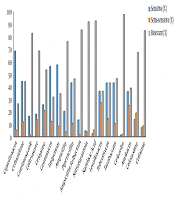
The antibiotic susceptibility results showed 99.2% resistance to carbenicillin, 98.4% to ticarcillin, 96.2% to ciprofloxacin, 95.4% to co-trimoxazole, 94.7% to imipenem and meropenem, 93.9% to piperacillin, 93.2% to azetronam, 92.4% to tobramycin, 91.7% to cefepime, 89.4% to amikacin and ceftazidime, and 87.2% to piperacillin-tazobactam ( Figure 1 ). All isolates were MDR (resistant to at least 3 different classes of antibiotics).

Figure 1
Py: carbenicillin, Tc: ticarcillin, Cip: ciprofloxacin, Ts: co-trimoxazole, Imp: imipenem, Mem: meropenem, Prl: piperacillin, Atm: aztreonam, Tn: tobramycin,Cpm: cefepime, Ak: amikacin, Caz: ceftazidime and Ptz: piperacillin/tazobactam.
Among the imipenem-resistant P. aeruginosa, there was 99.2% resistance to carbenicillin, 98.4% to ticarcillin, 96.8% to ciprofloxacin and azetronam, 96% to meropenem, 95.3% to co-trimoxazole, 94.5% to tobramycin, 93.7% to cefepime and piperacillin, 91.4% to amikacin, 89.4% to ceftazidime and 87.5% to piperacillin-tazobactam ( Figure 2 ). Since there was an overall high rate of imipenem resistance (94.7%), no statistical analysis could be performed to compare the susceptibility profiles of imipenem-resistant strains with the susceptible isolates. However, resistance to ceftazidime, tobramycin, meropenem, cefepime and ciprofloxacin was slightly higher in imipenem-resistant strains ( Figure 2 ), there was no relationship between antibiotic resistance and the source of the specimen.

Figure 2
Py: carbenicillin, Atm: aztreonam,Tc:ticarcillin, Mem: meropenem, Cip: ciprofloxacin, Ts: co-trimoxazole,Cpm: cefepime, Prl: piperacillin, Tn: tobramycin,Ak: amikacin, Caz: ceftazidime and Ptz: piperacillin/tazobactam.
5. Discussion
Over the past 20 years, P. aeruginosa has been repeatedly recognized as the most prevalent organism which causes infection in burn centers in Tehran (5, 13, 14). Unfortunately, the organism appears to be resistant to almost all antimicrobial agents creating a great problem in clinical settings. In addition, the more recent emergence of carbapenem resistance in P. aeruginosa has limited the therapeutic options.
Multidrug-resistant P. aeruginosa is often the cause of outbreak of diseases in the burn units (5, 10). Different rates of MDR have been reported for P. aeruginosa burn isolates in various cities of Iran (5, 10, 13). The reports from Shahid Motahari Burn Hospital in Tehran have varied considerably from 2007 to 2011 in both MDR and carbapenem resistance. Salimi et al. found 16% imipenem resistance and 42% MDR in P. aeruginosa isolates collected in 2008 from the intensive care burn patients (14). Saderi et al. reported that 69% of P. aeurginosa burn isolates in 2008 were multidrug-resistant and MDR was more prevalent in the imipenem- resistant strains compared to the imipenem susceptible isolates (87% vs. 29%) (10). In 2007, Ranjbar et al. reported that all P. aeruginosa burn isolates from Shahid Motahari Burn Hospital were MDR of which, 97.5% were resistant to imipenem (9).
We found that 100% of P. aeurginosa isolates from Shahid Motahari Burn Hospital were MDR of which 94.7% were resistant to both imipenem and meropenem. The main reasons for various rates of drug resistance in such a short period of time from the same hospital could be the use of different antibiotic regimes, presence of different persistent strains in hospitals and the quality of hygiene in different environments. Similarly, according to other studies in Iran, various degrees of imipenem resistance in P. aeruginosa have been reported. Beheshti and Zia reported 61.1% imipenem resistance in P. aeruginosa burn isolates from Imam Mousa Kazem Burn Center in Esfahan in 2011 (13). Haghi et al. reported 100% multidrug and imipenem resistance in P. aeruginosa burn isolates in Orumieh (13). Jamali and colleagues reported 61.8% imipenem resistance in the burn isolates of P. aeruginosa in 2009 (15). Studies in other countries have also shown different rates of imipenem resistance in P. aeruginosa burn isolates. Similar to these results, Shahid et al. found 100% MDR in P. aeurginosa burn isolates in India in 2003, (16). In 2004, Ozkurt et al. reported 69.92% imipenem resistance in P. aeruginosa burn isolates in Turkey (17). In a study conducted between 1996 and 1998 in Korea, 52% of P. aeruginosa were resistant to imipenem(18). In another study performed in Karachi, Pakistan in 2003, imipenem resistance in P. aeruginosa was 32.7% (19).
Antibiotic resistance in P. aeruginosa may be mediatedvia several distinct mechanisms including β-lactamase production, efflux pumps, modification of site-targeted drugs or outer membranes (4, 20). MDR is usually the result of a combination of different mechanisms in a single isolate or the action of a single potent resistance mechanism (20). The Increase in antibiotic resistance is mostly due to extensive use of antibiotics such as ciprofloxacin, β-lactams and aminoglycosides in the burn centers as well as non-availability and high costs of other effective drugs.
We believe that it is important to conduct surveillance programs for appropriate empirical therapy and the practices of infection control. Meanwhile, it is necessary for health care practitioners and policy makers to address this problem by implementing suitable protocols foruse of antibiotics not only to find strategies for treating such difficult infections, but also to avoid spreading of the resistance genes among bacteria.