Journal of Kermanshah University of Medical Sciences
Peer-reviewed Medical Quarterly
e-ISSN 2588-2570
p-ISSN 2588-2562
Outline
Comorbidity of substance dependency in patients with cluster B personality disorders
Authors
Faezeh Tatari1, Sayyed Ali Mousavi2, Jalal Shakeri3,*, Nasrin Abdoli2, Valyea Mohammadi Zavaleh4, Kyomars Zarafshani5
1psychiatry Faculty. university of medical sciences. Kermanshah, Iran
2psychology Faculty, Farabi Hospital. university of medical sciences. Kermanshah, Iran
3Fertility and Infertility Research Center, Kermanshah University of Medical Sciences & psychiatry Faculty. university of medical sciences. Kermanshah, Iran
4General Practioner, university of medical sciences. Kermanshah, Iran
5Statice Faculty, razi university, Kermanshah, Iran
*Corresponding Author: Corresponding author: Jalal Shakeri, Fertility and Infertility Research Center, Kermanshah University of Medical Sciences & psychiatry Faculty. university of medical sciences. Kermanshah, Iran, Tel: +98 9181311232 Email: [email protected]
Published online:Jan 29, 2016
Article type:Research Article
Received:Jun 01, 2015
Accepted:Nov 03, 2015
How to Cite:Tatari F, Mousavi SA, Shakeri J, Abdoli N, Mohammadi Zavaleh V, et al. Comorbidity of substance dependency in patients with cluster B personality disorders. J Kermanshah Univ Med Sci. 2016;19(6):e69812. doi: https://doi.org/10.22110/jkums.v19i6.2566
Abstract
Background: Personality disorders are considered as a risk factor for the development and intensification of substance dependency. This study was aimed to determine the comorbidity of substance dependency in patients with cluster B personality disorders.
Method: This cross-sectional study was performed on 96 patients (71 males and 25 females) referring to Farabi Hospital, Kermanshah, Iran .The data were gathered using a questionnaire. Data analysis was performed by SPSS software.
Results: Data analysis revealed that borderline personality disorder with one year substance abuse, combination of histrionic, borderline, narcissistic and anti-social disorders with two years of substance abuse, borderline personality disorder or a combination of borderline, histrionic, narcissistic and anti-social disorders with three years of substance abuse and combination of narcissistic, borderline, histrionic and anti-social disorders in patients with more than three years of substance dependency had the highest prevalence. Narcissistic personality disorder in patients with no attempts to quit and combination of histrionic, borderline, narcissistic and anti-social disorders in patients with two or three attempts to quit had the highest prevalence.
Conclusion: The results showed a relationship between substance dependency and cluster B personality disorders. Considering the prevalence of personality disorders among drug abusers, psychological and psychiatric interventions along with medication are necessary in substance abuse treatment centers.
References
- 1.The references of this article is available on PDF.
Copyright
© 2016, Journal of Kermanshah University of Medical Sciences. This open-access article is available under the Creative Commons Attribution-NonCommercial 4.0 (CC BY-NC 4.0) International License (https://creativecommons.org/licenses/by-nc/4.0/), which allows for the copying and redistribution of the material only for noncommercial purposes, provided that the original work is properly cited.
Similar Articles
31
Jul
2008
Personality Disorders in Treatment – Seeking Substance Dependent Patients
Mehrdad Salehi,
Azadeh Malekian Malekian,
Mohammad Haghighi,
Leila Jahangard,
Ehsan Rahimi
Salehi M, Malekian AM, Haghighi M, Jahangard L, Rahimi E. Personality Disorders in Treatment – Seeking Substance Dependent Patients. Iran J Psychiatry Behav Sci. 2008;2(2):. doi:
22
Oct
2014
The relationship between substance dependency, antisocial personality disorder and adult antisocial behaviors
Arsia Taghva,
Masoud Azizi,
Somayeh Nejati
Taghva A, Azizi M, Nejati S. The relationship between substance dependency, antisocial personality disorder and adult antisocial behaviors. Ann Mil Health Sci Res. 2014;12(3):e63278. doi:
2
Sep
2023
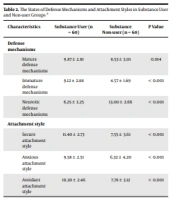
The Relationship Between Attachment Styles, Defense Mechanisms and Substance Use Disorder
Maedeh Kamrani,
Zohre Rouhbakhsh,
Ghazal Behravan,
Razie Salehabadi
Kamrani M, Rouhbakhsh Z, Behravan G, Salehabadi R. The Relationship Between Attachment Styles, Defense Mechanisms and Substance Use Disorder. Int J High Risk Behav Addict. 2023;12(3):e137086. doi: https://doi.org/10.5812/ijhrba-137086
30
Jun
2010
Comparing the Level of Dissociative Experience in Prisoners with and without Opioid Dependence Disorder in Shiraz and its Relationship with Other
Mohsen Kianpoor,
Mohammad Jaffar Bahredar,
Seyyed Javad Ommizade
Kianpoor M, Bahredar MJ, Ommizade SJ. Comparing the Level of Dissociative Experience in Prisoners with and without Opioid Dependence Disorder in Shiraz and its Relationship with Other. Iran J Psychiatry Behav Sci. 2010;4(1):. doi:
1
Jan
2013
Attachment Styles and Personality Disorders of A and B clusters
Ameneh Kazemi,
Davood Hoseninasab,
Zeynab Khanjani
Kazemi A, Hoseninasab D, Khanjani Z. Attachment Styles and Personality Disorders of A and B clusters. Zahedan J Res Med Sci. 2014;16(5):. doi:
Cited by
- Scopus by DOI: 0
Last Update: 2 weeks ago
- Scopus by Title: 0
Last Update: 2 weeks ago
- Scopus by Title (Ref): 2
Last Update: 2 weeks ago
- CrossRef: 0
Last Update: 2 days ago
Comments
Number of Comments:0