
J Rep Pharm Sci

Image Credit:J Rep Pharm Sci

Eucalyptol (1,8-Cineole) Exhibits Anti-seizure Activity Potentially via Modulation of the Nitric Oxide Pathway

Author(s):
Iraj BaratpourIraj BaratpourIraj Baratpour ORCID1, Fatemeh KavianiFatemeh KavianiFatemeh Kaviani ORCID1, Elham SaghaeiElham SaghaeiElham Saghaei ORCID2, 3,*, Elham BijadElham BijadElham Bijad ORCID3, Zahra RabieiZahra Rabiei3
1Student Research Committee, Shahrekord University of Medical Sciences, Shahrekord, Iran
2Physiology and Pharmacology Department, Faculty of Medicine, Shahrekord University of Medical Sciences, Shahrekord, Iran
3Medical Plants Research Center, Basic Health Sciences Institute, Shahrekord University of Medical Sciences, Shahrekord, Iran

Journal of Reports in Pharmaceutical Sciences:Vol. 13, issue 1; e160896
Published online:Sep 03, 2025
Article type:Research Article
Received:Mar 01, 2025
Accepted:Aug 24, 2025
How to Cite:Baratpour I, Kaviani F, Saghaei E, Bijad E, Rabiei Z. Eucalyptol (1,8-Cineole) Exhibits Anti-seizure Activity Potentially via Modulation of the Nitric Oxide Pathway. J Rep Pharm Sci. 2025;13(1):e160896. doi: https://doi.org/10.5812/jrps-160896

Abstract

Background:

Seizures remain a major therapeutic challenge, and novel neuroprotective agents are under investigation. Eucalyptol (1,8-cineole), a monoterpene ether with antioxidant properties, has shown neuroprotective potential; however, its anti-seizure mechanism is not fully elucidated.

Objectives:

The present study evaluated the anti-seizure effects of eucalyptol in a pentylenetetrazol (PTZ)-induced seizure model in mice and examined the involvement of the nitric oxide (NO) pathway.

Methods:

Seventy-two NMRI mice were randomly allocated into control and treatment groups. Eucalyptol (30, 100, 300, or 600 mg/kg, i.p.) was administered with or without L-NAME (10 mg/kg, non-selective NOS inhibitor) or L-arginine (45 mg/kg, NO precursor). Seizure thresholds were determined via intravenous PTZ infusion. Brain and serum samples were analyzed for malondialdehyde (MDA), total antioxidant capacity (TAC), NO content, and hippocampal inducible and neuronal (nNOS) NO synthase gene expression.

Results:

Eucalyptol at 300 and 600 mg/kg significantly increased seizure thresholds (25.26 ± 7.47 and 26.11 ± 4.64 mg/kg vs 10.15 ± 1.67 in control; P < 0.05). L-NAME enhanced the effect of 30 mg/kg eucalyptol, while L-arginine attenuated the effect at 600 mg/kg. Effective doses also reduced MDA, NO, and increased TAC levels and normalized iNOS expression in hippocampal tissue.

Conclusions:

Eucalyptol at higher doses delays seizure onset and mitigates oxidative stress, possibly via modulation of the nitrergic pathway. These findings support further investigation of eucalyptol as a candidate for seizure management.

1. Background

Seizures arise from abnormal electrical activity in brain neurons, leading to impaired neuronal signaling and synaptic transmission, which often result in altered consciousness and involuntary movements (1, 2). The recurrent occurrence of seizures defines epilepsy (3), a neurological disorder affecting approximately 50 million people worldwide, making it one of the most prevalent neurological conditions globally (4). Epilepsy imposes a significant burden on healthcare systems and is associated with increased risks of disability and mortality (5). Despite the availability of numerous antiepileptic drugs, many patients experience adverse effects, drug resistance, and inadequate seizure control (6, 7). Highlighting the urgent need for novel and effective therapeutic strategies (8). Recently, considerable attention has focused on natural and plant-derived compounds as potential therapeutic agents (9). Eucalyptol (1,8-cineole) is a monocyclic monoterpene ether present in various essential oils, particularly from the genus Eucalyptus. It has demonstrated therapeutic potential in treating respiratory disorders such as bronchitis, sinusitis, and asthma, partly through reducing inflammatory mediators in experimental models (10, 11). Furthermore, eucalyptol exhibits antioxidative, and neuroprotective properties, with reported benefits in brain injury and Alzheimer’s disease (12, 13). Notably, it has been shown to modulate seizure onset and protect against neuronal damage in pilocarpine-induced seizure models (14).
Nitric oxide (NO) is a versatile signaling molecule in the central nervous system, involved in neuromodulation, neuroinflammation, neurotransmission, and neurotoxicity. Its role in seizures is complex and influenced by factors such as regional brain distribution, NO production levels, and receptor interactions (15). Nitric oxide is synthesized from L-arginine by three nitric oxide synthase (NOS) isoforms: Inducible (16), endothelial (eNOS), and neuronal (nNOS) (17). Dysregulation of NOS isoforms has been implicated in seizure pathophysiology (18).

2. Objectives

The present study aimed to evaluate the anti-seizure effects of eucalyptol in a pentylenetetrazol (PTZ)-induced seizure model in mice and to investigate whether these effects are mediated through the NO pathway.

3. Methods

3.1. Animals

Seventy-two male NMRI mice (20 - 30 g, approximately 8 weeks old) were obtained from the Pasteur Institute, Tehran, Iran. Animals were housed under standard laboratory conditions at the Animal Science Center of Shahr-e-Kord University of Medical Sciences, with a 12-hour light/dark cycle, temperature of 21 ± 5°C, humidity of 50 ± 2%, and free access to food and water. All procedures complied with the National Guide for the Care and Use of Laboratory Animals (9th edition, 2021) and were approved by the ethics committee of the university. Mice were randomly assigned to nine groups (n = 8 per group): Control (normal saline, 1 mL/kg), PTZ + eucalyptol (30, 100, 300, and 600 mg/kg), PTZ + L-NAME (10 mg/kg), PTZ + L-arginine (45 mg/kg), PTZ + L-NAME + eucalyptol (30 mg/kg), and PTZ + L-arginine + eucalyptol (600 mg/kg)

3.2. Pentylenetetrazol-Seizure Induce Protocol and Eucalyptol Administration

Eucalyptol was dissolved in physiological saline and administered intraperitoneally at doses of 30, 100, 300, and 600 mg/kg, 30 minutes prior to seizure induction. L-NAME and L-arginine were administered 45 minutes before the PTZ injection. Seizures were induced by intravenous infusion of PTZ dissolved in physiological saline. A 30-gauge winged infusion set was carefully inserted into the tail vein of conscious, freely moving mice. Proper needle placement was confirmed by blood reflux. Pentylenetetrazol was infused at 5 mg/mL using a pump until the onset of forelimb clonus, followed by generalized clonus, considered as the seizure threshold. The minimal PTZ dose inducing generalized clonus was recorded as the seizure threshold (19). Seizure threshold (mg/kg) was calculated as (20):
After experiments, mice were anesthetized with ketamine (20 mg/kg) and xylazine (10 mg/kg) intraperitoneally. Blood was collected via cardiac puncture, and hippocampal tissues were dissected and stored at -70°C until analysis.

3.3. Brain and Serum Total Antioxidant Capacity

Total antioxidant capacity (TAC) in plasma and hippocampal tissue was measured using the ferric-reducing ability of plasma (FRAP) assay. Samples were incubated with 2,4,6-tripyridyl-s-triazine (TPTZ) reagent, sodium acetate buffer, and ferric chloride solution at 37°C for 30 minutes. Antioxidants reduce Fe3⁺ to Fe2⁺, forming a blue complex measured spectrophotometrically at 593 nm. The TAC values were determined by comparison to a standard curve and expressed as µmol/L (21, 22).

3.4. Brain and Serum Malondialdehyde Level

Malondialdehyde levels in serum and hippocampal tissue were quantified via the thiobarbituric acid (TBA) assay. Samples reacted with TBA in acidic conditions and were heated to 95°C, forming an MDA-TBA complex with a pink color, measured at 532 nm. Concentrations were calculated from an MDA standard curve and expressed as µg/mL (23, 24).

3.5. Nitric Oxide Content of the Hippocampus

The NO levels in hippocampal samples were determined by Griess assay, which quantifies nitrite (NO2-), a stable NO metabolite. Fifty microliters of the sample were mixed with 50 μL Griess reagent (sulfanilamide and NED solutions) in a 96-well plate and incubated for 10 minutes. Absorbance was read at 520 - 550 nm within 30 minutes. Nitrite concentration was calculated using a standard curve (25).

3.6. Real-time PCR

Expression of iNOS and nNOS genes was measured by quantitative real-time PCR. Total RNA was extracted from hippocampal tissues using RNX-Plus reagent (Sinaclon Co., Cat. No.: Ex6101). Complementary DNA (cDNA) was synthesized with the PrimeScript RT reagent kit (Takara Bio, Japan). The PCR amplification was performed using SYBR Premix Ex Taq (Takara Bio) on a LightCycler system (Roche Diagnostics). Reactions were run in triplicate and repeated twice for accuracy. Beta-2 microglobulin (B2M) served as the housekeeping gene. Relative gene expression was calculated using the 2-ΔΔCt method (26). Primer sequences are listed in Table 1.
Table 1.The Sequence of Primer Utilization in PCR Administration
Gene NameForward PrimerReverse Primer
B2mGGAAGTTGGGCTTCCCATTCTCGTGATCTTTCTGGTGCTTGTC
iNOSCCAACAGGAGAAGGGGACGAAGGACATCAAAGGTCTCACAGG
nNOSGGCTGTGCTTTGATGGAGATGAGAATAGGAGGAGACGCTGTTGA

Abbreviation: B2m, beta-2 microglobulin.

3.7. Statistical Analysis

Data were analyzed using GraphPad Prism software and expressed as mean ± SEM. One-way ANOVA followed by Tukey’s post hoc test was used for multiple group comparisons. Two-way ANOVA assessed the interaction effect of NO modulation on eucalyptol’s anti-seizure activity. Statistical significance was set at P < 0.05.

4. Results

4.1. Eucalyptol Increased the Seizure Threshold

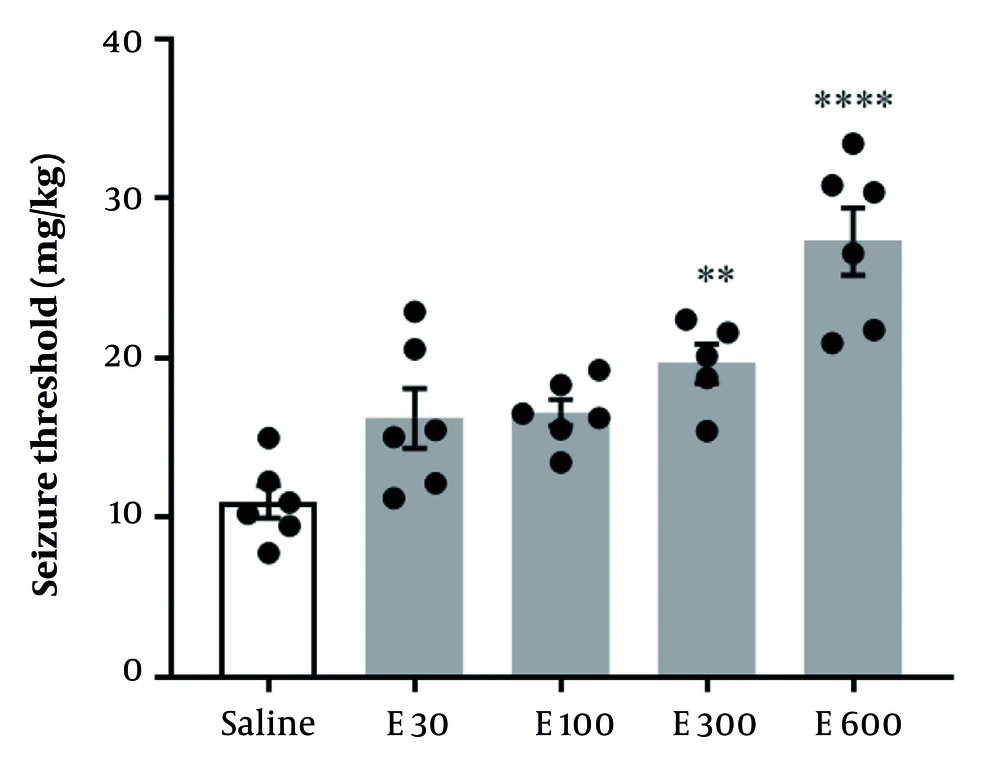
Figure 1 illustrates the effect of administering different doses of eucalyptol 30 minutes prior to PTZ infusion on the latency to clonus onset in mice. Statistical analysis revealed that treatment with eucalyptol at doses of 300 and 600 mg/kg significantly increased the seizure threshold compared to the saline-treated PTZ group (P < 0.01 and P < 0.001, respectively).
Effect of eucalyptol at various doses on seizure threshold. Data are presented as mean ± SEM. Statistical comparisons were performed using one-way ANOVA followed by Tukey’s multiple comparison test. E: Eucalyptol doses in mg/kg. ** P &lt; 0.01, **** P &lt; 0.0001 versus the saline-treated pentylenetetrazol (PTZ) group.
Figure 1.

Effect of eucalyptol at various doses on seizure threshold. Data are presented as mean ± SEM. Statistical comparisons were performed using one-way ANOVA followed by Tukey’s multiple comparison test. E: Eucalyptol doses in mg/kg. ** P < 0.01, **** P < 0.0001 versus the saline-treated pentylenetetrazol (PTZ) group.

4.2. The Role of the Nitric Oxide Pathway in Eucalyptol’s Anti-seizure Effects

The second phase of the study aimed to determine whether the anti-seizure effects of eucalyptol are mediated through the NO pathway. To explore this, the non-selective NOS inhibitor L-NAME and the NO precursor L-arginine were administered both alone and in combination with eucalyptol prior to PTZ-induced seizure induction. Additionally, nitrite levels were measured in isolated hippocampal tissue samples.
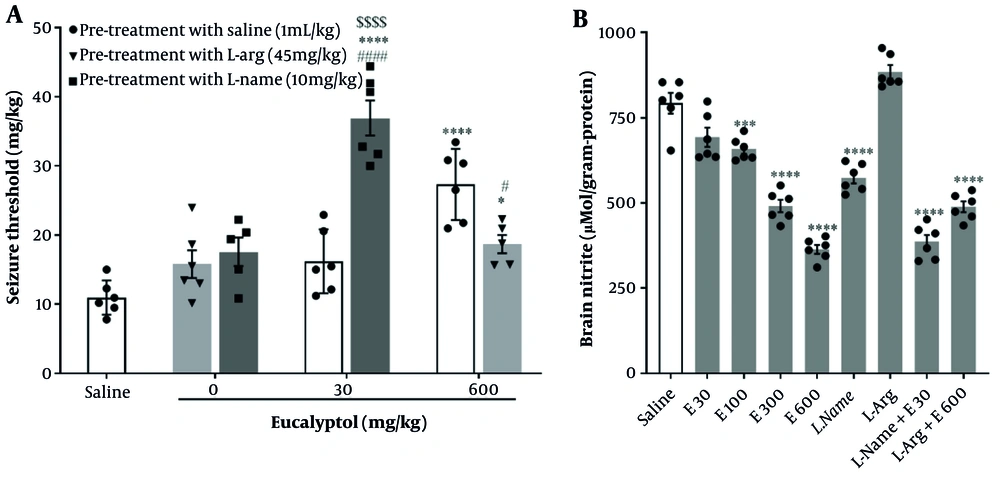
As shown in Figure 2A, treatment with L-NAME alone did not produce a significant change in seizure threshold. However, when combined with a sub-effective dose of eucalyptol (30 mg/kg), L-NAME significantly enhanced the anti-seizure effect compared to the saline-treated PTZ group [F(1,16) = 14.18, P = 0.0017].
Conversely, Figure 2A shows that L-arginine alone did not significantly affect seizure threshold. Nevertheless, co-administration of L-arginine with an effective dose of eucalyptol (600 mg/kg) notably augmented eucalyptol’s anti-seizure effect relative to the saline-treated PTZ group [F(1,16) = 6.62, P = 0.02].
Figure 2B depicts the hippocampal nitrite levels across experimental groups. Both 300 and 600 mg/kg doses of eucalyptol significantly decreased NO levels compared to the saline-treated PTZ group (P < 0.001). Significant reductions were also observed in groups treated with L-NAME alone, L-NAME combined with eucalyptol (30 mg/kg), and L-arginine combined with eucalyptol (600 mg/kg), compared to the saline-treated PTZ group (P < 0.01, P < 0.001, and P < 0.001, respectively).
Mediation of eucalyptol’s anti-seizure effect via the nitric oxide (NO) pathway. Data are presented as mean ± SEM and analyzed by one-way ANOVA followed by Tukey’s post-hoc test. A, effects of L-NAME or L-arginine, alone and combined with eucalyptol, on pentylenetetrazol (PTZ)-induced seizure threshold; B, brain nitrite content across groups. Statistical significance is indicated as follows: * P &lt; 0.05, *** P &lt; 0.001, **** P &lt; 0.0001 versus saline-treated PTZ group; ####P &lt; 0.0001 versus eucalyptol (30 mg/kg)-treated PTZ group; # P &lt; 0.05 versus eucalyptol (600 mg/kg)-treated PTZ group; $$$$P &lt; 0.0001 versus L-NAME-treated PTZ group.
Figure 2.

Mediation of eucalyptol’s anti-seizure effect via the nitric oxide (NO) pathway. Data are presented as mean ± SEM and analyzed by one-way ANOVA followed by Tukey’s post-hoc test. A, effects of L-NAME or L-arginine, alone and combined with eucalyptol, on pentylenetetrazol (PTZ)-induced seizure threshold; B, brain nitrite content across groups. Statistical significance is indicated as follows: * P < 0.05, *** P < 0.001, **** P < 0.0001 versus saline-treated PTZ group; ####P < 0.0001 versus eucalyptol (30 mg/kg)-treated PTZ group; # P < 0.05 versus eucalyptol (600 mg/kg)-treated PTZ group; $$$$P < 0.0001 versus L-NAME-treated PTZ group.

4.3. Eucalyptol Increased Total Antioxidant Capacity in the Brain and Serum

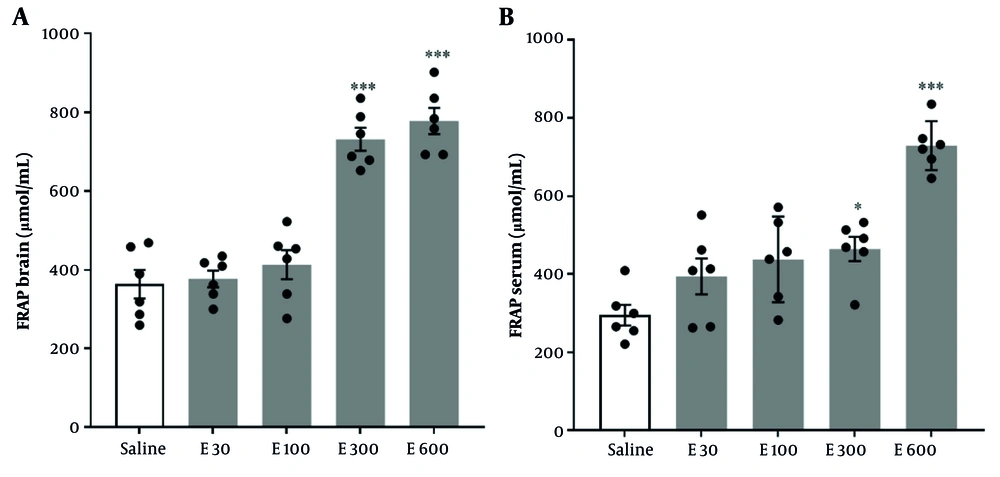
Figure 3A shows that administration of eucalyptol at doses of 300 and 600 mg/kg significantly increased TAC in the brain compared to the saline-treated PTZ group (P < 0.001). Similarly, as illustrated in Figure 3B, the 600 mg/kg dose of eucalyptol significantly restored serum TAC levels in convulsive animals relative to the saline-treated PTZ group (P < 0.001).
Effect of eucalyptol on total antioxidant capacity (TAC) in A, brain; and B, serum. Data are presented as mean ± SEM and analyzed using one-way ANOVA with Tukey’s multiple comparison test. E: Eucalyptol at indicated doses. * P &lt; 0.05, *** P &lt; 0.001 versus saline-treated pentylenetetrazol (PTZ) group.
Figure 3.

Effect of eucalyptol on total antioxidant capacity (TAC) in A, brain; and B, serum. Data are presented as mean ± SEM and analyzed using one-way ANOVA with Tukey’s multiple comparison test. E: Eucalyptol at indicated doses. * P < 0.05, *** P < 0.001 versus saline-treated pentylenetetrazol (PTZ) group.

4.4. Eucalyptol Decreased Malondialdehyde Levels in the Brain and Serum

Eucalyptol significantly reduced MDA levels in both brain and serum tissues. As shown in Figure 4A, administration of eucalyptol at doses of 100, 300, and 600 mg/kg resulted in significant reductions in brain MDA levels compared to the saline-treated PTZ group (P < 0.001, P < 0.01, and P < 0.001, respectively).
Similarly, Figure 4B illustrates that serum MDA levels were significantly decreased in animals treated with 100, 300, and 600 mg/kg of eucalyptol relative to the saline-treated PTZ group (P < 0.01 and P < 0.001, respectively).
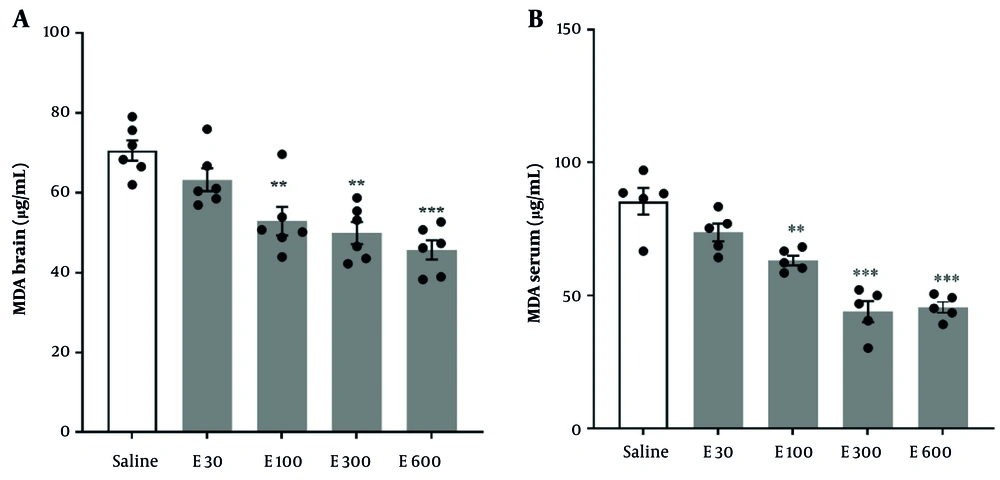
Effect of eucalyptol on MDA levels in the A, brain; and B, serum. Data are presented as mean ± SEM and were analyzed using one-way ANOVA followed by Tukey’s multiple comparison test. E: Eucalyptol at different doses. ** P &lt; 0.01 and *** P &lt; 0.001 compared to the saline-treated pentylenetetrazol (PTZ) group.
Figure 4.

Effect of eucalyptol on MDA levels in the A, brain; and B, serum. Data are presented as mean ± SEM and were analyzed using one-way ANOVA followed by Tukey’s multiple comparison test. E: Eucalyptol at different doses. ** P < 0.01 and *** P < 0.001 compared to the saline-treated pentylenetetrazol (PTZ) group.

4.5. Eucalyptol Downregulated the Expression of iNOS and nNOS Genes

Real-time PCR results measuring the expression levels of iNOS and nNOS genes are presented in Figure 5A and B. The saline-treated PTZ group showed significant overexpression of both iNOS and nNOS genes compared to the control group (P < 0.001).
Statistical analysis revealed that administration of 600 mg/kg eucalyptol significantly reduced iNOS gene expression compared to the saline-treated PTZ group (Figure 5 P < 0.01). However, as shown in Figure 5B, eucalyptol did not significantly suppress nNOS gene expression at the effective doses when compared to the saline-treated PTZ group.
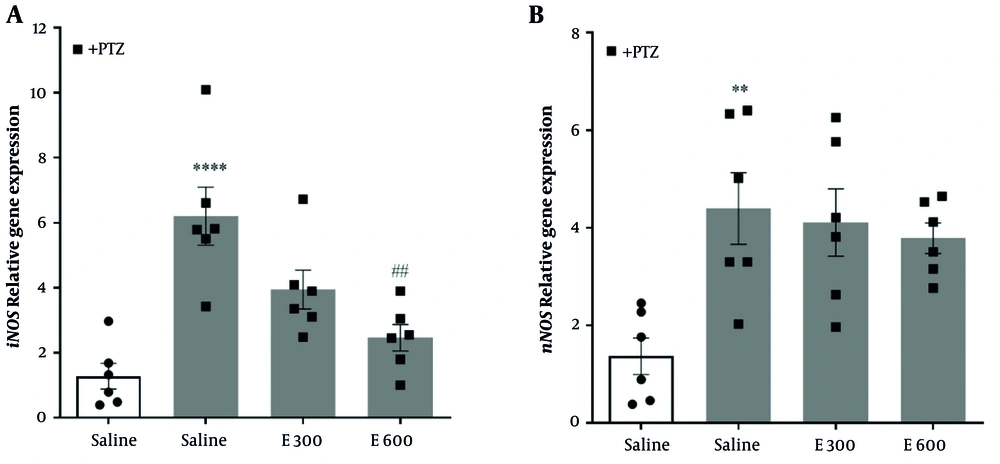
Downregulation of A, iNOS; and B, nNOS gene expression by eucalyptol. Data are presented as mean ± SEM and analyzed using one-way ANOVA with Tukey’s multiple comparison test. E: Eucalyptol at various doses. ** P &lt; 0.01, **** P &lt; 0.0001 versus saline-treated control group; ## P &lt; 0.01 versus saline-treated pentylenetetrazol (PTZ) group.
Figure 5.

Downregulation of A, iNOS; and B, nNOS gene expression by eucalyptol. Data are presented as mean ± SEM and analyzed using one-way ANOVA with Tukey’s multiple comparison test. E: Eucalyptol at various doses. ** P < 0.01, **** P < 0.0001 versus saline-treated control group; ## P < 0.01 versus saline-treated pentylenetetrazol (PTZ) group.

5. Discussion

This study investigated the effects of eucalyptol administered at various dose on a mouse model of PTZ-induced seizures. Our findings demonstrate that eucalyptol dose-dependently increased the seizure threshold and improved seizure control. Notably, eucalyptol elevated TAC while reducing MDA and NO levels following seizure induction. Moreover, the effective dose of eucalyptol significantly downregulated inducible NOS (16) gene expression. The anti-seizure effect was enhanced by co-administration with the NOS inhibitor L-NAME, while the NO precursor L-arginine attenuated eucalyptol’s protective properties. Herbal compounds such as eucalyptol are known for their antioxidant properties and neuroprotective potential in preventing seizures (27). In line with this, Hoch et al. reported that eucalyptol reduces neuronal excitability by depolarizing membrane potentials (11). Similarly, other studies have shown that eucalyptol prevents hyperexcitability in pilocarpine-induced seizures through oxidative stress inhibition (14). Sobreira Dantas Nobrega de Figueiredo et al. demonstrated its protective effect in a PTZ-induced seizure model (28). de Almeida et al. also reported anti-seizure effects of Ocimum basilicum, which contains 1,8-cineole (eucalyptol) as a major component (29). Pentylenetetrazol induces seizures primarily via antagonism of GABA_A receptors and imbalance of excitatory and inhibitory neurotransmission, leading to increased oxidative stress and generation of reactive oxygen species (ROS) and reactive nitrogen species (RNS) (30-32). This is associated with increased levels of H2O2, O2−•, nitrite, malonaldehyde, 4-hydroxynonenal. Oxidative stress plays an important role in the seizure pathophysiology (33). Excessive ROS and RNS disrupt redox homeostasis and cause lipid peroxidation, reflected by elevated MDA levels (34-36). Our study confirms that eucalyptol enhances antioxidant defenses, consistent with prior findings that 1,8-cineole attenuates neuronal oxidative stress (12, 37-39). The NO/NOS pathway plays a pivotal role in neurodegeneration and seizure pathophysiology (40-42). While NO serves important physiological functions in neurotransmission and cerebral blood flow (43), its excessive production contributes to neurotoxicity and seizure propagation (44). Pentylenetetrazol-induced seizures may be exacerbated by NO through modulation of NMDA and GABA_A receptor activity (45). Consistent with previous studies, our data show that inhibition of NO synthesis via L-NAME potentiates eucalyptol’s anti-seizure effects, whereas L-arginine mitigates them (18, 46, 47). A limitation of our study is the lack of isoform-specific NOS inhibitors, preventing definitive identification of the NOS isoform involved. However, real-time PCR results indicated that eucalyptol selectively downregulates iNOS expression without a significant effect on neuronal NOS (nNOS). This aligns with reports demonstrating that eucalyptol reduces iNOS expression and associated neural damage, thereby enhancing seizure tolerance (48-51).
It is important to acknowledge that some studies have reported pro-convulsive effects of eucalyptus extracts when inhaled or ingested (52-56). These discrepancies may stem from differences in extract composition, dosage, route of administration, or interactions among multiple bioactive compounds. Since eucalyptol was administered in purified form in our study, our findings specifically reflect its direct effects, which include neuromodulatory, anti-inflammatory, and antioxidant actions that reduce neuronal excitability (11, 27, 28).

5.1. Conclusions

Our results demonstrate that eucalyptol exerts dose-dependent neuroprotective and anti-seizure effects in a PTZ-induced seizure mouse model. These effects are likely mediated through suppression of the NO pathway, particularly via downregulation of iNOS gene expression, along with enhancement of antioxidant capacity and reduction of lipid peroxidation. Eucalyptol administration significantly delayed seizure onset, suggesting potential therapeutic value. Future studies should explore the precise molecular mechanisms involved, including the use of isoform-specific NOS inhibitors.
Acknowledgments

Footnotes

References

  • 1.
    Acharya UR, Hagiwara Y, Adeli H. Automated seizure prediction. Epilepsy Behav. 2018;88:251-61. [PubMed ID: 30317059]. https://doi.org/10.1016/j.yebeh.2018.09.030.
  • 2.
    De Lahunta A, Glass EN, Kent M. de Lahunta's Veterinary Neuroanatomy and Clinical Neurology-E-Book. 5th ed. Oxford, UK: Elsevier Health Sciences; 2020.
  • 3.
    Carpio A, Romo ML, Hauser WA, Kelvin EA. New understanding about the relationship among neurocysticercosis, seizures, and epilepsy. Seizure. 2021;90:123-9. [PubMed ID: 33632613]. https://doi.org/10.1016/j.seizure.2021.02.019.
  • 4.
    World Health Organization. Epilepsy. 2019. Available from: http://www.who.int/mediacentre/factsheets/fs999/.
  • 5.
    Li MCH, Cook MJ. Deep brain stimulation for drug-resistant epilepsy. Epilepsia. 2018;59(2):273-90. [PubMed ID: 29218702]. https://doi.org/10.1111/epi.13964.
  • 6.
    Mahmoudi T, Lorigooini Z, Rafieian-Kopaei M, Arabi M, Rabiei Z, Bijad E, et al. Effect of Curcuma zedoaria hydro-alcoholic extract on learning, memory deficits and oxidative damage of brain tissue following seizures induced by pentylenetetrazole in rat. Behav Brain Funct. 2020;16(1):7. [PubMed ID: 33023622]. [PubMed Central ID: PMC7542381]. https://doi.org/10.1186/s12993-020-00169-3.
  • 7.
    Loscher W, Potschka H, Sisodiya SM, Vezzani A. Drug Resistance in Epilepsy: Clinical Impact, Potential Mechanisms, and New Innovative Treatment Options. Pharmacol Rev. 2020;72(3):606-38. [PubMed ID: 32540959]. [PubMed Central ID: PMC7300324]. https://doi.org/10.1124/pr.120.019539.
  • 8.
    Penovich PE, Buelow J, Steinberg K, Sirven J, Wheless J. Burden of Seizure Clusters on Patients With Epilepsy and Caregivers: Survey of Patient, Caregiver, and Clinician Perspectives. Neurologist. 2017;22(6):207-14. [PubMed ID: 29095321]. https://doi.org/10.1097/NRL.0000000000000140.
  • 9.
    Najmi A, Javed SA, Al Bratty M, Alhazmi HA. Modern Approaches in the Discovery and Development of Plant-Based Natural Products and Their Analogues as Potential Therapeutic Agents. Molecules. 2022;27(2). [PubMed ID: 35056662]. [PubMed Central ID: PMC8779633]. https://doi.org/10.3390/molecules27020349.
  • 10.
    Campos JF, Berteina-Raboin S. Eucalyptol, an All-Purpose Product. Catalysts. 2022;12(1). https://doi.org/10.3390/catal12010048.
  • 11.
    Hoch CC, Petry J, Griesbaum L, Weiser T, Werner K, Ploch M, et al. 1,8-cineole (eucalyptol): A versatile phytochemical with therapeutic applications across multiple diseases. Biomed Pharmacother. 2023;167:115467. [PubMed ID: 37696087]. https://doi.org/10.1016/j.biopha.2023.115467.
  • 12.
    Xu G, Guo J, Sun C. Eucalyptol ameliorates early brain injury after subarachnoid haemorrhage via antioxidant and anti-inflammatory effects in a rat model. Pharm Biol. 2021;59(1):114-20. [PubMed ID: 33550883]. [PubMed Central ID: PMC8871613]. https://doi.org/10.1080/13880209.2021.1876101.
  • 13.
    Hussein J, Ashour M, Elias T, El-Wassef M, Ashraf R, Ramadan M, et al. A Promising Approach for the Treatment of Experimental Alzheimer's disease: Impact of Cardamom Essential Oil. Egyptian Journal of Chemistry. 2023;66(11):385-91.
  • 14.
    Bezerra DS, de Araujo Delmondes G, Pereira Lopes MJ, Araujo IM, de Lacerda Leite GM, de Oliveira Barbosa M, et al. Eucalyptol prevents pilocarpine-induced seizure and neuronal damage in mice, through the cholinergic, monoaminergic and antioxidant pathways. Food Bioscience. 2023;53. https://doi.org/10.1016/j.fbio.2023.102824.
  • 15.
    Cinelli MA, Do HT, Miley GP, Silverman RB. Inducible nitric oxide synthase: Regulation, structure, and inhibition. Med Res Rev. 2020;40(1):158-89. [PubMed ID: 31192483]. [PubMed Central ID: PMC6908786]. https://doi.org/10.1002/med.21599.
  • 16.
    Suzuki K, Hatzikotoulas K, Southam L, Taylor HJ, Yin X, Lorenz KM, et al. Genetic drivers of heterogeneity in type 2 diabetes pathophysiology. Nature. 2024;627(8003):347-57. [PubMed ID: 38374256]. [PubMed Central ID: PMC10937372]. https://doi.org/10.1038/s41586-024-07019-6.
  • 17.
    Vega Rasgado LA, Ramon-Gallegos E, Rodriguez-Paez L, Alcantara-Farfan V. The opposite effect of convulsant drugs on neuronal and endothelial nitric oxide synthase - A possible explanation for the dual proconvulsive/anticonvulsive action of nitric oxide. Acta Pharm. 2023;73(1):59-74. [PubMed ID: 36692466]. https://doi.org/10.2478/acph-2023-0004.
  • 18.
    Taskiran AS, Tastemur Y. The role of nitric oxide in anticonvulsant effects of lycopene supplementation on pentylenetetrazole-induced epileptic seizures in rats. Exp Brain Res. 2021;239(2):591-9. [PubMed ID: 33385251]. https://doi.org/10.1007/s00221-020-06012-5.
  • 19.
    Cendes F, Leproux F, Melanson D, Ethier R, Evans A, Peters T, et al. MRI of amygdala and hippocampus in temporal lobe epilepsy. J Comput Assist Tomogr. 1993;17(2):206-10. [PubMed ID: 8454746]. https://doi.org/10.1097/00004728-199303000-00008.
  • 20.
    Loscher W, Schmidt D. Which animal models should be used in the search for new antiepileptic drugs? A proposal based on experimental and clinical considerations. Epilepsy Res. 1988;2(3):145-81. [PubMed ID: 3058469]. https://doi.org/10.1016/0920-1211(88)90054-x.
  • 21.
    Benzie IF, Strain JJ. Ferric reducing/antioxidant power assay: direct measure of total antioxidant activity of biological fluids and modified version for simultaneous measurement of total antioxidant power and ascorbic acid concentration. Methods Enzymol. 1999;299:15-27. [PubMed ID: 9916193]. https://doi.org/10.1016/s0076-6879(99)99005-5.
  • 22.
    Ghasemi-Dehnoo M, Amini-Khoei H, Lorigooini Z, Ashrafi-Dehkordi K, Rafieian-Kopaei M. Coumaric acid ameliorates experimental colitis in rats through attenuation of oxidative stress, inflammatory response and apoptosis. Inflammopharmacology. 2022;30(6):2359-71. [PubMed ID: 36190687]. https://doi.org/10.1007/s10787-022-01074-z.
  • 23.
    Kuloglu M, Atmaca M, Tezcan E, Ustundag B, Bulut S. Antioxidant enzyme and malondialdehyde levels in patients with panic disorder. Neuropsychobiology. 2002;46(4):186-9. [PubMed ID: 12566935]. https://doi.org/10.1159/000067810.
  • 24.
    Amini-Khoei H, Taei N, Dehkordi HT, Lorigooini Z, Bijad E, Farahzad A, et al. Therapeutic Potential of Ocimum basilicum L. Extract in Alleviating Autistic-Like Behaviors Induced by Maternal Separation Stress in Mice: Role of Neuroinflammation and Oxidative Stress. Phytother Res. 2025;39(1):64-76. [PubMed ID: 39496541]. https://doi.org/10.1002/ptr.8360.
  • 25.
    Sadeghian R, Fereidoni M, Soukhtanloo M, Azizi-Malekabadi H, Hosseini M. Decreased nitric oxide levels in the hippocampus may play a role in learning and memory deficits in ovariectomized rats treated by a high dose of estradiol. Arq Neuropsiquiatr. 2012;70(11):874-9. [PubMed ID: 23175201]. https://doi.org/10.1590/s0004-282x2012001100010.
  • 26.
    Tavakoli Z, Tahmasebi Dehkordi H, Lorigooini Z, Rahimi-Madiseh M, Korani MS, Amini-Khoei H. Anticonvulsant effect of quercetin in pentylenetetrazole (PTZ)-induced seizures in male mice: The role of anti-neuroinflammatory and anti-oxidative stress. Int Immunopharmacol. 2023;116:109772. [PubMed ID: 36731152]. https://doi.org/10.1016/j.intimp.2023.109772.
  • 27.
    Bayat AH, Eskandari N, Sani M, Fotouhi F, Shenasandeh Z, Saeidikhoo S, et al. Anti-inflammatory and antioxidative effects of elderberry diet in the rat model of seizure: a behavioral and histological investigation on the hippocampus. Toxicol Res (Camb). 2023;12(5):783-95. [PubMed ID: 37915479]. [PubMed Central ID: PMC10615822]. https://doi.org/10.1093/toxres/tfad070.
  • 28.
    Sobreira Dantas Nobrega de Figueiredo FR, Monteiro AB, Alencar de Menezes IR, Sales VDS, Peticia do Nascimento E, Kelly de Souza Rodrigues C, et al. Effects of the Hyptis martiusii Benth. leaf essential oil and 1,8-cineole (eucalyptol) on the central nervous system of mice. Food Chem Toxicol. 2019;133:110802. [PubMed ID: 31493462]. https://doi.org/10.1016/j.fct.2019.110802.
  • 29.
    de Almeida RN, Agra Mde F, Maior FN, de Sousa DP. Essential oils and their constituents: anticonvulsant activity. Molecules. 2011;16(3):2726-42. [PubMed ID: 21441872]. [PubMed Central ID: PMC6259740]. https://doi.org/10.3390/molecules16032726.
  • 30.
    Aleshin VA, Graf AV, Artiukhov AV, Ksenofontov AL, Zavileyskiy LG, Maslova MV, et al. Pentylenetetrazole-Induced Seizures Are Increased after Kindling, Exhibiting Vitamin-Responsive Correlations to the Post-Seizures Behavior, Amino Acids Metabolism and Key Metabolic Regulators in the Rat Brain. Int J Mol Sci. 2023;24(15). [PubMed ID: 37569781]. [PubMed Central ID: PMC10418815]. https://doi.org/10.3390/ijms241512405.
  • 31.
    Ciltas AC, Toy CE, Gunes H, Yaprak M. Effects of probiotics on GABA/glutamate and oxidative stress in PTZ- induced acute seizure model in rats. Epilepsy Res. 2023;195:107190. [PubMed ID: 37473590]. https://doi.org/10.1016/j.eplepsyres.2023.107190.
  • 32.
    Monteiro AB, Alves AF, Ribeiro Portela AC, Oliveira Pires HF, Pessoa de Melo M, Medeiros Vilar Barbosa NM, et al. Pentylenetetrazole: A review. Neurochem Int. 2024;180:105841. [PubMed ID: 39214154]. https://doi.org/10.1016/j.neuint.2024.105841.
  • 33.
    Roganovic M, Pantovic S, Dizdarevic S. Role of the oxidative stress in the pathogenesis of epilepsy. Neurological Sciences and Neurophysiology. 2019;36(1):1-8. https://doi.org/10.5152/nsn.2019.11632.
  • 34.
    de Melo AD, Freire VAF, Diogo IL, Santos HL, Barbosa LA, de Carvalho LED. Antioxidant Therapy Reduces Oxidative Stress, Restores Na,K-ATPase Function and Induces Neuroprotection in Rodent Models of Seizure and Epilepsy: A Systematic Review and Meta-Analysis. Antioxidants (Basel). 2023;12(7). [PubMed ID: 37507936]. [PubMed Central ID: PMC10376594]. https://doi.org/10.3390/antiox12071397.
  • 35.
    Bahadoran E, Khorasani MA, Kazemi M, Naderi Y. Bavachinin attenuates pentylenetetrazol-induced seizures through antioxidant and anti-inflammatory mechanisms in adult male mice. Functional Food Science - Online ISSN: 2767-3146. 2025;5(5):182-93. https://doi.org/10.31989/ffs.v5i5.1627.
  • 36.
    Ji D, Mylvaganam S, Ravi Chander P, Tarnopolsky M, Murphy K, Carlen P. Mitochondria and oxidative stress in epilepsy: advances in antioxidant therapy. Front Pharmacol. 2024;15:1505867. [PubMed ID: 40177125]. [PubMed Central ID: PMC11961640]. https://doi.org/10.3389/fphar.2024.1505867.
  • 37.
    Kazak F. A bioactive compound: eucalyptol. Functional foods and nutraceuticals: bioactive compounds. Lyon, France: Livre de Lyon. 2022:125-38.
  • 38.
    Jongbloets BC, van Gassen KL, Kan AA, Olde Engberink AH, de Wit M, Wolterink-Donselaar IG, et al. Expression Profiling after Prolonged Experimental Febrile Seizures in Mice Suggests Structural Remodeling in the Hippocampus. PLoS One. 2015;10(12). e0145247. [PubMed ID: 26684451]. [PubMed Central ID: PMC4684321]. https://doi.org/10.1371/journal.pone.0145247.
  • 39.
    Moss M, Oliver L. Plasma 1,8-cineole correlates with cognitive performance following exposure to rosemary essential oil aroma. Ther Adv Psychopharmacol. 2012;2(3):103-13. [PubMed ID: 23983963]. [PubMed Central ID: PMC3736918]. https://doi.org/10.1177/2045125312436573.
  • 40.
    Lan J, Wang J, Wang S, Wang J, Huang S, Wang Y, et al. The Activation of GABA(A)R Alleviated Cerebral Ischemic Injury via the Suppression of Oxidative Stress, Autophagy, and Apoptosis Pathways. Antioxidants (Basel). 2024;13(2). [PubMed ID: 38397792]. [PubMed Central ID: PMC10886019]. https://doi.org/10.3390/antiox13020194.
  • 41.
    Blanco S, Hernandez R, Franchelli G, Ramos-Alvarez MM, Peinado MA. Melatonin influences NO/NOS pathway and reduces oxidative and nitrosative stress in a model of hypoxic-ischemic brain damage. Nitric Oxide. 2017;62:32-43. [PubMed ID: 27940344]. https://doi.org/10.1016/j.niox.2016.12.001.
  • 42.
    Guo C, Xia Y, Niu P, Jiang L, Duan J, Yu Y, et al. Silica nanoparticles induce oxidative stress, inflammation, and endothelial dysfunction in vitro via activation of the MAPK/Nrf2 pathway and nuclear factor-kappaB signaling. Int J Nanomedicine. 2015;10:1463-77. [PubMed ID: 25759575]. [PubMed Central ID: PMC4345992]. https://doi.org/10.2147/IJN.S76114.
  • 43.
    Iova OM, Marin GE, Lazar I, Stanescu I, Dogaru G, Nicula CA, et al. Nitric Oxide/Nitric Oxide Synthase System in the Pathogenesis of Neurodegenerative Disorders-An Overview. Antioxidants (Basel). 2023;12(3). [PubMed ID: 36979000]. [PubMed Central ID: PMC10045816]. https://doi.org/10.3390/antiox12030753.
  • 44.
    Rahimi N, Modabberi S, Faghir-Ghanesefat H, Shayan M, Farzad Maroufi S, Asgari Dafe E, et al. The possible role of nitric oxide signaling and NMDA receptors in allopurinol effect on maximal electroshock- and pentylenetetrazol-induced seizures in mice. Neurosci Lett. 2022;778:136620. [PubMed ID: 35395326]. https://doi.org/10.1016/j.neulet.2022.136620.
  • 45.
    Assaran AH, Beheshti F, Marefati N, Rashidi R, Hosseini M, Bibak B, et al. Effect of hydro-alcoholic extract of Cinnamomum zeylanicum on nitric oxide metabolites in brain tissues following seizures induced by pentylenetetrazole in mice. Avicenna J Phytomed. 2022;12(3):269-80. [PubMed ID: 36186935]. [PubMed Central ID: PMC9482713]. https://doi.org/10.22038/AJP.2022.19578.
  • 46.
    Rahimi N, Hassanipour M, Yarmohammadi F, Faghir-Ghanesefat H, Pourshadi N, Bahramnejad E, et al. Nitric oxide and glutamate are contributors of anti-seizure activity of rubidium chloride: A comparison with lithium. Neurosci Lett. 2019;708:134349. [PubMed ID: 31238129]. https://doi.org/10.1016/j.neulet.2019.134349.
  • 47.
    Nikbakhsh R, Nikbakhsh R, Radmard M, Tafazolimoghadam A, Haj-Mirzaian A, Pirri F, et al. The possible role of nitric oxide in anti-convulsant effects of Naltrindole in seizure-induced by social isolation stress in male mice. Biomed Pharmacother. 2020;129:110453. [PubMed ID: 32603891]. https://doi.org/10.1016/j.biopha.2020.110453.
  • 48.
    Kazak F, Deveci MZY, Akcakavak G. Eucalyptol alleviates cisplatin-induced kidney damage in rats. Drug Chem Toxicol. 2024;47(2):172-9. [PubMed ID: 36514998]. https://doi.org/10.1080/01480545.2022.2156530.
  • 49.
    Akcakavak G, Kazak F, Karatas O, Alakus H, Alakus I, Kirgiz O, et al. Eucalyptol regulates Nrf2 and NF-kB signaling and alleviates gentamicin-induced kidney injury in rats by downregulating oxidative stress, oxidative DNA damage, inflammation, and apoptosis. Toxicol Mech Methods. 2024;34(4):413-22. [PubMed ID: 38115227]. https://doi.org/10.1080/15376516.2023.2297234.
  • 50.
    Castaneda-Cabral JL, Urena-Guerrero ME, Beas-Zarate C, Colunga-Duran A, Nunez-Lumbreras MLA, Orozco-Suarez S, et al. Increased expression of proinflammatory cytokines and iNOS in the neocortical microvasculature of patients with temporal lobe epilepsy. Immunol Res. 2020;68(3):169-76. [PubMed ID: 32542572]. https://doi.org/10.1007/s12026-020-09139-3.
  • 51.
    Gholami M, Jafari F, Baradaran Z, Amri J, Azhdari-Zarmehri H, Sadegh M. Effects of aqueous extract of Hyssopus officinalis on seizures induced by pentylenetetrazole and hippocampus mRNA level of iNOS in rats. Avicenna J Phytomed. 2020;10(3):213-21. [PubMed ID: 32523876]. [PubMed Central ID: PMC7256281].
  • 52.
    Mathew T, K. John S, Kamath V, Kumar RS, Jadav R, Swamy S, et al. Essential oil related seizures (EORS): A multi-center prospective study on essential oils and seizures in adults. Epilepsy Res. 2021;173:106626. [PubMed ID: 33813360]. https://doi.org/10.1016/j.eplepsyres.2021.106626.
  • 53.
    Mathew T, Kamath V, Kumar RS, Srinivas M, Hareesh P, Jadav R, et al. Eucalyptus oil inhalation-induced seizure: A novel, underrecognized, preventable cause of acute symptomatic seizure. Epilepsia Open. 2017;2(3):350-4. [PubMed ID: 29588965]. [PubMed Central ID: PMC5862119]. https://doi.org/10.1002/epi4.12065.
  • 54.
    Kumar Ramineni K, Mudabbir M A M. Acute symptomatic seizure following eucalyptus oil inhalation: An uncommon provoking factor often ignored. IP Indian Journal of Neurosciences. 2020;6(2):144-5. https://doi.org/10.18231/j.ijn.2020.029.
  • 55.
    Dudipala SC, Mandapuram P, Ch LK. Eucalyptus Oil-Induced Seizures in Children: Case Reports and Review of the Literature. J Neurosci Rural Pract. 2021;12(1):112-5. [PubMed ID: 33531768]. [PubMed Central ID: PMC7846315]. https://doi.org/10.1055/s-0040-1721199.
  • 56.
    Mathew T, John SK, Kamath V, Kumar RS, Jadav R, Shaji A, et al. Essential oil-related status epilepticus: A small case series study. J Am Coll Emerg Physicians Open. 2020;1(5):918-21. [PubMed ID: 33145540]. [PubMed Central ID: PMC7593459]. https://doi.org/10.1002/emp2.12147.

Crossmark
Crossmark
Checking
Share on
Cited by
Metrics

Purchasing Reprints

  • Copyright Clearance Center (CCC) handles bulk orders for article reprints for Brieflands. To place an order for reprints, please click here (   https://www.copyright.com/landing/reprintsinquiryform/ ). Clicking this link will bring you to a CCC request form where you can provide the details of your order. Once complete, please click the ‘Submit Request’ button and CCC’s Reprints Services team will generate a quote for your review.
Search Relations

Author(s):

Related Articles
