1. Background
The exponential growth in the mobile phone systems in recent years has aggravated public doubts about the effects of the electromagnetic radiation on human health. Despite almost two decades of use, the biological effects of mobile phone radiation remain controversial. For instance, many studies have found that, at a 900MHz frequency band, radiations from mobile phones or telecommunication antennas have no effect on the memory or the brain function in animals (1-4) or humans (5, 6). However, a number of studies have reported changes in brain function or memory dysfunction with 1 800 and 2 400 MHz frequency bands (7, 8). Brain dysfunction can inadvertently increase anxiety in humans. Regardless of the rapid growth in the use of cell phones, very few studies have examined the level of anxiety caused by the use of this technology. High frequency cell phone users are physically less active and more sedentary than low frequency users (9); smartphone use may interfere with other pleasurable activities and disrupt social activities along with subsequently increasing depression (10), hence anxiety may be related to smartphone use (11). The findings of our previous study showed that two hours of mobile jammer radiation at a 900 MHz frequency reduced the time spent in the Light/Dark box in male mice; but 900 + 1800 MHz radiation increased the level of anxiety in females (12).
Antioxidant factors that inhibit the synthesis of free radicals and tissue damage in mammals include melatonin, catalase, glutathione peroxidase, and superoxide dismutase (13). The imbalance between the neutralizing effect of the antioxidants and the increased synthesis of free radicals creates conditions referred to as oxidative stress. According to the findings, 900 MHz mobile phone radiation can cause oxidative damage (rise in nitric oxide) in the brain tissue of rats and also, reduce superoxide dismutase (14). A similar effect has also been observed in the liver tissue of rats following irradiation with waves of similar frequency (15).
2. Objectives
The present study was conducted to determine the effect of mobile phone radiation produced by the three national mobile network operators (900, 1800, and 2100 MHz) on the anxiety-like behaviors in male rats in one (45 minutes) or seven irradiation sessions (45 min/day) (1-3). Furthermore, since irradiation is likely to cause oxidative stress in the body tissues, the rats’ serum superoxide dismutase levels were, also, examined.
3. Methods
3.1. Animals
A total of 80 male naive rats were procured and kept in an animal house in 12-hour day/night cycles and were, then, randomly divided into eight groups including the sham control groups without mobile communication for one and seven sessions, the 900 MHz irradiation groups for one and seven sessions, the 1800 MHz radiation groups for one and seven sessions, and the 2100 MHz irradiation groups for one and seven sessions. The test groups were kept in normal cages with non-metallic transparent lids and a mobile phone placed underneath for irradiation. Due to the penetration of radiation and the tested wavelength, the rats’ movement inside their cages had no effect on irradiation. The research ethics committee of Semnan University of medical sciences, Iran, approved all the procedures (93/503758).
3.2. Mobile Phone Radiation
To irradiate the animals, a Nokia X cell phone was placed underneath each cage (Human SAR = 1.3 W/kg for the head and SAR = 1.44 W/kg for the body). The cell phone was centrally placed underneath the cages in all the tests and the rats were, therefore, able to freely move inside their cages and still be in the wavelength field. It should be noted that the cell phone was set on airplane mode for both control groups, but on regular mode for 45-minute sessions for all the other groups (i.e., the case groups). To ensure that calls could be made during the irradiation phase in the case groups, a specific song was played on the cell phone throughout the test.
3.3. Anxiety-Like Behaviors
Immediately after their last exposure to mobile phone radiation, each rat was placed inside a black-walled Plexiglas cage of 30 × 40 × 40 cm dimensions to increase its explorative activity, and then in an elevated plus maze (EPM) on the floor facing the open arm to assess its anxiety level. The EPM is made of wood and contains two open arms (of 50 × 5 cm each), two closed arms(of 50 × 5 × 40 cm each), and a central floor (5 × 5 cm) such that the open arms are facing each other and the closed arms are also facing themselves and are placed about 50 cm above the floor. For five minutes, the number of the rats entering the open and the closed arms and their duration of stay in each of the arms were assessed and recorded. It is worth noting that an increase in the number of the event of entering the open arms and the duration of stay in the arms were considered as an index of reduced anxiety in rats (16). The difference in anxiety levels was considered significant when both indices (entering the open arms and the duration of stay in arms) decreased or increased together and when at least one of them was significantly different from the control group (16-18).
3.4. Superoxide Dismutase Level
The animals were anesthetized with Ether after one or seven sessions of exposure to mobile phone radiation by being placed in a closed-lid transparent glass container of ether. Once fully anesthetized, the rats were decapitated by guillotine and their blood samples were immediately taken using a funnel and a graded test tube. In the present study, serum superoxide dismutase was assessed using the Biorex Fars superoxide dismutase (SOD) kit and Analytik Jena SPEKOL 2000 at two wavelengths. SOD was measured using colorimetric or optical absorption during the inhibitory reaction. SOD accelerates the radical dismutation of the toxic superoxide (O2*) produced during the oxidative energy processes to hydrogen peroxide and molecular oxygen. Xanthine and xanthine oxidase were used in this method to produce superoxide radicals. These radicals react with 2-(4-iodine phenyl), 3-(4-nitrophenol) and 5-phenyl tetrazolium chloride (I.N.T) to produce red formazan. SOD activity was then measured according to the degree to which it inhibited this reaction. One unit of SOD inhibited 50% of the I.N.T reduction speed under in-vitro conditions. Only fully heparinized or EDTA-containing blood samples were used in this study.
Blood plasma was separated from 0.5 cc of the whole blood after centrifuging it at 3000 rpm for 10 minutes. The red globules were rinsed four times with 3 cc of 0.9% saline solution and were, then, centrifuged at 3000 rpm for ten minutes after each rinsing. The pack cells were then stored at -70°C in preparation for the SOD measurement. By adding cold distilled water, the rinsed red globules’ volume increased to 2 cc, and the mixture was then kept at 4°C for 15 minutes. The lysate was, then, diluted with a sample diluent, so that the percentage of the inhibition was reduced by 30% to 60%. Xanthine oxidase (R3) was, then, added to the samples and mixed and incubated for 30 seconds at 37°C. The first absorption was read and the next one followed after 3 minutes.
3.5. Data Analysis
The data obtained were analyzed in SPSS using the One-Way ANOVA, and Tukey’s test was, also, used for the paired comparison of the groups. The level of the statistical significance was set at P < 0.05.
4. Results
The results obtained in this study are presented in two separate parts including a part to assess anxiety levels in rats after 45 minutes of irradiation and another part to assess anxiety in them after seven sessions of irradiation. The results obtained in the EPM (Figure 1A) showed no significant differences between the groups after one 45-minute session of acute exposure to mobile phone radiation in the number of the entries into the open arm and the total number of the entry into both arms (P > 0.05). Figure 1B shows no significant differences between the groups in terms of the duration of stay in the open and the closed arms after one 45-minute session of exposure to mobile phone radiation (P > 0.05).
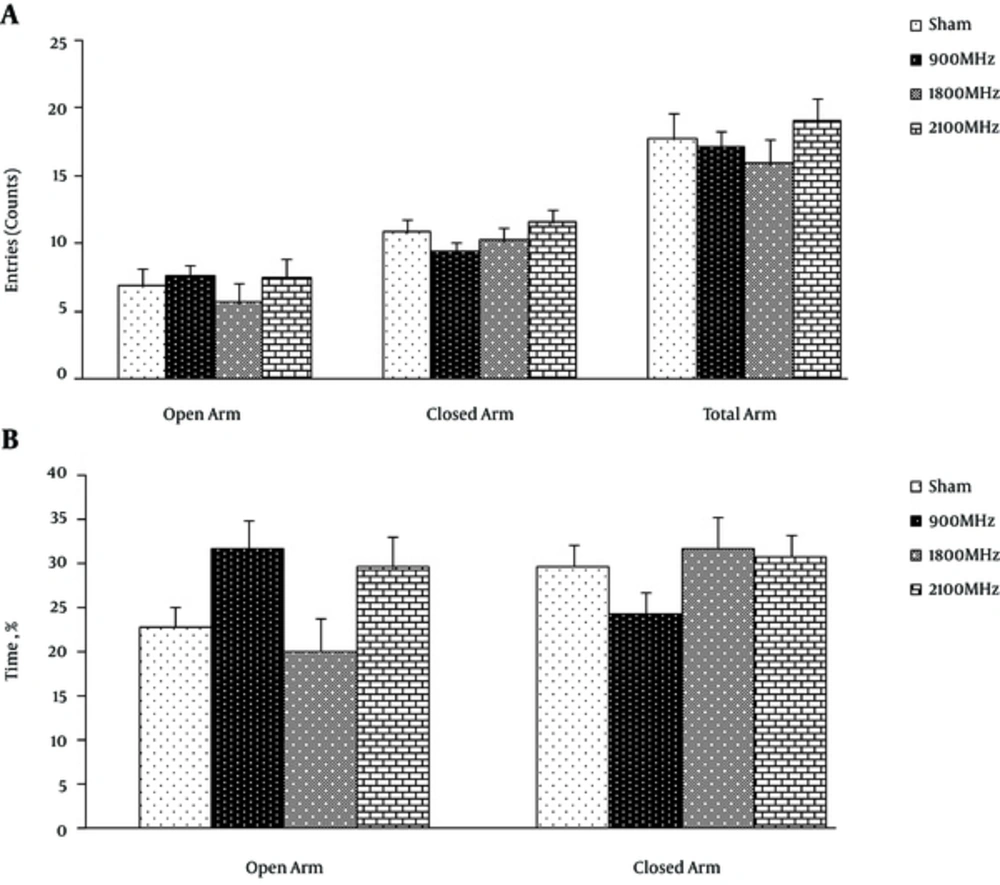
Figure 1.
A, the number of the entries into the open and closed arms and the total number of entries into both arms; B, the duration of stay in the open and closed arms; the results are presented for each group as Mean ± SEM.
The results obtained in the EPM (Figure 2A) showed no significant differences among the groups in terms of the number of entry into the open and closed arms and the total number of entry into both arms after seven sessions of exposure to mobile phone radiation (P > 0.05). Figure 2B shows no significant differences among the groups in terms of the duration of stay in the open and the closed arms after a week of exposure to cell phone radiation (P > 0.05).
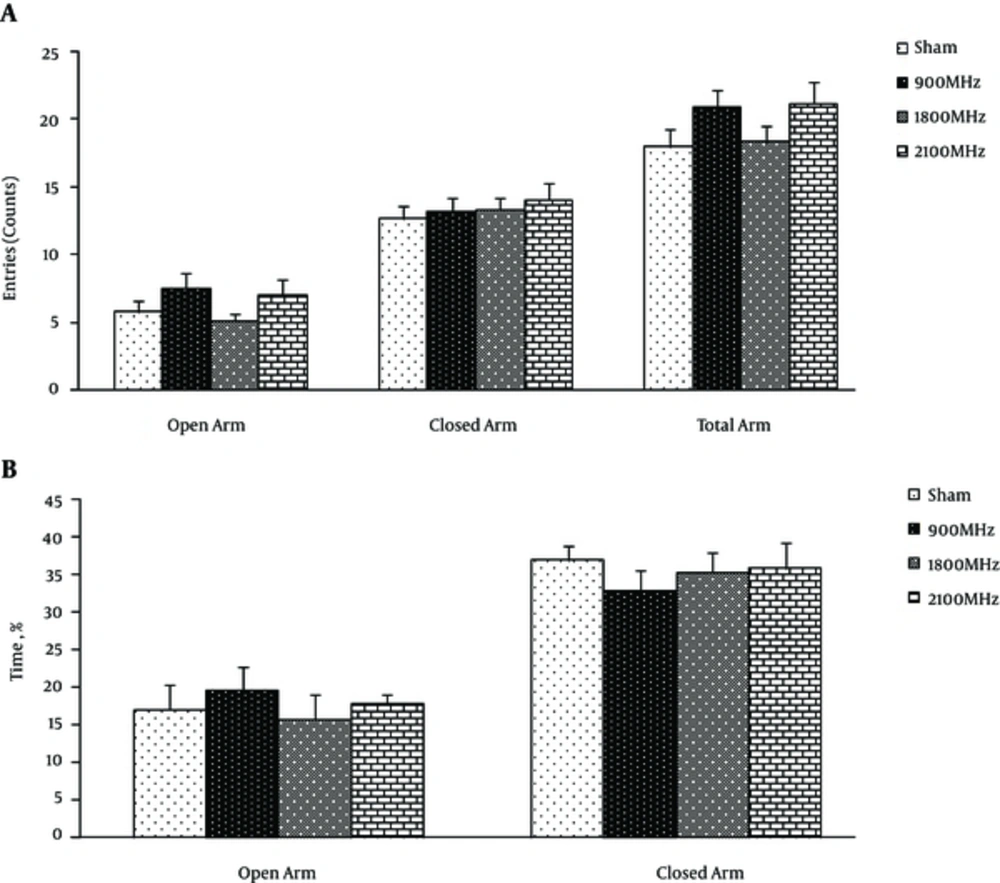
Figure 2.
A, the number of the entries into the open and closed arms and the total number of entries into both arms; B, the duration of stay in the open and closed arms; the results are presented for each group as Mean ± SEM.
The results obtained showed no significant differences (P > 0.05) between the two groups in terms of their SOD levels after one 45-minute session of acute exposure to mobile phone radiation (Figure 3A). As shown in Figure 3B, no significant differences were observed among the groups in terms of their serum SOD level after a week of exposure to mobile phone radiation, even though this level was lower in the rats irradiated by 900 MHz waves compared to the other groups (P > 0.05). It can be inferred from the results that, first, acute irradiation does not significantly change serum enzyme activity, and second, due to low tissue irritation during acute radiation, serum enzyme activity did not change significantly compared to the control group.
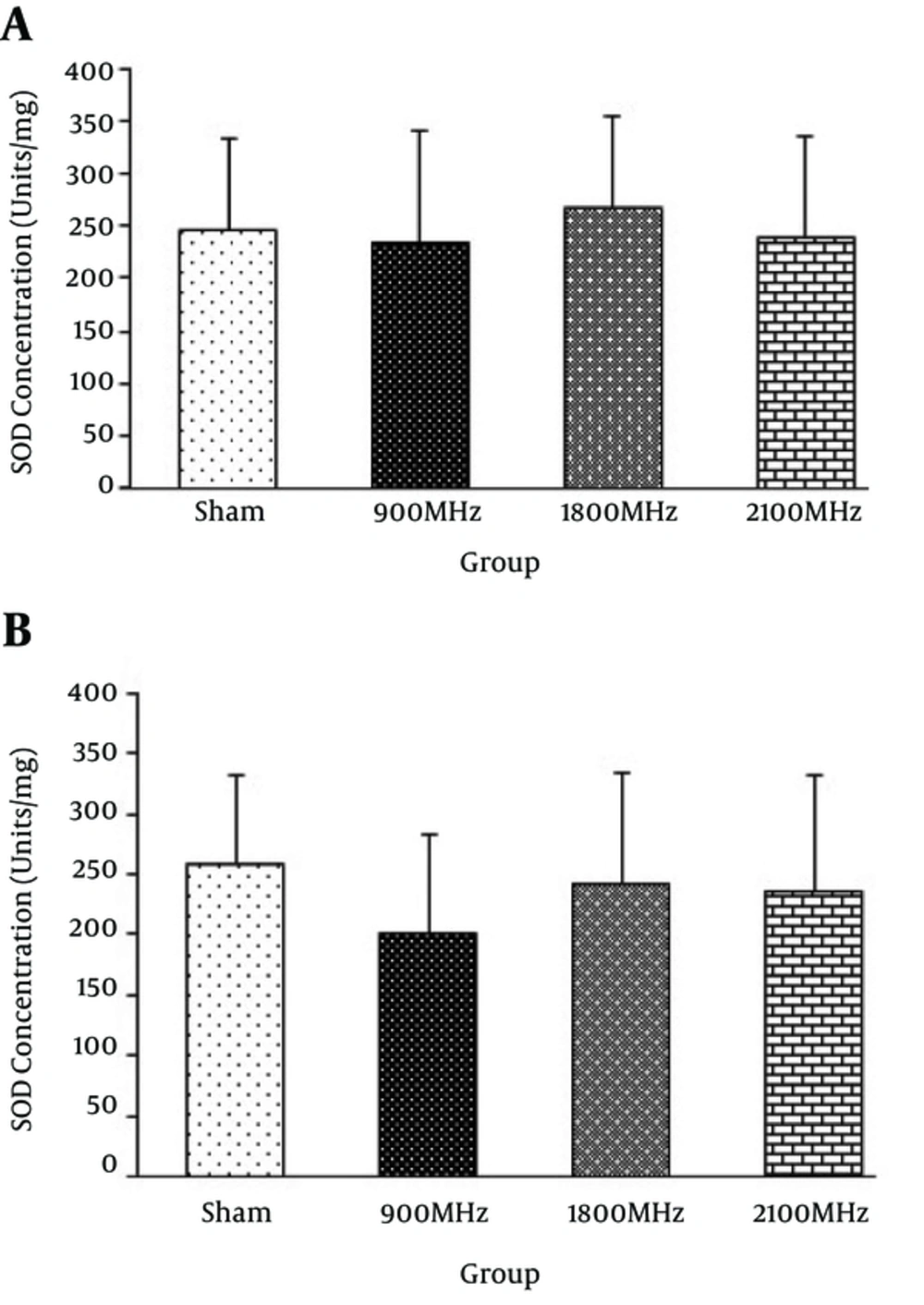
Figure 3.
A, after a 45 minutes of irradiation; B, after one week (45 minutes/day) of irradiation; the results are presented for each group as Mean ± SEM, SOD: Serum Superoxide Dismutase.
5. Discussion
The results of the present study showed that acute irradiation with mobile phone radiation ( 900, 1 800 and 2 100 MHz) had no effect on anxiety-like behaviors in male rats in an EPM; and no changes were observed in the rats’ frequency of entering and the duration of stay in the open and the closed arms of the maze. This finding is consistent with the results obtained on the effect of 2450MHz radiation on rats in EPMs and radial mazes (1, 2); and human results demonstrated that increasing depression and anxiety may be related to the cell phone use (9-11).
Cassel studied the behavior of rats exposed for 45 minutes to electromagnetic radiation at 2 450 MHz in a 12-armed maze and found that radiation had no effect on the rats’ behavior (1). Cosquer also studied the effect of exposure to a 2 450 MHz electromagnetic field on the behavior of the rats after 45 minutes of irradiation in an elevated maze and found that electromagnetic radiation had no effect on the rats’ behavior (2). Furthermore, irradiation with waves at a frequency band of 900 MHz in radial and water mazes had no effects on the rats' spatial memory function (3, 4, 19, 20). In one study, Dubreuil et al. (3) showed that exposure to GSM-900 electromagnetic fields for 45 minutes before each training (10 days) had no effects on spatial learning in rats. They, also, studied the effect of radiation on the rats' memory in spatial and non-spatial tasks. An eight-armed maze was used for the spatial learning test and objects of different shapes and colors were given to the rats to identify for their non-spatial learning test. The intervals between the irradiation and the training sessions were 15 and 60 minutes. The results obtained showed that the GSM had no significant effects on memory (4). In a study conducted by Jadidi, 45 minutes of exposure to mobile phone radiation at 950 MHz had no effects on learning and the memory acquisition phase in rats (19). Sienkiewicz studied the effect of an electromagnetic field at 900 MHz on spatial learning in rats using an eight-armed radial maze and found that placing the rats in this field for 45 minutes each day for 10 consecutive days had no effects on their memories (20). However, at these frequency bands, cell phone waves affect human memory (21, 22) and some of the studies have used water and radial mazes at a frequency of 2 450 MHz (7, 8, 23). Lai et al. (7) studied the effect of 45 minutes of irradiation with 2 450 MHz of electromagnetic waves for 10 days on rats’ memory using a 12-armed radial maze and found that the radiation affected memory in the hippocampal region of the brain. Wang and Lai (23) used a different method to study the effect of one hour of radiation with electromagnetic waves at a frequency of 2 450 MHz on memory in rats by examining their swimming pattern in the Morris water maze. The waves affected the reference memory with acute irradiation and learning was, also, affected by irradiation. These findings are inconsistent with the results obtained in the previous study on the effect of mobile jammer radiation with 900 MHz and 1 800 MHz frequency bands on anxiety level in the mice (12).
Measuring SOD level showed no significant differences between the groups after 45 minutes and one week of exposure to acute radiation from mobile phone waves, which is consistent with the results obtained by Chater et al. (24). Meanwhile, previous tests on the brain and kidney have shown a reduction in SOD levels after irradiation with 900 MHz frequency waves (14, 15), while an increase was reported in SOD in the spleen, thymus, and bone marrow (25). Despite the similar wave frequencies used in these studies, the results are disparate, which may be due to the number of irradiation days and, also, the assessment of SOD at the tissue level and in specific tissues. Moreover, the effect of electromagnetic radiation may not be discernible in studies testing only short-term irradiation, while the effects reported in the discussed studies pertain to long-term irradiation of over 10 days. The present study used a maximum of seven sessions of 45-minute irradiation and found no measurable changes in the variables examined; it may be that since acute short-term irradiation is associated with very little tissue irritation, it causes only insignificant changes in serum enzyme levels, which is consistent with the results obtained by Chater et al. (24). In contrast, chronic long-term irradiation causes a greater tissue irritation and does not have similar effects on different tissues such as the bone marrow, spleen, thymus, brain, and kidney, and also leads to significant changes in serum enzyme levels (14, 15, 25). As for the second reason for the disparity of the results, it should be noted that, in the present study, enzyme levels were assessed in the rats’ blood serum and cannot be representative of small changes in the body organs. As cited in previous studies, it is likely for enzyme levels to reduce in one organ but increase in another after exposure to mobile phone radiation, in the event of which serum enzyme levels cannot account for changes in different body organs.
5.1. Study Limitations
One of the most important limitations of this study was related to the methodology; the present study used a maximum of seven sessions of 45-minute exposure and found no measurable changes in the variables examined. In contrast, chronic long-term irradiation may cause a greater tissue irritation on different tissues such as the bone marrow, spleen, thymus, brain, and kidney, and also lead to significant changes in serum enzyme levels.
5.2. Conclusion
Short time mobile phone radiation in three national mobile network operators (900, 1 800, and 2 100 MHz) had no effect on anxiety-like behaviors and serum superoxide dismutase level of rats; this may be due to low tissue irritation during acute exposure to mobile phone waves. Further studies are, therefore, recommended to be conducted with a focus on target organs of the body so as to yield a more precise assessment of enzymatic changes in the body.