Full Text
Full text is available in PDF
Authors
The predominant etiologic theory of preeclampsia is that reduced uteroplacental perfusion is the unique pathogenic process in the development of preeclampsia. Maternal and fetal erythroblast counts are elevated in the peripheral blood of pregnant women with preeclampsia. The purpose of this study was to examine whether this elevation actually occurs before the clinical onset of the disorder.
In a prospective cohort survey erythroblasts were enumerated in 599 maternal blood samples obtained in 19-26 weeks with singleton pregnancy. After complete blood count a peripheral blood smear was done and erythroblast was counted , and results were subsequently correlated with pregnancy outcomes. The data were analyzed by SPSS 13.0.Independent sample t-test and Fishers exact test was used. A p value of <0.05 was considered statistically significant.
Significantly higher quantities of erythroblasts (mean 2.46?1.23 vs. 0.44?0.55; p=0.009) were detected in blood samples obtained from women who later acquired preeclampsia (n=50) than in blood samples from the control Cohort (n=549). Intrauterine growth restriction was accompany by a similar rise in erythroblast count (mean NRBC 0.82?0.8 in preeclamptic group vs. 0.59?0.85 in normotensive group; p=0.009). Mean gestational age was less in preeclamptic group (37.58?1.45 vs. 39.07?0.94, p=0.009).On the basis of 1.5 erythroblast as point of convergence there was sensitivity =61.45, specificity=93.02,NPV=98.16, accuracy=91.65
Because a large proportion of the erythroblasts in maternal blood are fetal origin, our data suggest that fetal-maternal cell traffic is affected early in pregnancies that are later complicated by preeclampsia.
© 2008, Author(s). This open-access article is available under the Creative Commons Attribution 4.0 (CC BY 4.0) International License (https://creativecommons.org/licenses/by/4.0/), which allows for unrestricted use, distribution, and reproduction in any medium, provided that the original work is properly cited.
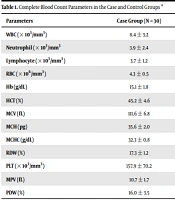
Miri Aliabad G, Dahmardeh F. Hematological Parameters in Newborns of Mothers with and Without Preeclampsia. Med Surg Nurs J. 2022;11(1):e128840. doi: https://doi.org/10.5812/msnj-128840

Mansouri N, Tarlan M, Azizi A, Khadem Erfan MB, Rahmani K, et al. Platelet Parameters as an Indicator of Preeclampsia: A Single-Center Retrospective Study. J Clin Res Paramed Sci. 2025;14(2):e157630. doi: https://doi.org/10.5812/jcrps-157630
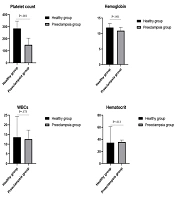
Papiahmadi F, Mirsamiyazdi N, Amiri R, Masoudiyekta L, Bahrami H, et al. Evaluation of Platelet Parameters in Patients with Preeclampsia in Comparison with Healthy Pregnant Women Referring to Ganjavian Hospital in Dezful City in 2019. J Adv Immunopharmacol. 2022;2(1):e121181. doi: https://doi.org/10.5812/tms-121181
Ghazavi A, Ranjbar A, Vakilian K. Comparison of oxidative stress in preeclampsia, normal pregnancy and non-pregnant women. koomesh. 2006;8(1):e152116. doi:
Golboni F, Heydarpour S, Taghizadeh Z, Rezaiepour A, Kazemnezhad A. Comparison of diagnostic value of roll over test and hematocrit level in early detection of preeclampsia. J Kermanshah Univ Med Sci. 2010;14(2):e79511. doi:
Last Update: 1 month ago
Last Update: 1 month ago
Last Update: 1 month ago
Last Update: 15 hours ago