Fulltext
The full text of this article is available on the PDF file.
Zahedan Journal of Research in Medical Sciences
The Official Journal of Zahedan University of Medical Sciences
Image Credit:Zahedan J Res Med Sci
Authors
Background : This study is carried out aiming to determine the prevalence of various causes of hirsutism in patients referred to the endocrine clinic of Golestan Hospital in Ahwaz.
Materials and Methods : In a cross-sectional study, 520 patients suffered from hirsutism whiting the age range of 10-50 year old participated based on Ferriman-Gallwey hirsutism classification system.
Results : Out of 520 patients under study, 274 ones (52.7%) had PCO, 176 ones (33.8%) suffered from idiopathic hirsutism, 24 persons (4.6%) had hyperprolactinemia, 22 persons (4.2%) had hirsutism caused by drugs consumption, 11 ones (2.1%) had hypothyroidism, 9 patients (1.7%) had cushing as well as 3 persons (0.57%) having Late Onset Congenital Adrenal Hyperplasia (LOCAH) and 1 person (0.19%) had ovarian tumor.
Conclusion : Results of this study show that PCO and idiopathic hirsutism constitute totally 86% of hirsutism causes.
© 2013, Author(s). This open-access article is available under the Creative Commons Attribution 4.0 (CC BY 4.0) International License (https://creativecommons.org/licenses/by/4.0/), which allows for unrestricted use, distribution, and reproduction in any medium, provided that the original work is properly cited.
Keshavarz D. Study of Hirsute women in Qazvin. J Inflamm Dis. 2024;4(3):e154733. doi:
akbarzadeh M, Naderi T, Dabbaghmanesh MH, Tabatabaee H, Zareh Z. The Relationship between Clinical and Chemical Hyperandrogenism in 14-18-Years- Old Girls. Zahedan J Res Med Sci. 2012;14(4):e93469. doi:
Naderi T, Akbarzadeh M, Dabbaghmaneh M, Tabatabaei H. Prevalence of various phenotypes of polycystic ovarian syndrome among high school girls of Shiraz (2009). J Inflamm Dis. 2024;15(4):e155665. doi:
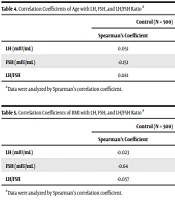
Fazli D, Moghaddasi SP. Correlations Between Gonadotropin Hormones and the Manifestations of Polycystic Ovary Syndrome. Thrita J Neu. 2022;11(1):e117396. doi: https://doi.org/10.5812/thrita-117396
Thathapudi S, Kodati V, Erukkambattu J, Katragadda A, Addepally U, et al. Anthropometric and Biochemical Characteristics of Polycystic Ovarian Syndrome in South Indian Women Using AES-2006 Criteria. Int J Endocrinol Metab. 2014;12(1):e12470. doi: https://doi.org/10.5812/ijem.12470
More by these authors
Last Update: 2 weeks ago
Last Update: 2 weeks ago
Last Update: 2 weeks ago
Last Update: 3 hours ago
Last Update: 6 hours ago
Last Update: 5 days ago