
1. Background
Rigid bronchoscopy is performed under deep sedation or general anesthesia. Therefore, maintaining oxygenation and ventilation via the uncuffed and open rigid bronchoscope requires the use of ventilation strategies that may be difficult to perform. The appropriate ventilation technique should be determined based on staff expertise and equipment availability (1). Hence, previous studies have mainly focused on various anesthetic management methods related to ventilation care (1-4). However, there has been no study on the dosage patterns of drugs administered during anesthetic management. Anesthesia can be maintained using either the inhalation or intravenous technique. Propofol is an ideal choice for anesthesia maintenance during total intravenous anesthesia because of its rapid onset and offset, as well as its effect on airway reflex suppression. The rigid bronchoscopy procedure constantly requires intense anesthesia induction. Therefore, we expected that drug doses required to maintain adequate anesthesia would constantly be large.
2. Objectives
In this study, we aimed to analyze the infusion pattern of anesthetic drugs used to maintain anesthesia during rigid bronchoscopy.
3. Methods
3.1. Ethical Considerations
The study was performed following the principles of the 1975 Helsinki Declaration (revised in 2018) and approved by the Institutional Review Board of our hospital (IRB no. 2019-04-011).
3.2. Patient Population
We reviewed the electronic medical records of patients aged > 18 years who had undergone rigid bronchoscopy under Total Intravenous Anesthesia (TIVA) between April 2015 and March 2019. Patients whose procedure was not completed or anesthesia was interrupted during the procedure, as well as those who had missing data, were excluded.
3.3. Anesthetic Management
Noninvasive blood pressure monitoring, electrocardiography, and pulse oximetry were used for patient monitoring. The hemodynamic parameters were recorded every three minutes until the end of the procedure to monitor the change in the vital signs during the continuous infusion of anesthetic maintenance agents and every five minutes in the recovery room. General anesthesia was induced with propofol and remifentanil using a target-controlled infusion pump (Module DPS Orchestra IS 3, Fresenius Vial, France). Depending on the patient’s renal function, rocuronium (0.8 - 1.0 mg/kg) or atracurium (0.4 - 0.6 mg/kg) was used for muscle relaxation. Patients who had a history of kidney disease or whose serum creatinine levels were higher than the normal range (0.8 - 1.3 mg/dL) in the preoperative tests were administered atracurium. A rigid bronchoscope was inserted and connected to the ventilator circuit using a corrugated tube on the side port. Initially, 100% oxygen was applied via high-flow manual bagging and stabilized during the procedure. The fraction of inspired oxygen was changed from 0.5 to 1.0 while maintaining the oxygen saturation of more than 95%. Anesthesia was maintained using propofol (target brain concentration 2.0 - 6.0 µg/mL), and additional midazolam was administered as needed to keep the Bispectral index below 60. The infusion rate of remifentanil (target brain concentration 2.0 - 6.0 ng/mL) was constantly adjusted for varying systolic blood pressure and was maintained within 20% of baseline. At the end of the procedure, the bronchoscope was removed and replaced with a plain endotracheal tube to secure the airway, and then, reversal agents were administered. After extubation, patients were assessed for spontaneous breathing and recovery of consciousness and transferred to the recovery room.
3.4. Data Collection
One researcher retrospectively reviewed the electronic medical records. The patients’ preoperative evaluation data were extracted, including the presence of respiratory distress, performed emergency procedures, and the cause and location of airway obstruction. Data on the procedure time, anesthesia time, and the total dosage of anesthetic drugs were collected from the anesthesia records. Data on complications related to the rigid bronchoscopy procedure (such as pain, nausea, pneumothorax) were collected from the nursing charts.
3.5. Outcome Measures
Based on the total dose of propofol and remifentanil administered during the procedure and the duration of the procedure, we converted the dose of each agent to the dose administered per minute during the procedure for each patient. We analyzed the differences in the dose of drug administered per minute according to the number of procedures. We also investigated whether differences in drug doses required to maintain anesthesia were related to the overall procedure time or the number of repeated procedures. In addition, we analyzed the incidence and the type of complications related to the procedure.
3.6. Statistical Analysis
Statistical analysis was performed using SPSS software (IBM SPSS Statistics 21; IBM Corp., USA). Linear regression analysis was used to determine the correlation of differences in drug doses required to maintain anesthesia with the overall procedure time and the number of repeated procedures. P values of < 0.05 indicated statistical significance. Univariate regression analysis was performed to evaluate the relationship between variables and complications. Multivariate stepwise modeling was then performed using variables with p-values of ≤ 0.25 from the univariate analysis.
4. Results
A total of 81 patients underwent rigid bronchoscopy between April 2015 and March 2019. All patients were classified within grade II to IV of the ASA physical status. Thirty-four (42.0%) patients had dyspnea before the procedure, and the most common reason for the procedure was airway mass effect due to granulation or tumor growth (38 patients, 46.9%). The most common lesion location was the main bronchi (43 patients, 53.1%), followed by the subglottic airway and the trachea (30 patients, 37%) (Table 1).
Table 1.
Demographic and Perioperative Data
| Variable | Patientsa |
|---|---|
| Gender | |
| Male | 41 (50.6) |
| Female | 40 (49.4) |
| Age (y) | 59.1 ± 12.3 |
| Height (cm) | 161.1 ± 6.9 |
| Weight (kg) | 63.7 ± 11.4 |
| BMI | 24.7 ± 4.4 |
| Dyspnea before the procedure | 34 (42.0) |
| Cause of airway problem | |
| Trauma (stenosis) | 9 (11.1) |
| Mass effect (granulation, tumor growth) | 38 (46.9) |
| malacic change | 3 (3.7) |
| Correction of the previous procedure | 19 (23.5) |
| Other | 12 (14.8) |
| Site of the airway problem | |
| Subglottic or trachea | 30 (37.0) |
| Main bronchus | 43 (53.1) |
| Branch of bronchus | 8 (9.9) |
| Procedure time (min) | 60.0 [38.5-75.0] |
| Anesthetic time (min) | 85.0 [65.0-105.0] |
| Patients received additional midazolam | 29 (35.8) |
| Total dose of midazolam (mg) | 1.01 ± 1.54 |
| Total infusion rate of anesthetic drugs | |
| Propofol (mg) | 567.3 ± 246.8 |
| Remifentanil (µg) | 462.0 ± 272.0 |
| Infusion rate per minute during the procedure | |
| Propofol (mg/min) | 10.3 ± 3.9 |
| Remifentanil (µg/min) | 7.9 ± 3.2 |
Abbreviation: BMI, body mass index.
aData are presented as number (%), mean ± SD, or median [interquartile range].
The dose of administered propofol per minute to maintain anesthesia showed a linear correlation with the total procedure time (r2 = 0.355, β = -0.067, P < 0.001). It was estimated that there was an inverse correlation in the curve goodness of fit (r2 = 0.565, β = -0.752, P < 0.001, Figure 1). However, the dose of administered remifentanil per minute did not show a significant correlation with the total procedure time (r2 = 0.093, β = 0.305, P = 0.310). In addition, the dose of administered propofol per minute when the procedure was repeated in the same patient among those who underwent the procedure three or more times was not significantly correlated with the number of times the procedure was repeated, except for just two patients (Table 2).
Table 2.
Linear Regression Analysis of the Changes in the Total Propofol Infusion Rate per Minute in Patients Who Underwent More Than Three Repeated Procedures
| ID | r2 | β | P Value |
|---|---|---|---|
| A | 0.95 | -1.36 | 0.03 |
| B | 0.68 | 0.99 | 0.38 |
| C | 0.00 | -0.07 | 0.96 |
| D | 0.01 | -0.26 | 0.89 |
| E | 0.72 | 1.62 | 0.36 |
| F | 0.37 | 1.20 | 0.58 |
| G | 0.02 | -0.94 | 0.91 |
| H | 0.51 | 0.45 | 0.01 |
| I | 0.00 | -0.07 | 0.93 |
| J | 0.38 | 0.52 | 0.10 |
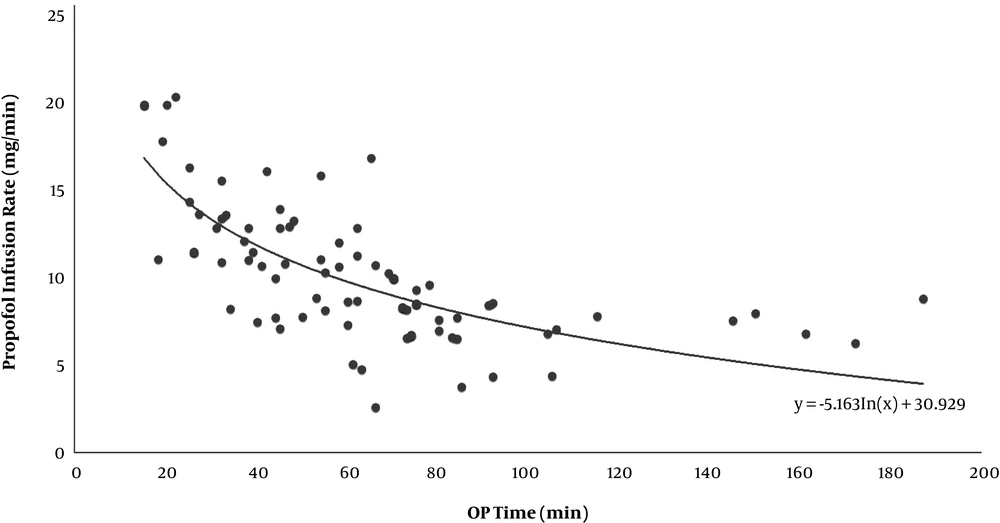
Figure 1.
The curve fit graph of regression analysis. The graph shows that the total propofol infusion rate per minute was inversely correlated with the procedure duration. OP time: operation time
The most common complication of rigid bronchoscopy was hemorrhage. Pneumothorax due to airway injury occurred in one patient (Table 3). However, none of the complications were life-threatening or severe. Univariate regression analysis of the complication outcome was performed using a variety of patient variables as potential predictors (Table 4).
Table 3.
Complications of Rigid Bronchoscopy
| Variable | Number of Patients (%) |
|---|---|
| Dental and facial trauma | 2 (2.4) |
| Hemorrhage | 6 (7.3) |
| Pneumothorax | 1 (1.2) |
| Central airway obstructiona | 2 (2.4) |
| Peripheral airway obstructionb | 2 (2.4) |
| Airway trauma | 2 (2.4) |
aTumor, blood, secretions
bAsthma, chronic bronchitis, emphysema, bronchospasm
Table 4.
Predictors of Complications in Univariate Logistic Regression Analysis
| Variable | χ2 | P Value | OR [95% CI] |
|---|---|---|---|
| Age | 0.36 | 0.55 | 0.98 [0.92 - 1.04] |
| Gender | 0.04 | 0.95 | 0.96 [0.24 - 3.79] |
| BMI | 2.37 | 0.14 | 0.89 [0.78 - 1.04] |
| ASA score | 0.89 | 0.35 | 0.62 [0.22 - 1.71] |
| Cause of airway problem | 0.51 | 0.47 | 0.82 [0.47 - 1.42] |
| Emergent situation | 1.94 | 0.16 | 0.39 [0.10 - 1.48] |
| Repetition | 0.75 | 0.41 | 1.14 [0.84 - 1.56] |
| Procedure time | 1.11 | 0.28 | 0.99 [0.97 - 1.01] |
Abbreviations: ASA, American Society of Anesthesiologists Physical Status Score; BMI, body mass index
5. Discussion
Rigid bronchoscopy represents a challenge for anesthesiologists because it requires allowing the interventionist easy access to the airway with an adequate degree of muscle paralysis while maintaining proper ventilation and oxygenation (2-4). For any anesthetic procedure, the combination of hypnosis, analgesia, muscular relaxation, and Total Intravenous Anesthesia (TIVA) is required. Specific considerations for airway surgery via rigid bronchoscopy include the need for a rapid and complete offset of anesthetic agents.
Until the development of propofol, TIVA was rarely performed for surgeries with planned extubation owing to the prolonged emergences. Infusing propofol using pharmacokinetic parameters to target blood concentrations has been considered a significant improvement in propofol administration. Propofol has several advantages over other anesthetics, one of which is a more relaxing effect on the pharyngeal musculature compared to thiopental (5), a commonly used anesthetic induction agent. In particular, the intravenous agent is more useful than the inhalation gas due to a large amount of leakage around the scope without packing.
In the past, surgery was the primary method of treatment for central airway obstruction. Recently, palliative procedures have been widely used, such as laser resection, coagulation, balloons, and insertion of silicone stents using rigid bronchoscopes (6-8). However, even if the airway is expected to be permanently secured using the stent, some complications may arise (9). Complication rates vary depending on the patient health status and the performed procedure (10-12). Ost et al described that the predictors of the increased complication rate of therapeutic bronchoscopy include emergent situation, ASA score, repetition, and the need for moderate sedation (13). In our study, all patients underwent rigid bronchoscopy under general anesthesia, and there were no systemic cardiovascular complications that could occur during hypoxemia and hypercapnia. However, there were some local complications. Hemorrhage was the most frequent adverse event, occurring in 7% of patients, but no additional procedure was required for hemostasis. One patient developed pneumothorax, and chest tube insertion was performed.
Endobronchial tumor destruction and removal are commonly performed using rigid bronchoscopy. Other frequently used indications include mechanical dilation, endobronchial ablation, and airway stent placement for obstructions, tracheoesophageal fistulae, or tracheobronchomalacia (14-16). In this study, the most frequent indication for this procedure was a therapeutic approach to mass effects, such as granulations and tumor growth (46.9%).
This study has some limitations. The number of patients was small, and the patient’s actual plasma drug levels were not confirmed. In addition, due to the retrospective nature of the study, various aspects were not considered because the results were interpreted based only on the recorded objective facts.
Nevertheless, we found that the dose of administered propofol decreased over time. This pattern was specific to propofol but not to remifentanil during TIVA. However, the dose administered per minute was not significantly correlated with the number of times the procedure was repeated in the same patient. These results are associated with the pharmacokinetic properties of both drugs, and understanding these mechanisms will help in the adequate administration of the drug. Therefore, when maintaining anesthesia with TIVA using propofol in a rigid bronchoscope procedure, caution should be exercised since large drug doses may be required from the early stage.