1. Background
Laparotomies that necessitate a midline incisions were commonly accompanied by postoperative pain which derived mainly from abdominal wall incision (1).
Adequate postoperative pain control is crucial to mitigate stress response, postoperative insulin resistance, and to reduce the incidence of postoperative chronic pain. In addition, postoperative analgesia enhances early mobilization and consequently decreases the incidence of postoperative chest infection and deep venous thrombosis (2, 3).
Administration of multimodal analgesics could limit the excessive use of systemic opioid analgesia, which had a high rate of postoperative side effects as sedation, respiratory depression, ileus, nausea, vomiting, constipation, urine retention, and itching (3-7). The thoracic epidural analgesia (TEA) is considered the standard analgesic modality for major laparotomies (2, 8). Nevertheless, TEA is not a technique without risks, although rare, it could be dangerous and devastating like hematoma formation, epidural abscess, neural damage, immobilization due to motor block, urine retention, sympathetic block, hypotension, and had 25% - 30% failure rate (9-12).
Rectus sheath analgesia (RSA) provides pain relief for anterior abdominal wall structures superficial to the peritoneum. It is suitable for the procedures that required a midline incision as well as the procedures that necessitated lower abdominal transverse incisions (13). Local anesthetic instillation within the posterior rectus sheath bilaterally provides intense analgesia for the middle anterior wall from the xiphoid process to the symphysis pubis in adults (14) and in pediatric population (15, 16). Nonetheless, it devoid the ability to control visceral pain, which could be severe in the early 12 - 36 hours postoperatively (2, 17).
The use of real-time ultrasonography guidance for rectus sheath block may reduce risks of peritoneal puncture, bleeding, visceral injury, and facilitate correct needle position. Furthermore, ultrasound guidance enables accurate catheter placement, ensures satisfactory local anesthetics spread, and putatively increases the rate of success (18-21).
2. Objectives
The aim of this trial was to compare continuous TEA with US-guided RSA with catheter placement for a midline abdominal incisions in adults undergoing elective major upper abdominal surgery as regard safety and efficacy. We hypothesized that RSA could be an efficient surrogate analgesic modality to continuous TEA in procedures requiring a midline incision.
3. Methods
3.1. Trial Setting and Eligibility Criteria
After local ethical committee approval and patient’s informed written consent, this prospective, observer-blinded, and randomized clinical trial was conducted on 60 patients whose ages ranged between 18 and 80 years. ASA physical status class I, II, and III patients who were prepared for elective upper abdominal surgery through a midline incision were included.
Patients with known hypersensitivity to local anesthetics, local infection at the site of block, uncontrolled hypertension, obese (BMI > 30 kg/m2), any cardiac, cerebrovascular, renal, hepatic or muscular disease, patients with coagulation disorders, and patients complaining of chronic pain were excluded from the study.
3.2. Randomization and Blinding
Patients were randomly assigned to receive either continuous TEA (TEA group, n = 31 patients) or bilateral RSA with catheter insertion (RSA group, n = 29 patients) with an online randomization program that generated a list of random numbers. Patient randomization numbers were concealed in opaque envelopes that were opened by the study investigator. The investigators who were involved in obtaining data were blinded to study protocol and randomization for the period of data collection and analysis.
3.3. Interventions
3.3.1. Preoperative Patients’ Preparation
One day before surgery, all patients were interviewed to elucidate the visual analog scale (VAS) (where 0 = no pain and 10 = worst comprehendible pain) and routine investigations were fulfilled.
3.3.2. Anesthesia Management
The patients were monitored with pulse oximeter, electrocardiogram, non-invasive arterial pressure, temperature probe, and capnography. An intravenous (IV) access was established and IV midazolam 0.01 - 0.02 mg/kg was given. An arterial line was inserted for blood gas analysis. Right internal jugular venous catheter was placed for central venous pressure (CVP) measurements. The fluid replacement strategy aimed to maintain CVP between 5 - 10 cm H2O with lactated Ringer’s solution and packed red blood cells were given to keep hemoglobin level above 10 g/dL.
3.3.3. Thoracic Epidural Analgesia
Before induction of anesthesia for patients allocated to TEA group, attending senior anesthetists who were not involved in the study inserted a 20 gauge epidural catheter (Perifix, B.Braun, Melsungen AG, Germany). The techniques were performed under aseptic precaution in the lateral position at T8 - T9 level. A midline approach with loss of resistance technique with saline was employed using an 18 gauge and an 80 mm Tuohy needle (Perifix, B.Braun, Melsungen AG, Germany). There were no drugs administered but test dose of 3 mL of Lidocaine 1% mixed with epinephrine 1: 200 000.
3.3.4. Standard General Anesthetic
Standard general anesthesia for both groups was induced with fentanyl 3 mcg/kg, propofol 1 - 3 mg/kg followed by rocuronium 0.6 mg/kg to facilitate endotracheal intubation. Anesthesia maintained with isoflurane 1.5 volume % and rocuronium 0.15 mg/kg as a maintenance dose every 30 minutes until completion of the procedure. Ventilation parameters were adjusted as follows: tidal volume (TV) = 5 - 8 mL/kg, positive end-expiratory pressure (PEEP) = 5 cm H2O, respiratory rate (RR) = 12/minute then it was adjusted to maintain end-tidal CO2 between 35 - 40 mmHg, and fraction of inspired oxygen (FiO2) = 0.4 - 0.7.
3.3.5. Thoracic Epidural Catheter Activation
After completion of the surgical procedure, the thoracic epidural catheter was activated with 10 ml of bupivacaine 0.25% in increments over 10 minutes.
3.3.6. Rectus Sheath Analgesia
For the patients allocated to RSA group, US-guided rectus sheath block with catheters insertion was performed bilaterally by other attending senior anesthetists, who did not participate in the study. The techniques were performed with complete aseptic precaution by using ultrasound machine (Logiq p5, GE corporate, general electric company®, USA) while the patient in the supine position after completion of the surgical procedure. The high frequency (11 MHz) linear array ultrasound probe enabled rectus muscle identification and allowed localization of the hyperechoic matching lines deep to it (posterior rectus sheath and fascia transversalis). The same type and size Tuohy needle was introduced in plane to the ultrasound probe below the costal margin at an angle of approximately 45 degrees to the skin. The needle tip proceeded to the desired position, posterior to the rectus muscle and above the underlying rectus sheath. Installation of a 20 ml bolus dose of 0.25% bupivacaine was done to dissect the posterior rectus sheath on each side, then the same type and size catheters were passed through the Tuohy needle and fixed to the skin, an 8 cm of the catheters were inserted into space on each side.
3.3.7. Postoperative Management
After anesthesia emergence, all patients were transferred to the post-anesthesia care unit (PACU) for 2 hours observation period. The patients were discharged from the PACU after fulfilling the discharge criteria based on the modified Aldrete score ≥ 9 (22).
As a part of standardized regular institutional postoperative pain control policy, Acetaminophen 1 gm every 6 hours by IV infusion and ketorolac 30 mg diluted in 100 mL normal saline through IV infusion over 20 minutes every 8 hours were administered as 2 components of multimodal anesthesia regimen for postoperative pain control.
Postoperative analgesia in the TEA group achieved with continuous infusion of a fixed rate of 5 mL/h of bupivacaine 0.25% for 72 hours started shortly after activation. The local anesthetic solution was equipped by a devoted nurse who did not participate in the trial by using the disposable ambulatory elastomeric accufuser® infusion pump (Accufuser, code C0050XL, CairoMed, Cairo, Egypt) with a total volume of 550 mL, fixed infusion rate of a 5 mL/h, and usable for 110 hours. Postoperative analgesia in the RSA group was achieved with an intermittent injection of 20 mL of bupivacaine 0.25% on each side every 6 hours till 72 hours. The local anesthetic solutions were prepared by another devoted nurse who did not contribute in the study.
A postoperative rescue analgesia with intravenous morphine per a titration protocol (3 mg morphine sulfate IV as a bolus dose that could be repeated every 5 minutes with a maximum dose of 15 mg per 4 hours or 45 mg per 24 hours) was employed if visual analog pain scale (VAS) ≥ 4. The morphine titration protocol was suspended with Oxygen saturation < 95%; respiratory rate < 10 / min; the development of sedation (Ramsay sedation scale >2); development of acute adverse effects (allergy, marked itching, excessive vomiting, and hypotension with systolic blood pressure ≤ 20% of baseline values); or attaining adequate level of analgesia.
3.4. Outcomes
The primary outcome measure was the cumulative 72 hours morphine consumption. Secondary objectives were to compare numbers of patients required postoperative analgesia, to compare the duration of analgesia based on time to first request of morphine analgesia, and to compare the quality of analgesia based on VAS at rest and upon coughing at 1, 6, 12, 24, 48, and 72 hours, postoperatively. Incidences of complications related to both techniques and morphine-related side effects (ileus; nausea; vomiting; pruritus; and excessive sedation) were reported. Ileus was defined as recent nausea and vomiting, abdominal distention, and abdominal discomfort with loss of bowel sounds. Sedation was assessed at 2, 6, 12, 24, 48, and 72 hours postoperatively on a 5-point sedation Ramsay’s score (23) (5, aroused only by shaking; 4, asleep, difficulty responding to verbal commands; 3, mostly sleeping but easily aroused; 2, drowsy or dozing intermittently; 1, awake). Over-sedation is defined as having a sedation score ≥ 4 combined with a respiratory rate < 8 breaths per minute. Patients with over-sedation were transferred to the intensive care unit for close monitoring and observation, and patients with nausea and vomiting were treated by Ondansetron 0.15 mg/kg intravenously over 15 minutes. Other secondary outcome measures included the duration of surgery, time elapsed for ambulation, time for returning of regular bowel habits and passing flatus, and patients satisfaction with post-operative analgesia after 72 hours postoperatively according to a satisfaction score (poor = 0; fair = 1; good = 2; excellent = 3).
3.5. Statistical Analysis
Continuous data with normal distribution were presented as the mean ± standard deviation (SD) and were compared for significance by using unpaired student t-test. Continuous data with skewness and kurtosis as well as ordinal data were presented as median (interquartile range [IQR] and range) and compared for significance by using the Mann-Whitney U test. The Kolmogorov-Smirnov test was implemented to check the normality of continuous data distribution (P ≤ 0.05). Qualitative data were presented as numbers (percentages) and were analyzed by using the Chi-square test or Fisher exact test as appropriate. Statistical analysis was performed using the statistical package for the social sciences (SPSS) version 16 (SPSS Inc., Chicago, IL, USA). P ≤ 0.05 was considered statistically significant.
3.6. Sample Size Calculation
T-test was used to detect the sample size based on a pilot study (8 participants in TEA arm and 9 participants in RSA arm) with estimation of cumulative morphine consumption at 72 hours (the primary outcome). The mean cumulative morphine consumption at 72 hours was 47.86 mg in the RSA group and was 32.55 mg in the TEA group. The clinical effect size d calculated to be 0.753 with a mean difference of cumulative morphine consumption at 72 hours between both groups = 15.31 mg and pooled SD = 20.34 mg. Assuming the power = 80% and the two-sided α error = 0.05, a sample size of 29 participants per group were found adequate to detect a 30% difference between the 2 groups. Recruitment of 35 patients per group was done to account for possible data loss. Sample size calculation has been done by using the G*Power software version 3.1.7 (institute of experimental psychology, Heinrich Heine university, Dusseldorf, Germany).
4. Results
Eighty patients were enrolled in the study. Data from 60 patients, 31 from TEA group and 29 from RSA group, were included in the final analysis (Figure 1). The 2 groups were comparable on age, sex, weight, height, BMI, duration of surgery, and types of surgical procedures, P > 0.05 (Table 1). Seventeen patients (54.84%) in the TEA group received morphine with 95% confidence interval (CI) (37.32% - 72.36%), compared with 25 patients (86.21%) in the RSA group with 95% CI (81.78% - 90.64%), P = 0.008 (Table 2).
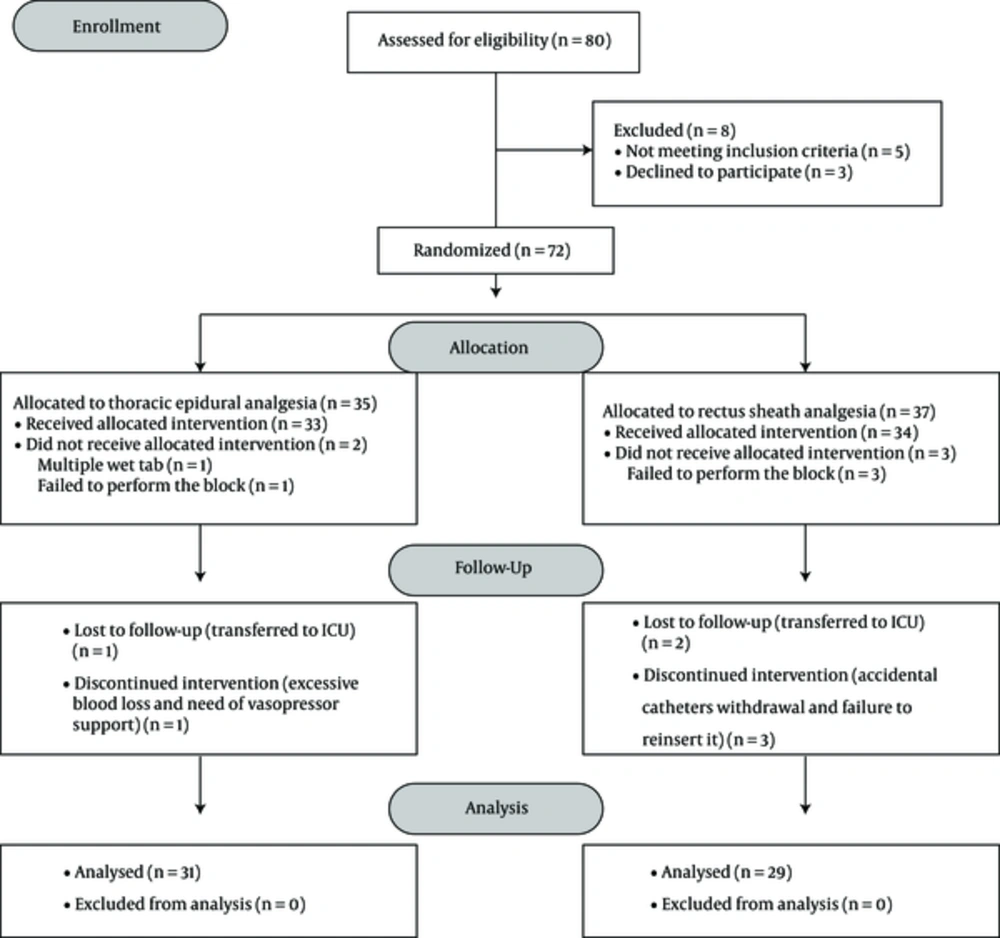
Figure 1.
CONSORT Flow Diagram
Table 1.
Demographic Characteristic and Types of Surgerya
| TEA (n = 31) | RSA (n = 29) | P Value | |
|---|---|---|---|
| Age | 48.36 ± 11.73 | 47.53 ± 9.43 | 0.76 |
| Weight | 79.39 ± 9.47 | 79.06 ± 7.52 | 0.88 |
| Height | 169.03 ± 7.26 | 168.56 ± 7.30 | 0.8 |
| Body mass index (kg/m2) | 27.7 ± 1.05 | 28.01 ± 1.52 | 0.36 |
| Gender (Male: Female) | 21:10 | 23:6 | 0.3 |
| ASA (I: II: III) | 7: 20: 4 | 3: 24: 2 | 0.2 |
| Duration of surgery (min.) | 225.51 ± 65.8 | 245.21 ± 71.44 | 0.27 |
| Types of surgery | |||
| Biliary | 11 (35.48%) | 9 (31.03%) | 0.71 |
| Partial gastrectomy | 8 (25.81%) | 12 (41.38%) | 0.20 |
| Small intestinal | 9 (29.03%) | 6 (20.69%) | 0.46 |
| Splenectomy | 1 (3.23%) | 2 (6.90 %) | 0.51 |
| Pancreatic | 2 (6.45%) | 0 (0%) | 0.16 |
Abbreviations: RSA, Rectus sheath analgesia; TEA, Thoracic epidural analgesia.
aAge, weight, height, body mass index, and duration of surgery presented as mean ± SD. Gender, ASA status presented as numbers, and type of surgery presented as numbers (percentages). * P ≤ 0.05.
Table 2.
Postoperative Morphine Consumptiona
| TEA (n = 31) | RSA (n = 29) | P Value | |
|---|---|---|---|
| Need for morphine n (%) | 17 (54.84%) | 25 (86.21%) | 0.008b |
| Time to first dose of morphine (min) | 256.77 ± 73.45 | 208.82 ± 64.65 | 0.031b |
| Morphine consumption at PACU 0 - 2 hours postoperatively (mg) | 6 (4.5, 6) | 9 (6, 12) | < 0.001b |
| Morphine consumption at 2 - 6 hours (mg) | 6 (5.25, 6.75) | 6 (6, 9) | 0.002b |
| Morphine consumption at 6 - 12 hours (mg) | 6 (6, 9) | 9 (6, 9) | 0.043b |
| Morphine consumption at 12 - 24 hours (mg) | 6 (3, 6) | 6 (6, 9) | 0.006b |
| Cumulative morphine consumption during 24 hours postoperatively (mg) | 18 (15, 18) | 33 (30, 36) | < 0.001b |
| Morphine consumption at 48 hours (mg) | 9 (9, 12) | 12 (9, 15) | 0.41 |
| Morphine consumption at 72 hours (mg) | 9 (6 ,9) | 9 (6, 9) | 0.53 |
| Cumulative morphine consumption during 72 hours postoperatively (mg) (primary outcome) | 33 (27, 39) | 51 (45, 57) | < 0.001b |
Abbreviations: RSA, Rectus sheath analgesia; TEA, Thoracic epidural analgesia.
aData presented as numbers (percentages), mean ± SD, and median (IQR).
bP ≤ 0.05.
The time for the first request for morphine was significantly longer in the TEA group (256.77 ± 73.45 minutes) with 95% CI (219.01 - 294.53 minutes) than in the RSA group (208.82 ± 64.65 minutes) with 95% CI (182.14 - 235.5 minutes), P = 0.031 (Table 2). The cumulative postoperative morphine consumption during 72 hours (the primary outcome) was significantly lower in the TEA group [a median of 33 mg, IQR (27 - 39 mg), and range (15 - 54 mg) with 95% CI (28.63 - 37.37 mg)], in comparison with the RSA group, [a median of 51 mg, IQR (45 - 57 mg), and range (36 - 63 mg) with 95%CI (47.4 - 54.6 mg)], P < 0.001 (Table 2). The cumulative postoperative morphine consumption during the early 24 hours was significantly lower in the TEA group [a median of 18 mg, IQR (15 - 18 mg), and range (9 - 27 mg) with 95% CI (16.91 - 19.09 mg)], in comparison with the RSA group [a median of 33 mg, IQR (30 - 36 mg), and range (24 - 39 mg) with 95%CI (31.2 - 34.8 mg)], P < 0.001 (Table 2). The titration doses of morphine consumption were significantly lower in TEA group than those of RSA group at the intervals during the initial 24 hours postoperatively, P < 0.05 (Table 2). The doses of morphine consumption at day 2 and day 3 postoperatively were comparable between both groups, P = 0.41 and 0.53, respectively (Table 2). The VAS at rest and upon coughing were similar between both groups at 1, 6, 12, 24, 48, and 72 hours postoperatively, P > 0.05 (Figure 2 and Figure 3). The time to ambulation was significantly longer in the TEA group than in the RSA group (45.89 ± 8.72 hour versus 38.47 ± 12.34 hour respectively), P = 0.009 (Table 3). There were no reported complications related to both techniques (hematoma formation, abscess, neural damage, and visceral perforation). The morphine-related side effects (ileus, nausea, vomiting, and pruritus), time elapsed to pass flatus, and patients’ satisfaction for postoperative analgesia were comparable between both groups, P > 0.05 (Table 3). Postoperative sedation scores were comparable between both groups at all time points of assessments except at 12 hours and at 24 huors. There was a significant increase in sedation scores in the RSA group as compared to the TEA group [a median (IQR) = 3 (2, 3) and 3 (2, 3) for the RSA group versus 2 (2, 3) and 2 (2, 2) for the TEA group at 12 hours and 24 hours respectively], P = 0.041 and 0.013 at 12 hours and 24 hours respectively (Table 4).
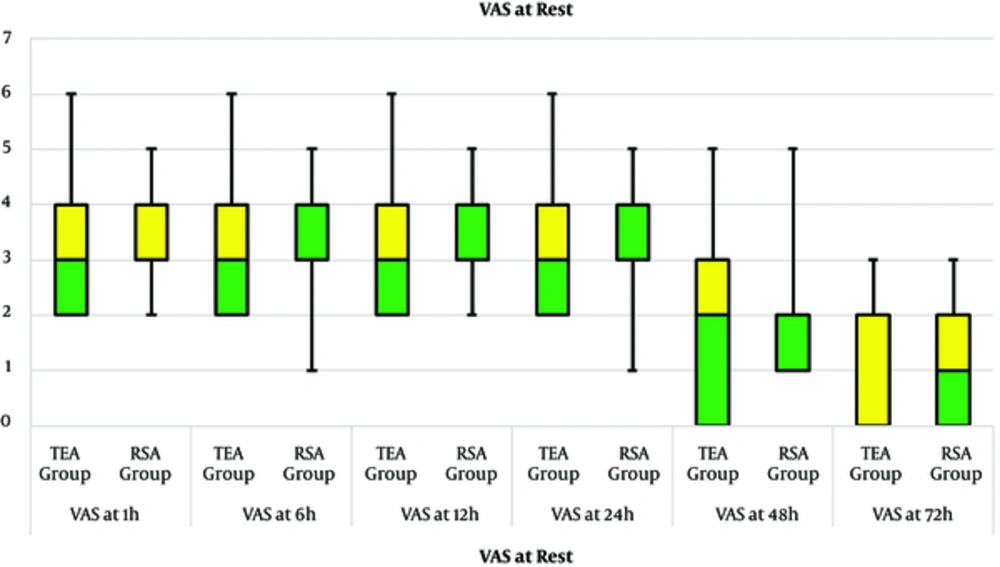
Figure 2.
TEA, Thoracic epidural analgesia; RSA, Rectus sheath analgesia; VAS, Visual analog score. Median values represented by a transverse line between the yellow boxes above and the green boxes below otherwise it is the upper border of the green boxes or the lower border of the yellow boxes, the 25th percentiles represented by the green boxes, the 75th percentiles represented by the yellow boxes, and the error bars refer to minimum and maximum values.
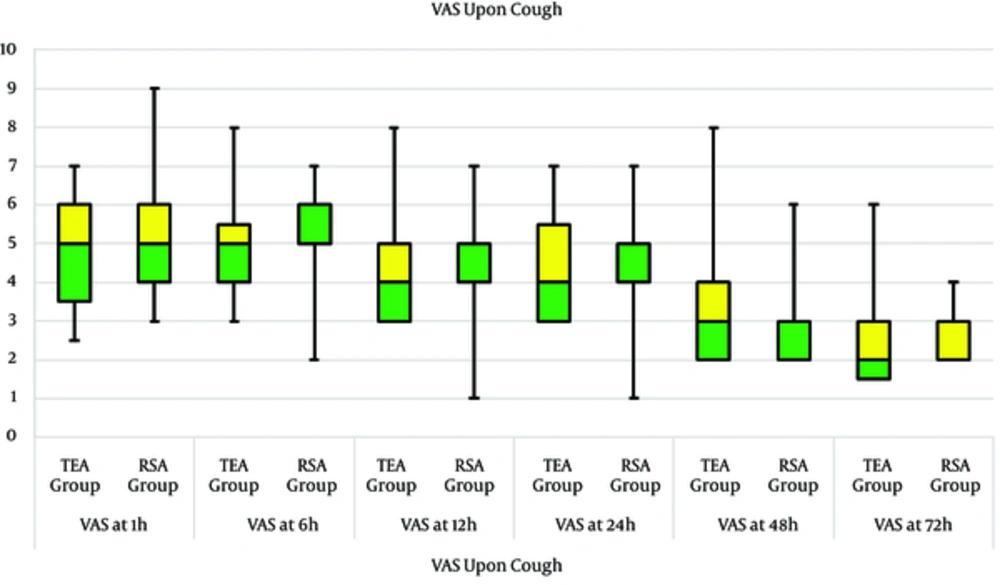
Figure 3.
TEA, Thoracic epidural analgesia; RSA, Rectus sheath analgesia; VAS, Visual analog score. Median values represented by a transverse line between the yellow boxes above and the green boxes below otherwise it is the upper border of the green boxes or the lower border of the yellow boxes, the 25th percentiles represented by the green boxes, the 75th percentiles represented by the yellow boxes, and the error bars refer to minimum and maximum values.
Table 3.
Morphine Related Side Effects, Time to Passing Flatus, Time to Ambulation, and Patient Satisfaction Scorea
| TEA (n = 31) | RSA (n = 29) | P Value | |
|---|---|---|---|
| Ileus | 4 (13%) | 9 (31%) | 0.08 |
| Nausea | 5 (16%) | 7 (24%) | 0.43 |
| Vomiting | 1 (3.23%) | 3 (10.34%) | 0.27 |
| Pruritus | 4 (12.9%) | 8 (27.59%) | 0.15 |
| Time to passing flatus (h) | 61.12 ± 9.37 | 57.54 ± 11.20 | 0.18 |
| Time to ambulation (h) | 45.89 ± 8.72 | 38.47 ± 12.34 | 0.009b |
| Patient satisfaction score | 2 (2 - 3) | 2 (1 - 3) | 0.08 |
Abbreviations: RSA, Rectus sheath analgesia; TEA, Thoracic epidural analgesia.
aCategorical data presented as numbers (percentages), Numerical data presented as mean ± SD, and ordinal data presented as median (interquartile range).
bP ≤ 0.05.
Table 4.
Postoperative Sedation Scorea
| TEA (n = 31) | RSA (n = 29) | P Value | |
|---|---|---|---|
| Sedation score on admission at PACU | 2 (2, 3) | 3 (2, 3) | 0.856 |
| Sedation score at two hours | 2 (2, 3) | 2 (2, 3) | 0.287 |
| Sedation score at six hours | 2 (2, 3) | 2 (2, 3) | 0.755 |
| Sedation score at 12 hours | 2 (2, 3) | 3 (2, 3) | 0.041c |
| Sedation score at 24 hours | 2 (2, 2) | 3 (2, 3) | 0.013c |
| Sedation score at 48 hours | 1 (1,2) | 2 (1, 2) | 0.351 |
| Sedation score at 72 hours | 1 (1, 2) | 2 (1, 2) | 0.124 |
Abbreviations: RSA, Rectus sheath analgesia; TEA, Thoracic epidural analgesia.
aOrdinal data presented as median (interquartile range).
cP ≤ 0.05.
5. Discussion
This study revealed that in an elective upper abdominal surgery with a midline incision, both TEA and RSA provided satisfactory control of postoperative pain with practically insignificant postoperative complications. However, TEA had a better opioid sparing effect than RSA, as showed by lesser postoperative cumulative morphine consumption during the early 72 hours. The better opioid sparing effects in the TEA group attributed mainly to the significant reduction of cumulative morphine consumption during the first postoperative day as the interval morphine consumption during the second and third postoperative days were comparable between both groups (Table 2). Despite the comparable effects of both techniques on the pain assessment at rest and upon coughing at all time points (Figures 2 and 3), the TEA group had smaller number of patients who needed opioid rescue therapy and had a prolonged analgesic effect in those who required opioid analgesia as signified by statistically significant prolonged time for rescue analgesia (Table 2). There were higher sedation scores in the RSA group only at 12 hours and 24 hours postoperatively with a significant statistical difference in comparison to the TEA group, reflecting the increased morphine consumption in the RSA group in the early 24 hours postoperatively (Table 4). The single advantage of RSA on TEA was in significantly shorter time for ambulation. Otherwise, there was an insignificant difference between both groups on other morphine-related side effects, the return of regular bowel habits, and patient’s satisfaction score for postoperative analgesia (Table 3).
In the same context, Bashandy and their colleagues concluded that RSA decreased pain scores and opioid consumptions in adult patients who underwent radical cancer resection necessitating an extensive midline incision at PACU and during the subsequent postoperative 2 days significantly (24). Gurnaney and their colleagues found a significant statistical difference in perioperative opioid doses administration between RSA group and the local anesthetic infiltration group in pediatric patients who underwent umbilical hernia repair (16). The findings of Gurnaney et al. were confirmed by the work of Kim and colleagues, who compared 2 groups of adult patients who underwent robotic cholecystectomies. They found that the RSA group had better pain scores, lower doses of opioid requirements, and higher satisfaction scores (17). The finding of Kamei and colleagues did not differ so much when they used RSA in a group of patients who underwent single incision laparoscopic cholecystectomies; they emphasized that analgesia could have lasted for 6 hours postoperatively (25). Manasserto and colleagues reported that ultrasound guided rectus sheath block can achieve complete sensory block when used as a sole anesthetic for umbilical hernia repair in 53.3% of patients. Furthermore, it can provide adequate postoperative analgesia in 97% of patients in their trial that aimed at detection of the local anesthetic spread and the effectiveness for surgical anesthesia of RSA (26). Unlike the previously mentioned trials (16, 17, 24-26), we used extended duration RSA for postoperative 72 hours through catheter embedded in rectus sheath bilaterally after completion of surgeries. There is lack of sufficiently designed prospective randomized controlled trials that compare the opioid sparing properties of extended time RSA against placebo or TEA (27). Furthermore, the work of Parsons et al. supported our trial findings. They retrospectively compared between lumber epidural and bilateral ultrasound-guided rectus sheath block in patients who underwent radical cystectomies (28). Contradictory to our results, Godden et al., reviewed 120 patients underwent open colorectal cancer surgery retrospectively, comparing thoracic epidural analgesia with rectus sheath analgesia via bilateral rectus sheath catheters and found no significant difference in the opioid sparing effect of TEA over RSA. The use of more diluted bupivacaine concentration (0.125 %) for TEA could be the cause of dissimilarity to our results (29).
We preferred to use bupivacaine 0.25% in the TEA group as there is a growing body of evidence that supported the view that the total dose administered hourly is the principal factor that determined the analgesic quality and the occurrence of side effects during continuous thoracic epidural analgesia (30-35). We believed that the delivered concentration or the volume has a modest role on sensory block, motor block, and adverse events incidences. Furthermore, the elastomeric pumps with higher flow rates (8 - 10 mL/h) were not accessible in our medical center. The lack of adjuvant opioid on bupivacaine encouraged us to not use the more diluted 0.125% or 0.0625% bupivacaine concentrations. Dernedde and colleagues used a small volume large concentration 0.5% and 0.75% levobupivacaine in postoperative thoracic epidural analgesia effeciantly with satisfactory safty profile (31). They have used a dose of 15 mg/h safely, meanwhile our patients received 12.5 mg/h in TEA group without reporting major related side effects.
Acetaminophen and ketorolac were prescribed as parts of the regular local institutional policy for postoperative pain management. Both drugs are integral parts of multimodal analgesia regimen, which necessitated administration of multiple analgesic drugs with different modes of action (3).
Numerous multimodal analgesia practices have been established to provide appropriate postoperative pain control for laparotomies done through a midline incision targeting at limiting the perioperative use of morphine, thus decreasing its related side effects, postoperative morbidity, and hospital stay (36). The use of ultrasound-guided techniques on a broad scale a decade ago guaranteed efficacy and safety of those techniques and became a substantial element of modern anesthesia practice that improved postoperative pain control and decreased the dependence on postoperative systemic opioid administration (6, 37). These facts called for a continuous arguable issue, that if the thoracic epidural analgesia is still considered the gold standard anesthetic management of postoperative pain control after major abdominal procedures as assumed for decades ago by a lot of field practitioner (38)? Our data supported that the TEA may be the most robust method to control postoperative pain after major laparotomies, however, it lacks the advantage with concerns related to patients’ safety perspective. Although we have not reported any complications pertained to the TEA technique, this trial was not powered primarily to detect rates of the TEA procedure complications. In addition, there are medical conditions where TEA could not, or contraindicated to be used as hemodynamic instability, excessive blood loss, systemic sepsis, or coagulopathy while RSA could be used with an acceptable level of effectiveness and supposedly better safety profile (24, 39-41).
The ability of TEA to alleviate both visceral and somatic components of postoperative pain is the most plausible cause of better opioid-sparing effects of TEA than RSA. Visceral pain mitigation is a pivotal constituent in multimodal analgesia regimens. This fact was emphasized by the work of Smith and their colleagues who found that the benefits of RSA were eminent in diagnostic laparoscopy than laparoscopic sterilization because women undergoing sterilization experienced a deep pelvic visceral pain (42).
Our study has many limitations. First, a continuous infusion was not considered in the RSA group. Otherwise, intermittent 6 hours’ interval injection was used, meanwhile an uninterrupted epidural infusion used for the TEA group. Second, we used single blinding in the PACU and during the observation time points in the consecutive 72 hours for IV morphine titration, because the TEA group patients received a comprehensible epidural infusion elastomeric pump. Third, we did not appraise the level of the sensory block in RSA group patients after catheters insertion. Fourth, exclusion of the patients with ASA physical status classes > III and BMI ≥ 30 kg/ m2 could limit the external validity and the generalizability of the current findings in this trial. Fifth, we did not use patients controlled analgesia (PCA) techniques in this trial due to limited resources, as an alternative we used a titration method to supplement morphine according to pain score assessments. Sixth, we have not reported the time needed by the practitioners to perform each procedure. Finally, adding adjuvants to bupivacaine may prolong the duration and intensify the block of RSA that can be verified in future studies.
5.1. Conclusion
Continuous thoracic epidural analgesia had better opioid sparing effects than that of intermittent rectus sheath analgesia with catheters inserted under real-time ultrasound guidance during the early 72 hours postoperatively, both had comparable safety perspectives, and RSA had the advantage of early ambulation. RSA could be used as an effective alternative when TEA contraindicated or could not be used in patients undergoing laparotomies with an extended midline incision especially after the first postoperative day.