1. Background
The new generation indirect video laryngoscopes provide an improved view of the glottic opening (1-4). This is essentially because the design of videolaryngoscope blades, especially the StorzC-Mac D-bladeTM (Karl Storz, Tuttlingen, Germany) and GlidescopeTM (Verathon Medical, Bothell, WA), is such that they have a steep angulation of more than 60°. This angulation obviates the need for alignment of oral, pharyngeal and laryngeal axes for viewing the glottis. This design of videoscope blades leads to minimal or no pressure exerted on the upper airway structure during video laryngoscopy (5). Unfortunately, enhanced video blade angulation leads to difficulty in passage or navigation of the endotracheal tube (ETT) towards the larynx around the steep blade angulation despite adequate visualization of the glottis (6, 7). Pre-shaping the ETT with a rigid malleable stylet is recommended (8).
However, we are still handicapped in clinical practice to precisely predict the curvature needed by advancing ETT towards the glottis using videolaryngoscope. We have observed that on occasions the ETT-stylet assembly has to be removed for reshaping its curvature prior to a new attempt using videolaryngoscope. This predisposes patient to the risk of aggravated hemodynamic responses and possibility soft tissue trauma. TruflexTM articulating stylet (TAS) [Truphatek International Ltd, Netanya, Israel] has an easily controllable flexible tip, which allows upward movement of 30 to 60° (Figure 1).
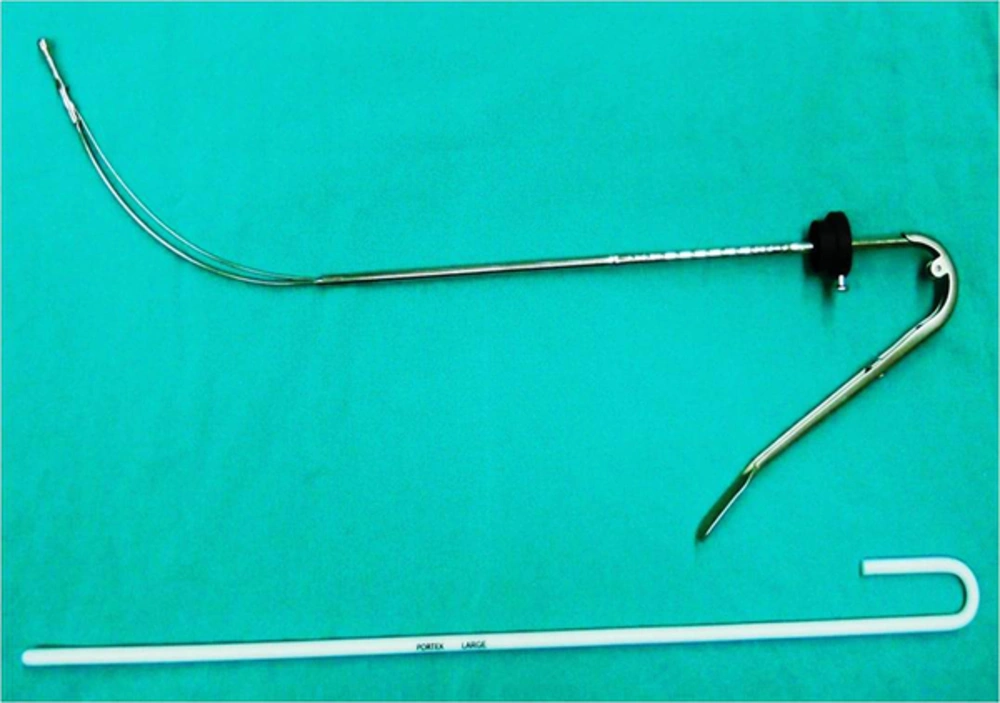
Figure 1.
TruflexTM Articulating Stylet and the PortexTM Malleable Stylet
2. Objectives
We hypothesized that using TAS as a dynamic aid to tailor the ETT shape in patient’s oropharynx would enhance first attempt tracheal intubation, shorten the intubation time, attenuate hemodynamic response and reduce the possibility of soft tissue trauma compared to conventional PortexTM intubation stylet (PIS) [Smiths Medical ASD, Inc. Norwell, MA, USA] while using Storz C-Mac D-bladeTM videolaryngoscope.
3. Patients and Methods
Following approval by the ethical committee of Khoula hospital (Muscat) and trial registration (ISRCTN57679531), informed consent was obtained from 218 ASA I to II patients of either sex over a 6-month period for this interventional, single blind, randomized controlled trial. Patients with known airway pathology, past surgery of oropharynx, or immobilized cervical spine were excluded from the study. All patients underwent general anesthesia for a variety of elective surgical procedures. Tracheal intubation was performed by anesthesiologists well versed with the use of the Storz’s C-Mac D-bladeTM videolaryngoscope. Patients were intubated using PIS and labeled as PIS Group (n = 110) or TAS as TAS Group (n = 108). All patients were assessed for adequacy of airway with a composite anticipated difficulty airway (ADA) score of routinely used parameters (Table 1). Based on this score, stratified randomization of patients was performed into easy airway or difficult airway strata when the ADA score was ≤ 6.0 or > 6.0 respectively. The detailed study protocol including plan of statistical analysis for this study has been published previously (9).
Table 1.
Anticipated Difficult Airway (ADA) Scorea
| Airway Factors | Score | ||
|---|---|---|---|
| 0 | 1 | 2 | |
| Mallampati classification | Class I | Class II | Class III-IV |
| Thyromental distance, cm | > 6.5 | 6 - 6.5 | < 6 |
| Head and neck movement, degree | > 90 | 90 | < 90 |
| BMI, kg/m2 | < 25 | ≥ 25 | - |
| Buck teeth | No | Mild | Severe |
| Inter-incisor gap, cm | > 5 | 4 - 5 | < 4 |
Abbreviations: ADA, Anticipated difficult airway; BMI, Body mass index.
aEasy airway strata: ADA Score ≤ 6; Difficult Airway strata: ADA Score > 6.
All patients were uniformly premedicated with oral 0.1 mg/kg midazolam about an hour prior to induction of anesthesia. A uniform induction technique with propofol 2.0 - 2.5 mg/kg and muscle relaxation with either cisatracurium 0.1 mg/kg or rocuronium bromide 0.6 mg/kg was used, as evident by loss of all four responses using a peripheral nerve stimulator. Patients also received 1.5 µg/kg fentanyl for induction of anesthesia. Primary efficacy endpoint was the success or failure to intubate in the first attempt and total intubation time. An attempt was counted if the laryngoscope or ETT needed to be removed for re-oxygenation (drop in oxygen saturation by 5%) or for reshaping the ETT in PIS group. The total tracheal intubation time was the sum of glotticoscopy time (from videolaryngoscope blade insertion between the teeth to the best laryngeal view) and ETT negotiation time (from receiving the stylet ETT in laryngoscopist’s hand to cross the black line on the ETT just beyond the vocal cord). A maximum of three tracheal intubation attempts was permitted, after which technique was considered as failure and alternative method was used to secure the airway. Only the successful tracheal intubation time was counted for the purpose of analysis. In addition, hemodynamic disturbances (blood pressure and pulse rate) were recorded before intubation, 1 minute and 5 minutes post-intubation; dental and airway trauma (present or absent) and trauma to the soft tissue were assessed as secondary safety endpoints. Furthermore, we analyzed the intubation difficulty score (IDS) between the two groups using intubation difficulty scale of Adnet et al. (10) and user satisfaction score. We used verbal analogue scale to note user satisfaction score (VAS = 1 and 10 were most unsatisfying and satisfying experiences respectively by anesthesiologist while performing C-Mac videolaryngoscopy and tracheal intubation).
4. Results
Total of 218 patients were finally recruited with 1:1 randomization into PIS (n = 110) or TAS Group (n = 108). There were no statistical differences (P > 0.05) in the possible confounding factors assessed as shown in Table 2. None of 218 patients belonged to difficult strata group where the ADA score had to be more than 6.
Table 2.
Baseline Characteristics of Patients in the Both Groupsa
| Variable | Group A (PIS) (n = 110) | Group B (TAS) (n = 108) | P-Value |
|---|---|---|---|
| Age | 37.45 (13.53) | 40.91 (13.99) | .064 |
| Sex (females) | 50 (45.45) | 40 (37.03) | .207 |
| BMI | 27.68 (5.82) | 27.67 (5.13) | .981 |
| MPG | 1.72 (0.65) | 1.75 (0.64) | .639 |
| TMD | 7.13 (0.73) | 7.19 (0.85) | .590 |
| IIG | 4.36 (0.57) | 4.39 (0.62) | .582 |
| Buck Teeth | 8 (7.27) | 4 (3.70) | .248 |
| Neck Movement restriction | 8 (7.27) | 13 (12.04) | .233 |
| ADA Score | 2.34 (1.49) | 2.98 (1.35) | .451 |
Abbreviations: ADA, Anticipated difficult airway; BMI, Body mass index; IIG, Inter incisor gap; MPG, Mallampati grade; PIS, Portex TM intubating stylet; TAS, TruflexTM articulating stylet; TMD, Thyromenta.
aValues are in mean (SD) except Buck Teeth and Neck Movement restriction presented in No. (%).
The number of patients in whom intubation was successful in the first attempt was significantly higher in the TAS group (99.1%) compared to PIS group (90.0%; P-Value = 0.003) (Table 3). In 12 patients, more than one attempt at tracheal intubation was needed. Of these, 11 patients were intubated with PIS in contrast to only one first attempt failure by TAS.
Table 3.
Cross Tabulation of Tracheal Intubation Attemptsa
| Attempts | Group | P-Value | |
|---|---|---|---|
| PIS | TAS | ||
| Single | 99 (90.0) | 107 (99.1) | .003 |
| Multiple (≥ 2) | 11 (10.0) | 1 (0.9) | .003 |
| Total | 110 | 108 | .003 |
Abbreviations: aTAS, Truflex TM articulating stylet; PIS, Portex TM intubating stylet.
aValues are presented as No. (%).
There were no significant differences between the two groups in total intubation time with two components of glotticoscopy and ETT negotiation time (Table 4). We considered only the successful intubation time in this study. ETT negotiation time was shorter in patients of TAS group compared to PIS Group by a mean of just over 2 seconds. However, this difference was not statistically significant (P-Value = 0.074). We observed significantly better IDS in patients intubated using TAS compared to PIS (P = 0.021).
Table 4.
Tracheal Intubation Times and IDS in The Two Groupsa
| Parameter | PIS (n = 110) | TAS (n = 108) | P-Value |
|---|---|---|---|
| GT, s | 6.97 (2.60) | 7.48 (2.40) | .136 |
| ETT, s | 12.64 (10.37) | 10.53 (6.3) | .074 |
| TIT, s | 19.61 (11.28) | 18.01 (7.59) | .222 |
| IDS | 0.26 (0.94) | 0.05 (0.25) | .021 |
Abbreviations: ETT, Endotracheal tube; GT, Glotticoscopy time; IDS, Intubation difficulty score; TAS, Truflex TM articulating stylet; PIS, Portex TM intubating stylet; TIT, Total intubation time.
aValues are presented as mean (SD).
Percentage change in hemodynamic parameters at 1 and 5 minutes post-intubation from immediate pre-intubation value between the two groups were slightly less in the TAS group compared to PIS group at the same time interval; however, these differences remained statistically insignificant (P-value > 0.05) over the study period (Table 5).
Table 5.
Percentage Change in Hemodynamic Parameters 1 and 5 Minutes Post-intubation From Immediate Pre-intubation Value
| PIS (n = 110) | TAS (n = 108) | P-Value | |
|---|---|---|---|
| HR | |||
| 1 min | 27.47 ± 22.62 | 24.69 ± 20.77 | .348 |
| 5 min | 4.04 ± 14.33 | 2.79 ± 11.83 | .479 |
| SBP | |||
| 1 min | 24.79 ± 23.95 | 22.46 ± 21.75 | .455 |
| 5 min | 2.56 ± 15.94 | 2.01 ± 11.47 | .772 |
| DBP | |||
| 1 min | 36.27 ± 36.60 | 32.59 ± 36.08 | .456 |
| 5 min | 4.89 ± 21.75 | 2.74 ± 17.97 | .427 |
| MAP | |||
| 1 min | 30.42 ± 27.77 | 27.53 ± 24.88 | .421 |
| 5 min | 3.46 ± 16.90 | 2.22 ± 13.62 | .553 |
Abbreviations: DBP, Diastolic blood pressure; HR, Heart rate; MAP, Mean arterial pressure; PIS, Portex TM intubating stylet; TAS, SBP, Systolic blood pressure; Truflex TM articulating stylet.
As indicated in Table 6, user satisfaction grade was significantly better in TAS group (8.5 ± 0.88) compared to PIS group (8.23 ± 0.99; P-Value = 0.035).
The rate of adverse events in the form of dental/airway trauma was comparable in the both groups as shown in Table 6.
Table 6.
User Satisfaction and Incidence of Dental/Airway Trauma in the Two Groups
| Group | User Satisfaction Grade (1 - 10) | Dental/Airway Traumaa |
|---|---|---|
| PIS | 8.23 ± 0.99 | 5 (0.90) |
| TAS | 8.5 ± 0.88 | 7 (0.92) |
| P-Value | .035 | .990 |
Abbreviations: PIS, Portex TM intubating stylet; TAS, Truflex TM articulating stylet.
aValues are presented as No. (%).
5. Discussion
The findings of this study on 218 randomized patients demonstrated that the use of Storz C-Mac D-bladeTM videolaryngoscope was associated with Cormack and Lehane’s grade I view in 99.1% of patients having an ADA score ≤ 6. We also noted first attempt successful tracheal intubation in 99.1% of patients in whom tracheal intubation was aided by TAS compared to 90% using PIS.
In this series, ADA Score showed no statistical difference in patients of either group. This was reflected in similar Cormack and Lehane’ laryngeal view with Storz C-Mac D-bladeTM videolaryngoscope in the both groups. During glotticoscopy, Cormack and Lehane’s grade 1 was noted in 216 (99.1%) patients with one patient each showing grades 2 and 3. Similar findings were reported by other investigators while using Storz C-Mac D-bladeTM videolaryngoscope (11). A good glottic view with the Storz C-Mac D-bladeTM videolaryngoscope is understandable as the D-blade has an increased angulation and the video camera is distally positioned on the blade.
We observed failed tracheal intubation in the first attempt in 12 patients. Of these, 11 patients (10.0%) belonged to the PIS group. In all these 11 patients, failed first attempt tracheal intubation was due to difficulty in ETT negotiation towards the glottis needing reconfiguration of the stylet. There was one patient whose trachea could not be intubated despite 3 attempts at reconfiguration of the PIS. This was a female patient with a short and thick neck and showed Cormack and Lehane’s grade 3 with an unliftable epiglottis. We did not attempt tracheal intubation using TAS as a crossover technique as we did not have ethical committee approval for this. Proseal laryngeal mask was successfully used in this patient for her surgical procedure. In contrast, there was only one patient needing a second attempt at successful tracheal intubation in the TAS group. This patient had slightly restricted mouth opening of 3.2 cm and developed desaturation during the first attempt. Thus, this study found that a good laryngeal view does not always ensure first attempt successful tracheal intubation with Storz C-Mac D-bladeTM videolaryngoscopes using the standard malleable stylet.
This study demonstrated that once the curvature of the PIS suits the oropharyngolaryngeal anatomy, there is no significant difference between the ETT negotiation time using either PIS or TAS. We observed first attempt success rate in 90.0% of our patients using PIS. This finding is similar to that observed by Kilicaslan et al. (12) who noted that ETT could be placed in the trachea on the first attempt in 86% and on the second attempt in 14% patients using Storz C-Mac videolaryngoscope after initial failure with conventional Macintosh laryngoscope. Time to achieve optimal laryngoscopic view of the glottis and total intubation time achieved in this study were similar to those reported by others (13).
Understandably, the IDS in this study was better when using TAS compared to PIS since its use was associated with a significantly improved first attempt tracheal intubation and an insignificantly shorter time to achieve intubation. There are no other studies with similar findings.
We noted that the percentage change in hemodynamic parameters at 1 and 5 minutes post-intubation from immediate pre-intubation value between the two groups were slightly higher in the PIS group compared to TAS group at the same time interval. This may be attributed to the greater number of repeat attempts at tracheal intubation in the PIS group, which was observed in 10% of these patients. However, these differences were not statistically significant.
In this study, users of Storz C-Mac D-bladeTM videolaryngoscope expressed their satisfaction with overall tracheal intubation experience based on quality of laryngeal view and ease of passage of tracheal tube using TAS or PIS on a scale of 1 - 10. We observed a significantly better user satisfaction in TAS group compared to PIS group.
This study had two major limitations. First, ethical issues committee did not give us permission for use of cross over method in shaping the ETT with PIS or TAS in case of failure with either of these two stylets. It is quite possible that change over TAS in the single failed tracheal intubation patient, while using PIS would have given a different result. Second, the anesthetist performing tracheal intubation could not be blinded as it was not possible to conceal the nature of stylet in use. However, to reduce the investigator bias, the intubation times were measured by an independent observer who was not part of the study. Furthermore, the data was analyzed by a statistician who was blinded to treatment allocation.
In conclusion, this study showed that a grade I Cormack and Lehane’s glottic view is observed in almost all patients with significantly improved first attempt successful tracheal intubation with the aid of TAS compared to PIS while using Storz C-Mac D-bladeTM videolaryngoscope.