Spinal Anesthesia in an Infant with Osteogenesis Imperfecta

Author(s):
Ozkan OnalOzkan Onal1,*, Muhammed Emin ZoraMuhammed Emin Zora1, Emine AslanlarEmine Aslanlar1, Aysun OzdemirkanAysun Ozdemirkan1, Jale Bengi CelikJale Bengi Celik1
1Selcuk University Medical Faculty, Department of Anesthesiology and Reanimation, Konya, Turkey
*Corresponding Author: Corresponding author: Ozkan Onal, Selcuk University Medical Faculty, Department of Anesthesiology and Reanimation, Konya, Turkey. E-mail: Email: [email protected]

Anesthesiology and Pain Medicine:Vol. 8, issue 1; e65917
Published online:Feb 10, 2018
Article type:Letter
Received:Jan 05, 2018
Accepted:Jan 16, 2018
How to Cite:Onal O, Emin Zora M, Aslanlar E, Ozdemirkan A, Bengi Celik J. Spinal Anesthesia in an Infant with Osteogenesis Imperfecta. Anesth Pain Med. 2018;8(1):e65917. doi: https://doi.org/10.5812/aapm.65917

Dear Editor,
Osteogenesis imperfecta (OI), which is a rare autosomal dominant disorder involving connective tissue, is manifested by skeletal fragility. In addition to its rarity, OI is associated with various risks, such as a difficult airway and malignant hyperthermia (1). Thus, it requires careful anesthesia management. We describe a case of OI in which surgical intervention was planned for a left inguinal hernia. The 2-month-old male patient weighed 3.2 kg on admission. In the operating room, the patient underwent a continuous electrocardiogram, pulse oximetry, noninvasive blood pressure, and temperature monitoring. Readings were recorded every 5 minutes. The patient’s baseline heart rate (HR) was 135 beats/min-1, his blood pressure (BP) was 110/62 mmHg, his SpO2 was 98%, and his skin temperature was 33.2°C. Hydration was started with a mixed pediatric solution (Biofleks, Osel, Turkey), which was administered intravenously at a rate of 10 mL/kg/h. Due to the extreme fragility of the patient’s bones, excessive neck extension may have led to a fracture, and overly vigorous laryngoscopy may have caused cervical teeth and mandibular injury (2). Spinal anesthesia administration was decided upon because of the short duration of the operation, the probability of difficult intubation, and the risk of mandibular bone fracture associated with intubation. Given the risk of malignant hyperthermia in patients with OI (3) and the fact that succinylcholine can induce fasciculation, resulting in fractures and dislocation, 2.5 mg/kg of propofol was administered without sevoflurane induction, and mask ventilation was carried out. The patient was carefully positioned in the left lateral knee-chest position. Then, 1 mg/kg of 0.5% bupivacaine (Marcaine, Eczacibasi, Turkey) was administered intrathecally using a 26 G Quincke (Atraucan, Braun, Germany) spinal needle at the level of L4 - L5 at a rate of 0.1 mL/sec. The needle was withdrawn after maintaining it in this position for 10 seconds (Figure 1). The surgery was initiated after it was confirmed by pinprick that the patient did not feel pain in the inguinal area. During the operation, spontaneous breathing was maintained with supplementary oxygen through a facemask. Paracetamol (Parol, Atabay, Turkey; 10 per 1 cc) 20 mg/kg was infused during the first 20 minutes of the surgery for postoperative analgesia. The surgery lasted for 45 minutes, and perioperative complications were not observed during the surgery. Postsurgery, the patient’s intraoperative BP, HR, and SpO2 values were as follows: 125 - 140 beats.min-1, 103/60 - 108/65 mmHg, and 98% - 99%, respectively. The patient was awakened by tactile stimulation and monitored in the recovery unit. He was transferred to the clinic after the motor block was discontinued.
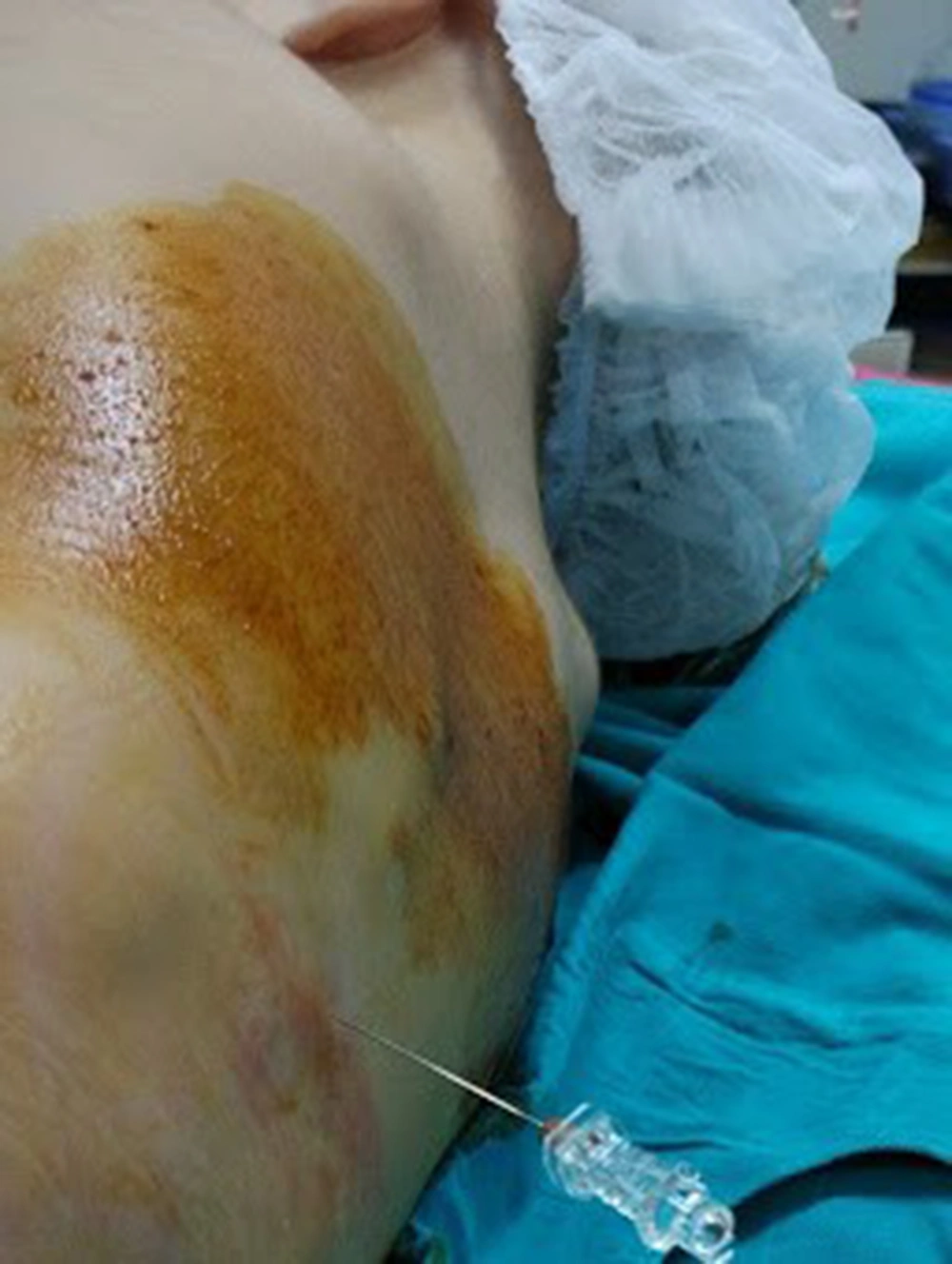
The Needle Was Withdrawn after Maintaining it in This Position For 10 Seconds
Figure 1.

The Needle Was Withdrawn after Maintaining it in This Position For 10 Seconds

Patients with OI may have anatomical abnormalities and bleeding diathesis, giving rise to difficulties during the administration of regional anesthesia. Bleeding diathesis and hemorrhage may result from the poor support of blood vessels due to a lack of normal adult collagen, capillary fragility, and abnormal platelet function (4, 5). In our patient, the bleeding profile and platelet values were normal. The anatomic impairment was not severe enough to prevent spinal anesthesia, probably due to the young age of the patient, and the intrathecal space was entered on the second attempt. Epidural and spinal anesthesia has been used successfully in pregnant patients with OI (4, 6). They may be the preferred approaches in those with difficult anatomy and help avoid the pulmonary complications associated with general anesthesia (4, 6). We choose spinal anesthesia because of the rapid onset of its effect and the ability to easily reach high levels. We choose spinal anesthesia because of its ability to quickly induce a high level of anesthesia. The management of patients with OI is challenging for anesthetists as OI-related complications influence the selection of both regional and general anesthesia. General anesthesia is associated with potentially more fatal complications than regional anesthesia, and it results in greater postoperative pain.
Thus, in our opinion, either regional anesthesia should be the first choice or spinal anesthesia should be kept in mind for children who are at high risk during general anesthesia (7).
References

  • 1.
    Lee J, Ryu HG, Kim A, Yoo S, Shin SY, Kang SH, et al. Anesthetic management of an 8-month-old infant with osteogenesis imperfecta undergoing liver transplantation: a case report. Korean J Anesthesiol. 2014;66(6):472-5. [PubMed ID: 25006373]. https://doi.org/10.4097/kjae.2014.66.6.472.
  • 2.
    Gornik-Wlaszczuk E, Majewski J, Szczygiel R, Dusiel A. Anaesthesia in children with osteogenesis imperfecta - report of 14 general anaesthetics in three children. Anaesthesiol Intensive Ther. 2013;45(2):85-8. [PubMed ID: 23877901]. https://doi.org/10.5603/AIT.2013.0019.
  • 3.
    Jagtap SR, Bakhshi RG, Jain A. A rare occurrence of pyloric stenosis in an infant with osteogenesis imperfecta: Anesthetic implications. J Anaesthesiol Clin Pharmacol. 2014;30(2):270-2. [PubMed ID: 24803772]. https://doi.org/10.4103/0970-9185.130064.
  • 4.
    Yeo ST, Paech MJ. Regional anaesthesia for multiple caesarean sections in a parturient with osteogenesis imperfecta. Int J Obstet Anesth. 1999;8(4):284-7. [PubMed ID: 15321125]. https://doi.org/10.1016/S0959-289X(99)80111-3.
  • 5.
    Wood SJ, Thomas J, Braimbridge MV. Mitral valve disease and open heart surgery in osteogenesis imperfecta tarda. Br Heart J. 1973;35(1):103-6. [PubMed ID: 4685898]. https://doi.org/10.1136/hrt.35.1.103.
  • 6.
    Oakley I, Reece LP. Anesthetic implications for the patient with osteogenesis imperfecta. AANA J. 2010;78(1):47-53. [PubMed ID: 20977129].
  • 7.
    Onal O, Erdogdu F, Cimen D, Ciftci I, Apiliogullari S. Spinal Anesthesia for Noncardiac Surgery in High-Risk Infants With Corrected Tetralogy of Fallot and Cardiomyopathy. Anesth Pain Med. 2015;5(4). e25778. [PubMed ID: 26473105]. https://doi.org/10.5812/aapm.25778v2.

Copyright

Copyright © 2018, Anesthesiology and Pain Medicine. This is an open-access article distributed under the terms of the Creative Commons Attribution-NonCommercial 4.0 International License (http://creativecommons.org/licenses/by-nc/4.0/) which permits copy and redistribute the material just in noncommercial usages, provided the original work is properly cited

Similar Articles

31
May
2016

Spinal Anesthesia in a 21-Year-Old Woman With Osteogenesis Imperfecta: A Case Report

Alireza Mirkheshti,
Elham Memary,
Ardeshir Tajbakhsh

Mirkheshti A, Memary E, Tajbakhsh A. Spinal Anesthesia in a 21-Year-Old Woman With Osteogenesis Imperfecta: A Case Report. Thrita J Neu. 2016;5(2):e37964. doi: https://doi.org/10.5812/thritaj.37964

7
Aug
2017

Osteogenesis Imperfecta: Genetic Overview and the Role of Anesthesiologists

Kamran Mottaghi,
Rofeideh Fallahinejadghajari,
Farhad Safari,
Parisa Sezari,
Mohammadreza Kamranmanesh,
Masoud Nashibi

Mottaghi K, Fallahinejadghajari R, Safari F, Sezari P, Kamranmanesh M, et al. Osteogenesis Imperfecta: Genetic Overview and the Role of Anesthesiologists. J Cell Mol Anesth. 2017;2(3):e149549. doi: https://doi.org/10.22037/jcma.v2i3.17267

14
Jul
2013

Cardiovascular Involvement in Children with Osteogenesis Imperfecta

Homa Ilkhanipoor,
Hamdollah Karamifar,
Gholamhossein Ajami,
Zohreh Karamizadeh,
Gholamhossein Amirhakimi,
Ali-Mohammad Shakiba

Ilkhanipoor H, Karamifar H, Ajami G, Karamizadeh Z, Amirhakimi G, et al. Cardiovascular Involvement in Children with Osteogenesis Imperfecta. Inn J Pediatr. 2013;23(5):. doi:

31
Jan
2008

Cyclic Pamidronate Therapy in Children with Osteogenesis Imperfecta

Sh Salehpour,
S Tavakkoli

Salehpour S, Tavakkoli S. Cyclic Pamidronate Therapy in Children with Osteogenesis Imperfecta. Int J Endocrinol Metab. 2008;6(1):. doi:

15
Oct
2017

Epidural Anesthesia Combined with Light General Anesthesia for a Juvenile with Charcot-Marie-Tooth Disease Undergoing Corrective Spine Surgery: A Case Report

Amir Poya Zanjani,
Azam Ghorbani,
Babak Eslami,
Babak Mirzashahi

Zanjani AP, Ghorbani A, Eslami B, Mirzashahi B. Epidural Anesthesia Combined with Light General Anesthesia for a Juvenile with Charcot-Marie-Tooth Disease Undergoing Corrective Spine Surgery: A Case Report. Anesth Pain Med. 2017;7(5):e14189. doi: https://doi.org/10.5812/aapm.14189

Download PDF1.99 MB
Indexed in

Crossmark

Crossmark

Checking

Share on
Cited by
Metrics

Ordering Reprints

Articles are published under the Creative Commons license stated on each article. No permission or royalty fee is required for uses permitted by that license. CCC handles optional bulk and customized reprint orders. Any quotation covers production and delivery services only, not copyright permission. > Request Reprints from CCC 

Search Relations

Author(s):

Related Articles