
1. Background
Renal colic is reported in 1 million patients presented to emergency departments in the United States, annually (1). In England, studies have shown that renal colic has led to 31,000 emergency admissions with 1-day stay and a cost of 19.3 million pounds in 2012 - 2013 (2). The prevalence of renal colic in the United States and England has been increased by 50% during the past decade. The prevalence of kidney stones in developed countries is estimated to be 7% in women and 10% in men and about 20% in the high-risk population (3, 4).
Intolerable pain of the patients requires the prescription of an analgesic, which exerts its effect in the shortest time possible (5). The most common analgesics that are used for pain relief in renal colic are non-steroidal anti-inflammatory drugs (NSAIDs), opioids, and paracetamol (6, 7). Choosing the type of analgesic depends on not only the effectiveness of the drug but also to the speed at which it reduces the patient’s pain (8). Considering the mechanism of pain in renal colic, NSAIDs can be the best choice (6). The most important problems existing regarding prescription of NSAIDs are their onset of action, titration, contradiction during pregnancy, as well as known digestive, kidney, and cardiac side effects (6, 9, 10). Among NSAIDs, diclofenac, ketoprofen, and ketorolac are routinely used and studies have shown that their effectiveness and safety are similar (11-13). Compared to opioid drugs, these drugs do not bring about drowsiness, respiratory depression, and dependency. The only injectable NSAID in the United States is ketorolac. Considering the production and presence of the injectable form of ibuprofen in Iran and its low cost, additionally in the absence of drugs such as diclofenac, and by taking the aforementioned points into consideration; this drug can also be a proper choice for management of the mentioned patients.
2. Objectives
Therefore, the present study was aimed to compare the effects of intravenous (IV) ibuprofen and IV ketorolac in pain management of the patients with renal colic presenting to the emergency department.
3. Methods
3.1. Study Design and Settings
The present study is a double-blind clinical trial performed on patients with renal colic presenting to the emergency department of Shohadaye Tajrish Hospital, Tehran, Iran, from 2016 to 2017. Protocol of the present study was evaluated and approved by the Ethics Committee of Shahid Beheshti University of Medical Sciences (IR.SBMU.MSP.REC.1395.251) and registered in the Iranian registry of clinical trials with the number: IRCT20180807040733N1. Throughout the study, the researchers adhered to the principles of the Helsinki declaration. Protocol of this study had no interference with patient treatment and was not dangerous for the patient. The gathered forms were anonymous and each patient was given a unique code. Before performing the study, the patients would fill out the consent form.
3.2. Participants
All the patients presenting to the emergency department aged between 18 and 65 years, who were diagnosed with renal colic by an emergency medicine specialist considering history and clinical examination, urinalysis, ultrasonography and computed tomography (CT) scan, and ruling out other differential diagnoses, were included in the study. Patients were excluded in cases that they had a history of adverse reactions to ketorolac and ibuprofen, were unable to determine the pain severity via visual analogue scale (VAS) tool, were pregnant, had a history of cardiac disease and hypertension, advanced systemic disease, malignancy, chronic liver disease, history of psychological and neurological illnesses, and consuming analgesics in the previous 6 hours prior to examination.
3.3. Procedure
After taking history and clinical examinations and ruling out other differential diagnoses, patients were randomly divided into 2 groups receiving IV ibuprofen or IV ketorolac using block randomization method. The physician that prescribed the drug, the patient, and the statistical analysis expert were blind to the type of drug used. All injections were performed under complete cardiorespiratory and blood pressure monitoring under the direct supervision of the senior emergency medicine resident.
First, injected solutions were prepared in similar packs by an emergency medicine specialist who had no role in the evaluation and prescription processes. The solutions were colorless and anonymous and both were diluted in 10cc distilled water. IV injection of a single dose of ketorolac was performed with 30 mg dose and IV injection of a single dose of ibuprofen was done with 800 mg dose. After drug injection, 500cc normal saline was prescribed for the patients.
To make sure that the study is double-blind, preparation of the solutions, their injection, and recording results were done by 2 different physicians who were not in contact during the trial. It should be noted that the information regarding the injected drugs would only be given to the treatment team if undesirable side effects or other clinical changes would manifest for the patient, which required knowledge of the injected drug. After 1 hour of follow up, if the pain vanished, the patient was discharged based on the opinion of the in-charge physician. If the pain persisted, rescue medication (morphine sulfate with 0.1 mg/kg titrated dose) was prescribed according to the opinion of the in-charge physician and the patient was discharged after the pain was alleviated and their condition had improved. If the pain relief did not happen during the first 30 minutes, a case of treatment failure was recorded and rescue medication was prescribed. Pain relief of 3 points based on VAS score was considered treatment success.
3.4. Data Gathering
Before prescribing the drugs, demographic data (age and sex), vital signs, positive history and clinical examination findings, and pain severity were recorded by the emergency medicine resident in charge of the patient. Then 15, 30, and 60 minutes after receiving medication, pain severity was recorded. Pain severity of the patients was measured and recorded based on standard 10-cm VAS (14).
3.5. Statistical Analysis
The sample size was estimated as 50 people in each group considering the decrease of 3 points on VAS as clinically significant, standard deviation of ketorolac and ibuprofen effectiveness in reducing migraine pain on VAS were 2.88 and 1.44 (15, 16), α = 0.05, and β = 0.1. The data were analyzed using SPSS version 21. Pain severity of the patient on admission, and 15, 30, and 60 minutes after injection were reported as mean ± standard deviation. To evaluate the age difference between the two groups, t-test was applied. The difference between the two groups regarding demographic factors, baseline characteristics, and side effects presenting with the patient after treatment were evaluated via chi-squared test. For evaluating intra-group changes of pain severity based on time, and for assessing the difference between the 2 groups, repeated measures ANOVA and two-way ANOVA were applied, respectively. It should be noted that the following method was used for assessing treatment success rate. Initially, pain relief of 3 points based on VAS was considered treatment success. Then by comparing the 2 groups treated with ibuprofen and ketorolac via a non-parametric test for trend based on chi-squared test it was determined which group had better treatment success. P < 0.05 was also considered the level of significance.
4. Results
4.1. Baseline Characteristics of the Patients
In this study, 240 patients suspected with renal colic with the mean age of 27.38 ± 12.32 (19 - 64) years were randomly divided into 2 groups of 120 treated with IV ketorolac or ibuprofen (66.4% male). Table 1 has compared the baseline characteristics of the patients in the two groups. The two groups were in a similar condition regarding the age (P = 0.56), sex (P = 0.78), history of kidney stone (P = 0.40), vital signs (P > 0.05), stone size (P = 0.73), stone location (P = 0.13), and pain severity on admission (P = 0.32).
Table 1.
Comparing Baseline Characteristics in the Two Studied Groupsa
| Variable | Ketorolac Group | Ibuprofen Group | P Value |
|---|---|---|---|
| Gender | 0.78 | ||
| Female | 41 (34.2) | 39 (32.5) | |
| Male | 79 (65.8) | 81 (67.5) | |
| Age, y | 38.7 ± 13.0 | 38.7 ± 11.6 | 0.56 |
| History of kidney stone | 0.40 | ||
| No | 81 (67.5) | 87 (72.5) | |
| Yes | 39 (32.5) | 33 (27.5) | |
| Vital signs | |||
| Body temperature, °C | 37.8 ± 0.5 | 37.8 ± 0.4 | 0.89 |
| Systolic blood pressure, mmHg | 117.0 ± 9.8 | 117.2 ± 8.5 | 0.86 |
| Diastolic blood pressure, mmHg | 73.6 ± 7.6 | 74.0 ± 6.7 | 0.65 |
| Heart rate, /min | 77.3 ± 6.3 | 76.6 ± 6.0 | 0.38 |
| Respiratory rate, /min | 15.6 ± 1.6 | 15.7 ± 1.6 | 0.83 |
| Stone size, mm | 5.5 ± 2.5 | 5.4 ± 2.4 | 0.73 |
| Stone location | 0.13 | ||
| Unknown | 10 (8.3) | 8 (6.7) | |
| Calice | 12 (10.0) | 19 (15.8) | |
| Ureter | 72 (60.0) | 72 (60.0) | |
| Bladder | 9 (7.5) | 14 (11.7) | |
| Calice + ureter | 17 (14.2) | 7 (5.8) | |
| Pain severity on admission (VAS) | 8.0 ± 1.2 | 7.8 ± 1.2 | 0.32 |
Abbreviation: VAS, visual analogue scale.
aValues are expressed as mean ± SD or frequency (%).
4.2. Comparing the Two Drugs in Pain Management
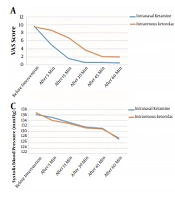
Table 2 and Figure 1 compare pain severity among the 2 groups in the studied times. Fifteen, 30, and 60 minutes after drug injection, pain severity in the ketorolac group was significantly higher than the group receiving ibuprofen (P < 0.0001 for all comparisons); however, these differences were not clinically significant. Fifteen minutes after injection, the rate of success in reducing pain severity by at least 3 points was significantly higher in the group receiving IV ibuprofen (P < 0.0001) compared with IV ketorolac group. At 15 minutes, there was no case of complete relief from pain (VAS = 0) in the two groups. However, 2 (1.7%) patients in the ketorolac group and 12 (10.0%) in the ibuprofen group reported complete pain relief after 30 minutes. After 60 minutes, the number of completely relieve cases reached 37 (30.8%) patients in the ketorolac group and 83 (69.1%) patients in the ibuprofen group (Table 3).
Table 2.
Comparison of Pain Severity Between the Two Groups at Various Timesa
| Time Range | Ketorolac Group | Ibuprofen Group | P Value |
|---|---|---|---|
| 15th minute | 5.9 ± 1.3 | 4.7 ± 1.1 | < 0.0001 |
| 30th minute | 3.4 ± 1.2 | 2.3 ± 1.0 | < 0.0001 |
| 60th minute | 1.2 ± 1.0 | 0.4 ± 0.6 | < 0.0001 |
| Pain reduction until 30th minute | 4.6 ± 0.6 | 5.6 ± 0.6 | < 0.0001 |
| Pain reduction until 60th minute | 6.8 ± 0.7 | 7.4 ± 0.9 | < 0.0001 |
aValues are expressed as mean ± SD.
Table 3.
Comparison of Treatment Success Rate in the Two Studied Groups Based on Time of Evaluation
| Time | Ketorolac Group (N = 120) | Ibuprofen Group (N = 120) | P Value | ||
|---|---|---|---|---|---|
| Success Rate, % | 95% CI | Success Rate, % | 95% CI | ||
| At least 3 points decrease in pain severity | < 0.0001 | ||||
| 15th minute | 11.7 | 6.5 - 18.9 | 92.5 | 86.2 - 96.5 | |
| 30th minute | 100.0 | 97.0 - 100.0 | 100.0 | 97.0 - 100.0 | |
| 60th minute | 100.0 | 97.0 - 100.0 | 100.0 | 97.0 - 100.0 | |
| Complete pain relief (VAS = 0) | < 0.0001 | ||||
| 15th minute | 0.0 | 0.0 - 3.0 | 0.0 | 0.0 - 3.0 | |
| 30th minute | 1.7 | 0.2 - 5.9 | 10.0 | 5.3 - 16.8 | |
| 60th minute | 30.8 | 22.7 - 39.9 | 69.1 | 60.1 - 77.3 | |
Abbreviation: CI, confidence interval; VAS, visual analogue scale.

Figure 1.
Comparison of pain severity in the two studied groups based on time of evaluation
The only side effect observed in the present study was nausea and vomiting. Overall, 52 (21.7%) cases with nausea and vomiting were seen, 23 (19.2%) of which were in the ketorolac group and 29 (24.2%) were in the ibuprofen group. No difference was seen between the two groups regarding the side effects (P = 0.35).
5. Discussion
The findings of the present study showed that IV prescription of ibuprofen with 800 mg dose as infusion acts faster than ketorolac in controlling renal colic pain. Analyses showed that the rate of treatment success in the group under treatment with ketorolac was 11.7% at 15 minutes after injection, while this rate was 92.5% in the ibuprofen group. It should be noted that the treatment success rate was 100% in both groups at the 30 and 60 minutes after injection. Finally, it was determined that the rate of complete pain relief (VAS = 0) was 37 (30.9%) cases in the ketorolac group and 83 (69.2%) in the ibuprofen group and this difference was statistically significant.
More rapid effect of ibuprofen compared with paracetamol has also been confirmed in Cenker et al. study (15). Imani et al. have also suggested that combining a lower than usual dose of ketorolac with dexmedetomidine can also be effective in post-caesarean pain management (17).
In line with the present study, Black et al. in 2002, aimed to evaluate the effectiveness of ibuprofen in analgesia following tooth surgery and showed that the mean time of the onset for this drug is 10 minutes. In the present study also, after 15 minutes from the injection of ibuprofen, a high rate (92.5%) of treatment success was observed (18). Meanwhile, studies show that it might take 30 to 60 minutes for ketorolac to exert its effect (19). That is the reason that we observed the highest effectiveness of ketorolac 30 and 60 minutes after injection in the present study.
In contrast to the findings of the present study, in the study of Neighbor and Puntillo comparing the intramuscular ketorolac with oral ibuprofen indicated that there was no difference between the two treatment strategies regarding treatment success and pain control after 2 hours of follow up in patients presenting to the emergency department with acute pain (20). In addition, in a similar study, Turturro et al. showed that oral ibuprofen has similar effectiveness to intramuscular ketorolac in controlling musculoskeletal pains (21). In another study, Braaten et al. showed that in abortion surgeries in the first 3 months of pregnancy, it is better to use oral ibuprofen and not intramuscular ketorolac, as the effectiveness of both drugs in controlling pain is similar to each other (22).
One of the major reasons for the difference between the findings of the present study with those of the mentioned studies could be the different route of drug administration in these studies. Since all the mentioned studies have used oral or intramuscular ibuprofen, the results are not consistent with the present study.
Although a piece of evidence has been introduced in terms of ibuprofen in the current study, more studies should be carried out in this regard because it has been shown in many studies that prescription of ketorolac has analgesic effects equal to meperidine in renal colic pain (23-27). Similar results have been reported in comparison to ketorolac and diclofenac for controlling renal colic pain (11, 13). In addition, by comparing IV morphine and IV ketorolac, Safdar et al. showed that both prescribed drugs had similar effectiveness in alleviating renal colic pain (28). Having a large sample size and being double-blind are among the strong points of this study. The studied sample size is about twice the minimum required sample size calculated for the present study, which guarantees the power of the study. In addition, this large sample size ensures the generalizability of the findings to the general population.
5.1. Limitation
Some degree of selection bias might be present in this study.
5.2. Conclusions
Findings of the present study show that ibuprofen is a more rapid-acting drug compared with ketorolac in controlling the pain caused by renal colic. In addition, its rate of complete relief from pain was twice that of ketorolac. Since the side effects observed for ibuprofen in the present study were very mild, it is suggested to use this drug in treatment and pain control of patients with renal colic.