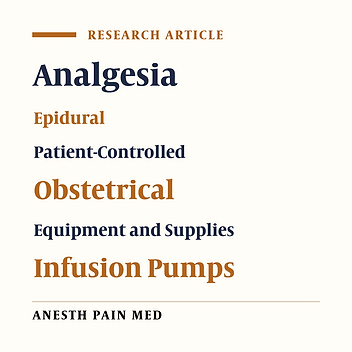
Image Credit:Anesth Pain Med
Outline
A Clinical Evaluation of the GemStar® and the AmbIT® Pumps for Patient-Controlled Epidural Analgesia
Authors
Abstract
Background: Patient-controlled analgesia is used for both labor and postoperative analgesia.
Objectives: This study aimed to assess user satisfaction and functionality of two ambulatory, electronic patient controlled analgesia devices, the GemStar pump Hospira Inc., Illinois, USA) and the ambIT Ambulatory Infusion Therapy pump (Sorenson Medical Products, Utah, USA).
Patients and Methods: It was a randomized clinical trial of laboring women and postoperative gynecology patients receiving patient-controlled epidural analgesia. Patients were randomized to use one of the pumps and both anesthesiologists and patients completed questionnaires about aspects of pump function, and rated their satisfaction with the equipment. Midwives and high-dependency unit nurses also evaluated the pumps in each clinical setting.
Results: Forty patients, 20 laboring women and 20 postoperative patients were randomized and completed the study. The pumps were compared by nine anesthesiologists. Patient and staff satisfaction with both devices was high. Patient satisfaction did not significantly differ between groups (median 10 [8, 10] for the GemStar and 10 [9, 10] for the ambIT, P = 0.525]. The median staff satisfaction score was 8 [6, 8] for the GemStar and 7 [5, 8] for the ambIT (P = 0.154). Both patient cohorts rated each pump highly for most aspects of clinical function. Staff rated the ambIT pump more favourably with respect to portability and storage at the bedside whilst the GemStar had better assessments with respect to its consumables and interactions involving the electronic interface.
Conclusions: Both devices were well-rated by patients and staff, with no significant difference between them for overall satisfaction, and only minor differences with respect to their respective strengths and weaknesses.
Highlights
References
- 1.The references are available in PDF file.
Copyright
© 2012, Author(s). The Author(s) retain copyright in the Article. Upon acceptance, the Author(s) grant Brieflands the non-exclusive right of first publication and a worldwide, perpetual, royalty-free, non-exclusive license to copyedit, format, publish, reproduce, distribute, display, preserve, archive, index, promote, and make the Version of Record available in all formats and media. Brieflands and the relevant journal will be identified as the original publisher of the Version of Record. The Article will be published under the [Creative Commons Attribution 4.0 International License (CC BY 4.0)](https://creativecommons.org/licenses/by/4.0/). The Author(s) may immediately deposit and share the Version of Record in any repository or platform. No separate permission or fee is required for uses permitted under CC BY 4.0. CCC may provide optional customized reprint services.
Similar Articles
A Comparison of Patient Controlled Epidural Analgesia With Intravenous Patient Controlled Analgesia for Postoperative Pain Management After Major Gynecologic Oncologic Surgeries: A Randomized Controlled Clinical Trial
Moslemi F, Rasooli S, Baybordi A, Golzari SE. A Comparison of Patient Controlled Epidural Analgesia With Intravenous Patient Controlled Analgesia for Postoperative Pain Management After Major Gynecologic Oncologic Surgeries: A Randomized Controlled Clinical Trial. Anesth Pain Med. 2015;5(5):e29540. doi: https://doi.org/10.5812/aapm.29540
Opioid Free Anesthesia in Laparoscopic Surgery: A New Emerging Technique
Kerketta CS, Chhanwal H, Kheskani D, Sharma V, Sitapara P, et al. Opioid Free Anesthesia in Laparoscopic Surgery: A New Emerging Technique. J Cell Mol Anesth. 2023;8(4):e151432. doi: https://doi.org/10.22037/jcma.v8i3.41302
Comparison of the Effect of Incremental Bolus and Incremental Infusion Regimens of Remifentanil on Labour Pain
Khooshideh M, Shahriari A, Sheikh M. Comparison of the Effect of Incremental Bolus and Incremental Infusion Regimens of Remifentanil on Labour Pain. Shiraz E-Med J. 2015;16(5):e25626. doi: https://doi.org/10.17795/semj25626
Comparison of the Efficacy of Adding Clonidine, Chlorpromazine, Promethazine, and Midazolam to Morphine Pumps in Postoperative Pain Control of Addicted Patients
Imani F, Rahimzadeh P, Faiz SHR. Comparison of the Efficacy of Adding Clonidine, Chlorpromazine, Promethazine, and Midazolam to Morphine Pumps in Postoperative Pain Control of Addicted Patients. Anesth Pain Med. 2011;1(1):10-14. doi: https://doi.org/10.5812/kowsar.22287523.1336
Intravenous Patient-Controlled Remifentanil Versus Paracetamol in Post-Operative Pain Management in Patients Undergoing Coronary Artery Bypass Graft Surgery
Jahangiri Fard A, Babaee T, Alavi SM, Nasiri AA, Ghoreishi SMM, et al. Intravenous Patient-Controlled Remifentanil Versus Paracetamol in Post-Operative Pain Management in Patients Undergoing Coronary Artery Bypass Graft Surgery. Anesth Pain Med. 2014;4(5):e19862. doi: https://doi.org/10.5812/aapm.19862
- Scopus by DOI: 3
Last Update: 2 weeks ago
- Scopus by Title: 3
Last Update: 2 weeks ago
- Scopus by Title (Ref): 3
Last Update: 2 weeks ago
- CrossRef: 4
Last Update: 10 hours ago
- OpenAlex: 4
Last Update: 9 hours ago
- OpenCitations: 4
Last Update: 5 days ago