1. Background
Heavy metals (HM) pollution is one of the biggest environmental issues of our era. Both natural and anthropological sources have an important role in the expansion of HM pollutions (1). The contamination of agricultural soils and vegetables by HM is one of the most severe ecological problems all around the world (2). It can easily affect human health via entering the food chain and direct ingestion (3-5). Vegetables are an important component of the human diet, which contain carbohydrates, proteins, vitamins, minerals, and HM (6, 7). There are different routes of HM exposure, the most important of which is the contaminated food chain, especially vegetables (8). Food safety has been the focus of several studies, which have investigated the risks associated with contamination of food resources (9). It's well documented that contamination of vegetables by HM is on the rise (10-13). However, plant species differ in their efficiency to absorb HM (14).
2. Objectives
The current study aimed to investigate HM levels of vegetables and health index risk (HIR) due to the consumption of vegetables in Isfahan Province, Iran.
3. Methods
3.1. Plant Sampling
Vegetable samples (potato, cucumber, tomato, carrot, lettuce, and spinach) were collected from local markets of Isfahan (Iran) in November 2018 on different days to determine nutrients (cadmium (Cd), copper (Cu), iron (Fe), nickel (Ni), manganese (Mn), lead (Pb), zinc (Zn), arsenic (As), phosphorus (P), and nitrate (N)).
3.2. Extraction of Plant
Crop samples were washed three times with distilled water, then dried and milled (72ºC for 48 h). Afterward, 0.2 g samples were weighted and 4 mL HNO3 and 0.2 mL H2O2 (37%) were used for digestion at 100ºC for 90 min and finally filtered by Whatman 42 (15). HMs were determined using atomic absorption spectroscopy (Varian, 220). Phosphorus was measured by a colorimetrically method. Nitrate was measured by the Jones procedure (16).
3.3. Daily Intake and Health Risk Index
The daily intake of metals (DIM) was calculated using the following equation:
Where; Celement is element content (mg kg-1) in dry matter of plant (DM); Cfactor is the conversion factor from fresh to dry weight of plants which was considered as 0.085 (17, 18); Dplant is DI of plants. Iranian family consumption represented by Institute of Standards and Industrial Research of Iran 2010 were 0.109 kg day-1 for cucumber and tomato, 0.058 kg day-1 for lettuce and spinach, 0.069 kg day-1 for potato, and 0.039 kg day-1 foe carrot. In addition, 70% of the mentioned intake for adults was considered for children. The BW is average body weight (60 kg for adults and 32.70 kg for children) (19, 20).
Health risk assessment for consumers, based on their intake of metal-contaminated crops, was characterized using a health risk index (HRI) as following:
Where; DIM is daily intake (mg kg BW−1 day−1); RfD is the reference oral doses for Cd, Cu, Fe, Mn, Ni, Pb, Zn, N, P, and As which they are 0.0005, 0.037, 0.3, 0.14, 0.2, 0.014, 0.3, 0.16, 0.00002, and 0.0003 mg kg−1 day−1, respectively (21) .
3.4. Data Analysis
The data were analyzed as a completely randomized design by the GLM (general linear models) procedure of SAS 2004. Significant differences were compared by Duncan's multiple range test (P ≤ 0.05).
4. Results
4.1. Elements Concentration in Plant Tissues
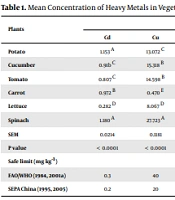
Cadmium in potato (1.153 mg kg-1 DM) and spinach (1.180 mg kg-1 DM) were significantly higher than other vegetables (Table 1). Among all investigated vegetables, the maximum Pb was observed in potato. The highest and lowest levels of Mn were found in lettuce and spinach, respectively. The highest As (16.02 mg kg-1 DM) was also observed in lettuce.
Table 1.
Mean Concentration of Heavy Metals in Vegetables (Mg Kg-1 DM) a
| Plants | Elements | |||||||||
|---|---|---|---|---|---|---|---|---|---|---|
| Cd | Cu | Fe | Ni | Mn | Pb | Zn | As | P | N | |
| Potato | 1.153 A | 13.072 C | 124.325 A | 3.383 A | 13.74 C | 8.352 A | 4.433 D | 12.902 B | 585.00 A | 149.50 C |
| Cucumber | 0.91b C | 15.318 B | 2.832 B | 1.290 A | 56.502 B | 0.513 D | 54.923 A | 8.209 D | 450.17 B | 286.33 B |
| Tomato | 0.807 C | 14.598 B | 5.787 B | 1.595 C | 75.097 A | 0.075 D | 35.945 B | 7.453 D | 221.83 D | 162.17 C |
| Carrot | 0.972 B | 0.470 E | 3.328 B | 0.402 F | 57.54 B | 0.048 D | 2.502 E | 2.657 E | 219.00 D | 142.50 C |
| Lettuce | 0.282 D | 8.067 D | 1.318 B | 0.810 E | 2.602 D | 4.410 C | 0.042 F | 10.35 C | 382.00 C | 180.00 C |
| Spinach | 1.180 A | 27.723 A | 6.180 B | 1.90 B | 3.218 D | 7.628 B | 5.534 C | 16.02 A | 387.00 C | 344.00 A |
| SEM | 0.0214 | 0.1181 | 12.773 | 0.0411 | 0.5985 | 0.0984 | 0.1066 | 0.196 | 6.186 | 8.138 |
| P value | < 0.0001 | < 0.0001 | < 0.0001 | < 0.0001 | < 0.0001 | < 0.0001 | < 0.0001 | < 0.0001 | < 0.0001 | < 0.0001 |
| Safe limit (mg kg-1) | ||||||||||
| FAO/WHO (1984, 2001a) | 0.3 | 40 | 450 | 20 | - | 5 | 60 | - | 0.00-0.07 | - |
| SEPA China (1995, 2005) | 0.2 | 20 | - | 10 | - | 9 | 100 | 0.5 | - | - |
a Means with the same capital letter in each column are not significantly different (P < 0.05).
In this study, Cadmium levels were lower than reported values (12.5 mg kg-1 for vegetables (22); 25 mg kg-1 for vegetables in polluted soils; 0.98 mg kg-1 in wheat,(23)). However, lower levels of Cd were reported in other studies (24, 25). The higher levels of Cd and Pb in potatoes and vegetables can be attributed to the fertilizers and sludge application. The mobility rate of Pb in soil and plant was very slow, and Pb rarely transports from roots to shoot parts of the plant (26).
In addition, the lowest level of Ni was measured in carrots. Evidence regarding the toxicity of Manganese in plants are not sufficient (27). The high concentration of Zn in cucumber and tomato might indicate the accumulation of Zn in soil. The abuse of pesticides and industrial sewage containing As in Isfahan probably has contaminated water resources. A positive correlation was reported between As content in corn root and shoot parts with total content and absorbable content of Zn in soil (28).
4.2. DIM and HIR of Elements
The DIM was higher in children than adults, mainly through potato consumption (Appendix 1 in Supplementary File). The highest level of DIM was observed for Fe, P, and N, and the lowest DIM was detected for Cd through consumption of potato. Therefore, compared to potato, HIR for As and P is of crucial importance and the entrance of these minerals to the food chain should be monitored.
The lowest amount of DIM via consuming cucumber was observed for Pb, while the highest amount of DIM was measured for P and N (Appendix 2 in Supplementary File). Except for the RfD amount of As, P, and N, other minerals were lower than standard amounts. Therefore, cucumber consumption may cause negative health consequences by As for both children and adults. The results of the present study are not consistent with the findings of other studies conducted in Isfahan (29), probably due to the high pollution of fruits and vegetables in recent years.
The highest amounts of DIM by tomato consumption were observed for N, P, and Mn (Appendix 3 in Supplementary File). Except for the As and P, the amounts of HIR in other vegetables for adults and children were lower than one. The higher HIR for As and P can be due to the high content of those minerals in tomato. Also, tomatoes had a high-risk potential for As. The lowest and highest amounts of DIM for carrot consumption were observed for Pb and P, respectively (Appendix 4 in Supplementary File). The upper amounts of DIM and HIR for P are due to the prevalent use of P fertilizers in the growth period of carrots. Although the concentrations of minerals were low in the soil, the mineral can be accumulated during plant growth.
The HIR through the consumption of lettuce for As and P was higher than one (Appendix 5 in Supplementary File). The DIM for P was higher than the standard (based on RfD) for both adults and children. Similar to other vegetables, the highest DIM through spinach consumption was observed in P, and N. The highest HIR for children was obviously observed than adults. The amount of HIR for N in spinach was about one (Appendix 6 in Supplementary File).
5. Discussion
This study demonstrated high levels of Cd in vegetables and potato, mainly due to extensive use of chemical (N, P, and potassium (K)) and animal fertilizers as well as pesticides in potato farms. The increase of Cl in the soluble phase of soil (due to using of P and K fertilizers) leads to increased levels of cadmium chloride in the soluble phase, which in turn results in enhanced bioavailability of Cd (30). Wangstrand et al. (31) reported that N fertilizers application had increased Cd concentration in soil, which in turn led to increased levels of Cd of wheat grains. Jalali and Khanlari (32) indicated that the mobile form of Cd in lime soils was higher during the cultivation of vegetables. Therefore, the long-term application of different fertilizers can increase the concentration of HM in plant biomass because many fertilizers contain HM or increase their mobility in the soil (33-35).
The concentration of Cd was higher than the safe limit (36, 37) for all plants, and the higher the concentration of Cd in the soil, the higher would be its concentration in plants. Besides, the amounts of lead measured in potato and air part of spinach were higher than the safe limits defined by the FAO/WHO (36), while these amounts were lower than the safe limits defined by the USEPA (37). However, the Pb for other vegetables was higher than the safe limits (36, 37).
In all plants, the measured level of copper was lower than the safe limits (29), except for spinach (37). Several studies reported lower concentrations of Cu (38, 39). Nickel was lower than the safe limits in all plants (36, 37), and similar results are reported by Rashed (40). Chabukdhara et al., (41) found that the contents of Cd and Pb in vegetables were higher than the standard limits, but other HMs (Co, Cu, Cr, Fe, Mn, Ni, and Zn) were lower than the limits.
Zinc concentration was lower than the safe limit for all plants (36, 37). Similar findings are reported by Wu et al. and Gulz et al. (42) for corn, sunflower, and canola for As. Also, sewage application for plants has led to increased concentration of As in plants. Moreover, T Levels of Cu and Zn in fruits and vegetables did not also appear to expose serious health problems (43). Another study (44, 45) also showed that P fertilizers might cause a linear increase in P concentration of plants. Therefore, the higher amount of P in plants in this study might be due to the extreme application of chemical P fertilizers. Increased level of As in soil caused to release P from absorption sites and increase the availability of P by roots (46). Therefore, this interaction will determine the final concentration of P and As in plants.
Several factors contribute to nitrogen content, such as geographical condition, type and cultivar of plants, and cultivation condition, etc (46-48). Kenny and Walsh (49) reported that the concentration of N in carrot and cucumber was lower than the safe limits defined in European countries. Also, the N concentration in spinach of this study is in accordance with their study, but N in potato was higher than reported amounts by Kenny and Walsh (49). The N concentration in potato was reported 167 mg kg-1 (50), and the amount of N in the present study was lower than the safe limits of almost all European countries. The N concentration in lettuce and spinach changes widely depending on the season (51). The results of the present study showed that the lettuce and spinach were in reported ranges by safe limits.
The high HIR for Fe, P, and N can be attributed to the high DI of potato and high concentration of these minerals in potato. Maynard and Hochmuth (52) reported that N, P, and K fertilizers for potatoes applied in 100, 100, and 33 times more than tomato. There are risks of As for human health due to the consumption of contaminated potatoes, which is emphasized by the present study. Also, As in plants, especially in carrots, should be measured. The application of fertilizers and other amendments containing HM in cucumber farms will increase the HM accumulation of this vegetable. However, Cd, As, and Pb, among other minerals, cause extreme concerns because they can lead to serious diseases in adults and children (53).
5.1. Conclusions
Potato, tomato, cucumber, lettuce, and spinach are highly consumed vegetables in Iran, similar to many countries. Thus, the health risks of HM caused by consumption of these vegetables are a great concern in the study area, and more attention should be paid to the potential hazardous exposure to HM, especially for As, over the lifetime. For all vegetables, the concentrations of N and P were higher than the safe limits, which prohibited the entrance of these minerals to products. Possible measurements are necessary to effectively limit or prevent the health risk of vegetable consumption, such as careful peeling, selection of pollution-safe cultivars, and improvement of agricultural practices.