
Annals of Military and Health Sciences Research

Image Credit:Annals of Military and Health Sciences Research

Fighting Fatigue in Military Forces

Author(s):
Babak DaneshfardBabak DaneshfardBabak Daneshfard ORCID1, Nafiseh Hosseini YektaNafiseh Hosseini YektaNafiseh Hosseini Yekta ORCID2,*
1Traditional Medicine Clinical Trial Research Center, Shahed University, Tehran, Iran
2Department of Persian Medicine, Faculty of Medicine, AJA University of Medical Sciences, Tehran, Iran
*Corresponding Author: Department of Persian Medicine, Faculty of Medicine, AJA University of Medical Sciences, Tehran, Iran. Email: [email protected]

Annals of Military and Health Sciences Research:Vol. 18, issue 2; e104579
Published online:Jul 19, 2020
Article type:Letter
Received:May 05, 2020
Accepted:Jul 07, 2020
How to Cite:Daneshfard B, Hosseini Yekta N. Fighting Fatigue in Military Forces. Ann Mil Health Sci Res. 2020;18(2):e104579. doi: https://doi.org/10.5812/amh.104579

Dear Editor,
One of the most common disorders related to military service is fatigue and weakness of the physical and mental strength. Fatigue is a feeling of exhaustion and lack of energy that interferes with physical and cognitive functions. This inability to perform and maintain optimal performance has been attributed to a number of factors, including disruption of the sleep-wake cycle, prolonged stressful state, and high workload (1).
Fatigue can cause many problems for the military forces, especially during military operations. Battle fatigue can reduce the ability of the forces by up to 50% (2). According to the studies, the weight of the equipment carried by soldiers is one of the causes of their fatigue and, consequently, their injuries. On the other hand, the weight of this equipment has been increased over the time (3). Hence, it will be useful and, of course, necessary to find a solution for increasing the strength of the soldiers and preventing this complication as much as possible to eliminate their fatigue in the shortest possible time.
Considering the current approach of integrative medicine in most parts of the world, herbal medicine as a popular branch of Complementary and Alternative Medicine (CAM) is commonly used for various disorders (4). In this regard, Persian Medicine (PM), as one of the oldest comprehensive medical schools with a history of thousands of years, has introduced herbal medicines for various ailments in its therapeutic approach (5).
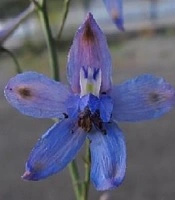
Delphinium denudatum Wall. (Ranunculaceae), also known as Jadwar (Mah-Parvin in Persian) (Figure 1), is a medicinal herb with various properties (6). In PM, Jadwar has been used as a tonic agent for increasing mental and physical stamina in addition to its usage as poison detoxification and a pain-relieving drug (7).
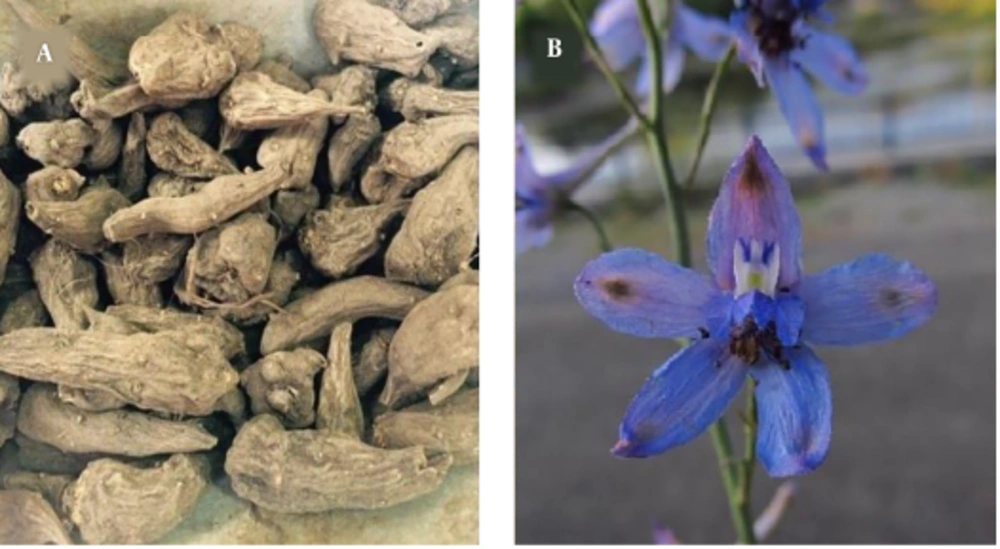
<i>Delphinium denudatum</i> (Jadwar) A: root, B: flower
Figure 1.

Delphinium denudatum (Jadwar) A: root, B: flower

Considering the aforementioned, we conducted a randomized placebo-controlled clinical trial in the students of AJA University of Medical Sciences to evaluate the efficacy of Jadwar root powder (in a capsule dosage form) in fighting fatigue. A total number of 64 healthy participants were evaluated in this study using the Persian version of the Multidimensional Fatigue Inventory (MFI) questionnaire as a standard self-report instrument for the assessment of fatigue. Based on the results of this trial, using 500 milligrams of Jadwar root powder for 15 consecutive days significantly improved the perception of participants regarding their mental, physical, and emotional functionality (8). Various active ingredients in Delphinium denudatum, including flavonoids (such as quercetin) and fatty acids, may play a role in its anti-fatigue effect; however, it should be further investigated.
Such a natural product could be easily used in military forces in the dosage form of capsule. This product is feasible for them to carry and consume in different military situations to increase their functionality. Further investigations considering objective outcome measures should be conducted in other groups of military forces to rigorously confirm its safety and efficacy.
Footnotes

  • Authors' Contribution: B. Daneshfard wrote the primary draft of the paper and N. Hosseini Yekta revised and approved the final version of it.

  • Conflict of Interests: The authors declare that they have no conflict of interest.

  • Funding/Support: None.

References

  • 1.
    Caldwell JA, Caldwell JL, Thompson LA, Lieberman HR. Fatigue and its management in the workplace. Neuroscience & Biobehavioral Reviews. 2019;96:272-89.
  • 2.
    Hazen S, Llewellyn C. Battle fatigue identification and management for military medical students. Military medicine. 1991;156(6):263-7.
  • 3.
    Orr RM, Johnston V, Coyle J, Pope R. Reported load carriage injuries of the Australian army soldier. Journal of occupational rehabilitation. 2015;25(2):316-22.
  • 4.
    Golshani SA, Daneshfard B, Mosleh G, Salehi A. Drugs and pharmacology in the Islamic Middle Era. Pharm Hist (Lond). 2015;45(3):64-9.
  • 5.
    Atarzadeh F, Daneshfard B, Dastgheib L, Jaladat A, Amin G. Early description of diet-induced blistering skin diseases in medieval Persia: Avicenna's point of view. Skinmed. 2016;14(5):367-70.
  • 6.
    Nizami Q, Jafri MA. Unani drug, Jadwar (Delphinium denudatum Wall.)—a review. Indian Journal of Traditional Knowledge. 2006;5(4):463-7.
  • 7.
    Alavi S. Makhzan Al-adviyah (The Storehouse of Medicaments). Tehran: Intisharat va Amoozesh Enghelab Press; 2009.
  • 8.
    Daneshfard B, Yekta NH, Khoshdel A, Heiran A, Cheraghi R, Yarmohammadi H. The effect of Delphinium denudatum (Jadwar) on fatigue: A randomized double blind placebo-controlled clinical trial. Complementary therapies in medicine. 2019;46:29-35.

Copyright

Copyright © 2020, Annals of Military and Health Sciences Research. This is an open-access article distributed under the terms of the Creative Commons Attribution-NonCommercial 4.0 International License (http://creativecommons.org/licenses/by-nc/4.0/) which permits copy and redistribute the material just in noncommercial usages, provided the original work is properly cited.

Similar Articles

11
Oct
2013

From the Persian Ancient Dramas, Jamm and Simurgh Toward the Modern Military Medicine

Ali Reza Khoshdel,
Mohammad Hossein Lashkari

Khoshdel AR, Lashkari MH. From the Persian Ancient Dramas, Jamm and Simurgh Toward the Modern Military Medicine. J Arch Mil Med. 2013;1(1):. doi: https://doi.org/10.5812/jamm.15082

31
Aug
2017

Prevention of Dystocia in Traditional Persian Medicine

Yasaman Vazani,
Fataneh Hashem Dabaghian,
Mansoor Keshavarz

Vazani Y, Hashem Dabaghian F, Keshavarz M. Prevention of Dystocia in Traditional Persian Medicine. Jundishapur J Nat Pharm Prod. 2017;12(3):e63798. doi: https://doi.org/10.5812/jjnpp.63798

31
Jul
2014

Ethno-pharmaceutical Formulations in Kurdish Ethno-medicine

Reza Tahvilian,
Soheyla Shahriari,
Akbar Faramarzi,
Ayoob Komasi

Tahvilian R, Shahriari S, Faramarzi A, Komasi A. Ethno-pharmaceutical Formulations in Kurdish Ethno-medicine. Iran J Pharm Res. 2014;13(3):e125492. doi: https://doi.org/10.22037/ijpr.2014.1541

13
Mar
2018

A Descriptive Study of Medicinal Plants and Polyherbal Formulation Prescribed for Patients in Persian Medicine Clinic (Salamatkadeh) Affiliated to Tehran University of Medical Sciences (2016)

Mahbubeh Bozorgi,
Elham Madreseh,
Mohammad Hossein Ayati,
Roja Rahimi

Bozorgi M, Madreseh E, Ayati MH, Rahimi R. A Descriptive Study of Medicinal Plants and Polyherbal Formulation Prescribed for Patients in Persian Medicine Clinic (Salamatkadeh) Affiliated to Tehran University of Medical Sciences (2016). J Rep Pharm Sci. 2018;7(2):e147584. doi:

6
Sep
2016

Review of an Aloe-Based Formulation Used in Iranian Traditional Medicine

Elham Moein,
Homa Hajimehdipoor,
Maryam Hamzeloo-Moghadam,
Rasool Choopani,
Tayebeh Toliyat

Moein E, Hajimehdipoor H, Hamzeloo-Moghadam M, Choopani R, Toliyat T. Review of an Aloe-Based Formulation Used in Iranian Traditional Medicine. Jundishapur J Nat Pharm Prod. 2016;11(4):e40193. doi: https://doi.org/10.17795/jjnpp-40193

Download PDF4.08 MB

Crossmark

Crossmark

Checking

Share on
Cited by
Metrics

Ordering Reprints

Articles are published under the Creative Commons license stated on each article. No permission or royalty fee is required for uses permitted by that license. CCC handles optional bulk and customized reprint orders. Any quotation covers production and delivery services only, not copyright permission. > Request Reprints from CCC 

Search Relations

Author(s):

Related Articles