
1. Background
Numerous factors are involved in the increase and the spread of cardiovascular disease, including poor eating habits, high blood pressure, inactivity, low aerobic fitness, obesity, overweight, and poor condition of lipid profiles (1). Although these cardiometabolic risk factors can be effectively treated with medication, lifestyle modification is recommended as a first-line approach (2). Most lifestyle intervention programs include behavioral components, diet, and physical activity; however, evidence suggests that regular exercise reduces the risk of cardiovascular-independent diet intervention (3). A study of adolescents' lifestyles showed that the transition from the beginning of adolescence to the later stages of adolescence was always accompanied by a decrease in physical activity, increased inactivity, and homelessness of adolescents, which has caused major concerns for public health (4). Accordingly, adolescents must lead an active lifestyle by developing physical activity, so the researchers suggested that adolescents should spend at least 60 minutes or more per day in moderate to vigorous, varied, and enjoyable activities during school (5). Aerobic and anaerobic sports activities are used to improve the health of individuals with obesity and diabetes, instead of medicine, and each of these activities is promoted through various mechanisms (6). There are various studies with different results on the effect of endurance, resistance training, or concurrent training on important health indicators of variables such as body fat weight or lipid profiles, including high-density lipoprotein (HDL), low-density lipoprotein (LDL), triglyceride, and total cholesterol (6). However, there is still no consensus on whether long-term endurance training or resistance training has significant effects on fat metabolism. Recently, high-intensity intermittent training (HIIT) has been used instead of traditional endurance training due to its attractiveness, variety, and greater metabolic adaptation. HIIT includes intense or super-intense training sessions (95 - 85% HRmax) with very short recovery periods or inactive rest between them (3, 4). Recent studies have also explicitly stated that performing HIIT for fat reduction is more effective than endurance training (3, 4); however, intensity and duration of HIIT for weight loss have not been determined so far, and there are still a lot of questions. Identification of training methods is important to evaluate biochemical changes associated with obesity and cardiovascular diseases due to the characteristics of HIIT (diversity of training, spending very little time, and similar metabolic effects) to help achieve optimal health elements.
2. Objectives
Considering that important metabolic factors increase during the activity, limited research compared different volumes of HIIT with the same intensity, and these exercises affect fat metabolism and hematological factors, the researchers aimed to investigate whether eight weeks of high-intensity intermittent exercise with different volumes could affect the performance and lipid profile of hematological factors in overweight adolescents.
3. Methods
The statistical population of this study was 30 overweight male students in the age range of 13 to 16 who were chosen based on different criteria, including no history of infectious disease and taking no medication. They were asked to participate in regular sports activities and all training sessions to measure research variables. The subjects who did not meet these conditions, did not participate in the practice or measurement of variables, and were injured during the research process, were all excluded from the research. In this study, subjects were randomly divided into three groups, including control (n = 10), HIIT-1 (n = 10), and HIIT-2 (n = 10). Serum levels of TG, TC, LDL, VLDL, and HDL were analyzed using special kits (Pars Azmun, Karaj, Iran). Besides, iron, hemoglobin levels (cell counter model Simex KX), and serum glucose levels were measured using Pars Azmun company kit (glucose oxidase method) before and 48 h after the last session of the training program (7, 8). Moreover, the YO-YO recovery test, RAST anaerobic test, and Jackson/Pollock method, body analyzer (Omron, BF511, Japan) were applied to measure the variables of aerobic and anaerobic performance and body fat percent, respectively (7-9).
3.1. Training Protocol
The subjects of the training groups performed the warm-up program first in each session, then in the main training, the HIIT program, and finally, in the cooling program. The warm-up program in each exercise session for both training groups consisted of 15 minutes of standard warm-up, starting with a low-intensity run (50% of maximum aerobic speed), and then three repetitions of a 30-second sprint, followed by a 30-second slow run and ended by a dynamic stretch for 5 minutes. The first HIIT-1 in the first week included intermittent running for 30 seconds with 100% maximum aerobic velocity (MAV), 30 seconds of active recovery with 50% of MAV, eight sets, two laps, and five minutes of inactive recovery between each lap. The number of sets and laps for the HIIT-1 program changed according to Table 1 for the following weeks. The second HIIT-2 in the first week included intermittent running for 30 seconds at 100% MAV, 30 seconds of active recovery at 50% MAV, four sets, four laps, and five minutes of inactive recovery between each lap. Moreover, the number of sets and laps for the HIIT-2 program changed according to Table 1 for the following weeks. The control group did not perform any training program (9, 10).
Table 1.
Two HIIT Programs After Eight Weeks
| Programs | Weeks of Training | |||
|---|---|---|---|---|
| 1, 2 | 3, 4 | 5, 6 | 7, 8 | |
| HIIT-1 | ||||
| Lap | 2 | 2 | 2 | 2 |
| Set | 8 | 12 | 12 | 15 |
| Exercise/rest (time: sec) | 30: 30 | 30: 30 | 30: 30 | 30: 30 |
| Exercise/rest (intensity: percent) | 100: 50 | 100: 50 | 105: 50 | 110: 50 |
| Rest (min) | 5 | 5 | 5 | 5 |
| HIIT-2 | ||||
| Lap | 4 | 4 | 4 | 5 |
| Set | 4 | 6 | 6 | 6 |
| Exercise/rest (time: sec) | 30: 30 | 30: 30 | 30: 30 | 30: 30 |
| Exercise/rest (intensity: percent) | 100: 50 | 100: 50 | 110: 50 | 110: 50 |
| Rest (min) | 5 | 5 | 5 | 5 |
3.2. Statistical Analysis
Descriptive statistical indices, such as mean and standard deviation (SD), were used to analyze data. One and two-way ANOVA with repeated measures was applied to compare within-group and between-group differences. It should be noted that the difference between pre-test and post-test became the unit number of delta (∆). Tukey post hoc test was applied when the differences were significant, and confidence interval of 95% (P < 0.05) was considered statistically significant at all stages of the test.
4. Results
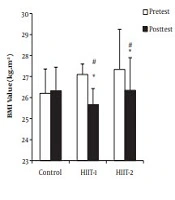
The result showed that there was a significant difference in weight, body mass index (BMI), body fat percentage, and VO2max in the two HIIT groups in comparison to the pre-test (P < 0.05). One-way ANOVA and Tukey post hoc test in delta changes (∆) indicated that in the HIIT-1 and HIIT-2 groups weight (P = 0.03, P = 0.007), BMI (P = 0.001, P = 0.001, and and body fat percentage (P = 0.001, P = 0.0001) significantly reduced compared to the control group, respectively (Figure 1). Besides, the HIIT-1 and HIIT-2 groups significantly increased VO2max (P = 0.0001, P = 0.02) compared to the control group. The results revealed that the HIIT-1 and HIIT-2 groups significantly increased the mean power output (P = 0.02, P = 0.003) and fatigue index (P = 0.001, P = 0.001) compared to the control group, respectively (Figure 1). Furthermore, the findings of the delta value of the maximum and minimum power output demonstrated that only the HIIT-2 group was significant compared to the control group, respectively (P = 0.05, P = 0.006, Table 2).

Figure 1.
Changes in body composition and aerobic performance of the studied groups [* significant difference with pre-test (P < 0.05); # significant differences with the changes of the control group (P < 0.05)].
Table 2.
Changes in Anaerobic Power and Hematological Indices in the Studied Groups
| Variables | Control | HIIT-1 | HIIT-2 | |||
|---|---|---|---|---|---|---|
| Pre-test | Post-test | Pre-test | Post-test | Pre-test | Post-test | |
| Maximum power (wat) | 298 ± 5 | 297 ± 4 | 300 ± 29 | 308 ± 28 | 302 ± 21 | 331 ± 39 b, c |
| Mean power (wat) | 279 ± 10 | 269 ± 15 | 272 ± 25 | 283 ± 29 c | 293 ± 35 | 299 ± 32 b, c |
| Minimum power (wat) | 260 ± 19 | 252 ± 18 | 244 ± 23 | 250 ± 29 | 262 ± 37 | 279 ± 36 b, c |
| Fatigue index (unit) | 1.0 ± 0.23 | 0.91 ± 0.9 | 1.17 ± 0.13 | 1.44 ± 0.18 b, c | 1.15 ± 0.11 | 1.57 ± 0.27 b, c |
| VLDL (mg.dl-1) | 30.1 ± 1.04 | 30.16 ± 1.3 | 27.4 ± 4.3 | 20.8 ± 2.2 b, c | 29.3 ± 2.3 | 25.2 ± 1.9 b, c |
| Glucose (mg.dl-1) | 104 ± 1.6 | 108 ± 7.7 | 101 ± 6.4 | 90 ± 3.4 b, c | 101 ± 6.1 | 93 ± 3.5 b, c |
| Hgb (mg.dl-1) | 12.2 ± 0.38 | 12.3 ± 0.44 | 12.3 ± 0.57 | 12.18 ± 0.86 | 12.6 ± 0.43 | 12.6 ± 0.73 |
| Iron (µg.dl-1) | 72.3 ± 8.7 | 73.6 ± 10.4 | 70.3 ± 7.1 | 73.8 ± 5.9 | 74 ± 6.1 | 76.3 ± 5.5 |
| Ferritin (ng.ml-1) | 75.7 ± 3 | 75.2 ± 2.5 | 76.9 ± 4.8 | 75.4 ± 4.7 | 78.3 ± 4.2 | 77.2 ± 3.8 |
Abbreviation: Hgb, hemoglobin.
a Values are expressed as mean ± SD.
b Significant difference with pre-test (P < 0.05)
c Significant differences with the changes of the control group (P < 0.05).
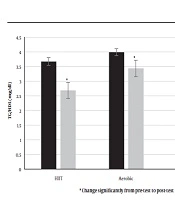
The findings revealed that all lipid profile variables in within-group comparison (pre-test to post-test) were significant in both training groups (P = 0.01). Moreover, a significant difference was observed in LDL and TG in the control group (P = 0.001) in within-group comparison (Figure 2). The results also showed a significant increase in HDL only in the HIIT-1 group (P = 0.03) compared to the control group. In the HIIT-1 and HIIT-2 groups, serum levels of the LDL, VLDL (Table 2), TC, TG and glucose significantly reduced compared to the control group (P = 0.002, Figure 2), although there was no significant difference between the HIIT-1 and HIIT-2 groups in LDL, VLDL, TC and glucose (Figure 2, P = 0.07). Moreover, the findings revealed that there was no significant difference in within-group and between-group comparisons in the variables of iron, hemoglobin, and ferritin between the three groups (P = 0.08, Table 2).

Figure 2.
Changes in blood lipid profile indices in the studied groups [HDL, high-density lipoprotein; LDL, low-density lipoprotein; TC, total cholesterol; TG, triglyceride; * significant difference with pre-test (P < 0.05); # significant differences with the changes of the control group (P < 0.05)].
5. Discussion
The findings of this study revealed that eight weeks of high-intensity intermittent training (HIIT) significantly decreased weight, body composition, and body fat percentage in the training groups compared to the control group; however, there was no significant difference between the two training groups in body composition variables. The results of this study are in line with the results of the study of Heydari et al. in 2012, who examined the effect of HIIT on body composition variables. They reported that weight, body composition, and body fat percentage significantly decreased with HIIT but had no effect on the waist-to-pelvic ratio (11). Moreover, Perry et al. in 2008 examined the effect of six weeks of HIIT on fat and carbohydrate metabolism capacity. They reported that these exercises resulted in an 18 to 29% increase in the content of several mitochondrial proteins (citrate synthetase, malate dehydrogenase, and pyruvate dehydrogenase) as well as increased fatty acid transporters. They stated that performing HIIT not only increased mitochondrial enzymes and fatty acid transporters in a short period but also increased lipid oxidation. These processes can improve the composition of the body and reduce the percentage of fat and weight. Research in this area suggests that increased fat oxidation after HIIT may be due to the need for energy to neutralize H+ and increase re-synthesize of glycogen and energy expenditure (4).
The findings also indicated that aerobic performance in the two groups of HIIT exercise had a significant increase compared to the control group. Dassin et al. in 2008 showed that HIIT improved aerobic performance (12), even though Burgomaster et al. in 2005 did not observe a significant increase in VO2max after HIIT (13). The interpretation of the possible mechanism of the increase in VO2max goes beyond the present study. Astorino et al. in 2012 reported an increase in cardiovascular function indices such as oxygen pulse, pulse volume, and cardiac output (14). The results also showed that there was a significant difference between the two HIIT groups in changes in VO2max and the HIIT-1 indicated a greater increase in VO2max values. The HIIT-1 group appears to keep the heart rate at a higher intensity for a longer period, thus putting more strain on the cardiovascular system and causing greater adaptation, while the HIIT-2 group has more rest and less load on the cardiovascular system than the HIIT-1 group (14).
The findings also revealed that HIIT-1 and HIIT-2 caused a significant increase in the mean power and fatigue index compared to the control group, respectively. Besides, the results of the changes in the maximum and minimum power output showed that these variables were significant only in the HIIT-2 group compared to the control group. The findings also are in line with the results of Larsen et al. in 2002, who reported a significant increase in maximal power in trained cyclists after four weeks (15). However, Rodas et al. in 2000 did not observe any changes in power output after 14 sessions of intermittent training (16). Among the mechanisms involved in increasing power output and fatigue index, we can mention the results of research by Ouergi et al. (2014). The researchers reported that HIIT increased the capacity of glycolytic enzymes (hexokinase, phosphofructokinase, and aldolase), muscle phosphate and glycogen, and the ratio of type IIa fibers. Therefore, it can be inferred that HIIT-2 during recovery makes the opportunity for the muscles to replenish energy reserves (phosphate) and remove lactate, thereby maximizing power production capacity and fatigue index in this type of exercise (9).
The findings demonstrated a significant change in fat profile indices of LDL, VLDL, TC, TG and glucose in both training groups compared to the control group; however, in terms of HDL index, only the HIIT-1 group was significant compared with the control group. However, there was no significant difference between the HIIT groups in terms of lipid profiles and glucose. The results of the present study are in line with the results of the research of Kouba et al. in 2013, who examined the effect of HIIT on fat profile indices. The researchers reported that HIIT exercise improved fat profile indices. Among the involved mechanisms, there may be an increase in the activity of the enzyme lecithin cholesterol acyltransferase (responsible for the transfer of cholesterol ester to HDL) and a decrease in the activity of plasma cholesterol transferase (responsible for the transfer of HDL cholesterol ester to other lipoproteins) (17).
In addition, in the between-group comparison, the results indicated that there was no significant difference between the three groups in iron, hemoglobin, and ferritin. The results of the present study are consistent with the results of Ahmadi et al. in 2017, who evaluated the effects of intermittent exercise on hematological factors (18) and contradicted the results of Gharari et al. in 2015. The reason for this can be found in some differences such as the type and intensity of training, gender, and level of readiness of subjects. Given that the subjects were trained by athletes in some studies, it is likely that the activity performed by them was associated with hemolysis (19).
5.1. Conclusion
The findings of the current study proved that HIIT exercises improved body composition and fat profile factors while did not affect hematological factors in inactive adolescents. The results suggest that HIIT-1 program can be applied to increase aerobic performance and reduce cardiovascular risk factors, while HIIT-2 program can be used to increase anaerobic performance because the volume of exercises plays a definitive role in the possible adaptations resulting from such exercises.