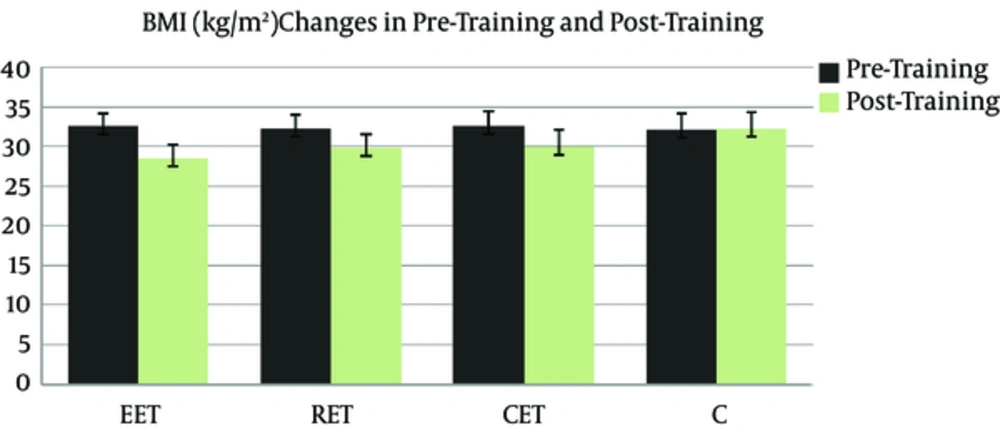
The present study aimed to evaluate the effects of three methods of exercise training on cardiovascular risk factors in male obese children aged 8 - 12 years. Results showed that three types of exercise training significantly increased HDL-C, significantly decreased fasting glucose, BMI, TC, TG, LDL, VLDL, HDL, TC/HDL and LDL/HDL (P < 0.001). In Addition, the EET method compared to the RET and CET training methods, had a more significant effect on improving these parameters and did not have significant effect on the ankle-brachial index (ABI) (P < 0.05).
The results are consistent with the findings of previous studies indicating that orderly exercise is followed by decreased lipid profile (
2,
17-
21). By contrast, the results are inconsistent with the findings of some other studies (
22). E Crimi et al reported the effect of two months of walking exercise on lipid profile and BMI in obese female children. Their findings showed that the BMI and risk factors of lipid profile reduced significantly, but HDL-C significantly increased (
18). They suggested that an orderly exercise like walking may change the metabolism of lipoproteins and decrease the risk factors of CVDs (
18). M Balas-Nakash et al reported that longer endurance exercises cause improvement of health status and decrease risk factors of CVDs. It is probably due to the use of fatty acids as fuel during exercise to produce muscle energy through increasing the level of catecholamines, cortisol, and growth hormones (
19).
The present research indicates that endurance, resistance, and combined exercise trainings may significantly decrease LDL-C. At least two key enzymes exist in the metabolism of lipoproteins in relationship with exercise training (
18). Lipoprotein lipase may have an important role in the rate of LDL-C to HDL-C alteration and its rate enhances endurance exercise training. Moreover, it seems that the enhanced level of HDL-C as a result of endurance exercise training, is because of the reduction of hepatic lipase activity, changes in different enzymes such as raise in lipoprotein lipase and lecithin cholesterol acyl transferase (LCAT) (
23). Conversion of LDL-C to HDL-C is an important role of the hepatic lipase enzyme. The level of this enzyme may decline in persons who do exercise training, and being physically active may increase HDL-C concentration. These enzymatic alterations, which are caused by exercise training, ameliorate the serum lipoproteins (
10,
23). Some studies suggest that orderly exercise usually ameliorates the serum lipoproteins in people with various ages and fitness levels (
10,
24). However, there are various findings about what kind of lipid parameters are affected by intensity, type, and duration of exercise, dietary habits, baseline blood lipid profiles, physical specifications and cardiovascular fitness level of subjects.
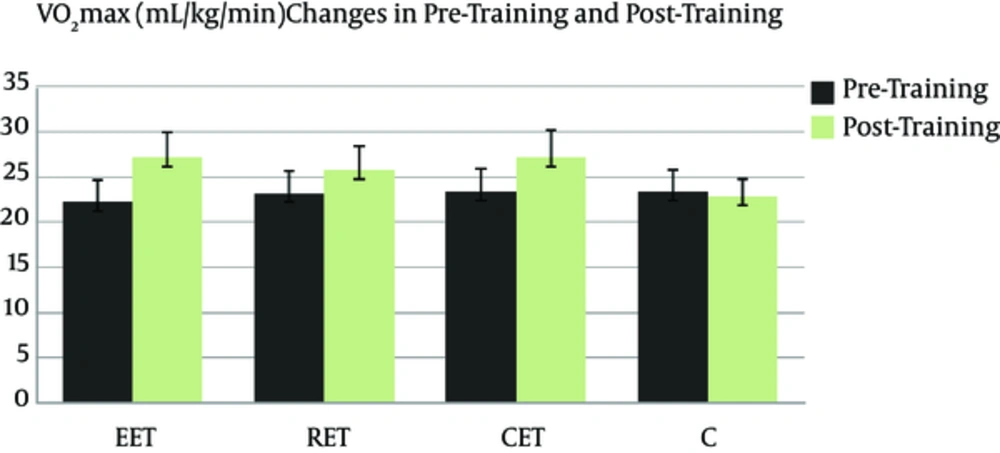
VO
2max levels of training groups significantly enhanced whereas no significant change was seen in the control group. It was shown that exercise training should be under anaerobic threshold in order to ameliorate lipid profiles (
24). Several researchers have also stated that duration and intensity of exercise training, participants’ diet, lipid profile and weight condition of the participants lead to differences in lipid levels (
25-
28). HDL-C and coronary heart disease (CHD) have a powerful but negative correlation. Enhancing HDL-C concentrations after aerobic exercise training can partly illustrate protection from coronary heart disease (CHD) (
28). In the current study, the HDL-C concentration compared to baseline significantly increased in children who did endurance exercise training.
Some studies illustrated that physical activity and exercise training may reduce BMI in children of 6 - 12 years of age (
29). Past researches in overweight children after regular exercise training have presented improvements in serum insulin, while diet accompanied by aerobic exercise improved insulin resistance in overweight children. Exercise training is known to enhance insulin-receptor autophosphorylation, GLUT4 expression, and glucose transport. Therefore, the third main reason of insulin resistance is a sedentary lifestyle. A prompt effect of exercise training is an enhance in glucose transporters in muscle cell membranes, that secondarily improves insulin-mediated glucose disposal (
30). It is expected that exercise training and desirable diets applied together would result in a more effective metabolism effect, as previously shown for glucose control improvement in diabetic patients (
31).
Exercise training and physical activity decreased blood pressure levels in children, consistent with observational researches indicating that blood pressure levels were reversely correlated with the rate of physical activity in childhood (
32-
36). As CC Cesa et al have indicated, there are observational documents related to the existence of cardiovascular risk factors in childhood with a raised risk of atherosclerosis in adult life (
37). Orderly exercise is related to a reduced CVDs risk in universes with and without type 2 diabetic disease (
9,
12). This risk decrease likely happens through various functions in the body including improved lipid profile, glycemic control, and vascular function. Yet, beneficial effects of exercise training are not clear on ABI in PAD patients completely (
10). Conversely, experimental researches have in general suggested that enhanced physical activity is related to higher rates for ABI in healthy persons (
38,
39). The identification of a dose-response correlation between exercise training and the ABI in childhood remains difficult to achieve.
5.1. Conclusion
The findings of the present study show that three ways of regular exercise training performed in 8 weeks includeding resistance training (50% - 75% of 1RM) and endurance training (50% - 75% of target heart rate) had desirable effects on risk factors of BMI, serum glucose, and lipid profile. Therefore, three types of exercise training used in the present research, especially endurance training method could be considered as a suitable and non-medicational method to prevent and decrease the morbidity of CVDs and obesity-related disturbances in obese children. Future studies should focus on the long-term benefits of risk factors for metabolic syndrome after 8-weeks with diet and exercise training interventions in children.