
1. Background
At the end of 2019-early 2020, COVID-19, which is an infectious disease, emerged in Wuhan in central China and spread rapidly by January 24, 2020 (1). The virus spread to 13 countries (2) and became a global health emergency (3). COVID-19 is quickly spreading around the world and causing thousands of mortalities every day (4). The spread of COVID-19 is the third serious outbreak, following SARS in 2002 - 2003 and MERS in 2012 (5). The COVID-19 outbreak has created massive challenges to health systems and global public health securities worldwide (6). In Iran, after COVID-19 spread in late February 2020, the growing trend of the outbreak was such that 987 people were infected, and 54 cases died (7). Worldwide by early April, its prevalence had risen to 50,468 cases and 3,160 deaths (8). The rapid spread of COVID-19 indicates the power of this virus (9). The disease can spread through person-to-person contact via respiratory droplets, sneezing, talking, and fomites (10).
The severity of COVID-19 outbreak has deeply challenged the mental well-being of people and their families (11). Quarantine, restrictions, fear of infection, the anxiety of losing loved ones, and depression of losing family members are all among the issues brought about by this disease (12). Whenever people’s living conditions change, they feel insecure. Stress is a universal reaction to environmental difficulties (13). Various international studies have shown significant correlations of COVID-19 outbreak with mental problems (14, 15), depression (16), suicide (17), and hysteria, even in people who are not at risk of infection (18). A new type of collective fear, known as corona phobia, has been created. This indicates the psychiatric effects of COVID-19 and its post-traumatic impacts on different strata of society (19); in a way that its psychological damage, including anxiety and depression, has been greater among young people compared to others since they think about the outbreak for at least three hours a day (20). Although this virus affects the human respiratory system, several factors such as the pandemic inherent fear, financial stress, and social isolation impose profound psychiatric consequences on humans (21). There have been a lot of efforts and researches over the past few months to generate knowledge on COVID-19 around the world and Iran. Most of the publications were submitted by the United States of America, European countries such as Germany, Hungary, France, Spain, Czech, and China (22). The rate of infected COVID-19 cases in all parts of Iran has increased dramatically, but some regions have more infected cases and some regions have fewer rates, so the Ministry of Health and Medical Education and Crisis Staff separate regions into four parts from high-risk to medium-risk, which are red, orange, yellow, and blue. Red and orange parts are known as high-risk and maximum rate of infected cases, yellow parts are known as medium-risk, and blue parts with lesser risk and fewer cases. According to the official divisions of the country, and as the red, orange, yellow, and blue parts expanded in all parts, it was assumed that comparison in five parts of north east-west, central part, and south east-west of Iran gives precise information related to the mental health and post-traumatic stress disorder consequences of COVID-19 outbreak. The spread of COVID-19 can impact the mental health of people in diverse communities. Thus, it is essential to do research about the consequences of the pandemic and preserve the mental health of individuals to develop psychological interventions for improving the mental health of vulnerable groups.
2. Objectives
This study compared mental health and post-traumatic impacts of COVID-19 outbreak in the peak period of the pandemic in five regions of Iran.
3. Methods
3.1. Study Design
In the present study, a web-based cross-sectional survey was carried out as the Iranian government has asked people to avoid face-to-face interactions and stay at home since early March. After being approved by the Research Committee of Islamic Azad University-Zahedan Branch with the following research code, 14.11.5.9381, this study was done in five regions of Iran from March 24 to 29th of 2020, when the number of COVID-19 cases peaked. A free Google Forms® software was used and, a snowball sampling method focused on the general public in the north east-west, central part, and south east-west of Iran was utilized to assess the impact of COVID-19 pandemic on mental health. Initially, the online questioner was posted on university websites and students’ social media. Then, the respondents were encouraged to pass it onto other people living in other cities. We received responses from 908 respondents, and 159 respondents did not complete the questionnaires. Eventually, we included 749 respondents from five regions in Iran who had completed the questionnaires. All the respondents provided their informed consent, and the current study followed the principles embodied in the Declaration of Helsinki. The data were collected anonymously and remained confidential. Respond to all questions precisely, and ages of 10 to 75 years were considered the inclusion criteria. Neurological disease and underlying disease were the exclusion criteria. As the present research was done at the first pick of COVID-19 pandemic in March, the questionnaire has been administered by healthy people.
3.2. Statistical Analyses
The statistical analyses were performed with SPSS ver. 21.0. For comparing the IES-R and DASS-21 means of the north east-west, central part, and south east-west of Iran, the multivariate analysis of variance (MANOVA) was used.
3.3. Research Tools
The Depression, Anxiety, and Stress Scale (DASS-21) assessed the respondents’ mental health statuses (23). Each of the three DASS-21 scales contains seven items. The following items, 3, 5, 10, 13, 16, 17, and 21, evaluate depression. The total depression score indicates a normal condition (0 - 9), mild depression (10 - 12), moderate depression (13 - 20), severe depression (21 - 27), and extremely severe depression (28 and more). These items, 2, 4, 7, 9, 15, 19, and 20, measure anxiety. The total anxiety score shows a normal condition (0 - 6), mild anxiety (7 - 9), moderate anxiety (10 - 14), severe anxiety (15 - 19), and extremely severe anxiety (20 and more). The following items, 1, 6, 8, 11, 12, 14, and 18, assess stress. The total stress score demonstrates a normal condition (0 - 10), mild stress (11 - 18), moderate stress (19 - 26), severe stress (27 - 34), and extremely severe stress (35 and more). The scores on the DASS-21 are multiplied by two to calculate the final score. The lowest score for each item is zero (does not apply to me), and the maximum score is three (completely applies to me). In Iran, the DASS scale is regarded as a valid and reliable measure for assessing mental health (24). The internal consistency estimated at 0.79, 0.77, and 0.78 for anxiety, depression, and stress, respectively (25).
The Impact of Event Scale-Revised (IES-R) evaluated the psychological impact of COVID-19. Weiss and Marmar designed the IES-R in 1997 (26). This scale consists of 22 items and three dimensions. Its dimensions are intrusion (eight items), avoidance (eight items), and hyper-arousal (six items). In the IES-R scale, the total score ranges from 0 - 23 (normal), 24 - 32 (a low psychological impact), 33 - 36 (a medium psychological impact), to > 37 (a severe psychological impact). In Iran, the Cronbach’s alpha coefficient of the total scale was 0.83 (27). The DASS-21 and IES-R were previously used in studies related to COVID-19 outbreak (28, 29).
4. Results
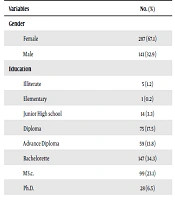
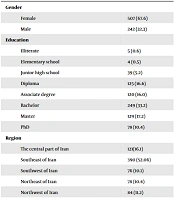
In the descriptive level, means, standard deviations, and percentages were used, and in the inferential level, MANOVA was applied to answer the main research question. A total of 908 citizens from the north east-west, central part, and south east-west of Iran participated in this study, and 159 respondents did not fill out the questionnaires thoroughly. This study included 749 respondents who had completed the questionnaires. Among these people, 507 subjects were female, and 242 subjects were male (Table 1). The results of the MANOVA indicated that there were no significant differences between the means of mental disorders and the impact of the COVID-19 outbreak in these five regions (Table 2). Nevertheless, one-sample test showed that the IES-R mean scores of the central part, south east-west, and north east-west of Iran were higher than 26, indicating the presence of PTSD symptoms in all of these regions (Table 3).
Table 1.
A Description of the Iranian Respondents’ Demographic Characteristics (N = 749)
| Variables | No. (%) |
|---|---|
| Gender | |
| Female | 507 (67.6) |
| Male | 242 (32.3) |
| Education | |
| Illiterate | 5 (0.6) |
| Elementary school | 4 (0.5) |
| Junior high school | 39 (5.2) |
| Diploma | 125 (16.6) |
| Associate degree | 120 (16.0) |
| Bachelor | 249 (33.2) |
| Master | 129 (17.2) |
| PhD | 78 (10.4) |
| Region | |
| The central part of Iran | 121 (16.1) |
| Southeast of Iran | 390 (52.06) |
| Southwest of Iran | 76 (10.1) |
| Northeast of Iran | 78 (10.4) |
| Northwest of Iran | 84 (11.2) |
| Marital status | |
| Single | 351 (46.8) |
| Married | 398 (53.13) |
| Age, y | |
| 10 - 19 | 113 (15.0) |
| 20 - 29 | 262 (34.9) |
| 30 - 39 | 191 (25.50) |
| 40 - 49 | 126 (16.82) |
| 50 - 59 | 48 (6.4) |
| 60 and older | 9 (1.2) |
| Staying at home, h | |
| 0 - 5 | 14 (1.8) |
| 6 - 10 | 29 (3.8) |
| 11 - 15 | 33 (4.4) |
| 16 - 19 | 28 (3.7) |
| 20 - 24 | 635 (84.7) |
| Variables | Central Iran | Southeast of Iran | Southwest of Iran | Northeast of Iran | Northwest of Iran | Kolmogorov– Smirnov Test | Significance | Regions | Tukey HSD |
|---|---|---|---|---|---|---|---|---|---|
| Anxiety | 9.08 ± 9.9 | 7.36 ± 8.2 | 7.78 ± 9.7 | 5.65 ± 5.5 | 6.24 ± 8.3 | 0.55 | 0.07 | North East; North West; South East; South West; Centre | 0.65 |
| Stress | 9.35 ± 11.3 | 8.26 ± 9.8 | 8.21 ± 10.2 | 6.39 ± 8.1 | 6.27 ± 9.7 | 0.89 | 0.19 | North West North East; South West; South East; Centre | 0.26 |
| Depression | 9.64 ± 11.9 | 7.86 ± 9.9 | 7.89 ± 10.8 | 7.0 ± 9.3 | 6.57 ± 10.3 | 0.66 | 0.31 | North West; North East; South East; South West; Centre | 0.30 |
| Impact of event | 31.65 ± 15.8 | 30.64 ± 15.2 | 31.05 ± 15.2 | 29.21 ± 12.33 | 26.39 ± 15.56 | 0.96 | 0.2 | North West; North East; South East; South West; Centre | 0.16 |
aThe multivariate analysis of variance.
b Values are expressed as mean ± SD unless otherwise indicated.
Table 3.
The Results of the One-Sample Test
| Variable | Mean | Test Value a | Significance | 95% Confidence Interval of the Difference | |
|---|---|---|---|---|---|
| Lower | Upper | ||||
| Impact of event | 30.26 | 26 | 0.00 | 3.22 | 5.31 |
a Cut-off point.
5. Discussion
The objective of this study was to compare mental health and post-traumatic impacts of COVID-19 outbreak in the peak period of the pandemic in the North, East, West, and Central parts of Iran. The key findings were that there were no significant differences between the means of mental disorders and the impact of COVID-19 outbreak in five regions of Iran. On the other hand, the one-sample test showed the presence of PTSD symptoms in all of these regions. A recent systematic global review showed that high rates of symptoms of depression, post-traumatic stress disorder, anxiety, and stress were reported in the general population during the Coronavirus (30). Similar research conducted in Italy showed a high percentage of PTSD symptoms in the community that resulted in sleep problems (31). Moreover, examining the anxiety and PTSD symptoms among recovered patients and their families indicated several negative effects on their lives, like a decreased quality of life and work performance, which may continue for a long time (32, 33). In Iran, a result of an online survey showed that anxiety was the common negative emotion reported by participants (34). The previous research study in China demonstrated that women, compared to men, experience higher levels of PTSD, which has a significant impact on their sleep quality (35). In contrast, the result of the present research shows high levels of PTSD in both genders. Indeed, the spread of COVID-19, on the one hand, and the attempt to combat this disease through quarantine and severe social restrictions in the long run, on the other hand, have caused panic, psychological effects, obsessive behaviors, anxiety, depression, and PTSD (19). COVID-19 is a catastrophic disease that has changed all human beings’ attitudes towards medical science worldwide. Other epidemics, such as mental and behavioral diseases, will undoubtedly emerge soon (36). One of the stressful aspects of COVID-19 is that humans do not know much about it (37). Controlling its spread is one of the main points that specialists are seriously taking into account (4). In addition to disease management, mental health interventions should be formally included in public health and emergency response programs (1). In the current critical situation, spirituality can reduce the distress of people, patients, and their families because numerous studies have shown the relationship between spirituality and physical and mental health (38-41). Additionally, training proper coping and control strategies, providing basic goods, especially medicine, and providing financial support by the government can be, to a large extent, psychologically effective and beneficial to society. Health information is protective to mental health for the general population, and the researcher will be able to do research on COVID-19-infected cases and compare the result with this research to find the precise mental impact of Coronavirus.
The present study has several strengths and limitations. The first strength was that an online survey was used, and people easily participate in the study. The first limitation was that, for some respondents who did not desire to participate in the online survey, no response was recorded, and we could not collect any information from them. The second limitation was the study population was female predominant, so there is a potential risk of sampling bias because we could not reach out to potential respondents without Internet access.
5.1. Conclusion
The COVID-19 outbreak has affected all important aspects of life and societies and led to post-traumatic stress disorder. This disease not only directly threatens human health but also has profound economic, psychological, and sociological consequences. The result of the present study shows the presence of PTSD symptoms in all regions, so mental health care is a necessity and should be provided to the general public. Also psychologists and mental health teams have to provide psychological services in-person or online method.