1. Background
Despite being regarded as the least desirable and final response to marital problems, divorce rates have shown a dramatically increasing trend in recent years in Iran, a country rooted in Islamic and traditional culture. A study analyzing divorce trends in Iran from 2004 to 2013 revealed that the overall mean divorce rate has risen in five of the most populous cities: Tehran, Isfahan, Tabriz, Mashhad, and Shiraz. Tehran consistently reported the highest percentage of divorces among these cities, with the peak frequency recorded in 2012 at 34.96 divorces per 100 marriages (1). This rising trend has intensified the focus on research to identify causes and risk factors associated with divorce.
A study examining the economic determinants of divorce in Iran found that unemployment and inflation significantly impact divorce rates, with coefficients of 0.70 and 0.14, respectively. Furthermore, there is a direct correlation between women’s participation in the labor market and divorce rates, with a coefficient of 0.74 (2). Additional factors contributing to divorce in Iran include weak literacy and marital skills, shifting marriage patterns, increased individualism and self-interest, unemployment, addiction, and the influence of online advertising (3). Economic instability, changing social and cultural dynamics, and unfavorable macroeconomic conditions have further contributed to the marked increase in divorces over the past few decades (2).
Specific data on divorce rates among military personnel in Iran remain limited; however, research highlights that military personnel face unique challenges that may exacerbate marital strain. A systematic review of suicide prevention interventions among military personnel underscored the importance of addressing mental health issues in this population, which may indirectly influence marital stability (4). Moreover, the inherent nature of military occupations may elevate the risk of divorce due to factors such as prolonged separations, high-stress environments, and exposure to trauma (5, 6). However, further studies are needed to comprehensively understand the distinct risk factors affecting divorce among military personnel in Iran. In conclusion, the complex nature of divorce in Iran calls for a multifaceted approach to address the myriad contributing factors. Tackling this issue necessitates coordinated efforts between scattered and isolated services through comprehensive social interventions aimed at mitigating the socioeconomic and cultural challenges that fuel divorce rates.
2. Objectives
This study aims to evaluate the factors influencing divorce among military personnel of the Islamic Republic of Iran Army from the perspective of psychologists and psychiatrists serving in the army, utilizing the Delphi method. The findings of this study can help identify the risk factors associated with divorce in this population and inform the development of preventive strategies and targeted interventions. By understanding the unique challenges faced by military personnel and their families, this survey provides valuable insights into the underlying causes of divorce within this group. The results can contribute to the planning and implementation of effective interventions to support military families and promote marital stability.
3. Methods
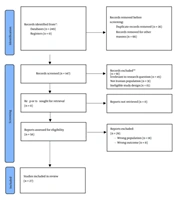
The qualitative study was conducted using the Delphi method among psychologists and psychiatrists serving in the Army of the Islamic Republic of Iran during 2023 - 2024. Inclusion criteria required participants to be psychologists or psychiatrists currently serving in the Iranian Army with a minimum of 5 years of experience. Exclusion criteria included civilian psychologists, retired personnel, and individuals with less than 5 years of experience.
The Delphi method was chosen because it is a practical and effective approach for achieving consensus among diverse participants. This method involves purposively selecting participants based on their expertise and specialization in a specific field. Responses are gathered from experts individually through interviews or surveys. Researchers then categorize and analyze the initial responses, subsequently returning them to the experts for scoring and prioritization. Delphi studies may involve two or more rounds. The sample size for this qualitative study was determined based on the principle of data saturation, which is achieved when no new information or themes emerge from the data. According to Guest et al. (7), data saturation generally occurs within the first 12 interviews, though it may vary depending on the study context and research questions. For this study, a minimum sample size of 30 participants was considered sufficient to ensure comprehensive representation from each branch of the army. Ultimately, the inclusion of 37 participants was deemed adequate to achieve data saturation.
In the first step of this study, a questionnaire was prepared, asking psychologists and psychiatrists to freely list any factors they believed influenced divorce among personnel of the Army of the Islamic Republic of Iran. The questionnaires were distributed via email to respondents, and their responses were collected and organized into a new questionnaire. This updated questionnaire was redistributed to the participants, who were asked to add any additional factors they considered relevant. The responses were collected again, analyzed, and the extracted factors were arranged in a table within the final questionnaire. In the third round, psychologists and psychiatrists were asked to rank the listed factors by importance and priority. The most important factor was scored 10, with descending scores assigned to subsequent factors down to 1 for the least important.
The qualitative phase focused on collecting and organizing responses while eliminating duplicates. In the final step, using SPSS version 25, the mean scores assigned to the factors across all questionnaires were calculated, and the factors were ranked in order of importance based on these scores. This study was approved by the ethics committee of the Army University of Medical Sciences.
4. Results
A total of 37 psychologists and psychiatrists serving across the four branches of the Army of the Islamic Republic of Iran participated in the study. The average age of the participants was 42.29 ± 5.65 years. Of the participants, 8 (21.6%) were female, and 29 (78.4%) were male. The educational qualifications of the participants were as follows: One participant (2.7%) held a bachelor's degree in psychology, 11 participants (29.7%) had a master's degree in psychology, 13 participants (35.1%) were psychiatrists, and 12 participants (32.4%) had doctorates in psychology.
The distribution of service branches among the participants was as follows: Twenty-one (56.8%) served in the ground forces, 8 (21.6%) in the air force, 4 (10.8%) in the navy, and 4 (10.8%) in the air defense forces.
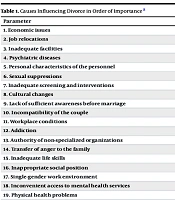
During the qualitative interviews, 19 factors were identified as influencing divorce among military personnel. These factors included: Economic challenges, job relocations, cultural changes, inadequate facilities, lack of awareness and education before marriage, workplace conditions, personal characteristics of personnel, single-gender work environments, transference of anger to the family, sexual suppression, addiction, incompatibility between spouses, inadequate access to mental health services, inappropriate social status, bureaucratic issues, physical health concerns, the influence of non-specialized organizations, and physical health problems. After compiling these factors from the interviews, the psychologists and psychiatrists were asked to rank the importance of each factor using a scoring system. The scores were aggregated, and the factors were ranked in order of importance as presented in Table 1.
Table 1.
Causes Influencing Divorce in Order of Importance a
| Parameter | Score |
|---|---|
| 1. Economic issues | 9.40 ± 0.89 |
| 2. Job relocations | 9.00 ± 0.85 |
| 3. Inadequate facilities | 8.32 ± 0.91 |
| 4. Psychiatric diseases | 8.00 ± 1.22 |
| 5. Personal characteristics of the personnel | 7.59 ± 1.40 |
| 6. Sexual suppressions | 7.48 ± 1.01 |
| 7. Inadequate screening and interventions | 7.21 ± 1.15 |
| 8. Cultural changes | 6.75 ± 1.46 |
| 9. Lack of sufficient awareness before marriage | 6.59 ± 1.53 |
| 10. Incompatibility of the couple | 6.48 ± 1.46 |
| 11. Workplace conditions | 6.10 ± 1.21 |
| 12. Addiction | 6.02 ± 1.48 |
| 13. Authority of non-specialized organizations | 5.94 ± 0.99 |
| 14. Transfer of anger to the family | 5.78 ± 1.37 |
| 15. Inadequate life skills | 5.75 ± 1.55 |
| 16. Inappropriate social position | 5.10 ± 1.42 |
| 17. Single-gender work environment | 4.05 ± 1.41 |
| 18. Inconvenient access to mental health services | 3.81 ± 1.30 |
| 19. Physical health problems | 1.89 ± 0.96 |
a Values are expressed as mean ± SD.
5. Discussion
The divorce rate among military personnel has recently seen a substantial rise. However, no research has been conducted to examine this phenomenon among military personnel in Iran or the factors contributing to it. This study is the first to address this topic. Military personnel and their families face unique challenges that can strain relationships and increase the risk of divorce. To better understand this issue, we can refer to statistics from the United States Army, where the divorce rate among female soldiers was 4.54% and among male soldiers was 2.9%. These rates are higher than those in all other professions and occupations in the United States and more than twice the national average divorce rate in the country (8).
The most commonly mentioned factor for divorce in the current study was economic issues. Supporting this finding, a report from the US Army indicated that higher salaries and benefits for married individuals led to military personnel marrying at a younger age, highlighting the importance of economic factors in the continuation or dissolution of marriages (9).
Economic challenges cited in the study include insufficient salaries that fail to meet the daily needs and welfare requirements of families, compelling personnel to seek second jobs (e.g., taxi driving or sales) despite such activities being prohibited. This additional employment reduces family time and increases stress. The economic strain often leads to frustration and potential hostile behaviors, stemming from financial inadequacy and perceived inequalities compared to other organizations. The consequences of economic pressure create a cascading effect. For instance, the necessity of taking on a second job diminishes the quality of family time, directly impacting spousal relationships. Moreover, the perceived mismatch between the demands of military service and income generates disappointment and frustration among military personnel, further straining marital bonds. The second influential factor in divorce identified in our study was job relocations. Consistent with our findings, a study by Karney et al. in the US Army reported that deployment and relocation, as well as the constant readiness for combat, act as persistent stressors in marital relationships. Issues stemming from prolonged deployments include infidelity, difficulties in re-establishing communication, and sexual relationship problems (10). Another study by Rossiter and Chandler identified deployment and relocation as the primary factors influencing divorce among female military personnel (11). Relocations contribute to increased stress and weakened social support networks, difficulties for spouses in accepting or accompanying relocations, disruption of family stability and challenges in adapting to new environments, complexities in children’s education and social adjustment, and potential cultural clashes when moving between different regions. Insufficient welfare facilities ranked as the third most significant factor in our study. A report on U.S. Army personnel highlighted that soldiers tend to marry at a younger age compared to non-military individuals, largely due to the rewards, benefits, and facilities provided for military personnel (9, 10, 12). Conversely, it has been observed that when soldiers leave service, the loss of benefits—such as access to housing—becomes a significant source of stress and pressure for these individuals (13).
Mental health disorders were the fourth most influential factor identified in our study. In the United States, one in five military personnel is diagnosed with PTSD, although this figure is likely an underestimation due to stigma (14). PTSD and other anxiety disorders are strongly associated with poor mental health, leading to decreased marital satisfaction for both the military individual and their spouse, thereby increasing the likelihood of divorce (15, 16). The effects of these disorders on marital relationships are profound and include emotional numbness, lack of empathy, and communication difficulties. These challenges underscore the critical role of mental health support and targeted interventions in mitigating the risk of divorce among military personnel and their families. The fifth factor influencing divorce in our study was the personal characteristics of the personnel. Two theories address this issue: One suggests that stress and military duties lead to divorce (stress theory), while the other posits that individuals entering military service are inherently at a higher risk of divorce due to their personal characteristics or backgrounds (selection theory) (12). However, a study found no evidence supporting the stress theory, highlighting that longer military service does not necessarily result in a higher divorce rate among military personnel, thereby challenging the stress theory (9).
Sexual suppressions were identified as the sixth factor contributing to divorce in military environments. Job conditions and prolonged deployments create challenges in reintegrating with spouses and lead to difficulties in sexual relationships (13), which can erode marital stability.
Inadequate access to mental health services ranked as the seventh factor contributing to divorce in our study. Beyond economic and logistical barriers, stigma surrounding mental health services from cultural and social perspectives remains a significant issue in society. This stigma appears to be even more pronounced within military forces. According to the U.S. Army's experience, a substantial number of soldiers refrain from seeking mental health assistance due to stigma and fears of jeopardizing career advancement. This avoidance exacerbates underlying issues and leads to long-term challenges (14).
Cultural changes, specifically extramarital relationships or infidelity, were ranked as the eighth factor. Other researchers have also identified infidelity as a significant issue during the extended separations and absences that military personnel experience (13). However, it has been suggested that infidelity often arises as a consequence of pre-existing problems in relationships that were already troubled (17). Therefore, the nature of the military job and long-term absences should not be regarded as the primary causes of infidelity. Instead, cultural shifts may have contributed to an increase in extramarital relationships, particularly in relationships that were already strained.
Another factor identified in our study was insufficient life skills, which, according to consulting experts, has led to both major and minor traumas occurring daily. These traumas contribute to emotional numbness and a lack of empathy, ultimately deteriorating marital relationships. Similarly, another study suggested that military personnel with weak emotional adaptation skills are more likely to develop PTSD. These individuals, upon returning from deployment, often experience emotional numbness, leading to significant issues in their relationships with their spouses (18). The lack of awareness and sufficient education before marriage was also recognized as a contributing factor in our study. A study examining the relationship between divorce and deployment suggested that the success of a marriage depends largely on the difficulties that military personnel and their spouses can endure during deployment. Internally strong marriages are more likely to withstand these challenges (19). The awareness and reactions of the spouse play a pivotal role in either maintaining or destroying a relationship. This issue is so critical that one study emphasized the necessity of involving the spouses of military personnel with PTSD in the treatment process. It recommended that spouses should be officially included in therapeutic interventions to improve relationship outcomes (18).
The work environment was another reported factor affecting marital relationships. The unpredictability of military duties, long missions requiring time away from family, and the associated stresses are significant contributors. Various studies have presented conflicting findings regarding the impact of missions on divorce. Some studies have suggested that prolonged absences from home, frequent relocations, and inflexible schedules increase the likelihood of military divorces (20, 21). Conversely, another study indicated that a higher number of days spent on missions is associated with a lower likelihood of divorce (9). Other studies have taken a more nuanced approach, emphasizing the cumulative time spent on missions and its correlation with the risk of divorce, regardless of exposure to dangerous military situations (10). One study highlighted that while deployment and missions may be associated with separation and divorce, these outcomes primarily depend on the challenges that military personnel and their spouses must navigate during deployment periods (19).
Given that this study is the first of its kind in Iran, and comparable studies outside the country are limited and not directly applicable to Iranian society and its armed forces, our findings provide a unique opportunity to identify the most influential factors contributing to divorce within the armed forces of the Islamic Republic of Iran. Based on these findings, targeted interventions can be designed to reduce and manage the risk of divorce in this population. Specifically, addressing economic issues, reducing constant relocations, and improving welfare facilities should be prioritized in intervention programs aimed at mitigating divorce rates among Iranian armed forces personnel.