
1. Context
Marriage is a foundational social structure in which individuals often seek to fulfill emotional needs and attain security. A healthy family environment is crucial for marital success, with love serving as the primary catalyst for the union. However, when partners enter marriage expecting to resolve unresolved childhood needs or traumas, unmet expectations can lead to frustration and diminished affection and commitment (1). Over time, this cycle of disappointment and prolonged conflict can result in marital burnout (MB), characterized by increased aggression, loss of intimacy, and overall relationship dissatisfaction (2).
Burnout is a multidimensional syndrome characterized by physical, emotional, and psychological exhaustion, accompanied by cynicism and a diminished sense of personal efficacy. Although the term originated in occupational psychology to describe job-related depletion, its application has broadened to diverse roles and relationships, including domestic contexts such as marriage (2). At its core, burnout arises from a chronic mismatch between an individual's expectations and lived reality, exacerbated by prolonged and unmanaged stress. This state is more than acute fatigue; it involves the depletion of adaptive energy that manifests as chronic tiredness, apathy, and emotional detachment (3). Within marital relationships, specific risk factors precipitate this syndrome. Unrealistic expectations, irrational thought patterns, and external life stressors can interact with a couple's existing compatibility and belief systems to create conditions for MB (2). Ultimately, burnout develops when an individual's coping resources are persistently overwhelmed, shifting stress from a manageable state to a chronic and debilitating condition (4). Mental burnout is characterized by feelings of hopelessness, sadness, emptiness, lack of meaning, and depression. Emotional burnout manifests as lowered self-esteem, negative emotions, and frustration with one's partner (2).
The prevalence of MB varies considerably across studies, reflecting differences in sampling and population characteristics. In a study of married women referring to health centers in Gonabad, Iran, 70.6% experienced moderate to high levels of MB, and 36.5% specifically reported high burnout (2). Globally, studies report varying prevalence rates, influenced by cultural norms, measurement tools, and sample characteristics. For example, research in the United States suggests that chronic relational stress affects a substantial proportion of couples, with studies of emotional exhaustion within marriage reporting clinically significant levels in approximately 20% - 30% of participants (5). In European contexts, studies using the Couple Burnout Measure have found moderate to high burnout scores among 25% - 40% of couples in community samples (6).
Marital burnout is a key contributor to conflict and a lack of intimacy between couples. In its most severe form, it can result in relationship collapse and eventual divorce. Additionally, MB is closely linked to communication patterns, conflict resolution, and problem-solving abilities within the couple. Couples who are more skilled in these areas tend to experience lower levels of burnout (2). According to previous findings, lower levels of MB and improved quality of life contribute to reduced mortality rates in married individuals (7). A strong relationship exists between marital dissatisfaction and depression, with higher marital dissatisfaction increasing the risk of depression among couples (2). As depressive symptoms escalate within couples, they exacerbate other sources of stress, leading to a decline in marital harmony (8, 9). Additionally, burnout can contribute to physical problems such as musculoskeletal strain and cardiovascular conditions in individuals affected by burnout (2). Because MB decreases love and increases negative behaviors, it can lead to marital dissatisfaction and undermine family stability.
Although numerous primary studies have investigated MB, several systematic reviews have synthesized evidence on related constructs, such as marital satisfaction and relationship quality. Previous systematic reviews have examined factors affecting marital satisfaction from the perspectives of Iranian women and men (10, 11). In general, the factors affecting MB in each country are shaped by cultural and social conditions (12). However, the literature review identified no systematic review assessing MB among Iranian couples. Therefore, this study sought to expand knowledge of factors affecting MB in Iran, considering the country's indigenous, cultural, and religious contexts.
2. Evidence Acquisition
2.1. Study Design
This systematic review was conducted and reported in accordance with the Preferred Reporting Items for Systematic Reviews and Meta-Analyses (PRISMA) guidelines. The study protocol was registered in PROSPERO (ID: CRD420261374337).
2.2. Search Strategy
A comprehensive systematic literature search was conducted from September 1, 2025, to December 1, 2025. The search was performed independently by 2 authors (P. Z. and Sh. S.) using Google Scholar and the following electronic databases: PubMed, Web of Science, Scopus, and Persian databases, including the Scientific Information Database (SID), Magiran, and Irandoc. To ensure the retrieval of all relevant literature, no restrictions were placed on publication year; however, only studies with an available English or Persian translation were included.
The PECO (Participant, Exposure, Comparison, and Outcome) framework informed the eligibility criteria. Participants were married Iranian couples; exposures encompassed demographic, psychological, interpersonal, and social factors; comparisons were between groups with varying levels of these exposures or factors; and the outcome was MB.
The search strategy used a combination of MeSH terms and free-text keywords related to the core concepts of MB and Iran. The key terms included: ("burnout, psychological"[MeSH] OR "burnout" OR "marital burnout" OR "couple burnout" OR "boredom" OR "exhaustion") AND ("marriage"[MeSH] OR "spouses"[MeSH] OR "couples" OR "married persons") AND ("Iran"[MeSH]). The search syntax was adapted for each database (Table 1). The reference lists of all included studies and relevant review articles were manually reviewed to identify additional eligible publications.
Table 1.
Detailed Electronic Search Strategy in Databases on Marital Burnout in Iranian Couples
| Database | Search Syntax | Results (n) |
|---|---|---|
| PubMed | ("burnout, psychological"[MeSH] OR "burnout"[tiab] OR "marital burnout"[tiab] OR "couple burnout"[tiab] OR "boredom"[tiab] OR "exhaustion"[tiab]) AND ("marriage"[MeSH] OR "spouses"[MeSH] OR "marital"[tiab] OR "couple*"[tiab] OR "spouse*"[tiab]) AND ("Iran"[MeSH] OR "Iran"[tiab] OR "Iranian"[tiab]) | 55 |
| Scopus | TITLE-ABS-KEY (("marital burnout" OR "couple burnout" OR burnout OR boredom OR exhaustion) AND (marriage OR marital OR couple* OR spouse*) AND (Iran OR Iranian)) | 38 |
| Web of Science | TS = (("marital burnout" OR "couple burnout" OR burnout OR boredom OR exhaustion) AND (marriage OR marital OR couple* OR spouse*) AND (Iran OR Iranian)) | 41 |
| SID | ("marital burnout" OR "couple fatigue" OR "couple burnout") AND ("Iran") | 14 |
| Magiran | [marital burnout] OR [couple fatigue] OR [couple burnout] AND [Iran] | 23 |
| Irandoc | ("marital burnout" OR "couple burnout") AND ("Iran" OR "Iranian") | 12 |
| Google Scholar | ("Marital burnout" OR "couple burnout") AND (Iran OR Iranian) AND (marriage OR couple OR spouse) | 66 |
2.3. Selection Criteria
The search included Iranian articles published in Persian and English. Cross-sectional, experimental, and qualitative studies on factors affecting MB were reviewed. The exclusion criteria were non-peer-reviewed or unpublished reports; gray literature, such as theses and conference papers; duplicate studies; letters to the editor; expert opinions; and critical appraisals. Studies that did not focus on relevant factors were excluded.
2.4. Data Extraction
Two authors (P. Z. and Sh. S.) independently reviewed the collected articles and extracted data. Relevant titles were selected during the initial screening process. The abstracts of the selected studies were then screened to obtain additional information and assess compliance with the inclusion criteria. The selected titles and abstracts were further screened to remove duplicates. Full-text versions of the selected studies were then obtained for further consideration for inclusion. Subsequently, the authors extracted relevant data on study characteristics. Any discrepancies were resolved through discussion between the 2 authors during the search and screening process. The reference lists of related articles were searched to identify additional reports. Finally, 32 articles were identified, and, according to the stated criteria, 27 articles were included in the study.
2.5. Quality Assessment of the Included Studies
All included studies were assessed for risk of bias using the JBI Critical Appraisal Tools (13). This tool consists of 8 items for descriptive and analytical studies, 9 items for quasi-experimental studies, and 10 items for qualitative studies. Each question is scored as yes = 1, no = 0, and unclear or not applicable = 0. Studies with a JBI score higher than 70% were classified as high quality, those with a score between 50% and 70% as moderate quality, and those with a score lower than 50% as low quality (13).
3. Results
3.1. Search Results
The systematic search across 7 major databases yielded 249 records. The database contributions were as follows: PubMed (n = 55), Scopus (n = 38), Web of Science (n = 41), SID (n = 14), Magiran (n = 23), Irandoc (n = 12), and Google Scholar (n = 66). Before screening, 102 records were removed, including 36 duplicate studies and 66 records excluded for other reasons, such as articles in languages other than Persian or English, inaccessible full texts, or publications that were not primary research articles. The remaining 147 unique records underwent title and abstract screening. At this stage, 91 records were excluded because they were irrelevant to the core research question regarding MB (n = 45), the study population was not Iranian (n = 31), or the study design was ineligible for this review (n = 15). During full-text screening of 56 reports, 29 reports were excluded. The specific reasons for exclusion were an inappropriate population (n = 18), such as studies focusing on general burnout, unmarried individuals, or non-Iranian couples, and an inappropriate outcome (n = 11), such as studies that did not measure MB as a primary or secondary outcome. Following this multistage process, 27 studies met all eligibility criteria and were included in this systematic review (Figure 1).
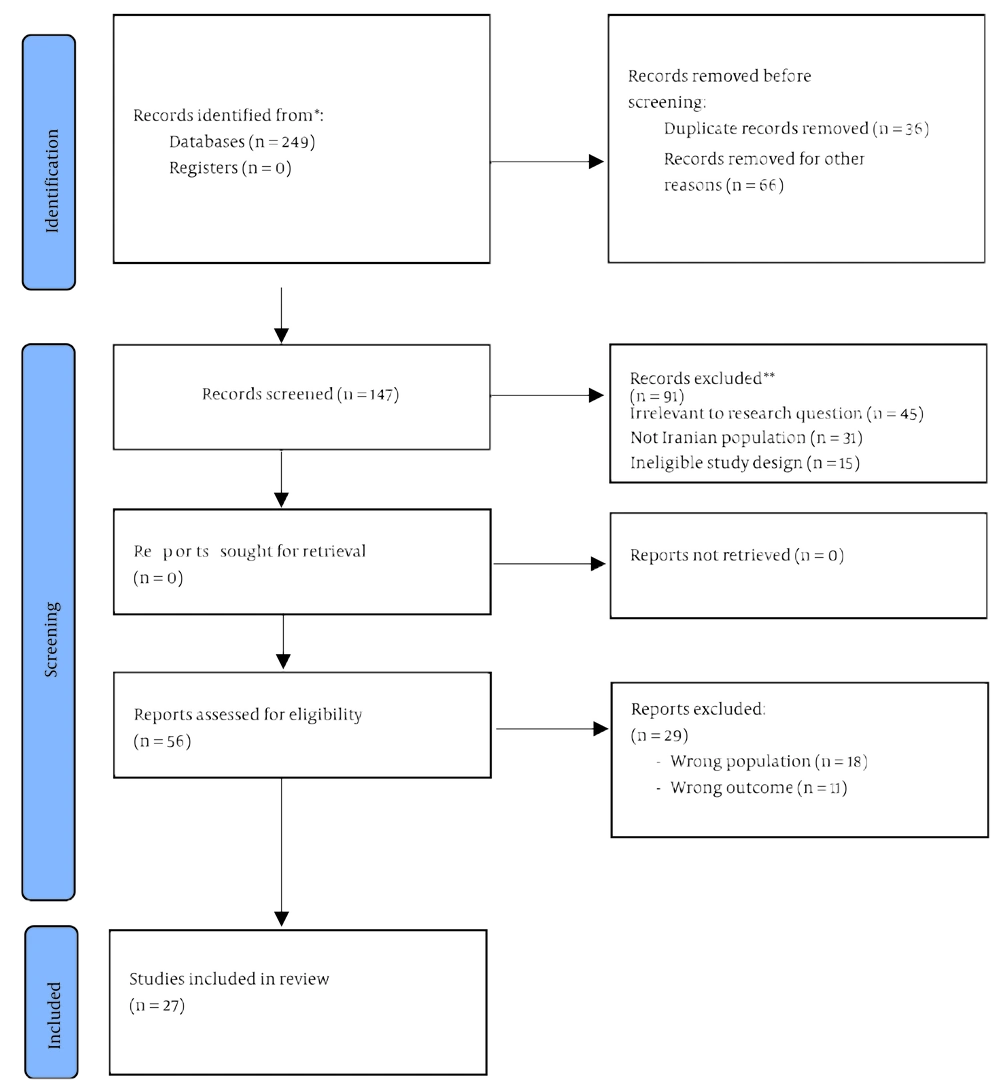
Figure 1.
PRISMA flowchart
3.2. Characteristics of the Included Studies
The 27 studies included in this review were published between 2011 and 2023 and were conducted across various regions of Iran. The study designs were predominantly cross-sectional (n = 24), with 2 qualitative studies and 1 quasi-experimental study. Sample sizes ranged from 8 to 936 participants. Study populations were diverse. The largest group of studies focused exclusively on women (n = 15), whereas others examined mixed-gender samples of men and women (n = 3), couples (n = 5), or specific subgroups such as infertile couples (n = 3), individuals seeking divorce (n = 3), healthcare professionals such as nurses and gynecologists (n = 3), and teachers (n = 2). One study each focused on pregnant women and female students.
The primary instrument for assessing MB was the Pines Couple Burnout Measure (CBM), which was used in 25 of the 27 studies. The qualitative studies used interview methods. The studies investigated a wide range of predictor variables, including psychological constructs (eg, differentiation, personality traits, and mindfulness), relational factors (eg, communication patterns, sexual intimacy, and conflict resolution styles), and demographic or contextual factors (eg, duration of marriage, infertility, and spouse's addiction). A detailed summary of each study's characteristics is provided in Table 2.
Table 2.
Characteristics and Quality Assessment of the Included Studies on Marital Burnout in Iranian Couples
| First Author, Publication Year | Location | Study Design | Sample Size | Data Collection Tools | Main Results | JBI Score (%) | Quality Level |
|---|---|---|---|---|---|---|---|
| Maghsudi, 2011 (8) | Tehran | Cross-sectional | 200 gynecologists | Demographic form; Maslach and Jackson's job burnout questionnaire; Pines Couple Burnout Measure (CBM) | Variables such as age, length of marriage, length of work experience, working hours, number of children, and income had no significant effect on marital boredom (P > 0.05). There was a significant positive relationship between job burnout, emotional breakdown, conflict, depersonalization, and marital boredom (P < 0.05). | 87.5 | High |
| Gohari, 2015 (32) | Tehran | Cross-sectional | 159 female nurses | Skowron Differentiation Questionnaire, Sexual Intimacy Questionnaire, and Pines CBM | A significant inverse relationship was observed between differentiation and sexual intimacy and MB (r = 0.612, P < 0.001). These 2 variables could predict MB. | 100 | High |
| Abhar Zanjani, 2015 (33) | Mashhad | Cross-sectional | 130 fertile and 130 infertile couples | Demographic form, Pines CBM, and Epstein and Eidelson's Relationship Belief Inventory | Regarding MB, psychological burnout scores were significantly higher in the infertile group (P = 0.001). Although physical burnout scores were higher in the infertile group and emotional burnout was higher in the fertile group, these differences were not significant (P = 0.33 and P = 0.51, respectively). | 87.5 | High |
| Ghavi, 2016 (3) | Yazd | Cross-sectional | 92 infertile couples | Demographic characteristics form and Pines CBM | Marital burnout was significantly higher in women than in men (P < 0.001). In infertile couples, infertility duration was correlated with specific burnout subtypes: In women, somatic burnout peaked at 11 - 15 years, emotional burnout at 16 - 20 years, and psychological burnout at 1 - 5 years; in men, all burnout types were highest at 11 - 15 years. Housewives experienced significantly higher overall and psychological burnout than employed women, although no significant differences were found in emotional or physical dimensions. | 62.5 | Moderate |
| Babaei-Givi, 2016 (34) | Karaj | Cross-sectional | 175 teachers and 175 housewives | Ryff's Psychological Well-Being Questionnaire and Pines CBM | There was a significant relationship in MB between working and nonworking women (P = 0.048), with a higher mean score among housewives. This significant difference was observed only in psychological burnout (P = 0.002) and total burnout (P = 0.04), with no significant differences in emotional or physical dimensions between the 2 groups (P = 0.13 and P = 0.7, respectively). | 75 | High |
| Gohari, 2016 (35) | Tehran | Cross-sectional | 159 married female nurses | Gordon's Personality Characteristics Index (GPI), Sexual Intimacy Index (SII), and Pines CBM | A significant relationship was observed between MB and sexual intimacy (P = 0.001, B = -0.52) and personality characteristics such as neuroticism (P = 0.001, B = 0.68), extroversion (P = 0.03, B = -0.48), and conscientiousness (r = -0.159). No significant relationship was reported for agreeableness (P = 0.006, B = -0.45) or openness (P = 0.042, B = -0.33). Overall, personality characteristics and sexual intimacy explained 41.6% of changes in MB. | 75 | High |
| Heshmati, 2017 (14) | Khoy | Cross-sectional | 140 couples seeking divorce (70 women and 70 men) | Demographic questionnaire, Connor-Davidson Resilience Scale, Five-Facet Mindfulness Questionnaire, and Pines CBM | Marital burnout was higher in women seeking divorce than in men (P = 0.037). Socioeconomic status had a significant inverse relationship with MB (P = 0.04, B = -0.11). Spouse's addiction had a significant positive relationship with MB (P = 0.04, B = 0.22). Marital burnout had a significant inverse relationship with resilience (P = 0.04, B = -0.13). Mindfulness had a significant inverse relationship with MB (P = 0.01, B = -0.1). | 100 | High |
| Esmaeilifar, 2019 (12) | Karaj | Qualitative | 17 men and women | Semi-structured interview and Pines CBM | Personal, relational, and contextual factors contributed to MB. Personal risks included incompatible personality traits, such as high neuroticism and low self-esteem, and dysfunctional beliefs. Relational risks involved diminished intimacy, lack of care, negative interactions, relationship stagnation, and loss of passion. External stressors, such as occupational, socioeconomic, and cultural pressures, further exacerbated burnout. | 80 | High |
| Rezaei, 2019 (36) | Isfahan | Cross-sectional | 209 married women | Pines couple burnout measure (CBM), Conflict Resolution Styles, Marital Expectations Questionnaires | Integrated and compromise conflict resolution styles are negative predictors (B=-0.53, B=-0.18, P < 0.001), and required conflict resolution style a positive prediction of MB (B=0.16, P < 0.001), and marital expectations has not role in MB prediction | 75 | High |
| Faraji, 2020 (37) | Tehran | Cross-sectional | 8 married men and 12 married women | Semi-structured interviews and Pines CBM | Marital burnout is a multidimensional process shaped by the interplay of dysfunctional communication (poor emotional, verbal, and relational skills), personality vulnerabilities (low responsibility, self-confidence, and flexibility; high neuroticism), and external stressors (economic and occupational pressures). | 80 | High |
| Moravejjifar, 2020 (16) | Gonabad | Cross-sectional | 261 pregnant women | Demographic characteristics form and Pines CBM | The spouse's higher education level was significantly associated with greater MB (p = 0.009), particularly in its physical (p = 0.011) and psychological (p = 0.03) dimensions. Furthermore, longer marriage duration, more children, more pregnancies, and having more sons were all positively and significantly linked to increased overall and physical MB (p < 0.05). The number of children and sons also correlated significantly with higher emotional burnout (P < 0.05). | 100 | High |
| Falahati, 2020 (9) | Shiraz | Cross-sectional | 150 couples | Demographic characteristics form, Pines CBM, Automatic Negative Thoughts Questionnaire, and Toronto Alexithymia Scale | Marital burnout had a significant positive correlation with automatic negative thoughts and alexithymia (P ≤ 0.05). The dimensions of automatic negative thoughts, alexithymia, age, and education predicted 27% of MB (P < 0.05). | 87.5 | High |
| Pourmohseni Kolouri, 2020 (38) | Ardebil | Cross-sectional | 210 married people (126 men and 84 women) | Dark Triad Personality Scale (DTPS), Differentiation of Self Inventory (DSI), Bem Sex Role Inventory (BSRI), and MB Scale (MBS) | There was a negative and significant relationship between men's differentiation and MB. In women, Machiavellianism and psychopathy had positive and significant relationships with MB, whereas femininity and androgyny were negatively and significantly correlated with MB. Self-differentiation, masculinity, and androgyny had significant roles in predicting men's MB. In women, Machiavellianism and psychopathy had significant roles in predicting MB. | 75 | High |
| Nejatian, 2021 (2) | Gonabad | Cross-sectional | 936 women | Demographic questionnaire, including age, duration of marriage, education level, occupation, and number of children; and Pines CBM | Key factors significantly associated with greater MB in women included older age in women (total and somatic burnout, P < 0.05), lower education level in women (total, somatic, and emotional burnout, P < 0.05), older age in husbands (total, somatic, and psychological burnout, P < 0.05), husband's self-employment (total, emotional, and psychological burnout, P < 0.05), longer marriage duration (total and somatic burnout, P < 0.05), mandatory marriage (total, somatic, emotional, and psychological burnout, P < 0.05), and lower marital satisfaction (the most significant predictor, P < 0.001). Attending communication skills training was associated with lower psychological burnout (P < 0.05). | 87.5 | High |
| Vahdani, 2021 (39) | Tehran | Cross-sectional | 280 married female students | Pines CBM, Christensen and Sullaway Communication Pattern Questionnaire, Simons and Gaher Distress Tolerance Scale, and King and Emmons Emotional Expressiveness Questionnaire | Constructive/reciprocal communication, 2 components of distress tolerance, and expression of intimacy, including appraisal and regulation, negatively predicted MB. Expression of negative emotion positively predicted MB (P < 0.01). | 75 | High |
| Faraji, 2021 (15) | Tehran | Cross-sectional | 500 married men and women | Researcher-developed 70-item questionnaire to assess effective factors and Pines CBM | Communication traits (emotional relationship, sex, support, and care), personality traits (responsibility, self-confidence, and emotional expression), and living conditions (job and financial conditions and marriage style) predicted MB (P = 0.001). | 87.5 | High |
| Yarmohammadi Vasel, 2021 (40) | Hamedan | Cross-sectional | 210 people | Pines CBM, Love Schema Questionnaire, and Kansas Marital Goal Orientation Questionnaire | Marital burnout had a negative relationship with marital goal orientation and secure love schema (P = 0.001, r = -0.63 and -0.39, respectively) and a positive relationship with avoidant, unstable, and nonserious love schemas (P = 0.001, r = 0.41, 0.54, and 0.33, respectively). Sticky love schema had no significant relationship with MB (P > 0.05, r = 0.02). Goal orientation had the greatest role in predicting MB. Unstable and secure love schemas also significantly predicted MB (P = 0.001). Sticky, avoidant, and nonserious love schemas did not have a significant role in predicting MB (P > 0.05). | 62.5 | Moderate |
| Mahmoudpour, 2021 (41) | Kermanshah | Cross-sectional | 200 women applying for divorce | Differentiation of Self Inventory, Pines CBM, Emotional Regulation Questionnaire, and Communication Beliefs Questionnaire | Communication skills and differentiation of self significantly predicted marital distress. Positive and negative emotions also significantly predicted marital distress (P = 0.001). Positive and negative emotions partially mediated the relationship between differentiation of self and communication skills with marital distress. | 62.5 | Moderate |
| Jafari, 2021 (30) | Gonabad | Quasi-experimental | 94 married women (experimental group = 47 and control group = 47) | Demographic questionnaire, Pines CBM, and Effective Communication Skills Questionnaire | The intervention (effective communication skills training) significantly reduced the mean total MB score and subscale scores, including physical, mental, and emotional burnout, in the experimental group (P < 0.001). | 88 | High |
| Amerehei Borcheloei, 2021 (42) | Tehran | Cross-sectional | 120 couples | Pines CBM, Tuckman's Procrastination Assessment Questionnaire, and Health-Promoting Lifestyle Profile-II (HPLP-II) | There was a statistically significant relationship between MB, procrastination, and lifestyle in positive and negative directions, respectively. | 75 | High |
| Zareh Zardini, 2021 (43) | Tehran | Cross-sectional | 17 infertile women | Pines CBM, UCLA Loneliness Scale, and Gottman Emotional Divorce Scale (EDS) | There was a significant positive relationship between loneliness and its subscales (lack of intimacy and lack of social network) and MB (r = 0.62). A positive and significant relationship was also found between emotional divorce and its subscales (feeling of separation from each other, feeling of loneliness, need for a companion, boredom, and restlessness) and MB (r = 0.65). Feelings of loneliness and its subscales and emotional divorce and its subscales predicted marital boredom in infertile women (P < 0.01). | 100 | High |
| Najafi, 2022 (44) | Kermanshah | Cross-sectional | 212 married women | Pines MB Scale (CBM), Sexual Health Literacy Scale, and Sexual Satisfaction Index | Sexual health literacy had a significant negative effect on MB (β = -0.45, P < 0.05). Sexual health literacy indirectly influenced MB through the mediating role of sexual satisfaction (β = 0.37). | 75 | High |
| Javdan, 2023 (45) | Minab | Cross-sectional | 162 married couples applying for divorce | Pines CBM, Rahim Organizational Conflict Inventory-II (ROCI-II), and Brief Family Relationship Scale (BFRS) | Family relationships and conflict resolution styles had significant negative correlations with MB (P < 0.05). | 87.5 | High |
| Khaledian, 2023 (46) | Qorveh | Qualitative, grounded theory | 17 women with addicted spouses | Interview | Individual, psychological, and interpersonal factors; revealing factors, including family, personality, and communication factors; sustainable factors, including social, cultural, and environmental factors; and aggravating factors, including emotional, lifestyle, and sexual factors, influenced the process of MB formation. | 80 | High |
| Moteshafie, 2023 (47) | Yasouj | Cross-sectional | 300 married women | Demographic form, Married Women's Sexual Satisfaction Questionnaire (MWSSQ), and CBM | The component of mental and physical barriers to sexual satisfaction had a significant positive correlation with the total CBM score (r = 0.488, P < 0.001). The other 3 components of the MWSSQ, including antecedents (r = -0.624, P < 0.001), husband-related factors (r = -0.662, P < 0.001), and dominant cultural values (r = -0.447, P < 0.001), had significant negative correlations with the total CBM score. | 75 | High |
| Sabetroo, 2023 (48) | Esfarayen | Cross-sectional | 225 married elementary school teachers | Pines MB Questionnaire (CBM), Dennis and Vander Wal's Cognitive Flexibility Questionnaire, Endler and Parker's Coping Style Questionnaire, and Baer et al.'s Five-Facet Mindfulness Scale | The total mindfulness score and the subscales of acting with awareness, nonjudging, and nonreactivity had significant negative correlations with marriage burnout. The total psychological flexibility score and the subscales of controllability perception, perception of different options, and behavior justification had significant negative correlations with marriage burnout. Problem-focused coping style had a significant negative correlation with marriage burnout. Avoidance coping style had a significant positive correlation with marriage burnout. No significant correlation was found between emotional coping style and marriage burnout. | 87.5 | High |
| Yarmohammadi Vasel, 2023 (49) | Hamedan | Cross-sectional | 220 couples | Pines MB Measure (CBM), Psychological Entitlement Measure, and Adaptation of Romantic Perfectionism Scale | Romantic perfectionism and entitlement had positive significant relationships with MB (P < 0.001). | 62.5 | Moderate |
3.3. Main Findings
According to Table 3, 4 categories of factors affect MB in couples: 1) demographic and reproductive factors, 2) personality factors, 3) relationship dynamics and quality, and 4) communication skills. Some factors had significant positive relationships with MB, whereas others had significant negative relationships.
Table 3.
Effective Factors on Marital Burnout in Iranian Couples
| Categories and Leading Factors | Protective Factors |
|---|---|
| 1) Demographic and reproductive factors | Economic status (12, 14, 15) |
| Woman's age (2, 9), husband's age (2, 9) | |
| Gender (3) | |
| Woman's level of education (2, 9), husband's level of education (2, 9, 16) | |
| Occupation (2, 8, 12, 15, 34) | |
| Duration of marriage (2, 16) | |
| Number of pregnancies (16), number of children (2, 16), number of male children (16) | |
| Duration of infertility (3) | |
| 2) Personality characteristics | |
| Neuroticism, lack of individuality preservation, husband's addiction, psychopathy, Machiavellianism, negative emotions, negative automatic thoughts, incompatible personality traits (excessive excitability, self-centeredness, low self-esteem, and weak ability), and procrastination (9, 12, 14, 15, 35, 38, 41) | Psychological flexibility (understanding controllability, understanding various options, and understanding behavior justification), responsibility, self-confidence, extroversion, optimism, differentiation, conscientiousness, resilience, problem-focused coping style, mindfulness (acting with awareness, nonjudging, and nonreactivity), distress tolerance, positive emotions, and gender roles (femininity and androgyny) (14, 15, 32, 35, 37, 38, 39, 41, 48) |
| 3) Relationship dynamics and quality | |
| Stagnation and lack of growth, including lack of common progress, aimlessness, and lack of self-development (12) | Marital goal orientation (40) |
| Lack of self-disclosure and lack of acceptance (12) | Couple intimacy, including emotional intimacy, temporal intimacy, sexual intimacy, sexual health literacy, and sexual satisfaction (12, 15, 32, 35, 44, 47) |
| Avoidant, unstable, and nonserious love schemas and romantic perfectionism (40, 48, 49) | Secure love schema (40) |
| Lack of passion and excitement in couples, including lack of positive experiences, lack of humor, and reduced attraction and attractiveness (12) | Marital satisfaction (2, 12) |
| Lack of caring behaviors, including lack of support, inattention, and ungratefulness (12, 15) | |
| Stressful experiences (12) | |
| Mandatory marriage and emotional divorce, including feeling separated from each other, loneliness, need for a companion, boredom, and restlessness (2, 43) | |
| 4) Communication skills | |
| Negative interaction, including inefficient communication, ineffective conflict resolution, weak expressiveness, destructive interactions, and lack of skills; and loneliness, including lack of intimacy and lack of a social network (12, 44). | Communication skills, participation in communication skills training courses (2, 15, 30, 37, 41), required conflict resolution style, integrated and compromise conflict resolution styles, and constructive/reciprocal communication (36, 39, 45) |
| Ineffective cognition, including ineffective communication beliefs and unrealistic expectations (12) | Emotional relations, verbal relations (expression of intimacy and expression of negative emotions), family relationships, understanding, cooperation and appreciation, trust and commitment, common goals and plans, conflict management, and maintenance of family independence (15, 37, 39, 45) |
3.4. Quality Assessment of the Included Studies
The quality assessment of the included studies is shown in Table 2. Overall, the quality of the included studies was satisfactory. Of the 27 studies assessed, 23 were rated as high quality, with JBI scores ranging from 75% to 100%, indicating a low risk of bias and acceptable methodological rigor. The remaining 4 studies were of moderate quality, with scores of 62.5%, suggesting some methodological limitations but still adequate for inclusion. No study was classified as low quality. These findings indicate that most of the evidence included in this review is methodologically robust, strengthening the reliability of the overall results.
4. Discussion
This study systematically reviewed the published literature on factors affecting MB among couples in Iran. Four categories of influential factors were identified: 1) demographic and reproductive factors, 2) personality factors, 3) relationship dynamics and quality, and 4) communication skills.
Demographic and reproductive factors constituted the first core category influencing MB. This domain included variables such as age, gender, education level, occupation, socioeconomic status, marriage duration, number of children, and infertility. The protective roles of higher education (2, 9) and greater economic stability (12, 14, 15) against MB are consistent with previous studies on marital satisfaction in Iran. Additionally, longer marriage duration and a higher number of children were associated with increased burnout, consistent with global studies on cumulative stress from marital and parental responsibilities over time (16). Research from other contexts similarly indicates that marital satisfaction tends to decline over time and with increasing family responsibilities. Longitudinal evidence suggests that longer marriage duration and larger family size are associated with gradual reductions in relationship quality, reflecting cumulative relational and caregiving stressors (17, 18).
A culturally specific finding of this review is the association between a husband's self-employment and higher MB among women (2). This contrasts with findings from economically stable settings, where self-employment may increase job autonomy and flexibility and thereby reduce work-family conflict (19). In the Iranian context, however, self-employment is often characterized by financial insecurity, irregular income, and blurred work-family boundaries, which may exacerbate marital stress and emotional exhaustion.
Furthermore, infertility was strongly associated with MB in this review, particularly among women (3). Evidence suggests that the relational consequences of infertility are more pronounced in societies in which motherhood is central to female identity and social status. Cross-cultural research has shown that infertility in pronatalist cultures is associated with heightened psychological distress, marital strain, and gendered blame, particularly for women (20). In contrast, a systematic review of marital satisfaction among Iranian infertile women reported heterogeneous outcomes, indicating that marital satisfaction may be preserved in the presence of effective coping strategies, social support, and adaptive marital functioning (11). This discrepancy highlights that MB and marital satisfaction, although related, represent distinct constructs with different underlying mechanisms and predictive pathways.
Personality characteristics constituted the second key domain of factors affecting MB. This review found consistent evidence that traits such as neuroticism pose a significant risk for MB, whereas resilience, mindfulness, and differentiation of self serve as protective factors. These findings align with the broader field of personality psychology and its application to relationship science. The role of neuroticism in predicting marital distress has been well established in cross-cultural research. A meta-analysis examining personality predictors of relationship satisfaction across 19 countries confirmed that neuroticism consistently shows the strongest negative association with relationship quality worldwide, supporting its role as a risk factor for burnout (21). Similarly, the protective function of mindfulness in relational contexts has been demonstrated in international studies. A recent systematic review and meta-analysis of mindfulness-based interventions for couples found consistent evidence that mindfulness practices reduce relationship stress and improve communication, corroborating the negative association between mindfulness and MB identified in this review (22). Although this review identified androgynous gender roles as protective against MB in the Iranian context, research from other cultural settings suggests different dynamics. A longitudinal study found that in more gender-egalitarian societies, the association between specific gender-role attitudes and marital quality was weak. These findings suggest that when societal gender equality is high, within-couple role flexibility becomes less critical for satisfaction, whereas in contexts with stronger traditional norms, such as Iran, adopting androgynous roles may be an important adaptive strategy against burnout (23). Additionally, the finding that differentiation of self serves as a protective factor shows cultural variation. A cross-cultural study found that the relationship between differentiation and relationship satisfaction was stronger in individualistic cultures, such as the United States, than in collectivistic cultures, such as Korea, suggesting that cultural values moderate the protective function of this personality characteristic (24).
Relationship dynamics and quality represented the third core category of factors affecting MB. This review identified marital satisfaction, intimacy, attachment styles, and the nature of marital formation as central components. Previous systematic reviews in Iran on marital satisfaction, which aimed to identify effective factors from the perspectives of Iranian women and men, showed consistent protective roles for higher education and economic stability, aligning with the findings of this review (10). However, this review uniquely identified a husband's self-employment as a specific risk factor (2), a nuanced finding not highlighted in prior syntheses focused on general satisfaction. Furthermore, a global meta-analysis on work-family conflict (19) supports the spillover of job stress into marital life, consistent with findings linking job-related factors and MB (6). The results regarding sexual intimacy align with the global consensus on its central role in relationship health. The literature indicates that sexual satisfaction, encompassing emotional connection and physical intimacy, is consistently associated with higher relationship satisfaction and psychological well-being. Meta-analytic and large-scale review evidence demonstrates a strong bidirectional association between sexual satisfaction and overall relationship satisfaction across diverse populations (25). Moreover, attachment anxiety and avoidance have consistently been linked to poorer sexual satisfaction and relational outcomes, underscoring the importance of intimacy processes in marital dynamics (26).
A key culturally specific contribution of this review is the strong association between mandatory marriage and MB. This contrasts with evidence from consensual arranged marriages, which may be associated with higher marital satisfaction when personal agency, mutual respect, and shared values are present (27). These patterns suggest that the critical risk factor is not family involvement per se but rather the absence of personal choice and consent in partner selection. Finally, the finding that relationship latency contributes to burnout aligns with relationship science frameworks in which stagnation and ineffective adaptive processes precede dissatisfaction and dissolution in contexts where separation is socially acceptable (28). In contrast, within the Iranian sociocultural context, in which divorce is more strongly constrained, similar latency may result in prolonged emotional exhaustion and passive endurance, thereby intensifying MB rather than leading to separation (29).
Communication skills emerged as the fourth core category influencing MB across the included studies. The findings of this systematic review are highly consistent with previous research demonstrating that communication skills training significantly reduces MB. For example, one study showed that structured communication skills training led to a meaningful reduction in MB among couples (30), and other studies emphasized that skill-building interventions aimed at improving communication and conflict management were effective in enhancing marital satisfaction and overall relationship functioning (5, 31).
4.1. Limitations
This systematic review has several limitations. Most included studies were cross-sectional, limiting causal inference. Restricting inclusion to Persian- and English-language studies may have increased the risk of language bias. The literature showed a gender imbalance, with a predominant focus on women, which limits generalizability to men and couples. Methodological heterogeneity across studies precluded meta-analysis. Reliance on self-reported measures may have introduced reporting bias, and the exclusion of gray literature raises the possibility of publication bias. Finally, cultural and regional diversity within Iran could not be fully examined, limiting the broader generalizability of the findings. Future research should use longitudinal designs, include more male perspectives, and examine the potential for cultural shifts in these dynamics over time.
4.2. Conclusions
This study identified factors affecting MB among couples in Iran. The findings indicate that MB is not a sudden event but rather a complex phenomenon shaped by multiple factors. The demographic factors identified in this study that showed significant relationships with MB could serve as key considerations in premarital and postmarital training programs. Additionally, greater emphasis should be placed on teaching effective communication skills to couples through various training initiatives.