
1. Background
Infertility is a complex crisis in married life and, throughout different periods, has consistently been associated with health threats, particularly in the psychological dimensions of couples (1). Infertility is defined as the failure to achieve pregnancy after one year of sufficient and regular intercourse without the use of contraceptive methods (2).
According to a report by the World Health Organization, one out of every six people worldwide experiences infertility, equivalent to 17.5% of the global adult population (3). In Iran, on average, 13.2% of couples are infertile (4). Infertility can lead to depression, anxiety, social rejection, low self-esteem, sexual disorders, and a reduced quality of life (5).
On the other hand, involuntary infertility leads to stigma in many cultures and exposes women to serious social and emotional consequences (6). Stigma is considered an important construct in the field of mental health and is one of the most significant consequences of fertility disorders (7). Studies have shown that 69.19% of infertile women feel stigmatized, and 53.05% suffer from self-stigma (8). A study conducted on 432 infertile women in the United States found that individuals experienced intense stigma when they realized others were talking about their infertility (9).
Since stigma is a psychological and entirely negative attitude, it is associated with a series of adverse consequences, including a lower quality of marital life (9). The quality of sexual life includes companionship, effective communication, absence of conflict, and agreement on important issues such as cooperation in joint activities and expressing affection. It is entirely subjective and based on a person's perception of their sexual experience (10). Infertile couples often face problems such as reduced communication with each other and with those around them, difficulties in sexual activity, and various mental and emotional disorders (11). A high quality of sexual life leads to compatibility and healthy communication. If infertile couples maintain a high quality of marital relations, the stress caused by infertility will have less of an impact on their relationship (10).
Considering that the stigma of infertility and sexual quality of life are context-dependent concepts in every society — and recognizing the role of these variables in public satisfaction, interpersonal relationships, and overall quality of life, especially for women, and ultimately in strengthening and promoting family and societal health — the need to explore these factors from the perspective of infertile women is evident.
2. Objectives
Considering that infertility is perceived as a crisis and a distressing shock in people's lives — as well as a growing social problem — its destructive effects not only disrupt the quality of couples’ sexual lives but also pose challenges for both the government and society. Therefore, conducting research to understand the different dimensions of the infertility problem in society can help fill the gap in existing literature. Hence, the present study was conducted to investigate the relationship between infertility stigma and the sexual quality of life in infertile women.
3. Methods
3.1. Process
The sample size consisted of 208 women, and sampling was carried out using a convenience sampling method from all women referred to the infertility control center at Imam Khomeini Hospital in Khoy city, in 2024.
This correlational study was approved by the Ethics Committee of Khoy University of Medical Sciences (IR.KHOY.REC.1403.009). After the participants were selected and the study objectives were explained, informed consent forms were provided. Instructions on how to complete the questionnaires were also explained. The questionnaires were then given to the participants to complete in a private room at the infertility center, arranged by the researcher.
To comply with ethical principles, in addition to obtaining the necessary permissions, participation in the study was entirely voluntary. The confidentiality of personal information was ensured, and participants were not required to include their names. All other ethical considerations were clearly communicated to the participants.
3.2. Instruments
3.2.1. Demographic Characteristics Questionnaire
Demographic characteristics included age, level of education of the woman and her spouse, employment status, income, place of residence, insurance coverage, marital status, history of specific diseases, history of infertility, duration of infertility treatment, cause of infertility, and type of treatment.
3.2.2. Infertile Stigma Scale
The Infertility Stigma Scale (ISS) was developed by Fu et al. to measure perceived stigma among infertile women. This scale consists of 27 items across four subscales: Self-devaluation, social withdrawal, public stigma, and family stigma. Items are rated on a five-point Likert scale ranging from 1 = completely disagree to 5 = completely agree. The minimum and maximum possible scores are 27 and 135, respectively, with higher scores indicating a greater level of perceived stigma (12).
The validity and reliability of the ISS were examined in a study by Rajabi et al. in Ahvaz. The internal consistency of the scale, assessed using Cronbach’s alpha coefficient, was 0.95. The test-retest reliability was reported as 0.58 (13).
3.2.3. Sexual Quality of Life Questionnaire- Female
The Sexual Quality of Life Questionnaire–Female (SQOL-F), developed by Symonds et al., is a self-report instrument designed to assess the impact of sexual dysfunction on women’s quality of life. The SQOL-F consists of 18 items divided into four subscales: Psychosexual feelings, sexual and relationship satisfaction, self-worthlessness, and sexual repression. Each item is rated on a 6-point Likert scale ranging from 1 = completely agree to 6 = completely disagree. Responses are scored from 1 to 6, resulting in a total score range of 18 to 108, with higher scores indicating a better quality of life (14).
The internal consistency of the SQOL-F, assessed using Cronbach’s alpha in a study by Roshan Chesli et al. in Tehran, was reported to be 0.89 (15).
3.3. Data Analysis
For data analysis, descriptive statistics such as frequency (percentage) were used to summarize demographic characteristics. The ISS and the SQOL-F are non-parametric measures (ordinal variables); therefore, the median (interquartile range [IQR]) was reported. To examine the relationship between demographic variables and the ISS and SQOL-F scores, non-parametric tests including the Kruskal–Wallis and Mann–Whitney U tests were used. Finally, the relationship between ISS and SQOL-F was assessed using the Spearman correlation test and linear regression analysis. A p-value of less than 0.05 was considered statistically significant.
4. Results
4.1. Demographic Information
The findings show that the mean age of participants was 36.9 ± 4.6 years. The mean duration of infertility was 3.4 ± 1.8 years, and the mean duration of infertility treatment was 2.8 ± 1.3 years. About 63.3% of the women had a diploma or college degree. Among participants, 19.1% had undergone In Vitro Fertilization (IVF) and 21.2% had received Intrauterine Insemination (IUI) (Table 1).
Table 1.
The Relationship Between the Infertility Stigma Scale and Sexual Quality of Life-Female with the Demographic Characteristics of Infertile Women in Khoy City
| Demographic Characteristics | No. (%) | ISS; Median (IQR) | P-Value | SQOL-F; Median (IQR) | P-Value |
|---|---|---|---|---|---|
| Age | 0.001 a | 0.001 a | |||
| < 35 | 72 (34.39) | 64 (33) | 85 (39) | ||
| > 35 | 136 (65.61) | 66 (35) | 80 (36) | ||
| Female education | 0.171 b | 0.001 b | |||
| Illiterate | 56 (27.1) | 69 (36) | 75 (38) | ||
| Elementary | 75 (36.2) | 59 (28) | 63 (31) | ||
| Diploma and above | 131 (63.3) | 58 (30) | 98 (41) | ||
| Spouse education | 0.313 b | 0.015 b | |||
| Illiterate | 71 (33.9) | 43 (24) | 84 (37) | ||
| Elementary | 55 (26.3) | 48 (26) | 83 (40) | ||
| Diploma and above | 126 (60.2) | 53 (27) | 78 (34) | ||
| Employment | 0.552 a | 0.132 a | |||
| Housekeeper | 172 (82.8) | 57 (23) | 75 (38) | ||
| Employed | 36 (17.2) | 61 (27) | 80 (34) | ||
| Income | 0.201 b | 0.526 b | |||
| Income less than expenses | 50 (24.1) | 65 (32) | 86 (41) | ||
| Income equals expenditure | 144 (69.0) | 61 (28) | 99 (40) | ||
| More income than expenses | 14 (6.9) | 62 (30) | 78 (39) | ||
| Residence | 0.065 a | 0.383 a | |||
| Urban | 133 (63.8) | 68 (36) | 86 (41) | ||
| Rural | 75 (36.2) | 63 (30) | 94 (38) | ||
| Insurance | 0.334 a | 0.001 a | |||
| Yes | 89 (42.9) | 64 (29) | 88 (36) | ||
| No | 119(57.1) | 61 (31) | 83 (32) | ||
| Marriage | 0.570 a | 0.052 a | |||
| Family | 45 (21.40) | 64 (38) | 79 (39) | ||
| Non-relative | 163 (78.6) | 66 (32) | 80 (34) | ||
| History of specific diseases | 0.484 a | 0.062 b | |||
| Yes | 59 (28.6) | 62 (39) | 76 (40) | ||
| No | 149(71.4) | 68 (39) | 83 (42) | ||
| History of infertility (y) | 0.018 b | 0.111 b | |||
| 2 | 53 (25.64) | 52 (31) | 79 (36) | ||
| 3 | 68 (32.74) | 63 (29) | 82 (40) | ||
| 4 | 37 (17.83) | 78 (34) | |||
| ≥ 5 | 50 (23.79) | 54 (38) | 90 (41) | ||
| Duration of infertility treatment (y) | 0.046 a | 0.184 a | |||
| < 5 | 91 (43.72) | 65 (40) | 81 (39) | ||
| > 5 | 117 (56.28) | 69 (39) | 78 (32) | ||
| Cause of infertility | 0.694 b | 0. 241 b | |||
| Related to women | 54 (25.9) | 62 (34) | 74 (36) | ||
| Related to man | 61 (29.5) | 60 (33) | 88 (40) | ||
| I don't know | 115 (55.4) | 67 (35) | 85 (38) | ||
| Treatment | 0.193 b | 0.116 b | |||
| No treatment | 47 (22.4) | 56 (37) | 79 (41) | ||
| Drug treatment | 66 (31.9) | 57 (26) | 63 (32) | ||
| Micro injection | 11 (5.33) | 63 (28) | 81 (35) | ||
| IVF | 40 (19.1) | 66 (31) | 89 (39) | ||
| IUI | 44 (21.2) | 68 (39) | 82 (37) |
Abbreviations: ISS, infertile stigma scale; SQOL-F, sexual quality of life questionnaire-female; IQR, interquartile range; IUI, intrauterine insemination.
a Mann–Whitney U test.
b Kruskal–Wallis test.
There was a significant relationship between age, history of infertility, duration of infertility, and infertility treatments with ISS scores (P < 0.05). Additionally, a significant relationship was found between age, couples’ education level, and health insurance status with SQOL-F scores (P < 0.05) (Table 1).
4.2. Coloration Between Infertile Stigma Scale and SQL-F
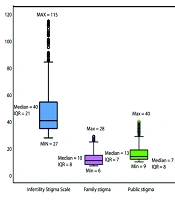
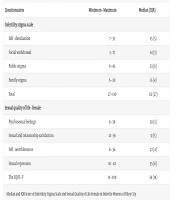
The results showed that the median (IQR) score for the ISS was 62 (27), and for the SQOL-F it was 58 (14) (Table 2).
Table 2.
Median and IQR Score of Infertility Stigma Scale and Sexual Quality of Life-Female in Infertile Women of Khoy City
| Questionnaires | Minimum - Maximum | Median (IQR) |
|---|---|---|
| Infertility stigma scale | ||
| Self - devaluation | 7 - 35 | 15 (5) |
| Social withdrawal | 5 - 17 | 14 (3) |
| Public stigma | 9 - 45 | 23 (6) |
| Family stigma | 6 - 30 | 15 (4) |
| Total | 27 - 130 | 62 (27) |
| Sexual quality of life - female | ||
| Psychosexual feelings | 8 - 36 | 28 (5) |
| Sexual and relationship satisfaction | 12 - 36 | 31 (5) |
| Self - worthlessness | 6 - 36 | 32 (4) |
| Sexual repression | 10 - 42 | 35 (6) |
| The SQOL - F | 18 - 108 | 58 (14) |
There was a significant negative correlation between infertility stigma and the sexual quality of life in infertile women (r = -0.563, P = 0.001). Additionally, a significant relationship (P < 0.001) was observed between the SQOL-F score and the subscales of self-devaluation, social withdrawal, public stigma, and family stigma (Table 3).
Table 3.
Coloration Between Infertility Stigma Scale and Sexual Quality of Life-Female
| Variables | SQOL-F | ISS | Self-devaluation | Social Wthdrawal | Public Stigma | Family Stigma |
|---|---|---|---|---|---|---|
| SQOL-F | 1 | |||||
| ISS | -0.563 a | 1 | ||||
| Self-devaluation | 0.565 a | 0.918 a | 1 | |||
| Social withdrawal | 0.543 a | 0.882 a | 0.774 a | 1 | ||
| Public stigma | 0.474 a | 0.962 a | 0.798 a | 0.784 a | 1 | |
| Family stigma | 0.496 a | 0.921 a | 0.767 a | 0.717 a | 0.967 a | 1 |
Abbreviation: ISS, infertility stigma scale; SQOL-F, sexual quality of life-female.
a P < 0.001.
5. Discussion
The present study focuses on investigating the relationship between infertility stigma and sexual quality of life in infertile women. The findings showed that both the level of infertility stigma and sexual quality of life were moderate. In addition, there was a negative relationship between sexual quality of life and infertility stigma. The findings of Alkhutaba and Alkhateeb revealed that higher levels of infertility stigma among participants were associated with lower levels of quality of life, with infertility stigma accounting for a significant portion of variance in quality of life (16). Similarly, Jing et al. (2022) reported a statistically significant negative relationship between quality of life and stigma (8). Song et al. also confirmed that most participants experienced high levels of worry and anxiety related to fertility, which contributed to a lower quality of life related to reproductive concerns (17).
The results also indicated that the correlation between sexual quality of life and all subscales of infertility stigma was statistically significant. A study by Van Rooij et al. revealed that stigmatization was negatively correlated with fertility-related quality of life, and that fertility quality of life was also negatively associated with active-avoidance coping strategies (7).
Behbahani Mondani Zadeh et al. described the indirect effect of infertility stigma on the quality of marital relationships. According to their findings, infertile women — due to the perception of intense infertility stigma — tend to adopt inappropriate coping strategies such as self-devaluation, self-blame, and social withdrawal, all of which contribute to reduced sexual quality of life (18).
The results also revealed that younger individuals had higher sexual quality of life scores compared to older participants. Additionally, participants with health insurance and those with higher education levels reported better sexual quality of life. Consistent with these findings, Inayat et al. also found an inverse relationship between age and sexual quality of life (19).
According to Ebrahimi et al., infertility treatments are expensive, and although individuals may have multiple opportunities to repeat the treatment process, the high costs often discourage them from starting or completing it. They emphasized that the cost of treatment remains a major barrier that must be addressed in order to improve the quality of life for infertile individuals (20).
In the study by Swift et al., low education was reported as a risk factor for reduced sexual desire, difficulty reaching orgasm, and pain during intercourse (21). Since knowledge plays a crucial role in personal growth and intellectual development, it can positively influence interpersonal behavior — especially within the family and between spouses — and ultimately enhance marital satisfaction.
The present study also found that age, history of infertility, and duration of infertility treatment were significantly associated with infertility stigma. These findings are in line with the study by Behbahani Mondani Zadeh et al., who noted that over time, prolonged infertility treatment and increasing age lead to heightened social pressure, invasive questions, and an intensification of infertility stigma. These factors contribute to severe anxiety and stress in infertile women, ultimately reducing optimism and hope (18).
One of the limitations of the present study is the restricted sample population, which was limited to infertile women from a single city. As a result, the findings cannot be generalized to infertile women from other cities with different cultural and ethnic backgrounds. Therefore, caution is advised when generalizing the results. It is recommended that mediating variables which may moderate the relationship between infertility stigma and sexual quality of life be further explored in future research.
5.1. Conclusions
According to the results obtained, there is an inverse relationship between infertility stigma and the sexual quality of life of infertile women. Infertility stigma not only disrupts the quality of marital relationships but also negatively affects the reproductive cycle, directly impacting the likelihood of fertility. Therefore, healthcare and treatment centers should incorporate psychological rehabilitation programs alongside infertility treatment protocols to enhance the quality of life for affected couples. Additionally, given the importance of the variables examined in this study, it is recommended that educational workshops be conducted to help infertile women cope with the effects of infertility stigma and improve the quality of their sexual relationships.