
1. Background
During the COVID-19 pandemic, an increase in psychological problems such as anxiety and depression has been reported (1). Generally, infectious disease outbreaks can increase anxiety. Thus, the anxiety caused by COVID-19 also led to the emergence of corona disease anxiety (CDA) (2). The CDA is prevalent and seems primarily due to its unknown nature, creating ambiguity about this virus (3). Fear of the unknown reduces the perception of safety in humans and has always been a source of anxiety (4). Therefore, this fear, anxiety, tension, or emotional disturbance may become a basis for creating CDA, leading to emotional failure (5). Emotional failure is a difficulty in cognitive emotion regulation (CER) or an inability to process emotional information and regulate emotions (6).
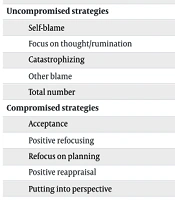
Cognitive emotion regulation includes conscious or unconscious cognitive, emotional, and behavioral strategies for maintaining, boosting, or suppressing an emotion (7). The CER strategies are generally divided into two categories: Positive and negative strategies. Positive strategies include acceptance, refocusing on planning, positive refocusing, positive reassessment, and perspective adoption, which are compatible strategies in dealing with stressful events and improving self-esteem and social skills (8).
Cognitive flexibility is described as the main characteristic of human cognition and refers to the ability of a person to consider contradictory representations of an object or an event simultaneously (9). Cognitive flexibility increases the self-care behaviors of COVID-19 patients (10). Acceptance and overcoming avoidance behaviors are good indicators of flexible cognitive behaviors, while avoiding the disease plays an essential role in the self-care behaviors of COVID-19 (10). In general, the ability to change cognitive attributes to adapt to changing environmental stimuli is the main element in the practical definitions of cognitive flexibility (11). Besides, evidence indicates that cognitive flexibility is related to psychological well-being and susceptibility to various disorders, including depression, anxiety, and general distress (12, 13). According to previous studies, anxiety disorders and depression have increased during the COVID-19 pandemic (14).
2. Objectives
The primary question of this study is whether there is a difference between people with a history of COVID-19 experience and normal individuals in Hamedan in comparing CDA based on the strategies of CER and cognitive flexibility.
3. Methods
The population of this cross-sectional, descriptive-analytical study consisted of all residents living in various districts of Hamedan during the first half of 1401. From this population, 420 individuals (210 with a history of COVID-19 and 210 normal individuals) were included in the study using the availability sampling method. In total, 431 questionnaires were filled using the availability sampling method from different areas of Hamedan, of which 11 questionnaires were discarded due to incompleteness, resulting in a sample size of 420 individuals (210 with a history of COVID-19 and 210 without a history of experience). It should be noted that only individuals with a history of COVID-19 who did not have a history of hospitalization due to COVID-19 were included.
The inclusion criteria for the study included: Minimum reading and writing literacy, not suffering from acute medical and psychiatric complications (in this study, hospitalization was considered the acute complications criterion), not taking psychiatric medications (for at least one month prior to filling out the questionnaire), having a final diagnosis of COVID-19 (CT scan, blood test, PCR, doctor's diagnosis), and willingness to participate in the research. The exclusion criteria included unwillingness to cooperate and an incomplete questionnaire.
Therefore, the study questionnaires (coronavirus-anxiety questionnaire, CER questionnaire, cognitive flexibility questionnaire) were given to those who met the inclusion criteria. They were analyzed using SPSS-26 software and the multivariate analysis of variance (MANOVA) test. All ethical considerations were addressed in the present study, including the right to anonymity of the questionnaires by using multi-digit numerical codes and letters instead of the names of the participants, a full explanation of the objectives and steps of the study to the participants before presenting the questionnaires, confidentiality of participants' information, not imposing any financial burden on participants, and receiving the code of ethics.
4. Results
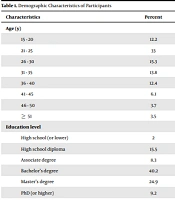
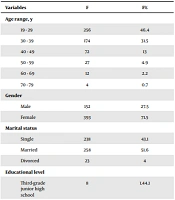
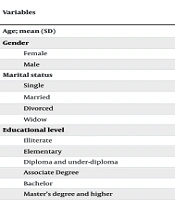
The information obtained from the demographic findings indicated that out of 420 participants, 63.57% (267 individuals) were female, and 36.43% (153 individuals) were male. Additionally, 73.33% (308 individuals) were single, and 26.67% (112 individuals) were married. Two hundred twenty-four individuals had bachelor's and master's degrees, 145 had associate degrees or high school diplomas, thirty-five individuals had doctorate degrees, and 16 had less than a high school diploma. One hundred forty-two individuals were unemployed, 116 had government jobs, sixty-six were homemakers, and ninety-six had freelance jobs. Two hundred ten individuals (50%) had a history of COVID-19 experience, and 210 individuals (50%) were normal and had no history of COVID-19 experience. The other descriptive indices are mentioned in Table 1.
Table 1.
Descriptive Indices of the Study Variables in People with a History of COVID-19 Experience and Normal People a
| Variables | People with COVID-19 Experience | Normal People |
|---|---|---|
| COVID anxiety | ||
| Psychological | 15.630 ± 5.648 | 13.869 ± 4.026 |
| Physical | 11.218 ± 4.520 | 10.076 ± 2.083 |
| Total number | 26.84 ± 9.15 | 23.94 ± 5.55 |
| Uncompromised strategies | ||
| Self-blame | 8.36 ± 2.23 | 8.37 ± 2.19 |
| Focus on thought/rumination | 5.93 ± 2.30 | 6.17 ± 2.34 |
| Catastrophizing | 6.79 ± 2.34 | 7.90 ± 1.95 |
| Other blame | 7.28 ± 2.14 | 8.15 ± 2.06 |
| Total number | 28.37 ± 6.33 | 30.61 ± 5.53 |
| Compromised strategies | ||
| Acceptance | 6.05 ± 2.34 | 5.66 ± 2.51 |
| Positive refocusing | 5.82 ± 2.07 | 5.81 ± 2.38 |
| Refocus on planning | 4.92 ± 1.85 | 4.48 ± 2.33 |
| Positive reappraisal | 4.59 ± 1.72 | 4.56 ± 2.42 |
| Putting into perspective | 5.22 ± 2.05 | 5.50 ± 2.14 |
| Total number | 26.62 ± 7.14 | 26.03 ± 9.59 |
| Cognitive flexibility | ||
| Alternatives | 50.87 ± 7.80 | 51.58 ± 8.40 |
| Control | 36.71 ± 9.85 | 38.95 ± 8.66 |
| Alternatives for human behaviors | 8.82 ± 2.27 | 9.34 ± 2.48 |
| Total number | 96.41 ± 15.50 | 99.88 ± 14.31 |
a Values are expressed as mean ± SD.
According to the Kolmogorov-Smirnov test, all the research data are normal, and parametric tests can be used to analyze the data. Based on the MANOVA test, the level of CDA, the strategies of CER, and cognitive flexibility significantly differed between the two groups of individuals with a history of COVID-19 experience and normal individuals in Hamedan. The results show a significant difference in CDA, the overall score of cognitive flexibility, adaptive CER strategies, and non-adaptive CER strategies between the groups of individuals with a history of COVID-19 and normal individuals. Therefore, there is a significant difference in at least one of the dependent variables (Lambda Wilks; P < 0.001; F = 7.222).
The MANOVA test was performed to check the difference in the overall scores of the dependent variables of CDA, cognitive flexibility, non-adaptive CER strategies, and adaptive CER strategies between the group with a history of COVID-19 experience and the control group. The results are shown in Table 2. Based on the results of this table and the F-value, a significant difference is observed between the two groups in the overall score of CDA, cognitive flexibility, and non-adaptive CER strategies. However, the two groups have no significant difference in the overall score of the adaptive CER strategies. The normal group had better cognitive flexibility and lower CDA, but the group with a history of COVID-19 experience had better non-adaptive CER strategies.
Table 2.
The Results of the Multivariate Analysis of Variance Test Compare the Group with a History of COVID-19 Experience with the Normal Group in the Variables of Corona Disease Anxiety, Cognitive Emotion Regulation Strategies, and Cognitive Flexibility
| Variables | Sum of Squares | df | Mean of Squares | F-Value | P-Value |
|---|---|---|---|---|---|
| COVID anxiety | 884.445 | 1 | 884.445 | 15.429 | 0.001 |
| Cognitive flexibility | 1262.630 | 1 | 1262.630 | 5.668 | 0.018 |
| Uncompromised strategies | 526.391 | 1 | 526.391 | 14.889 | 0.001 |
| Compromised strategies | 35.524 | 1 | 35.524 | 0.497 | 0.481 |
The MANOVA test was used to check the difference in CER strategies between the group of individuals with a history of COVID-19 and the normal individuals in Hamedan. The results show a significant difference between the group of individuals with a history of COVID-19 and the normal group in the CER strategies of self-blame, rumination, catastrophizing, blaming others, acceptance, positive refocusing, and refocusing on planning. Therefore, a significant difference is observed in at least one of the dependent variables in CER strategies (Lambda Wilks; P < 0.001; F = 5.508).
A MANOVA test was performed to investigate the difference in the scores of CER strategies of self-blame, rumination, catastrophizing, blaming others, acceptance, positive refocusing, refocusing on planning, positive reassessment, and undercounting in the group with a history of COVID-19 and the normal group, the results of which are shown in Table 3. Based on the results in Table 3 and according to the F-value, a significant difference is observed between the two groups in the CER strategies of catastrophizing, blaming others, and refocusing on planning. However, no significant difference is observed in the scores of CER strategies of self-blame, rumination, acceptance, positive refocusing, positive reassessment, and undercounting between the two groups.
Table 3.
The Results of the Multivariate Analysis of Variance Test for Comparing the Group with a History of COVID-19 and the Normal Group in the Cognitive Emotion Regulation Strategies Variable
| Variables | Sum of Squares | df | Mean of Squares | F-Value | P-Value |
|---|---|---|---|---|---|
| Self-blame | 0.005 | 1 | 0.005 | 0.001 | 0.976 |
| Focus on thought/rumination | 6.305 | 1 | 6.305 | 1.170 | 0.280 |
| Catastrophizing | 131.354 | 1 | 131.354 | 30.721 | 0.001 |
| Other blame | 79.270 | 1 | 79.270 | 17.865 | 0.001 |
| Acceptance | 16.335 | 1 | 16.355 | 2.764 | 0.097 |
| Positive refocusing | 0.001 | 1 | 0.001 | 0.001 | 0.991 |
| Refocus on planning | 19.717 | 1 | 19.717 | 4.430 | 0036 |
| Positive reappraisal | 0.104 | 1 | 0.104 | 0.023 | 0.878 |
| Putting into perspective | 8.233 | 1 | 8.233 | 1.863 | 0.173 |
In terms of CER strategies of catastrophizing, blaming others, and refocusing on planning, individuals with a history of COVID-19 were in a better condition than normal individuals, but the two groups were similar in CER strategies of self-blame, rumination, acceptance, positive refocusing, positive reassessment, and undercounting. Therefore, the two groups are significantly different in CER strategies of catastrophizing, blaming others, and refocusing on planning. However, no significant difference was observed between the two groups in CER strategies of self-blame, rumination, acceptance, positive reappraisal, positive reassessment, and undercounting.
The MANOVA test was used to check for the difference in the level of cognitive flexibility between the group of individuals with a history of COVID-19 and the normal group in Hamedan. The results show a significant difference in cognitive flexibility, alternatives, control, and alternatives for human behavior between the two groups. Thus, there is a significant difference in at least one of the dependent variables of cognitive flexibility (Lambda Wilks; P < 0.016; F = 3.485).
A MANOVA test was performed to investigate the difference in the cognitive flexibility scores of alternatives, control, and alternatives for human behavior between the group with a history of COVID-19 experience and the normal group. The results are shown in Table 4. Based on this table and the F-value, the two groups significantly differ in the cognitive flexibility variables of control and alternatives for human behavior. However, the two groups have no significant difference in the cognitive flexibility score of the alternatives.
Table 4.
The Results of the Multivariate Analysis of Variance for Comparing the Group with a History of COVID-19 and the Normal Group in the Cognitive Flexibility Variable
| Variables | Sum of Squares | df | Mean of Squares | F-Value | P-Value |
|---|---|---|---|---|---|
| Alternatives | 53.403 | 1 | 53.403 | 0.812 | 0.368 |
| Control | 527.394 | 1 | 527.394 | 6.129 | 0.014 |
| Alternatives for human behaviors | 27.675 | 1 | 27.675 | 4.863 | 0.028 |
Based on these findings, the normal group had better cognitive flexibility variables of control and alternatives for human behavior than the group with a history of COVID-19. However, no difference was observed between the two groups regarding the cognitive flexibility variable of alternatives. Therefore, the two groups significantly differ in cognitive flexibility variables of control and alternatives for human behavior. However, no significant difference was observed in alternatives between the two groups.
5. Discussion
The present study aimed to compare CDA between individuals with a history of COVID-19 and normal individuals in Hamedan based on CER strategies and cognitive flexibility. According to the study results, a significant difference is observed in CDA, cognitive flexibility, and uncompromised CER strategies between individuals with a history of COVID-19 and normal individuals in Hamedan. Several psychological studies have been conducted on COVID-19; however, no study was found comparing CDA, CER strategies, and cognitive flexibility between individuals with a history of COVID-19 and normal individuals.
According to the qualitative study by Navah et al. investigating women's experience with COVID-19, the COVID-19 pandemic has caused anxiety and stress in different groups (15). Furthermore, Ahmadi et al.’s study concluded that individuals with low cognitive flexibility show less acceptance towards life events, and incidents like COVID-19 experience will negatively impact individuals who cannot regulate their emotions appropriately (16). Another study by Mohammadpour et al. showed that psychological flexibility (experiential avoidance) and difficulty in emotion regulation could explain 18.6% of the changes in COVID-19 fear (17). Furthermore, Canli and Karasar's study showed that health anxiety scores were higher in individuals with physical and mental health conditions. This study also showed a weak and negative correlation between health anxiety and cognitive reassessment (18). The overall conclusion showed that health-related anxiety during the COVID-19 outbreak is related to emotion regulation and can be predicted by this component.
The results of the present study also showed that individuals with a history of COVID-19 were in a better condition than normal individuals regarding CER strategies of catastrophizing, blaming others, and refocusing on planning. However, no difference was observed between the two groups regarding CER strategies of self-blame, rumination, acceptance, positive refocusing, positive reassessment, and undercounting. The findings are consistent with the results of Tabe Bordbar et al., Ahmadi et al., Majidpour Tehrani and Aftab, Salari et al., Riaz et al., and Zhao et al.'s study (16, 19-23). The inability to regulate emotions leads to negative emotions, causes disturbance in individuals' adaptation process and mental health, and seriously threatens them. Therefore, the difficulty in regulating emotions can play a crucial role in predicting psychological damages such as CDA. The study by Mohammadpour et al. showed that psychological flexibility (experiential avoidance) and difficulty in regulating emotions could explain the changes in COVID-19 fear (17). In light of this finding, it can be stated that individuals with difficulty regulating their emotions tend to use ineffective emotional strategies such as rumination, catastrophizing, and self-blame, which in this era of COVID-19 expose them to emotional complications and anxiety.
In examining the difference in cognitive flexibility between the group with a history of COVID-19 and the normal group in Hamedan, the results showed that the normal group had better control and alternatives for human behavior than the group with a history of COVID-19. However, no difference was observed between the two groups regarding the alternatives in cognitive flexibility. The findings are consistent with the studies of Talebi, Guldal et al., and Demirtas (24-26). Low flexibility in unpreventable events, such as COVID-19 disease, increases emotional turmoil. Therefore, these individuals have less psychological resilience. When they are in a chaotic and stressful situation, they develop symptoms of psychological damage, including anxiety, as a way to adapt to the changing environment (27). Individuals with low flexibility are prone to anxiety and rumination in stressful situations such as the COVID-19 outbreak, which affects them physically, socially, and economically. These individuals also suffer from catastrophic thinking in dealing with received information about this environment. Any disregard for hygiene that increases the possibility of contracting COVID-19 may put them in a vicious cycle of self-blame and blaming others and will lead to overexcitement and worries about this disease. As individuals become worried about their negative emotions regarding COVID-19, their ability to focus on the issue that initially created uncertainty, worries, and anxiety decreases. They cannot evaluate the situation and plan to deal with such conditions. Therefore, the individual will not be able to accept the existing facts and take a perspective about COVID-19; in this cycle, they experience more and more anxiety.
5.1. Limitations
The present study, like other studies, had limitations, including the non-random sampling method, self-reporting questionnaires, the limited implementation of the study to Hamedan, and the generalizability of the results to other cities. Additionally, COVID-19 restrictions posed challenges. Although our initial objective was to examine anxiety-related patterns among individuals with varying COVID-19 experiences, we recognize that grouping participants solely based on infection status may have constrained our ability to treat anxiety as an independent variable. Therefore, it is suggested that future studies investigate the gender factor in the psychological variables of CDA, CER strategies, and cognitive flexibility. Other research tools, such as interviews and observation types, should be used. The present study should be duplicated in other cities and statistical societies using a random sampling method for better generalization.
5.2. Conclusions
The present study showed that the level of anxiety about contracting a virus such as COVID-19 and people's psychological coping mechanisms are influenced by their personality and psychological preparations. Individuals with a history of COVID-19 experience have different CER strategies and cognitive flexibility related to CDA compared to normal individuals. The CDA and cognitive flexibility were higher in normal individuals, while the non-adaptive CER strategies were higher in individuals with a history of COVID-19.
From a practical point of view, it is suggested that health counselors and therapists improve these variables in individuals with a history of COVID-19 by teaching cognitive flexibility and enhancing CER strategies through online workshops and applying appropriate interventions in the current situation to reduce CDA.