Fulltext
full text is available in pdf
Image Credit:Ann Mil Health Sci Res
Authors
Purpose: To evaluate colostrum total protein differences between left and right breasts and between mothers of boy and girl infants. Materials and Methods: A cross sectional study for delivery was carried out on 30 boy-delivered and 30 girl-delivered mothers aged 16 to 36 years, conducted at the Izadi and Al-Zahra Hospitals in Qom city, Iran. Colostrum was collected from both breasts by manual milking within the first day of delivery. Total protein concentration was assessed by Biuret method using affiliated kits. The data was analyzed through the student’s t-test using the SPSS program. Results: Colostrum total protein was significantly higher in the left (166.9±13.1 mg/ml) and right (165.3±14.7 mg/ml) breasts of the boy-delivered mothers than in the left (144.8±4.1 mg/ ml) and right (122.7.3±7.4 mg/ml) breasts of the girl-delivered ones. It was also significantly higher in the left breast than the right breast in the girl-delivered mothers. However, there was no significant difference between the two breast colostrum total protein levels in the boydelivered mothers. Conclusion: The results of the present study suggest that total protein of colostrum in the boydelivered mothers is greater than the girl-delivered mothers.
© 2015, Annals of Military and Health Sciences Research. This open-access article is available under the Creative Commons Attribution-NonCommercial 4.0 (CC BY-NC 4.0) International License (https://creativecommons.org/licenses/by-nc/4.0/), which allows for the copying and redistribution of the material only for noncommercial purposes, provided that the original work is properly cited.
JavanMardi E, Saboory E. Leptin levels in breast milk of mother bearing girls and boys. koomesh. 2012;13(2):e152507. doi:
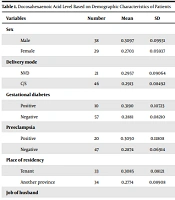
Naserly F, Fallahi M, Tajalli S, Kazemian M, Hajipour M, et al. Breast Milk Docosahexaenoic Acid and Neonatal Outcome in Preterm Infants: A Cross-sectional Study. J Compr Ped. 2022;13(1):e112148. doi: https://doi.org/10.5812/compreped.112148
Karandish M, Djazayery A, Michaelsen K, Rashidi A, Mohammadpour-Ahranjani B, et al. Does Supplementation with Calcium During Pregnancy Affect the Mineral Concentration in Mature Breast-Milk?. Int J Endocrinol Metab. 2007;5(4):. doi:
Oveisi MR, Sadeghi N, Jannat B, Hajimahmoodi M, Behfar A, et al. Human Breast Milk Provides Better Antioxidant Capacity than Infant Formula. Iran J Pharm Res. 2010;9(4):e126081. doi: https://doi.org/10.22037/ijpr.2010.912
Dehghan P, Pakshir K, Rafiei H, Chadeganipour M, Akbari M. Prevalence of Ochratoxin A in Human Milk in the Khorrambid Town, Fars Province, South of Iran. Jundishapur J Microbiol. 2014;7(7):e11220. doi: https://doi.org/10.5812/jjm.11220
Last Update: 6 days ago
Last Update: 6 days ago
Last Update: 6 days ago
Last Update: 4 hours ago
Last Update: 8 hours ago
Last Update: 5 days ago