
1. Background
Whole Body Vibrational Training (WBVT) could provide health benefits. In elite athletes, WBVT has been used as preventive medicine and resistance training (1). Furthermore, WBVT regardless of age or fitness status can be beneficial for everyone and it represents a high revolution in health and fitness science. One of the major risk factors for cardiovascular disease is a sedentary lifestyle (2, 3). Besides numerous benefits of exercise, it is well-known that regular exercise minimizes cardiovascular morbidity and mortality (4, 5). Watanabe et al. showed WBV training along with aerobic training in comparison with aerobic training alone significantly reduced arterial stiffness and increased cardio-respiratory fitness (6). For some groups, such as elderly people, WBVT rather than aerobic training is more safe and effective and has more anti-inflammatory effects (7). So et al. showed that WBVT significantly decreased TC, LDL, and TG (1). Hypertension, smoking, and hyperlipidemia can induce coronary heart disease (8, 9). There are some studies indicating that there is a significant correlation between inflammatory markers and coronary heart disease (9). Furthermore, CRP is a marker of sub-clinical inflammation. An increase in CRP concentration results in a four- to five-fold increase in coronary risks (10). Fibrinogen is a high molecular weight protein and is formed in the liver (11). Evidence shows that reduction of 1 g/L in fibrinogen concentration results in 15% reduction of coronary disease (12, 13). A wealth of data during the last decade suggests that fibrinogen level represents an independent cardiovascular risk factor. Its impact seems to be as strong as, or even stronger than, that of total cholesterol concentration. If this view is accepted, the question arises as to how fibrinogen and/or CRP levels can be altered in order to reduce the risk. Clearly, this aspect has not yet been fully investigated (14). Studies showed that WBVT have utilized training time periods ranging from ten days to six months, frequencies between 12 to 60 Hz, and amplitudes ranging from 1.7 to 10 mm (15, 16). Various frequencies, amplitudes, and durations have been utilized yet an optimal pattern is not recognized. For proper doses of WBVT, attention should be paid to intensity, strength, and volume of the vibration, which can effect positive biological and physical responses. The volume refers to time under vibration stimulus; intensity refers to the mechanical characteristics of frequency and amplitude and strength refers to observational characteristics of the muscle impacted by the vibration load (17). Little modification frequency and amplitude can lead to relatively large changes in acceleration and magnitude of vibration being transmitted to the body. Furthermore, WBVT in health centers has been recognized as a well-known training method and effect of vibration exercises on risk factors are widely studied in humans and it has also been suggested that mechanical frequency and low range stimulation can be an effective way to prepare muscle structures; nevertheless, the results of the reported studies are contradictory. The reason for the inconsistency in researches is due to the difference in the subject’s gender, the time of the test, the age of the subjects, duration and frequency of the vibration, the type of exercise, and the amount of motivation of the subjects. Therefore, a study that can control disruptive factors as much as possible can provide valuable findings regarding the effects of vibration exercises on inflammatory factors. Therefore the main hypothesis of the present study is that high intensity and low intensity vibration have the same influence on inflammatory markers (CRP and fibrinogen).
2. Objectives
Since different intensities of WBVT may have different effects on inflammatory responses; the present study aimed at reviewing the effects of high and low intensity WBVT on inflammatory markers in young healthy males.
3. Methods
3.1. Subject Selection and Measurement
Overall, 36 healthy and sedentary students of Islamic Azad University, Science and Research Branch (in 2018) were selected voluntarily. At first, all subjects filled the physical activity behavior questionnaire. Inclusion criteria were age between 20 and 25 years, no history of physical exercise in the last three months, no smoking, no consumption of systemic corticosteroids. The exclusion criteria included severe co-morbidities or self-reported contraindications for WBV (e.g. deep vein thrombosis, metal implants, pacemaker, epilepsy, tumors, arterial aneurysm, and arrhythmia). All participants were paired for gender, age, and body mass index (BMI). They were informed about the procedures, risks, and benefits of the research in advance.
As six subjects were not able to continue exercise sessions, they were excluded from the study and the rest of the subjects were randomly divided to three groups including high intensity vibration (N = 11), low intensity vibration (N = 11), and control (N = 8). It should be noted that the present study was blind study, which means none of the subjects knew about the amplitudes of training; however, only trained staff knew about differentiation between groups.
In pre-test and post-test (48 hours after the last training session) all subjects referred to the laboratory (eight hours of overnight fast). Blood samples (5 mL), taken by venipuncture, were then analyzed for concentrations of hsCRP and fibrinogen. Both tests measured the same protein in blood. The hsCRP concentrations were between 0.5 and 10 mg/L. Plasma levels of hsCRP was measured by immunoturbidimetry 5+1 Greiner, Germany, and fibrinogen was measured by Clauss, MahsaYaran, Iran.
3.2. Whole Body Vibration Training
During the six-week experimental period, all subjects continued their conventional living schedule, yet the intervention groups (low intensity and high intensity groups) additionally performed a WBVT program, three times per week with amplitudes of 4 or 2 mm and progressive frequencies from 25 Hz with increments of 5 Hz, weekly. Subjects completed a standardized warm-up. This consisted of five minutes of cycling on a cycle ergometer (Technogym Italy) at 50 W. Furthermore, WBVT was performed on a Vibofit vibration fitness machine (Figure 1). The WBVT program is summarized in Table 1. It should be noted that in this period of time, the control group did not contribute to any training and only had their daily activity.
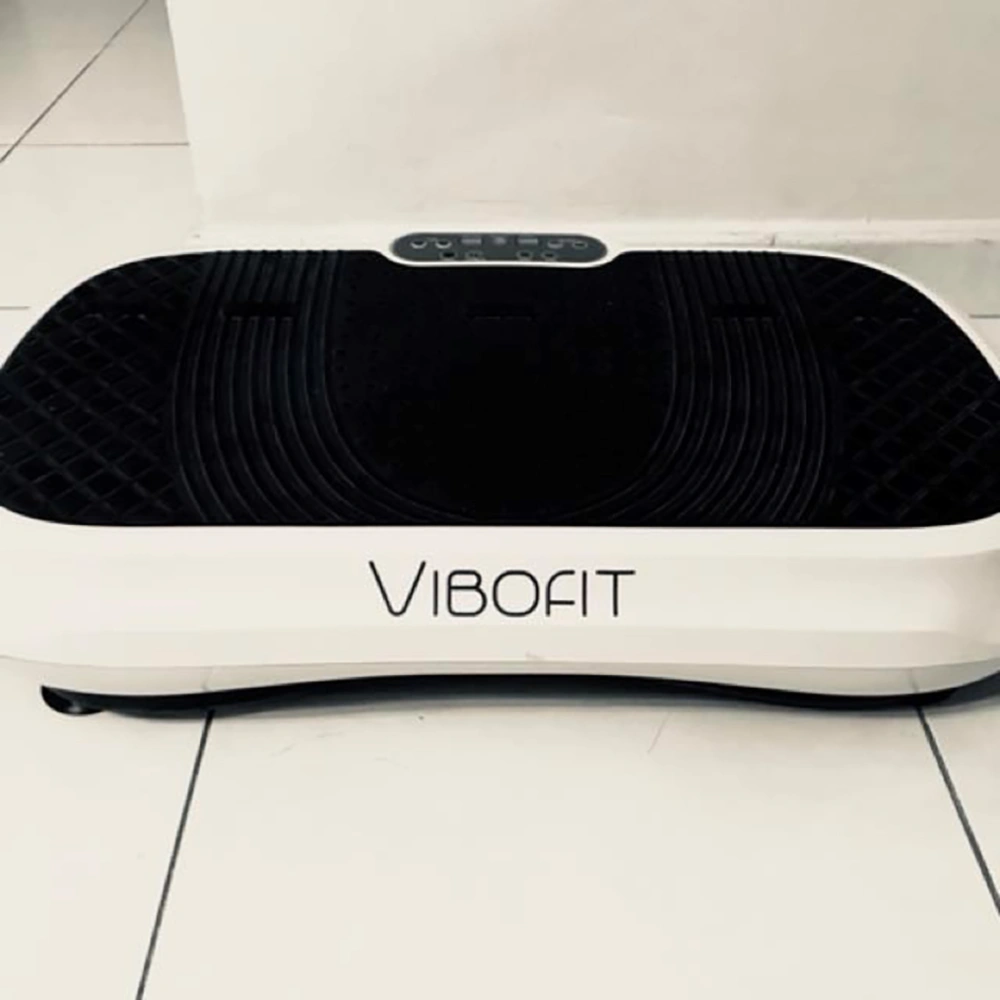
Figure 1.
Vibofit vibration fitness machine
Table 1.
The WBVT Training Schedule
| Position of Training | Set | Repetition | Frequency in the First Weeka, Hz | Amplitudesb, mm | Duration of Each Repetition, s | Duration of Rest Between Sets, s | Total Duration of Training in the Session, min |
|---|---|---|---|---|---|---|---|
| 1st session of the week | 25 | 4 or 2 | 30 | 30 | 9 | ||
| Squat | 2 | 3 | |||||
| Lunges | 2 | 3 | |||||
| Deep squat | 2 | 3 | |||||
| 2nd session of the week | 25 | 4 or 2 | 45 | 30 | 13.5 | ||
| Squat | 2 | 3 | |||||
| Lunges | 2 | 3 | |||||
| Deep squat | 2 | 3 | |||||
| 3rd session of the week | 25 | 4 or 2 | 60 | 30 | 18 | ||
| Squat | 2 | 3 | |||||
| Lunges | 2 | 3 | |||||
| Deep squat | 2 | 3 |
aThe frequency at beginning of the program was 25 Hz which was progressively increased (5 Hz each week) to the final frequency of 50 Hz.
b4 mm for the high amplitude and 2 mm for the low amplitude groups.
3.3. Ethical Issues
The study protocol was evaluated and accepted by the Ethical Committee of the Sports Medicine Federation of Iran and complied with the Helsinki Declaration of 1975, revised in 2002. All the participants received adequate information about the study protocol and possible advantages and disadvantages of training. They entered the study deliberately and were free to quit the protocol upon their request.
3.4. Statistical Analysis
All data were found to be normally distributed; therefore, analysis was carried out using parametric statistical tests. Paired sample t-test and One-way ANOVA was used to identify any statistically significant differences within and between groups. Data are expressed as mean ± standard deviation (SD). All statistical analysis was done by SPSS version 18 (SPSS Inc., USA) The level of significance was set at P ≤ 0.05.
4. Results
Demographic characteristics of all subjects are reported in Table 2. The results of One-way ANOVA showed that there were no significant differences between age (P = 0.67), height (P = 0.90), weight (P = 0.55), and BMI (P = 0.45) between high intensity, low intensity, and control groups (Table 2).
Table 2.
The demographic characteristics of groupsa
| Variable | Group | P Valueb | ||
|---|---|---|---|---|
| High Intensity (N = 11) | Low Intensity (N = 11) | Control (N = 8) | ||
| Age, y | 21.14 ± 1.51 | 20.45 ± 1.39 | 20.88 ± 0.83 | 0.67 |
| Height, cm | 177.20 ± 8.01 | 174.56 ± 4.30 | 176.42 ± 2.97 | 0.90 |
| Weight, kg | 70.68 ± 9.21 | 69.80 ± 15.38 | 65.20 ± 9.50 | 0.55 |
| BMI, kg/m2 | 22.69 ± 3.23 | 22.83 ± 4.69 | 20.89 ± 2.47 | 0.45 |
aValues are expressed as mean ± SD.
bResults of One-way ANOVA test.
The results of One-way ANOVA test showed that WBVT with progressive frequencies between low and high intensity groups caused no significant differences in hsCRP (P ≥ 0.05) (Figure 2) and fibrinogen (Figure 3) concentrations (P ≥ 0.05). The results of paired sample t-test showed that there were no significant differences between pre-test and post-test levels of hsCRP and fibrinogen in low intensity (P ≥ 0.05) and control (P ≥ 0.05) groups; also, there was no significant difference between pre-test and post-test levels of fibrinogen in the high intensity group (P ≥ 0.05). Nevertheless, hsCRP in the post-test of high intensity group was significantly increased compared to the pre-test.
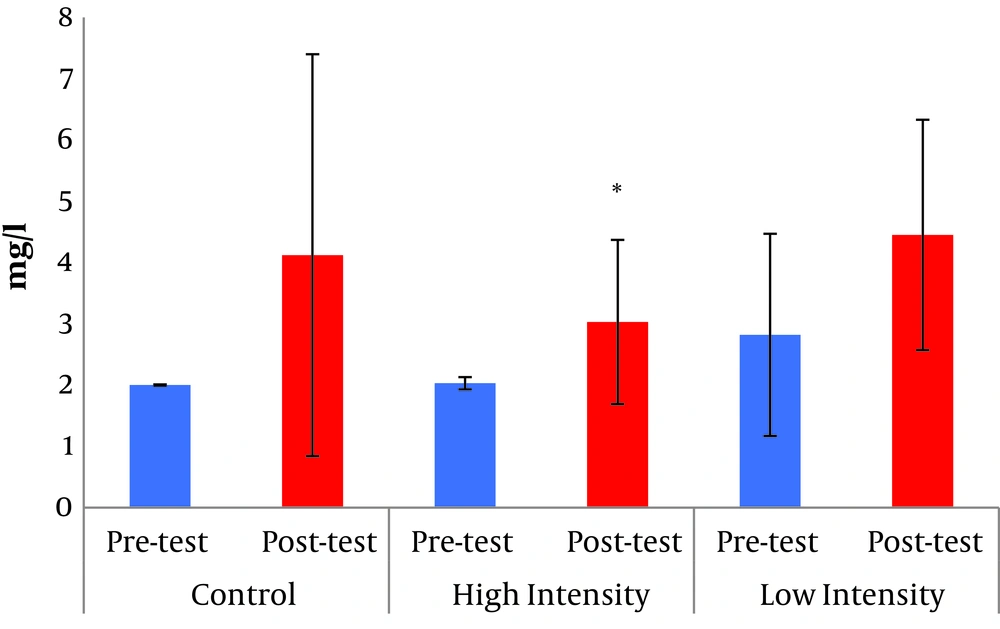
Figure 2.
hsCRP levels in three groups of research. *Significant increase in post-test compared to pre-test
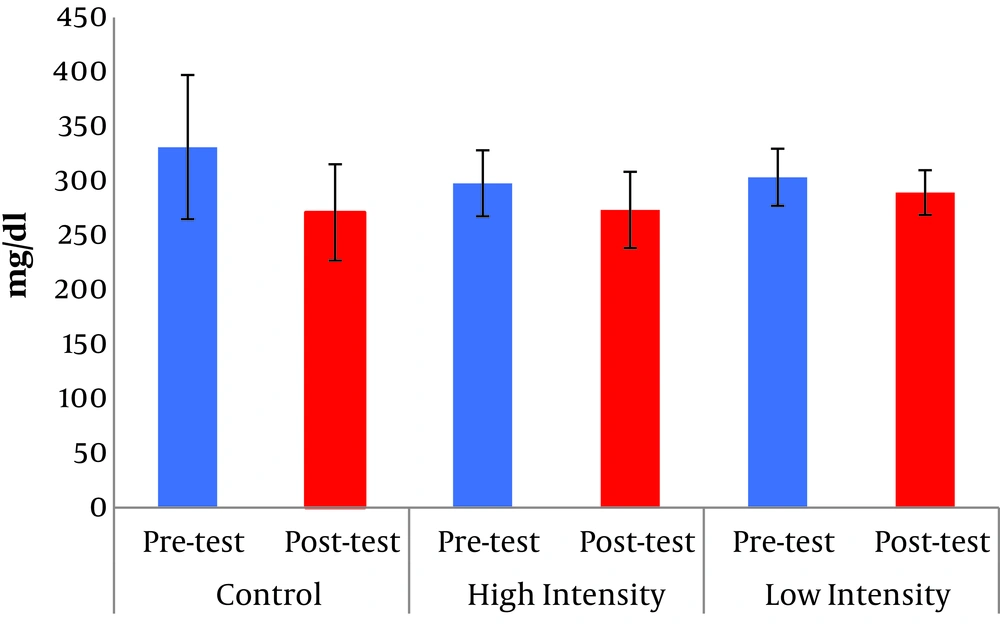
Figure 3.
Fibrinogen levels in three groups of research
5. Discussion
Increased CRP and fibrinogen concentrations can reflect low grade chronic inflammation (18). It has been reported that measurement of CRP and fibrinogen can be a method for detection of cardiovascular risk. The present study showed that high and low intensity WBVT caused no significant differences in hsCRP and fibrinogen concentrations. However, the increase of hsCRP in the high intensity group was significant. In relation to WBVT, various studies have been reported, for example Rittweger et al. reported that WBVT by increase in oxygen uptake significantly increased basal energy metabolism rate (17); also, it has been suggested that in WBVT, the energy expenditure is similar to light work of 0.3 metabolic energy equivalents (19). Furthermore, it has been reported that WBVT similar to those experienced during moderate walking at 4 km/h provides cardiovascular stimuli (20). In one study, three seconds up and three seconds down squat training on a vibration plate similar to cycling at 70 Watt had the same metabolic rate (21) and in another study, WBV session significantly increased the 24-hour oxygen consumption (22). Also it has been reported that 10% WBVT reduced body weight, body fat, and serum leptin (23).
It appears that exercise directly and indirectly reduces CRP; indeed exercises reduce cytokine production in mononuclear cells, muscle, and fat (directly), and also increases endothelial function and insulin sensitivity while it reduces body weight (indirectly). It was found that the endothelium is essential for vasodilatation in response to increases in blood flow associated shear stress (24). In response to shear stress, several vasodilators are released by the endothelium, which include prostaglandins and nitric oxide (25). During WBVT, blood flow of skin increases (26) and this increase in blood flow could induce reduction in shear stress on blood vessels. Increase in blood flow can increase on endothelial walls of blood vessels. It has also been shown that WBVT leads to the speculation that WBVT may also result in an increased fibrinolytic response (27). Thus, WBVT may enhance the cardio-protective benefits and influence fibrinolytic activity of a therapeutic exercise regimen. Increased vascular shear stress has been shown to increase fibrinolytic activity in cultured endothelial cells (28). The mechanism underlying the fibrinolytic responses reported in the present study may be related to vascular shear stress. As the movement of the platform is sinusoidal, the acceleration transmitted to the body is calculated as a = A (2πf) 2. Where “A” is the amplitude of the oscillations and “f” is the frequency. The intensity of the vibration load refers to the mechanical characteristics of the frequency and amplitude of the vibration stimulus. Small changes in amplitude and frequency determine relatively large changes in acceleration and magnitude of vibration being transmitted to the body. It seems that WBVT affects CRP and fibrinogen indirectly by improving endothelial function. Frequency and amplitude in WBVT are important variables that affect vascular shear stress factors. In conclusion, amplitude seems to be a less important parameter than frequency for intensity of whole body vibration training programs on inflammatory markers.
5.1. Conclusions
According to the results of the present study, it seems that six weeks of low and high intensity vibration training have the same effects on CRP and fibrinogen.