1. Introduction
One of the most important issues in maintaining and improving health and quality of life among the elderly is independency in activities of daily living (1). In the elderly, Sarcopenia results in the reduction of muscle mass that directly leads to a decline in muscle strength (2). Muscle weakness and inability to produce rapid forces are considered important factors in the loss of functional independence and falls in the elderly (2). In addition, feeble balance and mobility cause a decrease in independence of daily activity, which increases the risk of falls among the elderly (3). Falls may lead to fractures and consequently decrease the quality of life, increase disability, and impose high economic costs on the health service system (3).
Some elderly people are not eager or not able to do conventional exercise trainings (4), so seeking and evaluating new forms of exercises is of great importance in this population. Whole body vibration (WBV) has been proposed as a new form of exercise training: a potentially safe and a low contact exercise. In addition, WBV seems to be useful in preventing muscle and bone degeneration in people with limited mobility and exercise tolerance. Additionally, WBV is safe compared with other customary trainings like high contact or strenuous exercise trainings (5). Therefore, WBV training could be considered as a mild training approach to improve neuromuscular performance and physical fitness. Standing on WBV devices begets a reflectory response in the leg and postural muscles, which is called “tonic vibration reflex” (6). Furthermore, through the vibratory stretch reflex, in which muscle spindle and Ia afferents activate a myotactic stretch reflex and produce mechanical vibration, WBV training may activate muscles and improve their performance (7).
Several studies investigated the effect of WBV on health and performance related components of physical fitness in the elderly. Some studies investigated the effects of WBV on muscle strength, balance, and functional mobility, and reported its positive effects (2, 6, 8-10). In a meta- analysis, Lau et al. (2011) suggested that WBV training might significantly improve leg muscle strengths in the elderly (11). Furthermore, authors reported that use of WBV improves balance and mobility and may decrease risk factors related to falling in the elderly (8, 12-14). In some studies, comparison of WBV and resistance training has shown that both training methods result in almost the same level of improvement in muscle strength and other physical fitness factors (15-18). Moreover, if WBV training program is designed based on the overload principle, it could be helpful in combating Sarcopenia (18, 19).
On the other hand, it has been shown that muscle creatine, muscle mass, and strength decrease with ageing and physical inactivity (20). Aging also leads to a decline in total creatine and phosphocreatine (PCr) in muscles (21, 22). Furthermore, the rate of post exercise PCr synthesis decreases about 8% in every decade of life after the age of 30 (22). Existing evidences suggest that creatine supplementation may reverse these events and could subsequently improve performance in daily activities (20). Several studies have found that consuming creatine supplement, independent of exercise, may cause an increase in fat-free mass, cause resistance against fatigue, and improve muscle strength and performance in activities of daily living in elderly adults (20, 21). Furthermore, creatine supplementation plus resistance training has been shown to have more desirable effects on physical fitness and performance in the elderly compared to the resistance training alone (20).
There are evidences in support of short-time (5 - 7 days) oral creatine supplementation effectiveness on the ability to improve performance of functional living tasks, mean power output, and functional capacity in fatigue threshold (23-25). By reviewing the existing evidences, Dalbo et al. (2009) concluded that creatine supplementation is an effective nutritional intervention for diminishing Sarcopenia in the elderly, especially, if it is combined with resistance-type exercises (22).
Although several previous studies investigated the effect of WBV training or creatine supplementation separately on physical fitness and performance in the elderly, some have reported desirable results. However, to the best of our knowledge the combination effect of these interventions on neuromuscular performance and physical fitness has not been studied in elderly women. Therefore, the present study aimed at investigating the effect of WBV training along with creatine supplementation on neuromuscular performance and some physical fitness factors in the elderly women.
2. Methods
This was a 10-day, double-blinded, randomized trial of exercise with assessments at baseline and after 10 days of the intervention. The present study was confirmed by Iranian research center on aging at the University of Social Welfare and Rehabilitation Sciences (USWR). The ethics committee of USWR approved this study (ethics number 91/801/t/1/7228). Elderly women were recruited from a nursing home in city of Brojen, Shahrekord (Iran). Individuals were screened by a physician who checked the exclusion criteria. Elderly women were excluded if they had the following conditions: (1) Being older than 60 to 80 years; (2) those who were currently taking medications affecting neuromuscular performance and fall risk; (3) those with implants in the lower extremity or the spine; (4) women who had a current medical condition for which exercise was contraindicated; (5) those who regularly participated in resistance training or aerobic training in the last 2 years; (6) women who had contraindications for participation in WBV (diabetes, neuromuscular and heart diseases, stroke, implant, bypass, stent, arthritis, and other joint disease, epilepsy) (26). Finally, 22 women (mean age 66 ± 5 years), who signed the consent form after reading the information sheet about the study, were recruited and matched for body mass index (BMI).
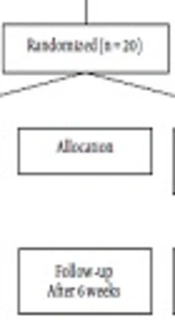
The participants were randomly assigned into 1 of the following groups: The WBV + creatine (Cr) supplementation group (n = 8), the WBV + placebo group (n = 7), and the control group (n = 7). The WBV groups performed exercises consecutively in 10 days on a Galileo vibration machine (Novotec, Pforzheim, Germany). The participants in the training groups stood on the oscillating platform, which was associated to peak-to-peak amplitude of 5 mm of vertical vibration; and we set the frequency at 30 to 35 Hz. The work-to-rest ratio was 1:1 (Table 1). The training positions were as follow: (1) standing straight with knees semi-locked; (2) isometric squat at a knee angle of approximately 120°; (3) kneeling on the floor with arms straight and hands placed on the platform; (4) squatting at a rhythm of 2 seconds up and 2 seconds down at a knee angle of approximately 120°; (5) lunge position with the left leg on the platform and the right leg on the ground; and (6) lunge position with the right leg on the platform and the left leg on the ground (27). Whole body vibration training, and warming up and cooling down lasted up to 30 minutes. Physical fitness professionals supervised all the training sessions. Then, we gradually increased the training volume and intensity based on the overload principle.
Table 1.
Whole Body Vibration (WBV) Training Protocol
| Sets | WBV Duration, s | Rest, s | Amplitude, mm | Frequency, HZ | |
|---|---|---|---|---|---|
| Day 1 - 2 | 6 | 45 | 45 | 5 | 30 |
| Day 3 - 4 | 6 | 50 | 50 | 5 | 30 |
| Day 5 | 6 | 55 | 55 | 5 | 30 |
| Day 6 | 6 | 55 | 55 | 5 | 35 |
| Day 7 - 8 | 6 | 60 | 60 | 5 | 35 |
| Day 9 - 10 | 6 | 65 | 65 | 5 | 35 |
A double-blinded, placebo-controlled design was accomplished. The WBV group consumed creatine monohydrate (Creatine Fuel®, Twin Laboratories, Inc., Hauppague, NY), and the placebo group received the same powdered dextrose. Creatine supplementation dosage for the first 5 days (loading phase) was 20 g/day body mass-1 daily, packed into 3 equivalent dosages to be drunk with each major meal; and the participants consumed 5 g/day after WBV training for 5 consecutive days (preservation phase) (28). The participants of the WBV + placebo group pursued the identical procedure, but their parcels contained dextrose. The participants in the control group did not participate in any training programs, and they were asked not to change their lifestyle during the study.
Baseline and follow-up measurements were conducted at the same time during the day by the same research assistant, who was blinded to grouping of the participants and the aims of the study. All participants fulfilled a familiarization session for tests before the study was initiated. The outcome measures were performed prior and after the 10-day training program. All the safety issues were considered for the participants.
We used a hand grip dynamometer to measure the maximal isometric strength of hand (dynamometer, YAGAMI, TY-300i, Nagoya, Japan). The participants held the dynamometer with the dominant hand, with the arm at right angles and the elbow at the side of the body. The handle of the dynamometer was adjusted if required. The participants were asked to squeeze the dynamometer with maximum isometric force and were asked to maintain the contraction for about 2 seconds. Griping contraction force was recorded to the nearest 0.1 kg. The best score result was recorded, with at least 2 minutes recovery between each effort.
Isometric strength of the legs was measured by full body dynamometer (dynamometer, YAGAMI, TY-300i, Nagoya, Japan). The participants performed a maximal voluntary isometric contraction of the knee extensors thrice. The knee joint angle was 130° and the upper body was upright. Each contraction lasted 3 seconds, and it was separated by a 2-minute rest interval. After 3 trials, the best score (kg) was recorded as isometric strength performance.
To measure leg dynamic strength, we used leg extension machine by universal knee flexor/extensor bench. After a 5-minute warm-up, the resistance was set close to the participant’s one repetition maximum load. The participants sat on the bench with the pad edge against the back of the knee joint and performed a series of flexion-extension movements. The participants hooked their feet against the padded rollers, while grasping the handles. They performed leg extensions until exhaustion. The number of successful leg extensions was recorded. If the number of leg extensions exceeded 8, then the participant rested for 10 minutes, and the resistance increased and then she would repeat the test. The records of the participant or 1 maximum repetition (1RM) was calculated according to the following formula (29):
1RM = (0.92 × Weight) + (0.79 × Repetition) - 3.73; r = 0.90, SEE = 2.04 Kg
The Flamingo Balance test is a total body balance test. This single leg balance test assesses the static balance. The participants were asked to stand on the mattress with shoes removed. They were asked to maintain balance by holding the instructor’s hand, and while balancing on the preferred leg they had to hold the free leg flexed at the knee and close to the buttocks. The test started as the instructor let the participant to stand-alone without support. The stopwatch stopped each time the participant lost her balance. The test was repeated 3 times, and the best score (to the neared 0.01 s) was recorded.
The dynamic balance was evaluated by timed-up and go-test (TUG). The TUS test involved rising from a chair, walking 3 meters, marking a line on the floor, turning around, and walking back to the chair and sitting back down on the chair as fast as possible. A 43.2-cm-high chair with backrest and without arms was prepared for the test. The best performance of the 3 trials was used for analysis, and a 2- minute rest was considered between each trail. Intraday reliabilities of the TUG test and turning time were 0.92 and 0.90, respectively.
To evaluate the neuromuscular function, we used functional tests that included tandem gait test and 3o-meter walking test. The tandem gait test measured time of walking along a 6- meter line as fast as possible so that each foot was in tandem position (heel of one foot straight in front of and in contact with the toe of the other foot). Three trials were conducted, one- minute rest was taken between each trial, and the fastest trials were recorded. The times that the participants were required to walk a 30- meter line marked, they walked as fast as possible without the use of any aids. At first, the participants who fulfilled the 3 trails were carried with a 2- minute rest between trails. The best time was recorded to the neared 0.01 second by an electronic stopwatch.
Kolmogorov-Smirnov test was used to test the normality of the variables. The correlation between pretest and posttest data was significant in the variables; ANCOVA test was used to compare the groups. If the correlation between pretest and post-pre/pre was not significant in variables, one-way ANOVA test was used. If there was a significant difference between the groups, Tukey and Sidak post hoc tests were used. Data were analyzed by (statistical package for the social sciences) SPSS 18.0 software for windows (SPSS Inc. Chicago, IL). Level of significance was set at ≤ 0.05.
3. Results
Participants’ characteristics (Mean ± SD) are presented in Table 2.
Table 2.
Participants’ Characteristics by Group
| Age, y | Height, cm | Weight, kg | BMI, kg/m2 | |
|---|---|---|---|---|
| WBV + Cr (n = 8) | 64.87 ± 3.35 | 153.25 ± 3.91 | 65.92 ± 12.61 | 27.91 ± 4.06 |
| WBV + P (n = 7) | 66 ± 4.58 | 153.28 ± 6.72 | 60.62 ± 11.30 | 25.70 ± 3.82 |
| C (n = 7) | 68 ± 9.20 | 153.57 ± 4.96 | 66.61 ± 14.93 | 28.08 ± 5.28 |
There were no significant differences (P > 0.05) between the groups among any variables at baseline. There were no reports of adverse side effects in the WBV groups. Most of the participants enjoyed the vibration and did not consider it a difficult exercise. The overall average allegiance (number of exercise classes attended as a percentage of the total number of classes) to the training program was 97.8%.
Table 3 demonstrates the results of the strength, balance, and functional performance at baseline and posttest.
Table 3.
Before and after Values of Variables in the Studied Participantsa
| Variable | Groups | Pretest | Posttest | |
|---|---|---|---|---|
| Strength | Hand isometric, kg | WBV + Cr | 17.43 ± 5.04 | 18.25 ± 4.88 |
| WBV + P | 18.71 ± 4.27 | 18.64 ±5.03 | ||
| C | 18.85 ± 4.72 | 17.57 ± 2.84 | ||
| Leg isometric, kg | WBV + Cr | 31.12 ± 9.47 | 34.75 ± 14.51 | |
| WBV + P | 22 ± 11.22 | 23.71 ± 10.32 | ||
| C | 15.85 ± 8.93 | 15.85 ± 9.65 | ||
| Leg isotonic, kg | WBV + Cr | 14.59 ± 3.11 | 21.92 ± 3.32 | |
| WBV + P | 10.69 ± 4.25 | 16.46 ± 4.62 | ||
| C | 12.12 ± 5.83 | 12.8 ± 6.41 | ||
| Balance | Static balance, s | WBV + Cr | 22.67 ± 13.01 | 51.85 ± 33.16 |
| WBV + P | 35 ± 27.89 | 47.94 ± 33.26 | ||
| C | 17.41 ± 17 | 20.56 ± 14 | ||
| TUG, s | WBV + Cr | 6.15 ± 0.44 | 4.75 ± 0.55 | |
| WBV + P | 6.31 ± 1.33 | 5.11 ± 0.60 | ||
| C | 6.09 ± 1.41 | 6.12 ± 1.03 | ||
| Functional performance | 30-m walking, s | WBV + Cr | 18.62 ± 1.78 | 15.65 ± 1.30 |
| WBV + P | 19.7 ± 2.90 | 16.85 ± 1.96 | ||
| C | 20.3 ± 3.82 | 20.01 ± 4.38 | ||
| Tandem gait, s | WBV + Cr | 13.8 ± 2.50 | 10.28 ± 2.33 | |
| WBV + P | 15.46 ± 4.04 | 11.2 ± 2.24 | ||
| C | 15.06 ± 4.66 | 13.81 ± 4.75 |
aValues are expressed as the mean ± SD.
To evaluate the results of leg and hand isometric strength, 30- meter walking, tandem gait, ANOVA test (Table 4), and Tukey post hoc test were used.
Table 4.
The Results of ANOVA in the Studied Variables
| Variable | Source | Mean Square | Df | F | P Value |
|---|---|---|---|---|---|
| Leg isometric strength | Group | 1356.07 | 2 | 4.81 | 0.02* |
| Error | 2673.78 | 19 | - | - | |
| Hand isometric strength | Group | 4.12 | 2 | 0.107 | 0.89 |
| Error | 367.57 | 19 | - | - | |
| 30 meters walking | Group | 74.17 | 2 | 4.41 | 0.04* |
| Error | 150.40 | 19 | - | - | |
| Tandem gait | Group | 30.79 | 2 | 1.45 | 0.25 |
| Error | 200.84 | 19 | - | - |
The one-way ANOVA results revealed no significant differences in isometric strength of the hand (P = 0.89) and tandem gait performance (P = 0.25); however, increase was significant in isometric strength of the leg (P = 0.02) and the 30- meter walking test (P = 0.04) between the groups. Tukey test revealed differences in the 2 later variables that was related to WBV + Cr group compared to the control group (P = 0.016 and P = 0.020, respectively).
ANCOVA (Table 5) and Sidak post hoc tests were used to evaluate the results of static and dynamic balance and leg isotonic strength.
Table 5.
The Results of ANCOVA in the Studied Variables
| Variable | Source | Mean Square | Df | F | P value |
|---|---|---|---|---|---|
| Static balance | Baseline | 5866.95 | 1 | 10.94 | 0.004 |
| Group | 2664.66 | 2 | 2.48 | 0.11 | |
| Error | 9648.51 | 18 | - | - | |
| Dynamic balance | Baseline | 4.30 | 1 | 4.297 | 0.003 |
| Group | 7.79 | 2 | 10.94 | 0.001* | |
| Error | 6.40 | 18 | - | - | |
| Leg isotonic strength | Baseline | 368.11 | 1 | 78.16 | 0.001 |
| Group | 173.79 | 2 | 18.45 | 0.001* | |
| Error | 84.77 | 18 | - | - |
The ANCOVA results revealed no significant improvement in static balance variable (P = 0.11). In contrast, dynamic balance (P = 0.001) and leg isotonic strength (P = 0.001) were significantly increased. Post hoc test revealed that dynamic balance was improved in both experimental groups, WBV + Cr (P = 0.001), and WBV + P (P = 0.009) compared to the control group. Furthermore, leg isotonic strength increased in WBV + Cr (P = 0.001) and WBV + P (P = 0.001) groups.
4. Discussion
Our specific aims were to evaluate whether the combination of WBV and creatine consumption would improve neuromuscular performance and physical fitness in elder women. Thus, we reported some key findings. First, we found that WBV training with and without creatine supplementation led to significant improvement in leg muscle dynamic strength in 10 days, but no significant change was observed in hand strength. However, WBV training without creatine did not change the isometric strength of the leg muscle. Therefore, consumption of creatine supplement increased isometric strength of the leg in elderly women for 10 days. Improvements in strength have been reported after WBW training (2, 10, 16, 17, 30-32) in several previous studies with different durations. However, some other studies have not reported significant improvements in strength after WBW training (8, 9). In our previous study, we found that WBV training and creatine supplementation did not improve hand and leg strength in elder men in the short- term (33). It seems that duration of training is a determinant factor; and in those studies that an improvement in strength after WBV training was reported, training duration varied from 6 weeks to a year. Moreover, the findings on the effect of creatine supplementation with different time periods on strength are inconsistent. In some studies, a significant increase was reported in leg and hand strength after 7 (23, 24) and 14 days (34) of creatine supplementation, while no significant changes have been reported even after 52 days (35) and 6 months of supplementation (36) in other studies. In a study, a significant improvement was reported in leg strength after 14 weeks of resistance training plus creatine supplementation, but the authors reported significant changes in hand strength (13). The differences in the findings might be due to the type of strength assessment. Studies that assessed the dynamic strength or isotonic maximal force reported that creatine supplementation may have positive effects on strength, but more diversity results were found in studies in which isokinetic strength has been measured. Moreover, studies that assessed isometric strength reported that creatine supplementation has had small but positive effects on strength (37). In our study, we assessed hand isometric and leg isometric and isotonic strength, and it could have affected the results because leg dynamic strength increased, while isometric strength did not improve in comparison to the control group.
Second, we found no significant differences in static balance among the groups. On the contrary, dynamic balance was improved in WBV training + creatine and WBV + placebo groups compared to the control group. Thus, it seems that WBV training with and without creatine supplementation may improve dynamic balance in elderly women within 10 days. Some previous studies reported improvement in dynamic and static balance after different WBV training periods (8, 13, 38-40). In addition, it has been found that WBV training might improve balance and posture control of those who suffer from heart attack, Parkinson disease, and multiple sclerosis (18, 41). In our previous study, we found that WBW training and creatine supplementation did not affect the static and dynamic balance in elder men in the short- term (42).
One of the most important factors affecting the sensory-motor integration is the myotatic reflex, which is done by muscle spindles (15). It has been proposed that WBV may enhance the sensitivity of the muscle spindles and may improve the speed of neuromuscular responses. Moreover, WBV could improve the coactivation of alpha and gamma motor neurons that may finally lead to facilitation of muscular contractions. Enhancement of the sensitivity of the muscle spindles and improvement in neuromuscular responsiveness that were observed following WBV, have been proposed as the possible reasons of improvement in balance after WBW training. The other possible reason may be related to the central effects of WBW training that may improve the agonist and antagonist muscles coordination. The coordination of lower limb agonist and antagonist muscles, especially those around the ankle joint, is of great importance in ankle fixation and plays an important role in balance maintenance (15).
Evidence shows that there is a strong relationship between balance and strength. Wolfson et al. (1995) studied the effect of lower limb strength, walking, and balance on the frequency of falling in nursing home residents. They reported that the increase in strength was accompanied with fewer falls. Thus, they concluded that there is a strong relationship between lower limb strength, balance, and walking (43). Furthermore, Wiacek et al. (2009) found a significant correlation between lower body strength and balance in elder women (44). Our findings are also consistent with their results, indicating that an increase in leg static and dynamic strength is accompanied by improvement in balance.
Third, our results revealed that WBV training along with creatine supplementation led to significant improvement in 30- meter walking performance, while WBV alone did not improve this variable. In fact, it means that creatine supplementation improved performance. In contrast, most of the previous studies have demonstrated that WBW training has significant effects on neuromuscular performance and motor function (2, 13, 45). Moreover, results of some other studies have shown that short-time creatine supplementation may improve motor fitness (23-25). On the contrary, some researchers reported that combined resistance training and creatine supplementation for 14 days (34), 30 days (46), and 14 weeks (47) did not result in improvement in lower body performance. Moreover, in our previous study, we found that combined creatine supplementation and WBW training (10 days) did not have significant effects on neuromuscular performance in the short- term (42).
Perhaps neural adaptations are not only the most relevant mechanism of balance and strength improvement in strength training but also in vibration training. In addition, it is suggested that vibration training induces biological adaptation such as neural potentiation, which is comparable to that of resistance and explosive strength training (10). Because vibration training results in increased muscle activity in the elderly, most of the strength gain may be related to muscles stimulation by the vibratory stimuli (10). In addition, improvement in lower body function following training is subject to increased strength, and there is a strong relationship between strength and the ability to perform daily activities such as walking, getting up, and sitting on a chair, and climbing stairs. Moreover, several studies have found that increase in strength and improvement in performance occurred simultaneously (23, 24, 30). Accordingly, the increase in leg strength may be a possible mechanism for improvement in the 30- meter walking performance in our study.
However, duration of intervention is a determinant factor. Because compared to our 10-day training protocol, long-term WBV training resulted in beneficial gains in muscle strength and balance, and other physical fitness factors. In addition, gender was another factor that might have influenced the results, so in our previous similar study, which was conducted on elderly men, we did not observe any changes in these variables (33, 42). Hence, diversity in the time of training intervention and gender of the participants might have affected the results.
In addition, individual characteristics and basic levels of intracellular creatine of the participants could influence creatine efficiency. Therefore, in response to creatine, people can be categorized into responders and nonresponders; thus, based on this fact, it may be possible that people give positive response to creatine supplementation or show no change (36, 37, 47). Candow et al. (2008) showed that those who had less basic level of total intracellular creatine, experienced more response to creatine supplement with resistance training (48). Therefore, it seems that elderly adults who have low creatine level are flexible to creatine, whereas those elderly adults who have high creatine level in their muscles are considered as inflexible and show less response to creatine. Although we did not measure the amount of total creatine and phosphocreatine, this factor could have affected the outcome.
With respect to the physical fitness and motor performance, factors such as difference in intensity, time, position of exposure on WBV device, and kind of device are among the reasons for the variation in the studies. Thus, different results should be interpreted with caution, because in some cases even very little changes in intensity and amplitude have significant effects on the results. Moreover, dynamic or static training on WBV device, number of repetitions, and rest between repetitions are other factors that may affect the outcome. Although many researches have been conducted in this field, there is no consensus on the practical and operative protocol.