1. Background
Domestic mites (DM) refer to all indoor mite species that are able to induce IgE-mediated sensitization. The domestic mites consist of the house dust mites (HDM) and some of the storage mites (1, 2). In the last decades, the prevalence of allergic disease such as asthma has increased worldwide (3). Domestic mites are one of the major sources of indoor allergens that induce allergic diseases such as asthma and other allergic disorders. The importance of mites’ allergens in asthma and allergy have been confirmed by different studies (4, 5). During the digestion of food in different regions of the mites’ digestive tract, the cells of Midgut walls produce large quantities of digestion enzymes and a peritrophic membrane that protects the delicate hindgut from the damage by abrasion mix with the fecal pellets of dust mites that can trigger an immune response when humans are exposed to them (5-7). Public buildings and homes provide a good habitat for the DMs as well as humans (8). Mite allergens can be found in many areas of the homes such as carpets, mattress, furniture, and closet. The beds are the ideal habitats for the mites since the beds prepare the food, ideal temperature, and humidity for their propagation. The mite allergens may stock deep inside old pillows, mattresses, and carpets (9).
The pyroglyphid mites have been the object of most works on mite allergens (1, 2, 5, 7, 8, 10-12). Despite the fact that the principal allergen-producing mite species belong to the family Pyroglyphidae, some of the storage mites such as Blomia tropicalis are capable of inducing allergy as well (5). Based on recent surveys of allergen mites in Iran, the most common and abundant species are Dermatophagoides pteronyssinus, D. farinae, Blomia tropicalis, and Cheyletuseruditus (5, 13-16). Until now, only thirteen species of DMs have been recorded from homes, hotels, inns and kindergartens of Iran as follows: Dermatophagoides pteronyssinus, D. farinae, D. evansi, Euroglyphusmaynei, Acarussiro, Tyrophagusputrescentiae, Lepidoglyphus destructor, Glycyphagusfusca, G. domesticus, Cheyletusmalaccensis, Cheyletuseruditus and Cheyletusarcuatus (5, 13-20).
2. Objectives
Considering the importance of DM and lack of investigation on DM in military bases of Iran, this study was designed to determine the fauna and seasonal abundance of DMs in three northern military areas, Iran.
3. Methods
This cross-sectional study was carried out in three military areas, North of Iran, between September 2017 and August 2018.
Each military area was divided into three sampling zones (lieutenant dormitory, soldier dormitory, and administrative place). In the lieutenant dormitory and the soldier dormitory sampling zones, 7 places were randomly selected (four beds and three parts of the floor) and four places in the administrative place (two chairs and two parts of the floor). Dust samples were collected using a vacuum cleaner from 1 m2 of each sampling place in 2 minutes. The sampling has been done monthly. After collection, samples were placed in 120 milliliters vials, labeled separately, and transferred to the laboratory. In the laboratory, the samples were weighted separately, the mites were counted by a Stereo microscope, cleared in lactophenol solutions, mounted in Hoyer’s medium, and identified by standard keys. The data were analyzed using statistical SPSS version 17 and Microsoft Excel version 2013 software.
4. Results
A total of 648 dust samples were collected from three military areas, 1043 mites were collected and identified at the species level that 741 of them belonged to DMs. The collected DMs were identified as six species, five genera, and four families, including Dermatophagoides farinae, D. pteronyssinus, Euroglyphusmaynei (Pyroglyphidae), Blomia tropicalis (Echimyopodidae), Glycyphagusdomesticus (Glycyphagidae), and Cheyletusmalaccensis (Cheyletidae).
Dermatophagoides farina with 72.74% was the dominant species and present in all mite-positive samples. D. pteronyssinus and B. tropicalis with 14.57% and 7.02% were the second and third most frequent species, respectively (Table 1). E. maynei and G. domesticus with 0.54% and 0.94%, respectively were the least frequent species. Ch. malaccensis with 4.18% was the moderate frequent species. A total of four families were collected, Pyroglyphidae with 94.33 was the main and most frequent family. The prevalence of DMs in the second military area was less than other military areas and the prevalence of DMs in the first military area was a little more than third one (Table 1).
Table 1.
Mite Species Present in Dust Samples Collected from Three Military Areas, During 2017 - 2018a
| Species | Species | Total | ||
|---|---|---|---|---|
| First Area | Second Area | Third Area | ||
| D. farinae | 235 (43.59) | 117 (21.7) | 187 (34.69) | 539 (72.74) |
| D. pteronyssinus | 27 (25) | 36 (33.33) | 45 (41.66) | 108 (14.57) |
| B. tropicalis | 23 (36.54) | 12 (23.08) | 17 (40.38) | 52 (7.02) |
| Ch. Malaccensis | 11 (35.48) | 13 (41.94) | 7 (22.58) | 31 (4.18) |
| G. domesticus | 5 (71.43) | 0 | 2 (28.57) | 7 (0.94) |
| E. maynei | 1 (25) | 0 | 3 (75) | 4 (0.54) |
| Total | 302 (40.76) | 178 (24.02) | 261 (35.22) | 741 (100) |
aValues are expressed as No. (%).
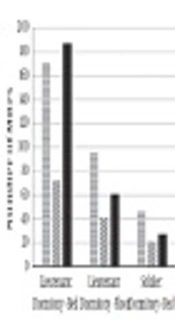
In total, the DMs were found almost throughout the year, the highest abundance of DMs was in summer (37.4%) and the lowest in winter (11.2%). The highest peaks were in September (14.7%) and August (13.1%) and the smallest peaks were in March (3.2%) and January (3.8%). The dynamic population of DM in military areas almost followed the same pattern (Figure 1). Most DMs were found in the lieutenant dormitory (84.3%) and just 1.9% of DMs were found in the administrative place (Figure 2). Most of the mites were isolated from the beds (70.7%) and smaller numbers from the chairs (1.6). The results showed that the beds (1.82 mites per sample) and floors (0.75 mite per sample) were more infected place than the chairs (0.03 mite per sample) (Figure 2).
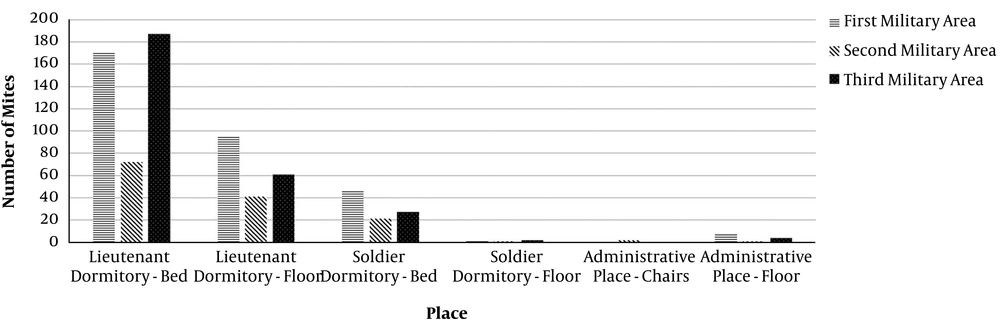
Figure 1.
Seasonal abundance of DMs in three military areas in 2017 - 2018.
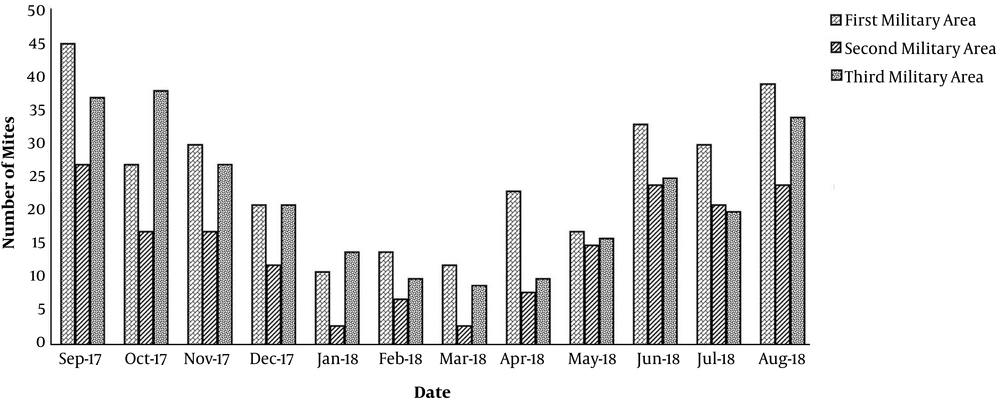
Figure 2.
The prevalence of DMs in different zone samples of the military area
5. Discussion
In this study, Dermatophagoides farina was the most dominant species with a frequency of 82.8% of the pyroglyphid mites and 72.7% of the total mites’ population. D. pteronyssinus with 14.57% was the second most frequent species. Almost all studies on the HDMs in Iran have confirmed that the most dominant HDMs species in Iran is D. pteronyssinus such as a study that have been done in the homes of Sari city, Mazandaran province (the Guilan province neighbor) in Iran, that reported D. pteronyssinus (87.75%) as the main species and D. farina (1.15%) as the second most frequent species (19). Just a study on level of house dust mite allergens in Sari and Gorgan cities revealed the level of Der p1 was less than Der f1 and they mentioned that D. farina is more resistant than D. pteronyssinus to variable weather, causing more density of D. farinae (21). There are two probabilities for this inconsistency: (1) the special condition of military areas dormitory such as the strict rule for cleaning and used material for dormitory building, has been in favor of D. farinae and in the lack of D. pteronyssinus; (2) the latest morphological research on dust mites in the South shore of the Caspian Sea dates backs to 16 years ago (19), and changing in dust mites biodiversity over time have been reported by Halmai, and Petrova and Zheltikova (22, 23). According to the Fereidouni et al. and our finding, the second one is more probable (21).
The third most frequent species was B. tropicalis (7.02%). This species is a storage mite and the most common and abundant species in tropical and subtropical regions of the world (23, 24). The pyroglyphid mites and the storage mite such as B. tropicalis are the main sources of allergens in house dust (25). Also, studies on indoor allergen in Iran confirmed that those species are one of the main sources of indoor allergens in Iran (20, 21, 26-28). The presence of all of these species in military areas dormitory showed that doing preventive control was mandatory.
According to the results, most DMs were found in the lieutenant dormitory and 13.6% of DM were found in the soldier dormitory. The reasons for the higher prevalence of DMs in the lieutenant dormitory than the soldier dormitory can be as follows: (1) type of floor coverings (the lieutenant dormitory floor has been covered with carpet, but the soldier dormitory has been covered with natural stone tiles, except for the lieutenant dormitory of second area that a small part of floor has been covered with carpet); (2) cleaning regulations (there were stricter cleaning regulations in the soldier dormitory than the lieutenant dormitory); (3) the possibility to bring personal blankets and pillows from outside of military areas to the lieutenant dormitory (it is prohibited in the soldier dormitory except for the lieutenant dormitory of second area). Studies on the efficacy of the type of the floor on the density of house dust mites revealed the water resistant materials such as wooden and natural stone tile are the best for floor coverage in the place with a chance of mite outbreak because the water-resistant materials are easily washed and reduce the indoor humidity (5, 29).
The prevalence of DMs in the second military area was less than other naval bases, the main difference was related to the difference in the prevalence of DMs in the lieutenant dormitories. Regulations and rules of the lieutenant dormitory of the second area were as good as the soldier dormitory (but there were not in the other lieutenant dormitories). Also, a small part of the lieutenant dormitory of the second area was covered with a carpet that cleaned every day (but in the other lieutenant dormitories a carpet covered the whole of the floor).
5.1. Conclusions
In summary, the results of this study show that all military areas dormitories are contaminated with more than four allergen mite species. Three main allergenic dust mite species D. farinae, D. pteronyssinus, and Blomia tropicalis were the most prevalent species in the studied area. The prevalence of DMs was near the risky threshold in the first and third military areas from June to November. Regarding the high prevalence of DMs in those military areas, we suggest that the following preventive measures will be done in first and third military areas from June to November: weekly monitoring of allergen mite population, indoor temperature and humidity, weekly cleaning all surfaces by vacuum cleaner in full power (especially pillows, mattress, and carpets), implementation of strict cleaning regulation, and avoiding of leaving dirty clothes under beds.