


1. Background
Many students perceive entering a university, including the experience of living in a dormitory, as the beginning of a new stage of their life. Given the large number of students annually admitted to universities outside their place of residence, dormitories are considered a substitute for their family environment (1). In 1996, Johnson et al. showed that living in dormitories and their hygienic status increase students’ tolerance, develop their psychosocial characteristics, self-confidence and critical thinking and help with their adaptation to the community, participation in non-teaching activities and mental maturity (2). Research suggests that good health can improve the learning potential, and that a healthy and systematic learning environment is required for ensuring psychophysical health as an essential component of efficient learning (3). In 2004, Bahreinian et al. found inappropriate conditions of dormitories to disrupt the psychophysical health and educational status of students (4). In Iran, the number of student dormitories has increased proportionally to the recently-growing student population. According to the statistics adopted from the ISNA website, in 2015, the total number of Iranian university students was 4400000, including 92457 in Kermanshah, and 45% of the students were living in dormitories (5). Given the importance of the hygiene of dormitories as the place of residence of students, significant health factors and their standards are categorized in Table 1.
Table 1.Significant Health Factors and Their Standards in Student Dormitories
| Health Items | Standards |
|---|---|
| Provide safe drinking water | Access to safe sanitary water |
| Collection and proper disposal of waste materials | At least 2 days once (6) |
| Collection and proper use of sewage | Lack of seizure of sewage and lack of accumulation of sewage |
| Control and fight against insects and rodents | Equipped with windows to the grid, the existence of a regular refinement and spraying program |
| Create an environment improvement facility | There is a curriculum to rehabilitate and improve the environment |
| Provide general cleaning | Regular dusting, cleaning and repairing failures |
| Ambient lighting | Bedroom: 100 to 50 lx |
| Study table: 500 lx | |
| Living room: 200 lx (6) | |
| Air requirement | 0.7 - 1 per hour (7) |
| Ventilation | At least 45% of the window level should be opened / the area and size of the ventilation valve per cubic meter of the room is equal to 100 m2 (6) |
| Moisture | 40% (6) |
| Temperature | 20°C (6) |
| Dust | - |
| Mite | - |
2. Objectives
The present study was conducted in 2016 to investigate the environmental hygiene status of dormitories for female students of Kermanshah University of Medical Sciences. The different areas of the dormitories evaluated included the building and rooms, sanitary facilities, study halls and buffets.
3. Methods
3.1. Field Data Collection
The present descriptive cross-sectional study was conducted on a population comprising dormitories for females students of Kermanshah University of Medical Sciences, namely Shahid Mofatteh, Boostan and Taleghani. Table 2 presents the details of these dormitories.
Table 2.Details of the Dormitories for Female Students of Kermanshah University of Medical Sciences
| Unit Name | Number of Floors | Number of Rooms | Sub-Basement (m2) | Number of Students |
|---|---|---|---|---|
| 1 | 4 | 54 | 1366 | 271 |
| 2 | 3 | 64 | 4100 | 287 |
| 3 | 2 | 60 | 2000 | 243 |
3.2. Collecting Data About Health Parameters in Dormitories
Table 3 presents the study parameters. To investigate these parameters, a checklist comprising 14 sections was developed according to library information and the existing standards and regulations of the Iranian Ministry of Health, and completed through field inspections for each dormitory. Before being included in calculating the overall score, the study parameters were given weighting factors based on the advice of environmental health experts.
Table 3.The Number of Questions in Each Study Group
| Parameters Reviewed | Weight Based on Importance | Number of Questions |
|---|---|---|
| Prayer room | 11 | 1 |
| kitchen | 2 | 20 |
| General cleaning | 3 | 9 |
| Buffet | 1 | 17 |
| Wastewater | 3 | 7 |
| Garbage | 3 | 16 |
| room | 3 | 17 |
| Building | 3 | 15 |
| Ventilation | 3 | 5 |
| Safety | 3 | 10 |
| Area | 1 | 4 |
| Reading room | 1 | 17 |
| Gym | 1 | 18 |
| Toilet | 2 | 15 |
3.3. Data Analysis
The score obtained for each parameter was multiplied by its weight, and the average of that parameter was calculated in different rooms. The overall score of the parameter was then determined on a three-point Likert scale, including poor: 0 - 0.33; moderate: 0.33 - 0.66 and favorable: 0.66 - 1. The data obtained were plotted in Microsoft Excel 2010, and humidity, temperature, light (based on the ratio of the window surface to the internal surface of the room) and dust were expressed with measures of dispersion, including mean, minimum and maximum.
3.4. Prevalence of Mites in the Study Rooms
To investigate the prevalence of HDMs, 1 m2 of the study surfaces, including mattresses and carpets, was sampled using a vacuum cleaner with a suction flow of 95.8 L/min. The dust collected in the vacuum cleaner cyclone was weighed with a digital scale, sifted using a mesh sieve with 500 micron-pores, and then divided into three parts, each of which was suspended in 25 mL of a saline solution containing 9% caustic soda and 3 drops of detergent in a 50-mL propylene tube, and vortexed for 20 seconds. The suspension was passed through a mesh with 235-µm pores, and the residue was washed with distilled water in a clean sample container, and then stained with crystal violet, which causes all the components of the dust sample to be stained except for HDMs. It is worth noting that detecting mites is easier against a purple background. A microscope made by Carl Zeiss Jena was used with low magnifications of X25 and X40 to count HDMs. The number of HDMs was determined and their density calculated in each of the three sub-samples as the number of HDMs per gram of dust. To investigate HDMs and temperature and humidity in each room, a sample size of 114 was obtained as the number of study rooms using the Morgan table.
3.5. Measuring Environmental Parameters
Humidity and temperature were measured with a thermo-hygrometer made by TFA Dustman Company, and the amount of dust and number of HDMs were examined through sampling the surface unit of the carpets and mattresses.
4. Results and Discussion
4.1. Results Obtained from the Checklists
After the field inspection and completion of the checklist, the results were entered into SPSS and assigned weighting factors based on their health importance, and the scores were classified as poor, moderate and favorable based on the Likert scale. Table 4 presents the health status of the study items in Shahid Mofatteh, Boostan and Taleghani dormitories.
Table 4.The Status of the Study Health Parameters in the Dormitories
| Dormitory, Condition | |||||||||
|---|---|---|---|---|---|---|---|---|---|
| 1 | 2 | 3 | |||||||
| Weak | Medium | Optimal | Weak | Medium | Optimal | Weak | Medium | Optimal | |
| Prayer room | - | 100 | 100 | 100 | |||||
| Toilet | - | 100 | 100 | 100 | |||||
| kitchen | - | 87.5 | 12.5 | 70.5 | 100 | ||||
| Garbage | 12.5 | 87.5 | 80 | 20 | 100 | ||||
| Building | - | 100 | 100 | 100 | |||||
| Safety | - | 100 | 100 | 100 | |||||
| Ventilation | - | 100 | 100 | 100 | |||||
| Gym | - | 100 | 100 | 100 | |||||
| Reading room | 100 | 100 | |||||||
| Room | 100 | 100 | |||||||
| Wastewater | - | 58.8 | 41.1 | 5.8 | 76.4 | 17.6 | |||
| Area | - | 100 | 100 | ||||||
| Buffet | - | 100 | 100 | ||||||
| General cleaning | - | 100 | 100 | 100 | |||||
The overall score of Taleghani dormitory was 0.67, Mofatteh 0.6, and Boostan 0.77. According to the Likert scale, the health status of Taleghani and Boostan was favorable and that of Mofatteh moderate. In the majority of the investigated rooms, the health status of the study hall and the rooms and waste disposal was poor. The health status was better in Boostan dormitory, poor items were not observed, and kitchen, waste disposal, building condition and general health were categorized as moderate. In Taleghani dormitory, sewage disposal and the buffet health status were in poor health conditions. Based on the study parameters in the checklist, the general health status of Boostan dormitory with a score of 0.77 was the best compared to that of the other two.
4.2. Environmental Parameters
The mean room temperature in Mofatteh dormitory was found to be 25.94 ± 1.57°C, in Boostan to be 26.835 ± 1.45°C and in Taleghani 26 ± 1.92°C. According to Figure 1, the mean humidity was measured as 21% - 48% in the three dormitories. Both the study parameters therefore lay in the standard range.
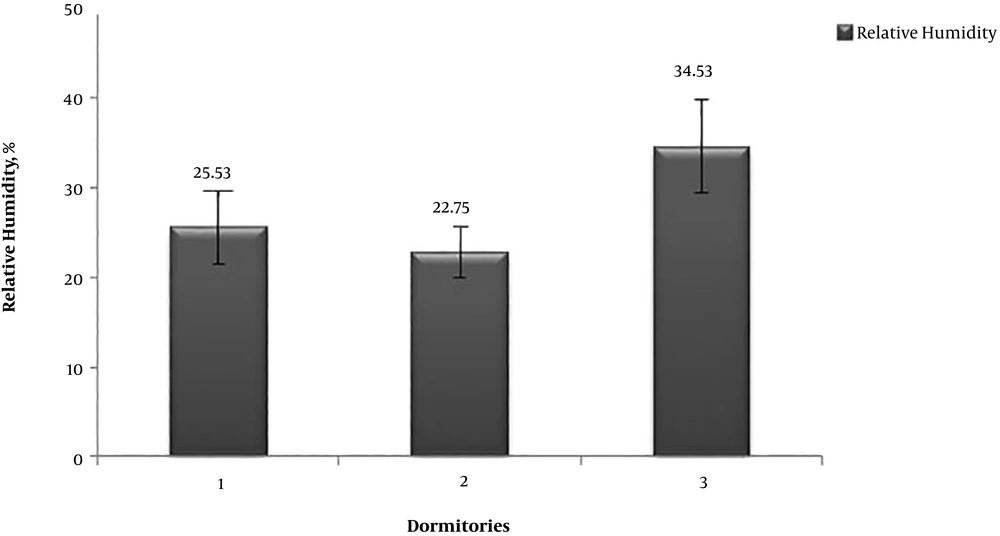
Figure 1.
Relative humidity in the study dormitories
4.3. Dust Levels and Prevalence of HDMs in the Rooms
Figure 2 shows the measured level of dust in the samples collected from the surfaces of the mattresses, pillows and carpets in the study rooms, suggesting the highest amount of dust in Mofatteh dormitory and the lowest in Taleghani. The completed checklist as per Table 4 also suggests a poor health status for Mofatteh dormiory in terms of all the examined items.
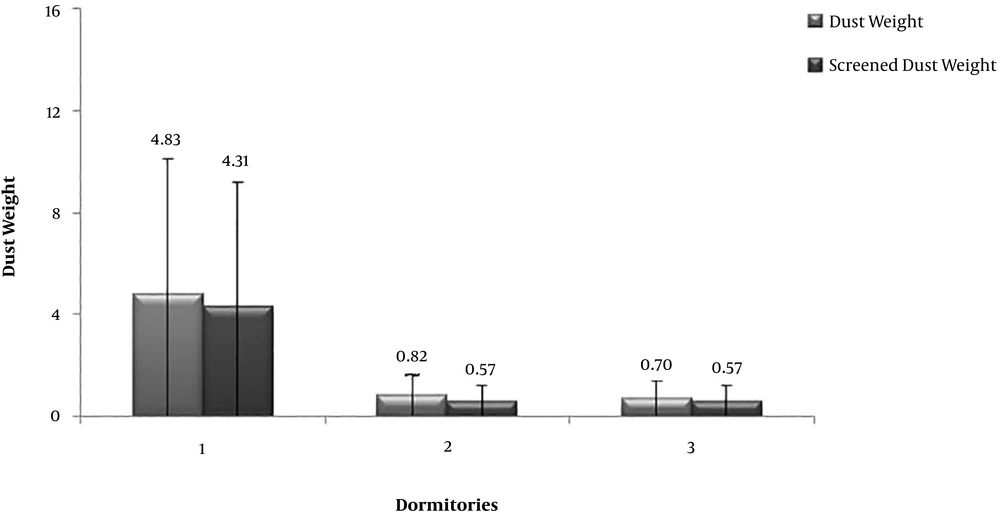
Figure 2.
The amount of dust in the study dormitories
4.4. Relationship Between the Levels of Humidity and Dust
Investigating the dust samples collected from the dormitories found only one sample positive for (dead) mites in both Boostan and Taleghani dormitories, and no positive samples in Mofatteh dormitory. Research suggests humidity is an effective factor in the survival of HDMs. In 1999, Arlien et al. observed the highest number of HDMs at a relative humidity of over 60% (8), which is consistent with the present research failure to identify samples positive for HDMs given the low relative humidity of the sampling sites and the city of Kermanshah as a whole.
4.5. Conclusions
The results obtained from the present research suggest that the health status of the dormitories was moderate to high based on their overall score; nevertheless, the buildings oldness and a lack of a consistent management of waste collection and sewage disposal were among the most effective factors in the degradation of the health status of all the dormitories. These problems are recommended to be solved by developing short-term, mid-term and long-terms plans. In terms of the health status of rooms, training programs are recommended to be implemented to teach students about their individual health and promote their health culture.

