Delayed Recanalization of an Embolized Pulmonary Arteriovenous Malformation Caused Brain Abscess in a Patient with Osler-Weber-Rendu Syndrome

Author(s):
Salman FarooqSalman Farooq1, Ashkan MowlaAshkan Mowla1,*, Mahmoud Abdel RazekMahmoud Abdel Razek1, Azher IqbalAzher Iqbal2, Robert N SawyerRobert N Sawyer1
1Stroke Division, Department of Neurology, State University of New York at Buffalo, New York, US
2Vascular Interventional Associate, Buffalo General Medical Center, New York, US
*Corresponding Author: Corresponding author: Ashkan Mowla, Stroke Division, Department of Neurology, State University of New York at Buffalo, New York, US. Tel: +716-8597540, Fax: +716-8592430, E-mail: Email: [email protected]

Archives of Neuroscience:Vol. 4, issue 1; e35607
Published online:Jun 14, 2016
Article type:Letter
Received:Dec 19, 2015
Accepted:Mar 05, 2016
How to Cite:Farooq S, Mowla A, Abdel Razek M, Iqbal A, N Sawyer R. Delayed Recanalization of an Embolized Pulmonary Arteriovenous Malformation Caused Brain Abscess in a Patient with Osler-Weber-Rendu Syndrome. Arch Neurosci. 2017;4(1):e35607. doi: https://doi.org/10.5812/archneurosci.35607

Dear Editor,
Osler-Weber-Rendu Syndrome (OWRS), also known as hereditary hemorrhagic telangiectasia, is a rare genetic disorder characterized by telangiectasias and excessive bleeding. Brain abscess and ischemic stroke are rare but potentially serious complications of OWRS, caused by paradoxical embolism from pulmonary arteriovenous malformations (AVMs) (1). We describe a case of a 56 year old woman with past medical history of OWRS who presented to emergency room with headache and confusion and was found to be febrile. She had a known pulmonary AVM, previously coiled. A head CT scan without contrast showed an area of hypodensity of right temporal lobe. Brain MRI revealed a brain abscess (Figure 1) which was treated with antibiotic therapy. A pulmonary angiogram revealed recanalized AVM in the left lobe of lung which was embolized 15 years ago (Figure 2). She underwent endovascular re-embolization to avoid future neurologic complications. Frequent follow-up of treated patients is indicated since pulmonary AVM tend to increase in size over time and might cause neurological complications.
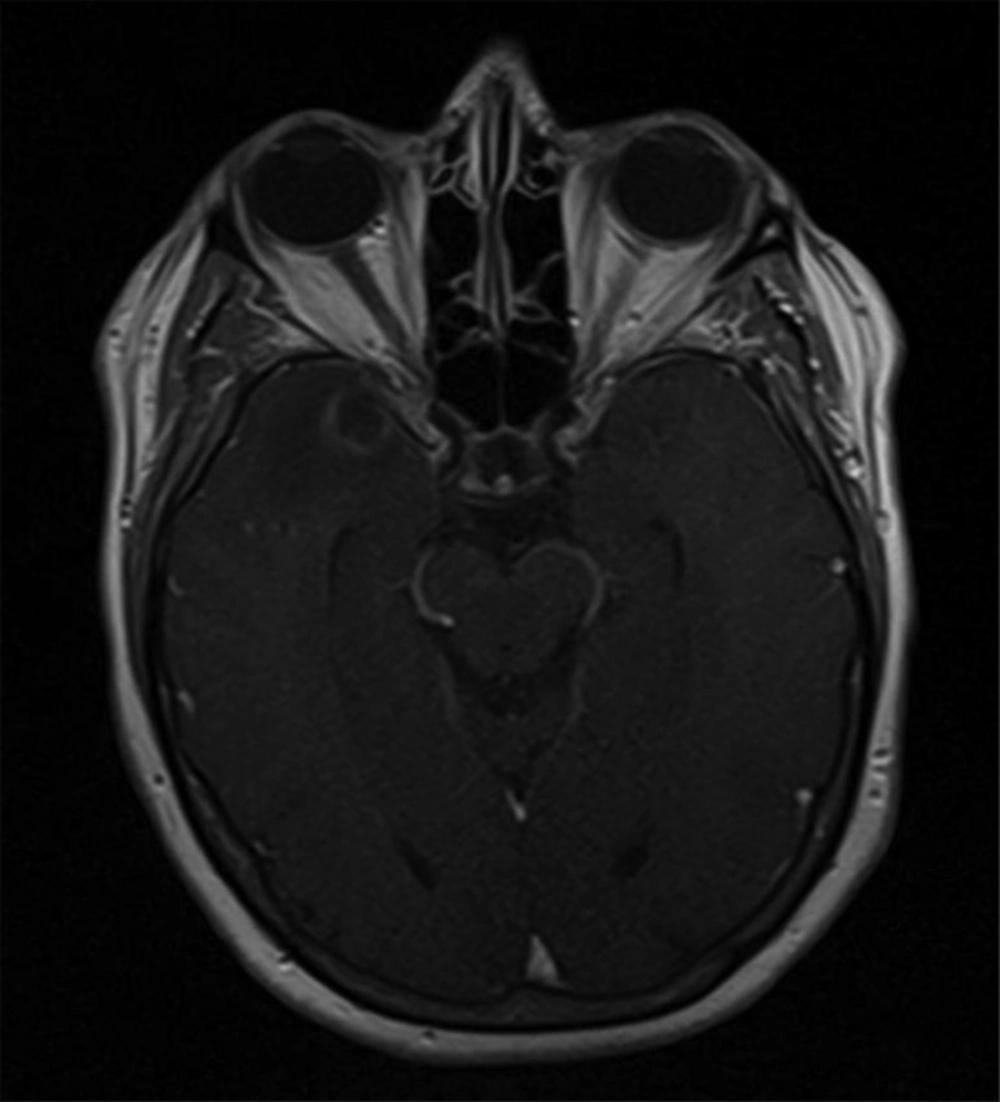
Gadolinium-Contrasted axial T1-Weighted Image of Brain MRI Shows Ring Enhancing Lesion in Right Temporal Lobe With Surrounding Edema
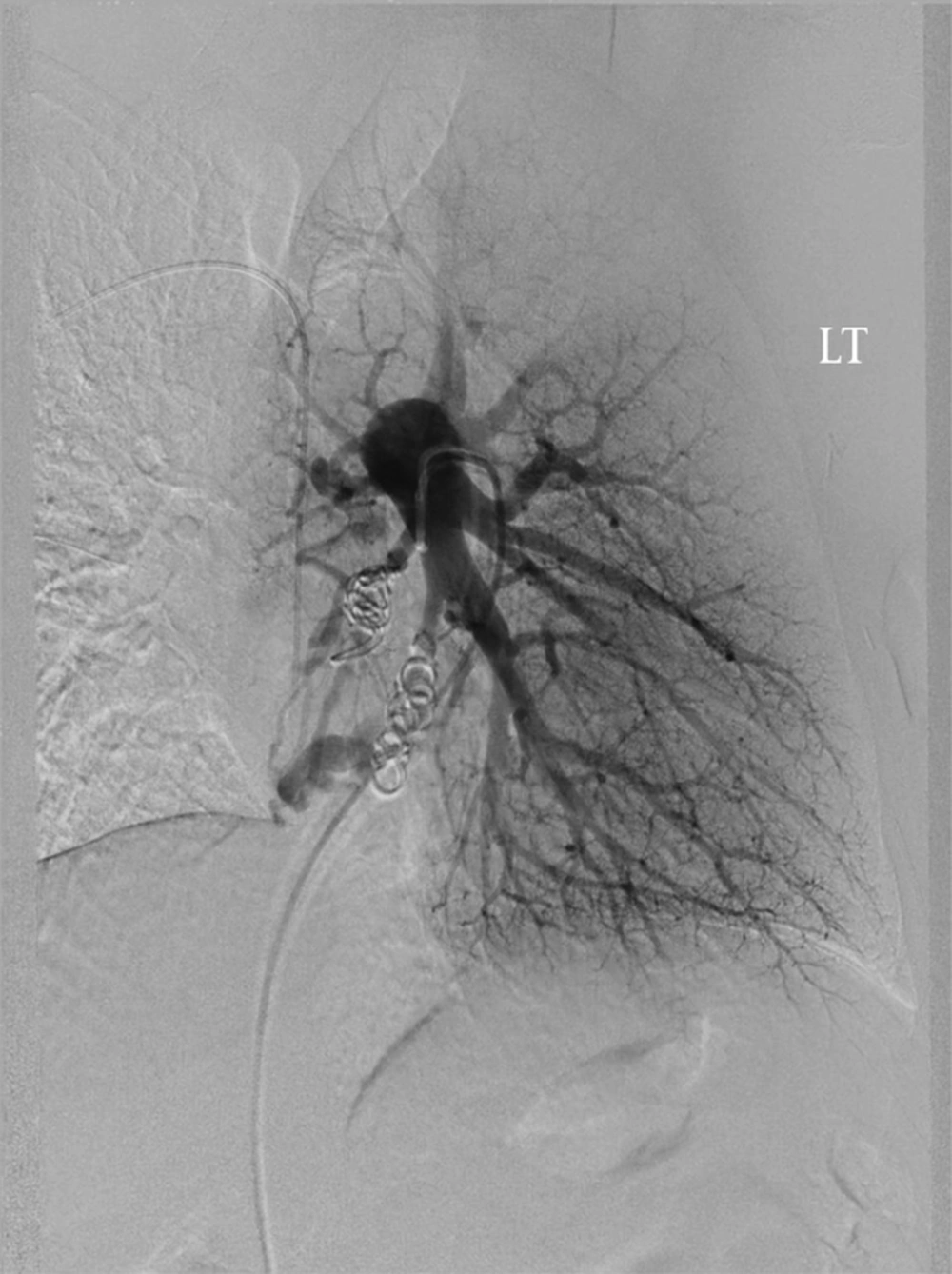
Figure 1.

Gadolinium-Contrasted axial T1-Weighted Image of Brain MRI Shows Ring Enhancing Lesion in Right Temporal Lobe With Surrounding Edema

Left Lower Lobe Branches of Pulmonary Arteriogram Shows 2 Recanalized AVM Nidi Through the Previously Embolized Feeding Vessel With Microcoils
Figure 2.

Left Lower Lobe Branches of Pulmonary Arteriogram Shows 2 Recanalized AVM Nidi Through the Previously Embolized Feeding Vessel With Microcoils

Acknowledgments

Footnotes

  • Authors’ Contribution:All authors have contributed equally, read and approved the submitted manuscript.

  • Financial Disclosure:Authors have no relevant financial interest to disclose.

  • Funding/Support:None declared.

References

  • 1.
    Swanson KL, Prakash UB, Stanson AW. Pulmonary arteriovenous fistulas: Mayo Clinic experience. Mayo Clin Proc. 1999:671-80.

Copyright

Copyright © 2016, Tehran University of Medical Sciences. This is an open-access article distributed under the terms of the Creative Commons Attribution-NonCommercial 4.0 International License (http://creativecommons.org/licenses/by-nc/4.0/) which permits copy and redistribute the material just in noncommercial usages, provided the original work is properly cited.

Similar Articles

3
Aug
2021
Multidiscip Cardio Annal

Unusual Course of Pulmonary and Brain Arteriovenous Malformation: A Case Report

Zahra Khajali,
Hojjat Mortezaiyan,
Faramarz Amiri,
Maryam Aliramezany

Khajali Z, Mortezaiyan H, Amiri F, Aliramezany M. Unusual Course of Pulmonary and Brain Arteriovenous Malformation: A Case Report. Multidiscip Cardio Annal. 2021;12(2):e111209. doi: https://doi.org/10.5812/mca.111209

23
Sep
2024
J Kermanshah Univ Med Sci

Rendú Osler Weber Syndrome or Hereditary Hemorrhagic Telangiectasia: A Case Report from Iran

Khadijeh Ramezani-Aliakbari,
Soudabeh Ramezani-Aliakbari,
Bita Anvari

Ramezani-Aliakbari K, Ramezani-Aliakbari S, Anvari B. Rendú Osler Weber Syndrome or Hereditary Hemorrhagic Telangiectasia: A Case Report from Iran. J Kermanshah Univ Med Sci. 2024;28(3):e144045. doi: https://doi.org/10.5812/jkums-144045

22
Jul
2015

Coil Embolotherapy of Unilateral Diffuse Pulmonary Arteriovenous Malformations in a Nineteen-Year-Old Woman

Hadi Rokni Yazdi,
Hamidreza Abtahi,
Hazhir Saberi,
Mona Salahi

Rokni Yazdi H, Abtahi H, Saberi H, Salahi M. Coil Embolotherapy of Unilateral Diffuse Pulmonary Arteriovenous Malformations in a Nineteen-Year-Old Woman. I J Radiol. 2015;12(3):e9632. doi: https://doi.org/10.5812/iranjradiol.9632

1
Mar
2016

Congenital and Acquired Renal Arteriovenous Malformations: Curative Embolization with Onyx

Serkan Guneyli,
Celal Cinar,
Halil Bozkaya,
Mehmet Korkmaz,
Turker Acar,
Mustafa Parildar
,et al.

Guneyli S, Cinar C, Bozkaya H, Korkmaz M, Acar T, et al. Congenital and Acquired Renal Arteriovenous Malformations: Curative Embolization with Onyx. I J Radiol. 2017;14(2):e25672. doi: https://doi.org/10.5812/iranjradiol.25672

12
Mar
2012

Aortic Runoff as a Sign of Intracranial Arteriovenous Malformation: Report of Two Cases

Maryam Moradian,
Paridokht Nokhostin-Davari,
Mahmood Merajie,
Hamid-Reza Pouraliakbar

Moradian M, Nokhostin-Davari P, Merajie M, Pouraliakbar H. Aortic Runoff as a Sign of Intracranial Arteriovenous Malformation: Report of Two Cases. Inn J Pediatr. 2013;23(2):. doi:

Download PDF1.23 MB

Crossmark

Crossmark

Checking

Share on
Cited by
Metrics

Ordering Reprints

Articles are published under the Creative Commons license stated on each article. No permission or royalty fee is required for uses permitted by that license. CCC handles optional bulk and customized reprint orders. Any quotation covers production and delivery services only, not copyright permission. > Request Reprints from CCC 

Search Relations

Author(s):

Related Articles